Absorbent Glass Mat batteries, usually called AGM batteries, are a sealed lead-acid battery design developed to improve reliability, handling, and power delivery compared with conventional flooded lead-acid batteries. AGM technology became widely used in the early 1980s in demanding applications such as military aircraft, vehicles, and uninterruptible power supplies, where reduced maintenance, spill resistance, lower weight than flooded designs, and dependable high-current output were important.
AGM is still a lead-acid chemistry: the active materials, sulfuric acid electrolyte, and charging principles are related to those of flooded lead-acid batteries. The major difference is how the electrolyte is contained and how gases are managed inside the cell. Instead of leaving free liquid acid around the plates, an AGM cell immobilizes most of the electrolyte in a very fine fiberglass separator. This makes the battery more tolerant of orientation, vibration, and transport than an open flooded battery, while retaining many familiar lead-acid electrical characteristics.
What AGM Batteries Are and How They Work
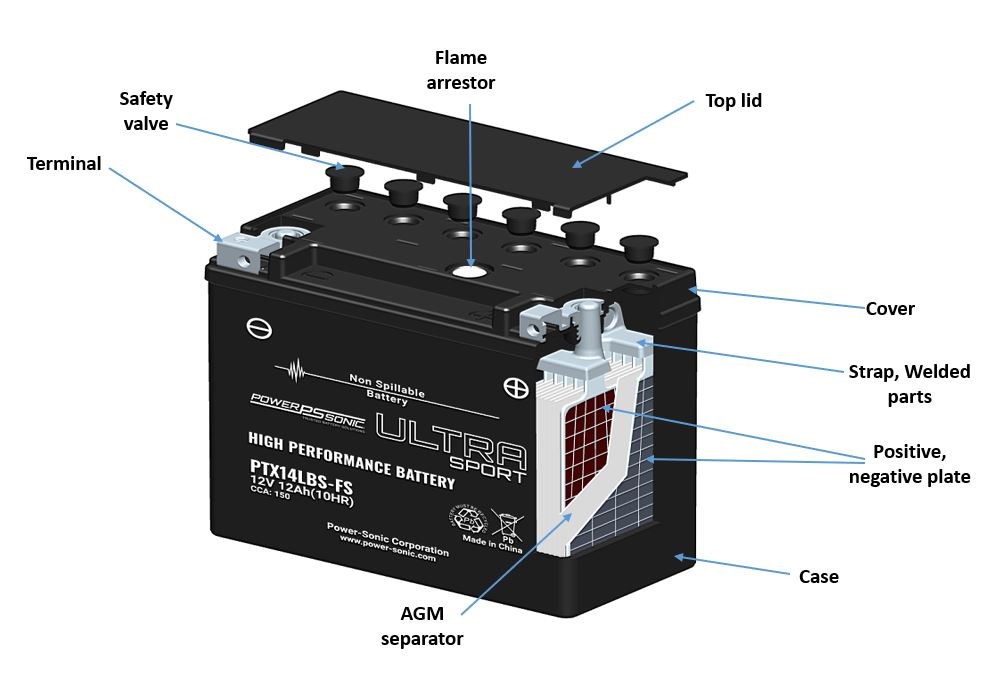
AGM stands for Absorbent Glass Mat. It is a type of valve-regulated lead-acid battery (VRLA). In normal service, the battery is sealed from routine user access and does not require water addition. It is not hermetically sealed in the absolute sense: a pressure-relief valve is built into the design to protect the cell if internal gas pressure rises beyond the intended range.
Inside an AGM battery, positive and negative lead-based plates are separated by a porous fiberglass mat. The mat is saturated with sulfuric acid electrolyte, but the battery is designed with little or no free liquid electrolyte that can slosh around the case. The glass mat keeps the electrolyte in close contact with the plates, supports ion transport, and helps maintain uniform spacing between electrodes.
Source: Original source
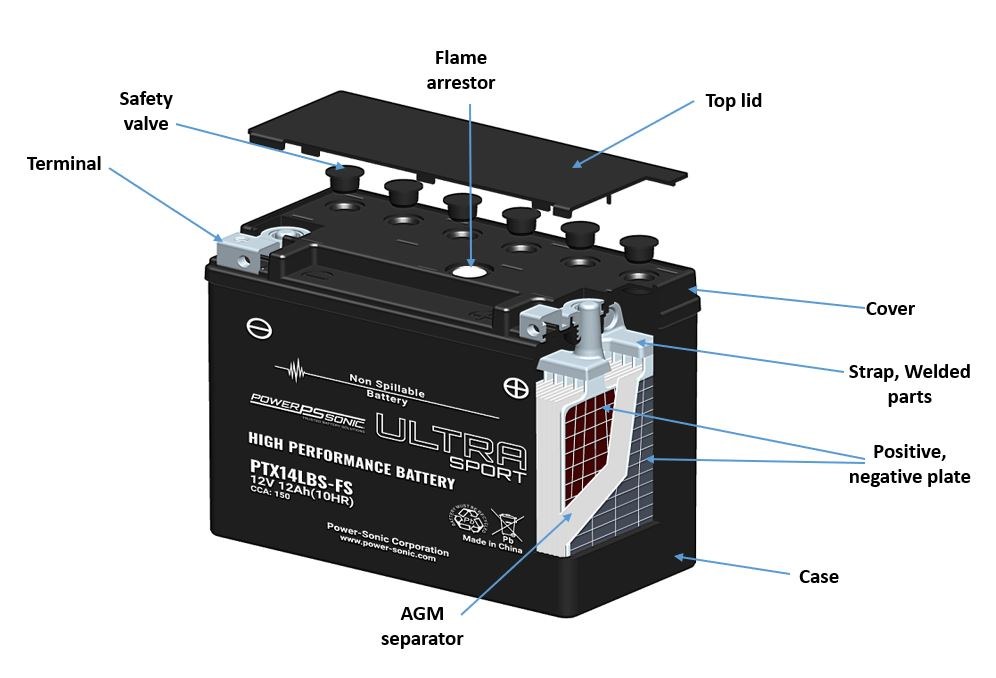
This absorbed-electrolyte structure is the reason AGM batteries are often described as spill-resistant or nonspillable when they are properly designed and intact. The acid is held in the separator rather than existing as a pool of liquid. In practical terms, this can simplify packaging and transport under applicable nonspillable battery rules. However, shipping classification depends on the exact battery design, condition, labeling, test compliance, and jurisdiction. It is better to say that AGM construction can qualify a battery for nonspillable handling rules, not that every AGM shipment is automatically free of restrictions everywhere.
AGM cells are commonly built in two mechanical formats:
- Flat-plate designs, packaged in rectangular cases that resemble conventional flooded lead-acid batteries.
- Spiral-wound cylindrical designs, where plates and separators are wound into a tight roll inside a cylindrical cell.
Both formats use the same basic principle: immobilize the electrolyte in glass mat separators and operate as a valve-regulated lead-acid system.
Gas management is central to AGM operation. During charging, especially near full charge, oxygen can be generated at the positive plate. In a flooded battery, gas often escapes through vents and water must eventually be replaced. In an AGM VRLA battery, the porous mat and controlled electrolyte volume allow oxygen to migrate to the negative plate, where it recombines chemically to form water. This oxygen recombination mechanism greatly reduces normal water loss.
The pressure-relief valve is a safety and durability component, not a service vent for routine operation. If the battery is overcharged, overheated, or charged with unsuitable voltage settings, gas generation can exceed the recombination rate. Internal pressure then rises and the valve may open to vent gas. Once gas is vented, water is lost from the sealed system and cannot normally be replaced. Repeated venting therefore causes permanent drying, capacity loss, higher resistance, and shortened life.
Advantages of AGM Batteries
AGM batteries are used where a conventional flooded lead-acid battery would be inconvenient, less reliable, or less robust. Their advantages come mainly from immobilized electrolyte, low internal resistance, sealed construction, and recombination behavior.
A key benefit is spill-resistant operation. Because the electrolyte is absorbed in the fiberglass mat, AGM batteries can tolerate movement and vibration better than flooded batteries with free liquid acid. This is valuable in vehicles, aircraft, marine installations, portable equipment, and backup systems that may experience shock or non-ideal mounting conditions. The sealed case also reduces acid misting and routine electrolyte exposure during normal use.
AGM batteries also have low internal resistance compared with many flooded lead-acid designs. Lower resistance helps the battery deliver high current on demand with less voltage sag. This makes AGM suitable for applications such as:
- engine starting and start-stop support,
- uninterruptible power supplies,
- emergency lighting and security systems,
- high-load DC equipment,
- mobile power systems where short bursts of current are needed.
The same low-resistance construction supports strong charge acceptance. Under suitable charging conditions and with the correct charger settings, AGM batteries can accept charge faster than comparable flooded lead-acid batteries. Battery University cites AGM charging capability as up to five times faster than flooded versions, but this should be understood as application- and charger-dependent rather than a universal promise. Charge rate limits still depend on manufacturer specifications, battery temperature, state of charge, and the charger’s voltage regulation.
Another major advantage is maintenance-free operation in normal service. Flooded lead-acid batteries may require periodic electrolyte level inspection, distilled-water addition, terminal cleaning, and ventilation management. AGM batteries remove the watering requirement because the electrolyte is sealed inside the mat and water is conserved through gas recombination. Terminals and external connections still need inspection, but the cell itself is not normally opened or serviced.
AGM batteries generally show lower self-discharge than conventional flooded lead-acid batteries. This helps in standby and seasonal applications, where a battery may sit unused for extended periods. AGM batteries are also described as less prone to sulfation than flooded batteries in some storage scenarios, particularly when they are stored fully charged and kept on an appropriate maintenance charge. This does not mean they are immune to sulfation; it means the design is more forgiving under some conditions.
For cycling service, AGM often performs better than standard flooded starting batteries. The commonly cited comparison is that AGM can support about 80% depth of discharge in some designs, while flooded lead-acid may be specified around 50% depth of discharge to obtain similar cycle life. This comparison is useful as a general technology distinction, but it is not a substitute for the datasheet. Actual allowable depth of discharge depends strongly on whether the battery is a starting, dual-purpose, or true deep-cycle AGM model, as well as temperature, recharge completeness, and the required cycle-life target.
AGM construction also improves mechanical durability. The compressed mat supports the plates, limits active-material shedding, and immobilizes the electrolyte. As a result, AGM batteries typically resist vibration and shock better than flooded batteries. This is one reason they are common in vehicles, off-road equipment, motorcycles, boats, and mobile backup systems.
Low-temperature performance is another practical advantage. Lead-acid chemistry still loses capacity and cranking ability in cold conditions, but AGM batteries generally stand up well to low temperatures compared with flooded alternatives, helped by low internal resistance and stable electrolyte distribution. For cold-weather starting or standby service, this can be a meaningful benefit.
AGM batteries are also lighter than comparable flooded lead-acid batteries in many cases because they contain only enough electrolyte to saturate the mat rather than a larger reserve of free liquid. The difference should be framed within lead-acid technology. AGM batteries remain heavy compared with lithium-ion batteries of similar usable energy, but they can reduce weight relative to flooded lead-acid designs while preserving lead-acid compatibility in many systems.
A simplified comparison is shown below.
| Characteristic | AGM lead-acid | Flooded lead-acid |
|---|---|---|
| Electrolyte | Absorbed in fiberglass mat | Free liquid electrolyte |
| Watering | Not required in normal service | Often required periodically |
| Spill resistance | High when intact and properly built | Must remain upright; liquid can spill |
| Internal resistance | Generally low | Generally higher |
| Vibration resistance | Good due to compressed mat | More dependent on construction |
| Charge acceptance | Often faster with correct charger | Usually slower |
| Upfront cost | Usually higher | Usually lower |
Limitations and Care Requirements
AGM batteries solve several problems associated with flooded lead-acid batteries, but they are not a universal upgrade. Their sealed construction improves convenience, yet it also makes correct charging and storage more important.
The first limitation is cost. AGM batteries usually cost more to manufacture and buy than flooded lead-acid batteries. They use controlled electrolyte volume, glass mat separators, valve-regulated construction, and tighter manufacturing tolerances. Battery University notes that AGM is generally more expensive than flooded lead-acid but cheaper than gel lead-acid. In practice, the best value depends on whether the application benefits from AGM’s maintenance-free operation, vibration resistance, high current delivery, and faster charge acceptance.
The most important care requirement is proper voltage control during charging. AGM batteries need chargers or charge controllers with AGM-compatible settings. They should not be treated as identical to flooded batteries unless the battery manufacturer explicitly allows the same charging profile. Absorption voltage, float voltage, temperature compensation, and maximum charge current must match the specific battery design.
Overcharging is especially harmful. If charging voltage is too high or the battery is held too long at an aggressive charge level, gas generation can exceed the recombination capability of the mat structure. The pressure-relief valve may open, releasing gas and permanently removing water from the cell. Because sealed AGM batteries cannot normally be refilled, this water loss cannot be corrected by maintenance.
Overcharging can lead to several failure symptoms:
- elevated case temperature,
- venting through the pressure-relief valve,
- dry-out of the glass mat separator,
- case swelling or deformation,
- increased internal resistance,
- reduced capacity,
- shortened cycle and calendar life.
Undercharging is also damaging. A battery that is repeatedly only partially recharged can develop sulfation, where lead sulfate becomes harder to convert back into active material during normal charging. AGM batteries may be less prone to sulfation than flooded batteries in some storage conditions, but they can still sulfate if left discharged or operated for long periods at partial state of charge.
Gradual capacity decline is normal with age and use. Cycling, high temperature, incomplete recharge, excessive discharge depth, long storage, and poor charging control all accelerate decline. High temperature is particularly important because it increases corrosion and chemical reaction rates inside the battery. A battery installed near an engine, inverter, or poorly ventilated enclosure may age faster than the same battery kept in a cooler standby location.
AGM also has lower specific energy than some newer battery technologies. Even though AGM may be lighter than a comparable flooded lead-acid battery, it remains a lead-acid system and is relatively heavy for the amount of usable energy stored. Where low mass, high usable capacity, and long cycle life are the main design requirements, lithium-based systems may be more suitable, provided the system includes the correct battery management, charging, protection, and safety provisions.
AGM is also not the best deep-cycle solution for every application. It can handle moderate cycling well, especially when designed as a deep-cycle AGM battery, but repeated very deep discharge shortens life. Applications such as daily off-grid energy storage, electric propulsion, or frequent high-depth cycling may exceed what a typical AGM battery can economically provide. In those cases, a properly specified lithium iron phosphate or other lithium-based battery may offer lower weight and longer cycle life, although with different cost and system-integration requirements.
Storage practice matters. For long storage life:
- Store the battery fully charged.
- Keep it in a cool, dry location.
- Avoid leaving it discharged for extended periods.
- Disconnect parasitic loads where practical.
- Recharge periodically according to the manufacturer’s instructions.
- Use a maintenance charger or float charger only if it is compatible with AGM voltage limits.
A stored AGM battery should not be ignored indefinitely. Low self-discharge helps, but it does not stop discharge completely. Small standby loads, alarm circuits, vehicle electronics, or monitoring equipment can drain the battery over time. Once the battery remains at low state of charge, sulfation and capacity loss become increasingly likely.
The practical engineering view is that AGM batteries are best where sealed construction, high-current performance, low maintenance, and vibration resistance are worth the higher cost and stricter charging requirements. They are a strong fit for starting, UPS, standby, marine, mobility, and many mobile power applications. They are a weaker fit where the system demands repeated maximum-depth cycling, minimum weight, or the longest possible cycle life per unit of usable energy.
References
- Battery University | BU-201a: Absorbent Glass Mat (AGM)
- BU-201a: Absorbent Glass Mat (AGM) - info not very clear (sort of 12V/mobile post) - Solar Panels - Solar Panels Forum
- AGM Battery Overview: Insights & Benefits (BU-201a)
- Flooded Batteries vs AGM Batteries: Understanding the Differences
- What is absorbent glass mat (agm) battery technology
- Flooded Batteries vs AGM vs Gel: What are the Differences? | Discover Battery
- Clarification on AGM battery | DIY Solar Power Forum
- AGM vs Lead Battery: What’s the Difference | Fullriver
- What Is the Main Disadvantage of an AGM Battery? | AGM Battery Guide
- What to Know About AGM Battery Vs. Lead Acid Battery