Aftermarket batteries can reduce replacement costs, but price alone says little about cell quality, pack construction, protection electronics, or compatibility. A replacement pack may be a properly engineered third-party product, or it may be counterfeit, poorly assembled, inaccurately labeled, or unsuitable for the device and charger.
The consequences of a poor choice range from short runtime and premature failure to overheating, device damage, electric shock, or fire. The risk is especially important when a battery powers medical equipment, industrial machinery, mobility equipment, or another system where failure can affect safety or mission continuity.
The right question is not simply whether a battery is original equipment. It is whether the replacement has credible traceability, appropriate testing, compatible electrical and mechanical characteristics, adequate protection, and approval for the intended application.
How to Distinguish Reputable Aftermarket Batteries from Counterfeits
An unusually low price is an important warning sign, although it is not conclusive by itself. A low-cost pack may use lower-grade cells, omit protection components, have less capacity than its label claims, or be sold through a supply chain with little accountability. Counterfeit products may also copy the name, appearance, packaging, and markings of an established manufacturer.
This makes visual inspection useful but insufficient. Convincing labels do not prove that the cells, battery-management system, fuses, temperature sensors, or assembly quality match the claimed product. Buyers should assess the supplier and the product together.
Useful checks include:
- Compare the part number, voltage, capacity, connector, dimensions, and terminal arrangement with the device manufacturer’s specification.
- Look for a traceable manufacturer, physical business address, support contact, and clear warranty terms.
- Treat spelling errors, inconsistent logos, missing documentation, or packaging that differs from the manufacturer’s normal presentation as warning signs.
- Check whether safety marks and certification claims are appropriate for the destination market and the specific battery product. A printed mark without a verifiable listing or declaration should not be treated as proof of approval.
- Confirm whether the product has been tested for the intended device rather than merely advertised as a physical replacement.
- Avoid packs with damaged housings, swelling, exposed conductors, loose connectors, corrosion, or signs of tampering.
A reputable third-party battery is not automatically unsafe. Independent manufacturers can produce acceptable replacements when they use suitable cells, design the pack for the device, implement appropriate protection, control manufacturing quality, and support their safety claims with relevant testing. The difficulty for a buyer is distinguishing that product from an imitation or an inadequately engineered pack.
Device manufacturers commonly recommend approved replacement batteries because the original pack is designed around the device’s electrical limits, charging behavior, connector arrangement, thermal environment, and control electronics. The recommendation may also reflect validation, traceability, and product-liability considerations. Warranty terms can differ by manufacturer and jurisdiction, so a buyer should read the current warranty language rather than assume that every third-party battery automatically voids coverage. In many situations, the practical issue is whether damage was caused by the replacement part, not simply whether it was made by another company.
Certification terminology also requires care. The relevant requirements depend on the battery chemistry, pack design, product category, transport route, and target market. A certification or conformity mark may address particular safety tests, but it does not guarantee capacity, service life, or compatibility with every device. Verify the meaning of the mark and whether it applies to the complete battery pack, not only to an individual cell or component.
Source: Battery University
Choosing Aftermarket Batteries for Consumer, Industrial, and Critical Uses
Aftermarket replacement batteries are considered by individual consumers as well as public-sector departments, healthcare organizations, maintenance contractors, laboratories, and industrial operators. Cost pressure can make a lower-priced pack attractive, particularly when many units must be kept in service.
Industrial buyers may use vendor qualification, sample testing, incoming inspection, and field trials before approving a replacement pack. These controls reduce uncertainty, but they do not make all aftermarket products equivalent. Packs from different suppliers can vary in cell matching, usable capacity, voltage behavior under load, thermal performance, connector quality, enclosure strength, and consistency between production batches.
Advertised capacity should therefore be treated as a specification to verify, not as proof of real-world performance. A pack can appear to have the correct label while delivering less runtime or experiencing excessive voltage drop under the device’s actual load. For important equipment, procurement teams may need evidence from controlled testing rather than relying only on a seller’s description or user reviews.
Application criticality should determine how much uncertainty is acceptable:
- Noncritical consumer use: A lower-cost replacement may be reasonable when a failure causes inconvenience but does not create a significant safety or operational consequence. The pack must still be electrically compatible and adequately protected.
- Operational or industrial use: Buyers should consider duty cycle, peak current, environmental exposure, maintenance intervals, replacement consistency, and the consequences of an unexpected shutdown.
- Healthcare, public safety, mobility, or mission-critical use: Traceability, qualification, documented testing, service support, and regulatory or procurement requirements deserve priority over the initial purchase price. A failure may affect a patient, operator, emergency response, or essential process.
Liability is part of the cost calculation. Savings from a cheaper pack can disappear if a failure damages the host equipment, interrupts operations, injures a user, or creates a fire investigation. Organizations should document the approved part number, supplier, inspection procedure, charging equipment, and replacement interval. They should also prevent unapproved packs from entering service through informal purchasing channels.
Independent performance evidence is particularly valuable when a battery is used heavily. Useful testing can include runtime under the intended load, temperature rise, charge acceptance, shutdown behavior, mechanical fit, connector heating, and repeatability across samples. Testing should be performed by personnel who understand the device and the battery chemistry; a basic voltage check cannot establish pack safety.
Charger Compatibility and Independent Battery Protection
A charger is part of the battery system, not a generic power adapter. The charger must suit the battery chemistry, nominal and maximum voltage, charging current, connector polarity, communication requirements, and pack-management electronics. A connector that fits does not establish compatibility.
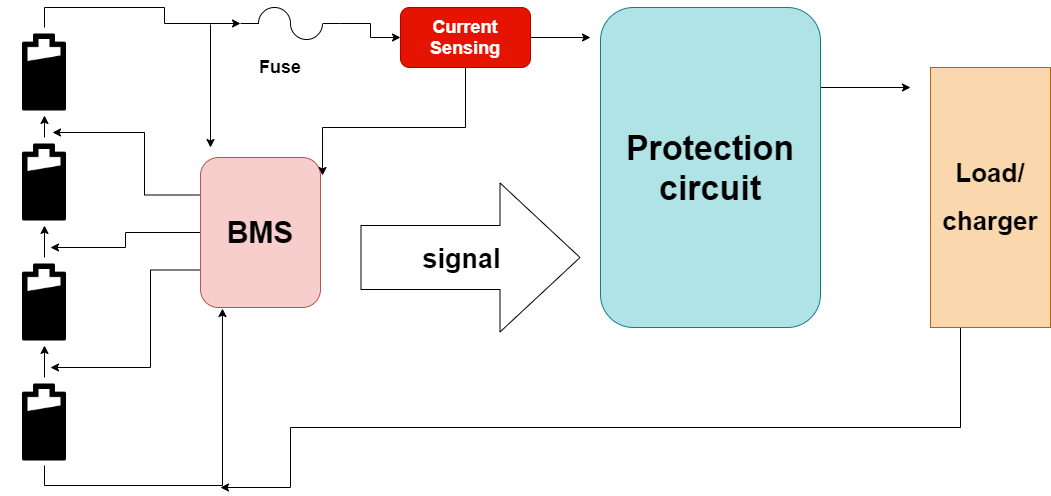
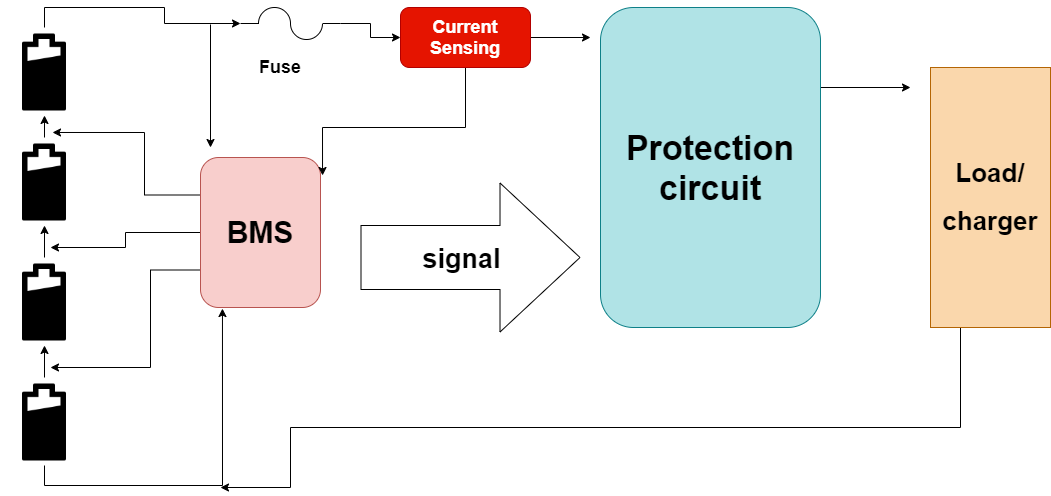
Charging control may be distributed among the charger, the host device, and the battery pack. Depending on the design, the charger can regulate the charging profile while the pack provides cell monitoring, overvoltage protection, overcurrent protection, temperature sensing, and a means of disconnecting the cells. Some systems also use communication between the pack and the device before or during charging.
These functions are not interchangeable. A pack protection circuit is not a substitute for a correctly designed charger, and a charger should not be expected to compensate for a damaged or incorrectly designed battery-management system. Independent or redundant safeguards are valuable because a single failed component should not be the only barrier against an unsafe charging condition.
Poorly designed or damaged chargers may fail to control voltage or current correctly, terminate charging at the wrong point, or respond improperly to pack signals. A low-cost charger may also depend excessively on protection inside the battery. That arrangement becomes especially hazardous if the protection circuit is missing, damaged, bypassed, or incompatible with the charger.
Before using a replacement charger, verify:
- The battery chemistry and required charging profile.
- The charger output voltage and current.
- The connector wiring and polarity.
- Whether the device or battery requires data communication or authentication.
- Whether the charger is intended for the complete pack rather than only for individual cells.
- Whether the charger has credible conformity or safety documentation for the relevant market.
Do not defeat a protection circuit to restore operation. A circuit that repeatedly disconnects may be reporting overtemperature, overcurrent, cell imbalance, abnormal voltage, or another condition requiring diagnosis. Continuing to charge a pack after protection has operated can turn a recoverable equipment fault into a thermal or electrical hazard.
Failure Hazards from Incompatible Batteries, Chargers, and Power Converters
The most dangerous condition is often a combination of weaknesses rather than one isolated defect. An inadequately protected battery paired with a poorly controlled charger can be exposed to excessive voltage, excessive current, overheating, or an incorrect charging profile. If the pack cannot interrupt the fault and the charger does not control it correctly, the cells and wiring may be subjected to conditions they were not designed to withstand.
Possible outcomes include cell venting, fire, electric shock, damage to the device’s charging circuit, melted connectors, or personal injury. The likelihood and severity depend on the chemistry, cell construction, pack design, state of charge, fault current, enclosure, and surrounding materials. The hazards are technically plausible, but a general warning should not be interpreted as proof that every aftermarket battery will fail in this way.
Vehicle charging introduces additional compatibility questions. A vehicle’s 12-volt system is not automatically equivalent to the power source expected by a portable-device charger. Voltage variation, startup and load transients, grounding arrangements, connector wiring, and the quality of an inverter or converter can affect the result. A device may also draw more power than a small adapter or converter can supply continuously.
When a vehicle inverter is used, check the input and output ratings, waveform requirements, current capacity, ventilation, fusing, and the device manufacturer’s guidance. Avoid improvised wiring, damaged adapters, loose connections, and converters with unclear specifications. Do not assume that a universal adapter is safe merely because it provides the correct nominal voltage.
Before connecting a battery and charger combination, confirm all of the following:
- The battery is intended for the specific device or approved system.
- The nominal and maximum charging voltages match.
- The chemistry and charging algorithm are compatible.
- The charger can provide the required current without overheating.
- The connectors are correctly wired and mechanically secure.
- The pack includes appropriate monitoring and protection.
- The equipment is undamaged and used in the environmental conditions specified by its manufacturer.
Stop using a pack that becomes unusually hot, swells, leaks, emits an odor, makes abnormal sounds, or shows physical damage. Move away from the device if it is smoking or burning, and follow local emergency and battery-disposal guidance. Do not puncture, crush, open, or continue charging a visibly damaged rechargeable pack.
Battery Authentication, Pack Lockouts, and Replacement Restrictions
Some modern products can identify a battery electronically rather than treating it as a collection of cells. Laptops, medical devices, e-bikes, power tools, and other equipment may use pack memory, authentication codes, tamper detection, firmware checks, digital pairing, or communication over the battery connector. If the expected response is absent, the device may display a warning, limit operation, refuse to charge, or lock out the replacement pack.
These controls can serve legitimate engineering purposes. The device may need information about temperature, state of charge, cell condition, cycle history, or remaining capacity. Authentication can help ensure that the pack’s protection behavior and communication protocol are compatible with the host system. It can also support traceability, service diagnostics, recall management, and warranty administration.
There are commercial motivations as well. A proprietary battery interface can direct customers toward the original supplier, preserve replacement-part revenue, and make it harder for independent repair businesses to substitute a pack. The existence of a lockout does not by itself establish whether the restriction is primarily safety-related or commercial; that depends on the product design and the manufacturer’s stated rationale.
Electronic compatibility can be as important as physical fit. A replacement pack may have the correct dimensions and voltage yet fail because its firmware, identification data, temperature-sensor characteristics, or communication behavior does not match the device. Conversely, bypassing an authentication or tamper mechanism can remove information and safeguards that the system expects during charging and operation.
Before purchasing a digitally controlled replacement, verify that the supplier explicitly supports the device’s hardware and current software version. Confirm whether installation requires programming, calibration, registration, or an authorized service procedure. Do not modify firmware, bridge terminals, or defeat a lockout without documented technical justification and a safe, approved procedure. A battery that operates only after bypassing the device’s controls should be treated as an unresolved compatibility problem, not as a successful repair.
References
- BU-810: What Everyone Should Know About Aftermarket .... (n.d.). http://www.batteryuniversity.com/article/bu-810-what-everyone-should-know-about-aftermarket-batteries
- How Aftermarket Power Tool Batteries Are Made. (n.d.). https://ceenr.com/blog/how-aftermarket-power-tool-batteries-are-made
- Fujitsu LifeBook U810 Battery Replacement. (n.d.). https://www.ifixit.com/Guide/Fujitsu+LifeBook+U810+Battery+Replacement/116600
- The Best Batteries for Power Tools: A Complete 2026 Guide. (n.d.). https://www.rdbatteries.com/blog/post/best-batteries-for-power-tools.html
- Generic Battery 810 replacement battery. (n.d.). https://batteryguy.com/generic+battery+810-replacement-battery.html
- Replacement Tool Batteries: Aftermarket Savings?. (n.d.). https://www.protoolreviews.com/replacement-tool-batteries
- We Bought the New Universal Battery for All Tool Brands. (n.d.). https://www.youtube.com/watch?v=CDFMOP0qr3Q
- Battery Replacement Kits Overview | PDF. (n.d.). https://www.scribd.com/document/643693548/6B-Battery-replacement-kits-tools
- BATTERY. (n.d.). https://energizer.com/wp-content/uploads/2025/04/ENR_BATTERY-CROSS-REFERENCE-GUIDE.pdf
- Are aftermarket batteries for power tools worth the risk?. (n.d.). https://www.facebook.com/groups/woodworkingforbeginner/posts/2908118459342760