Battery development attracts attention because the need is real: longer runtime, faster charging, safer materials, lower cost, and better suitability for electric mobility and stationary storage. New battery announcements often sound decisive, but electrochemical systems are rarely improved in only one dimension. A chemistry that offers high energy may have limited power. A cell that is safe and compact may be too expensive. A design that works well in the laboratory may be difficult to manufacture, qualify, recycle, or operate at scale.
This article examines three alternative battery systems that have occupied useful but narrower positions beside mainstream lead-acid, nickel-based, and lithium-ion batteries: zinc-air, silver-zinc, and reusable alkaline. Each chemistry has genuine technical strengths. Each also illustrates why battery selection is an engineering tradeoff rather than a search for a universal replacement.
Why Alternative Battery Claims Need Careful Evaluation
New battery technologies are often presented with claims of very long runtime, rapid charging, thin or flexible formats, low material cost, or suitability for electric vehicles. Some of these claims are based on legitimate laboratory progress. Others emphasize a single attractive property while leaving out constraints such as recharge efficiency, calendar life, production yield, safety qualification, or system-level complexity.
For investors, manufacturers, and engineers, the difficult part is not proving that a cell can work once. The harder tasks include:
- producing cells consistently at commercial scale;
- maintaining safety over abuse, temperature, storage, and aging conditions;
- achieving acceptable cycle life and calendar life;
- controlling cost of active materials, separators, current collectors, packaging, and manufacturing;
- designing reliable charging, balancing, and battery management systems;
- meeting transport, certification, recycling, and end-use requirements.
This is why many promising chemistries have long development periods before any return on investment is visible. A battery may be compelling for hearing aids, aerospace hardware, railway signaling, or specialty medical equipment while still being unsuitable for consumer electronics or traction batteries.
Established chemistries set a demanding benchmark. Lead-acid batteries remain widely used where low cost, high surge current, recyclability infrastructure, and tolerance of simple systems matter more than high specific energy. Nickel-based batteries, especially nickel-metal hydride in consumer and hybrid applications, offer robust rechargeability and power capability. Lithium-ion dominates many portable and mobility markets because it combines relatively high energy density, good cycle life, and mature manufacturing.
Alternative systems should therefore be compared using practical criteria, not only theoretical energy:
| Criterion | Why it matters |
|---|---|
| Energy density and specific energy | Determines runtime and pack size for a given load. |
| Power capability | Determines whether the battery can handle high current pulses or traction loads. |
| Rechargeability | Includes not only whether charging is possible, but how efficient, safe, and durable it is. |
| Cycle and calendar life | Determines usable lifetime and replacement cost. |
| Safety and maintenance | Includes gas generation, leakage, thermal behavior, and handling requirements. |
| Cost and material availability | Controls whether performance can be justified in mass markets. |
| Manufacturing maturity | Determines consistency, qualification time, and field reliability. |
With those criteria in mind, zinc-air, silver-zinc, and reusable alkaline batteries occupy different technical niches.
Zinc-Air Batteries: High Energy from Oxygen, Limited Rechargeability
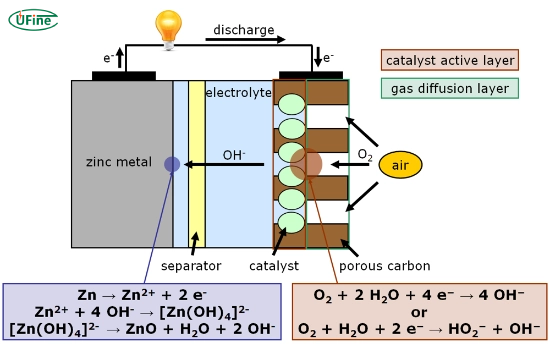
Zinc-air batteries generate electrical energy by oxidizing zinc while using oxygen from ambient air at the positive electrode. Because one of the reactants comes from the surrounding air rather than being fully stored inside the cell, zinc-air can offer high specific energy compared with many enclosed battery systems.
Source: Original source
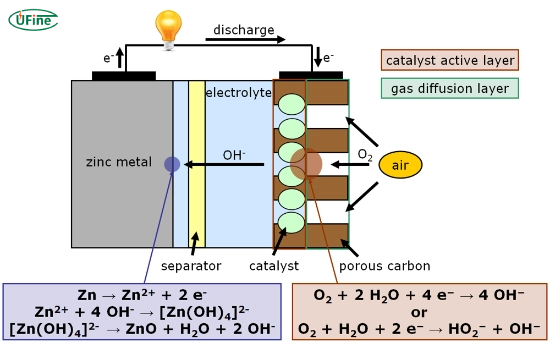
A zinc-air cell has some behavior in common with a fuel cell. Zinc is effectively the fuel. Oxygen enters through an air electrode, where electrochemical reactions support discharge. In some larger or experimental systems, spent zinc reaction products can be removed and fresh zinc material supplied. This makes mechanical recharging possible in principle: instead of electrically reversing every reaction inside the same sealed cell, the system can replace or replenish zinc and electrolyte materials.
Common small zinc-air cells have a nominal cell voltage of about 1.45 V, and reported open-circuit potential for typical primary zinc-air cells is around 1.48 V. Battery University notes that zinc-air batteries reach full operating voltage within a few seconds after activation. In button-cell formats, users commonly remove a sealing tab that admits air; once oxygen reaches the cathode, the cell becomes active.
The strengths of zinc-air are clearest in low-to-moderate power applications where compact energy storage is more important than repeated electrical recharging. Small button cells are widely associated with hearing aids and medical devices because they can provide high energy in a compact package. Larger zinc-air batteries have also been used or considered for applications such as marker lights, navigation instruments, railway signaling, oceanographic equipment, stationary storage concepts, and mechanically refueled mobility systems.
Reported general figures for zinc-air include a practical specific energy around 470 Wh/kg and a theoretical value around 1370 Wh/kg, with a nominal cell voltage of 1.45 V. Such numbers explain why zinc-air remains technically interesting. However, they should not be interpreted as proof that zinc-air automatically outperforms lithium-ion or other rechargeable systems in a complete product. Air management, electrolyte design, discharge rate, package design, and operating environment strongly affect real performance.
The main weakness is rechargeability. Primary zinc-air cells are well established, but electrically rechargeable zinc-air designs face several persistent problems:
- Zinc dendrites. During charge, zinc must plate back in a controlled way. Nonuniform deposition can form dendrites that reduce life or threaten internal short circuits.
- Nonuniform zinc dissolution and precipitation. Zinc behavior in aqueous electrolyte must be tightly controlled through many cycles.
- Air-electrode complexity. The positive electrode must support oxygen reduction during discharge. In an electrically rechargeable design, it may also need to support oxygen evolution during charge, which is difficult to do efficiently and durably in a single bifunctional electrode.
- Electrolyte and water management. Exposure to air brings practical issues such as drying, carbonation, flooding, and contamination depending on design.
- Power limitations. Oxygen access and air-electrode kinetics can limit high-current performance.
- Lower round-trip efficiency. Electrically rechargeable zinc-air systems can require a much higher charge voltage than discharge voltage, with cycle energy efficiency reported as low as about 50% in some designs.
One approach is to separate the discharge and charge functions into different electrodes, but that adds size, mass, and system complexity. Another approach is mechanical refueling, where zinc material is replaced rather than electrochemically replated inside the cell. Mechanical refueling can decouple energy capacity from power components and can theoretically allow rapid turnaround, but it requires infrastructure, material handling, recycling, and reliable system design.
For these reasons, zinc-air remains a strong primary-battery chemistry and an active area of interest for specialty storage and refuelable concepts. It is not simply a drop-in rechargeable replacement for lithium-ion or nickel-metal hydride.
Silver-Zinc Batteries: Premium Performance at a High Material Cost
Silver-based zinc batteries appear in two main categories. Small button cells commonly sold as silver-oxide cells are typically non-rechargeable primary batteries. They are used where stable voltage, compact size, and dependable operation justify a relatively expensive chemistry in a very small package. Higher-capacity rechargeable versions are generally referred to as silver-zinc batteries.
Silver-zinc cells use zinc as the negative electrode and silver oxide chemistry at the positive electrode. The system can deliver strong performance in compact, high-reliability applications. Battery University describes silver-zinc as safe, free of toxic metals, and recyclable, while also emphasizing the central disadvantage: silver makes the battery expensive to manufacture.
That cost structure explains its application pattern. Silver content may be acceptable in tiny cells because the absolute amount of silver is small relative to the value of the final product. In larger batteries, silver-zinc tends to appear where performance, compactness, reliability, or mission value outweighs material cost. Typical or historical uses include aerospace, defense, military electronics, torpedoes or underwater systems, medical equipment, instrumentation, and other specialty devices where energy delivery and reliability can matter more than low purchase price.
Compared with mass-market rechargeable systems, silver-zinc is not usually selected because it is cheap or broadly available. It is selected when the engineering requirement is narrow and demanding. Advantages can include:
- high performance in a compact cell;
- good discharge behavior for specialized loads;
- materials that can be recycled;
- suitability for mission-critical systems where cost is secondary;
- a safety profile that can be attractive compared with some higher-risk rechargeable chemistries when properly designed and managed.
Historically, rechargeable silver-zinc designs have had durability problems. The zinc electrode is a common source of difficulty, as it is in several zinc-based rechargeable systems. Repeated cycling can produce shape change, zinc redistribution, or dendrite growth. Separator failure can allow internal shorts or accelerated degradation. These mechanisms limit cycle life and reduce confidence in long-service applications.
Older silver-zinc batteries therefore often offered excellent performance but limited cycle life, especially compared with modern nickel-metal hydride or lithium-ion systems in everyday rechargeable use. A chemistry can be attractive in a missile, spacecraft, or emergency device while being economically unattractive in a laptop or cordless tool.
Modern silver-zinc development has focused on improving the weaknesses rather than changing the fundamental cost problem. Useful improvement areas include:
- better separators that resist dendrite penetration and chemical degradation;
- improved zinc electrode formulations to reduce shape change and nonuniform deposition;
- tighter manufacturing controls for electrode balance and separator placement;
- electrolyte management improvements;
- battery management methods that limit abusive charge and discharge conditions.
These measures can improve reliability and cycle life, but they do not remove the cost penalty of silver. As a result, silver-zinc remains a premium specialty chemistry rather than a general-purpose competitor to lithium-ion or nickel-metal hydride. It is technically valuable where its performance and reliability justify the bill of materials, and much less attractive where cost per watt-hour dominates the decision.
Reusable Alkaline Batteries: Rechargeable Convenience with Narrow Limits
Reusable alkaline batteries, also known as rechargeable alkaline manganese cells, were introduced as an alternative to disposable alkaline batteries. The idea is appealing: keep the familiar alkaline format, reduce waste, and allow multiple uses in common household devices.
It is important to distinguish reusable alkaline cells from ordinary disposable alkaline batteries. Standard alkaline cells are not designed for recharging unless specifically labeled and manufactured for that purpose. Charging an ordinary alkaline battery can generate gas, including hydrogen, and may lead to leakage, rupture, or explosion. Battery manufacturers generally do not endorse household recharging of normal disposable alkaline cells for this reason.
Purpose-built reusable alkaline cells are different, but their rechargeability has narrow limits. Their performance depends heavily on shallow depth of discharge. If the cell is only partly discharged before recharging, it may deliver a useful number of cycles. Battery University gives a reference point of about 50 cycles at roughly 50% depth of discharge. That is much less than what users often expect from rechargeable batteries, but it can be acceptable in low-drain applications if the user recharges early and consistently.
The practical problem is user behavior. Many people run AA or AAA cells until the device stops working, then recharge. For reusable alkaline batteries, deep discharge greatly reduces capacity retention and cycle life. A cell that might provide reasonable service under shallow cycling can perform poorly when repeatedly drained close to empty.
Reusable alkaline cells also have limitations in power delivery. They are not usually the best choice for high-drain consumer devices such as cameras, toys with motors, bright flashlights, or equipment with frequent current pulses. Their best fit is low-drain or moderate-drain equipment where the discharge is shallow and predictable.
Compared with nickel-metal hydride, reusable alkaline cells generally face a difficult market position. NiMH rechargeable AA and AAA batteries are widely available, tolerate repeated cycling better, and usually provide stronger power capability for common rechargeable consumer uses. Lithium-ion systems, where suitable formats and protection electronics are used, dominate many higher-energy portable products. Reusable alkaline cells therefore compete mostly on familiarity and compatibility, not on superior recharge performance.
A practical comparison is shown below:
| Feature | Reusable alkaline | NiMH rechargeable |
|---|---|---|
| Best use case | Low-drain devices with shallow discharge | General rechargeable AA/AAA use, including moderate to high drain |
| Cycle-life sensitivity | Strongly affected by deep discharge | Generally more tolerant of normal recharge use |
| User behavior required | Recharge before the cell is deeply depleted | Less demanding in typical use |
| Power capability | Limited for high-drain loads | Usually better for high-current devices |
| Safety concern | Do not recharge ordinary disposable alkaline cells | Use appropriate chargers and cells |
Reusable alkaline batteries are therefore not useless; they are simply specialized. They can make sense where shallow cycling is realistic and where users understand the restrictions. In most mainstream rechargeable consumer applications, however, NiMH has been more successful because it better matches how people actually use rechargeable cells.
The broader lesson is the same as with zinc-air and silver-zinc: an alternative battery chemistry must be judged by the complete operating profile. High energy, low toxicity, familiar packaging, or good laboratory results are not enough by themselves. The final value depends on recharge behavior, safety, power demand, cost, service life, and whether the chemistry fits the real habits and requirements of the application.
References
- Battery University | BU-211: Alternate Battery Systems
- Battery University | BU-211: Alternate Battery Systems
- Zinc–air battery - Wikipedia
- Zinc–air battery - Wikipedia
- Zinc–air battery - Wikipedia
- How to Compare Nickel-Metal Hydride and Zinc-Air Cells
- Zinc–air battery - Wikipedia
- Mechanically rechargeable zinc-air batteries for two- and three-wheeler electric vehicles in emerging markets
- Next Generation Rechargeable Zn-Air Batteries
- Zinc-Air Battery Market Share and Opportunities 2026-2033