A stationary battery is often installed for one obvious reason: to keep equipment operating when the normal AC supply fails. In many real systems, however, the same battery bank can also perform a second job. It can act as a short-term power buffer when the load temporarily exceeds what the AC supply can comfortably deliver.
This buffering role is different from using a battery as the primary energy source. The battery normally remains charged and ready, then contributes energy during a disturbance, outage, or high-demand interval. Afterward, it must be recharged before the next event. The usefulness of this arrangement depends less on a single nameplate capacity figure than on the full operating pattern: how often the battery is called on, how deeply it is discharged, and how much recovery time it has between events.
Used correctly, a buffer battery can improve continuity of service and reduce stress on an undersized or temporarily overloaded supply path. Used incorrectly, the same battery may be cycled too deeply or too often, shortening its useful life. The key design question is therefore not only whether the battery can deliver the required power, but whether the charge-discharge pattern is suitable for the battery type.
What a Buffer Battery Does
A buffer battery sits between a power source problem and the equipment that must continue operating. In a conventional standby role, the problem is a loss of AC input power. When the normal supply is interrupted, the battery provides energy to the connected load until the AC supply returns, another source takes over, or the system shuts down in a controlled way.
In a buffering role, the AC supply may still be present. The issue is that the instantaneous demand can rise above the capacity that the supply system can provide without unacceptable voltage sag, overload, or service degradation. A battery bank can then supplement the supply for a limited period. Instead of carrying the load continuously, it contributes during the high-demand interval and then returns to charge when demand falls.
This is similar in concept to the battery in a hybrid vehicle, but the analogy should be used carefully. In a hybrid car, the battery can assist during acceleration, when short-term power demand is high. The battery does not necessarily act as the sole energy source for the vehicle in all operating modes; rather, it helps cover a transient power requirement. A stationary buffer battery can serve the same type of function for an electrical system: it helps during a short peak, then replenishes energy later.
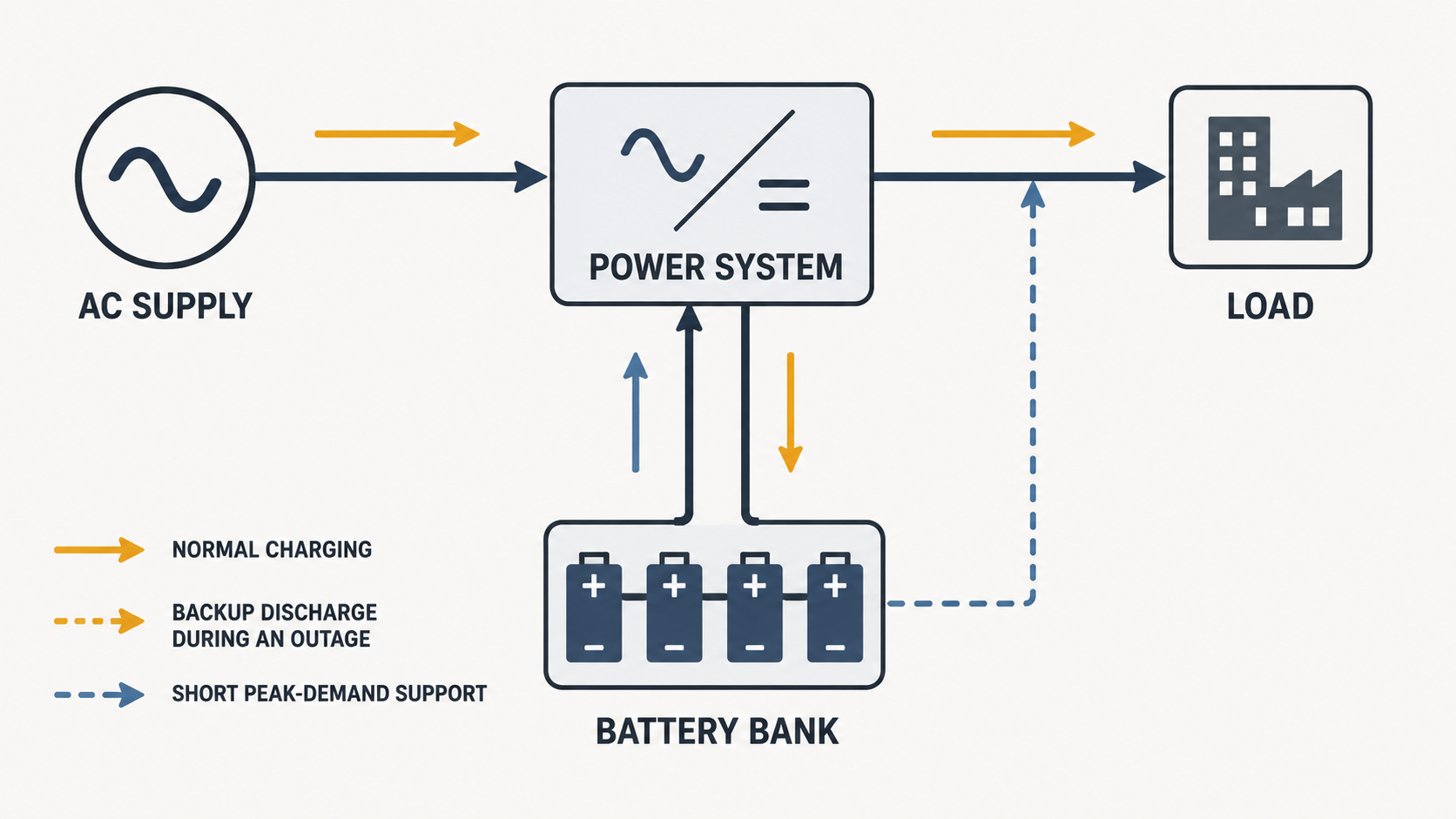
Original illustration by Bond Battery.
A buffer battery arrangement normally involves three practical functions:
- Standby support: supplying the load when AC power is unavailable.
- Peak-load support: adding power when demand temporarily exceeds what the AC source can provide alone.
- Energy recovery: recharging during lower-demand or off-peak periods so the battery is ready for the next event.
The battery bank therefore behaves as a short-term energy reservoir. It is not just a passive backup component waiting for rare failures; in some applications, it may become part of the normal power-management strategy. That makes its duty cycle important. A battery used only for infrequent outages can have a very different life profile from one that assists the power supply every day during predictable peaks.
From an engineering perspective, a buffer battery must be matched to both power and energy requirements. The power requirement is the rate at which the battery must deliver current to support the load. The energy requirement is the total amount removed during the support interval. Even without assigning specific numerical limits, the distinction matters: a short, high-current assist event stresses the system differently from a longer, lower-current discharge.
The connected equipment also matters. Loads with communication, control, or computing functions may require stable DC bus voltage or uninterrupted conversion through a power electronics stage. In such cases, the battery, charger, rectifier, and load interface must operate as a coordinated system. The battery is only one part of the buffering function; the charging and power-path design determine when it is charged, when it discharges, and how smoothly the transition occurs.
Backup Batteries in Peak-Demand Applications
Cellular repeater towers provide a practical example of a backup battery serving as a buffer. These sites require dependable power for communications equipment. Backup batteries are installed so that service can continue during power outages, but the same battery bank can also assist the AC supply during high-traffic periods if the site demand rises beyond what the supply path can support by itself.
The operating pattern is straightforward:
- During off-peak periods, the AC supply powers the equipment and charges the battery bank.
- The battery reaches a ready state before the next expected demand peak.
- During a peak period, the battery discharges to assist the AC supply.
- When the peak passes, the AC supply again covers the load and returns charge to the battery.
This cycle can be useful where the peak demand is temporary. The battery helps bridge the difference between normal supply capacity and short-term load demand. If the high-demand interval is brief and the off-peak recovery interval is long enough, the battery can remain within a manageable operating pattern.
The important point is that the battery is not a replacement for adequate primary power in all conditions. It is a buffer. If the system repeatedly depends on the battery because the AC supply is chronically insufficient, the battery may spend too much time in discharge or partial recharge. That can reduce readiness for an actual outage and can accelerate wear, especially if the battery chemistry and construction are not intended for frequent cycling.
For a cellular repeater tower or similar remote power site, buffering must also preserve the original backup function. A battery that has just supported a traffic peak may not be fully available if an outage occurs immediately afterward. The designer must therefore consider how the battery is managed between service continuity and peak support. The more often the battery is used for peak shaving or supply assistance, the more important recharge time and state-of-charge management become.
A simplified comparison helps separate the two roles:
| Operating condition | Battery role | Main design concern |
|---|---|---|
| AC supply outage | Supplies the load while normal power is unavailable | Enough stored energy for the required support interval |
| Short high-demand period | Supplements the AC supply | Enough discharge capability without excessive depletion |
| Off-peak period | Recharges from the supply system | Enough time and charging capacity to restore the energy used |
This pattern applies beyond telecommunications. Any stationary system with short, predictable demand peaks may be a candidate for battery buffering, provided the duty cycle is suitable. However, the technical principle remains the same: the battery must be charged during lower-demand periods and must not be asked to give back more energy than the system can reliably restore.
It is also useful to distinguish buffering from long-duration energy storage. A buffer battery is commonly used to cover a temporary mismatch between supply and demand. Long-duration storage, by contrast, is designed around extended discharge periods and broader energy-shifting objectives. The reference case here is the shorter-term buffer function: assisting the supply during outages or peak load intervals, then returning to charge.
Charging Balance and Cycle-Life Limits
The most important operating rule for a buffer battery is that it must have enough time to recharge between discharge events. If the battery assists during a peak period and the next peak occurs before adequate recharge, the battery begins the next event at a lower state of charge. Repeated over time, this can produce a downward energy balance in which the battery is never fully recovered.
For a buffer application, the net charge returned to the battery over the operating cycle must be greater than the energy drawn from it. This does not mean the battery can ignore normal charging losses or efficiency limits; it means the system must be designed so that the charging interval restores the battery sufficiently before the next expected discharge. If the discharge demand grows, the recharge opportunity must grow with it, or the battery will gradually become less ready.
This charge balance is especially important in applications with predictable daily or repeated peaks. A battery that performs well during one event may still be unsuitable if the operating schedule does not allow recovery. The battery bank, charger, and AC source must be treated as one system. A large battery connected to an inadequate charger may still fail to recover between events. Conversely, a battery with suitable charging support may perform reliably if discharge intervals are shallow and recovery time is adequate.
Repeated deep discharges should be avoided unless the battery is specifically designed for that duty. Deep discharge removes a large portion of the battery’s stored energy and increases cycling stress. When this happens repeatedly, the battery can wear out prematurely. The issue is not only whether the battery can deliver power once, but whether it can survive the intended number and depth of discharge events over its service life.
Battery construction matters here. Stationary standby batteries are commonly selected for readiness and backup service, not necessarily for frequent deep cycling. Starter batteries are designed for short, high-current bursts followed by prompt recharge; they are not intended to be deeply discharged as a normal operating mode. If the application requires periodic cycling, especially repeated discharge and recharge as part of regular operation, a deep-cycle battery is the more appropriate choice.
| Battery category | Typical intended use | Suitability for repeated deep cycling |
|---|---|---|
| Stationary standby battery | Backup power during outages | Generally not intended for deep cycling unless specified for that duty |
| Starter battery | Short high-current starting duty followed by recharge | Poor fit for repeated deep discharge |
| Deep-cycle battery | Repeated discharge and recharge service | Preferred when periodic cycling is expected |
Selecting a deep-cycle battery does not remove the need for proper charge management. It simply aligns the battery type with the duty. The system still needs sufficient recharge time, appropriate charging control, and protection against excessive discharge. A deep-cycle battery used beyond its intended limits can also age rapidly.
A practical review of a buffer battery application should therefore include the following questions:
- How often will the battery discharge in normal operation?
- Is the discharge caused by rare outages, predictable peak demand, or both?
- Does the battery have enough time to recharge between events?
- Is the charger capable of restoring more energy than the previous event removed?
- Are discharges kept shallow enough for the selected battery type?
- If repeated cycling is expected, is the battery specified as a deep-cycle design?
These questions are more useful than assuming that any backup battery can be used as a buffer indefinitely. A battery bank installed for standby may appear to have spare capacity, but its life can be shortened if it is repeatedly used outside its intended service pattern.
The safest engineering approach is to define the duty cycle before selecting the battery. If the battery is expected to sit fully charged and discharge only during occasional outages, a standby design may be appropriate. If the battery will regularly assist the AC supply during peak demand, the design should account for cycling from the beginning. If those cycles are periodic and meaningful in depth, a deep-cycle battery should be chosen.
A buffer battery is most effective when it is treated as an energy-management component rather than an emergency accessory. It can keep equipment operating during power interruptions and can help a limited AC supply ride through short demand peaks. Its reliability, however, depends on maintaining a positive charge balance, avoiding unnecessary deep discharges, and matching the battery type to the real operating duty.
References
- Battery University | BU-406: Battery as a Buffer. (n.d.). http://www.batteryuniversity.com/article/bu-406-battery-as-a-buffer
- Battery University | BU-211: Alternate Battery Systems. (n.d.). http://www.batteryuniversity.com/article/bu-211-alternate-battery-systems
- Battery University | BU-208: Cycling Performance. (n.d.). http://www.batteryuniversity.com/article/bu-208-cycling-performance
- Battery University | BU-808: How to Prolong Lithium-based Batteries. (n.d.). http://www.batteryuniversity.com/article/bu-808-how-to-prolong-lithium-based-batteries
- Battery University | BU-504: How to Verify Sufficient Battery Capacity. (n.d.). http://www.batteryuniversity.com/article/bu-504-how-to-verify-sufficient-battery-capacity
- BU-811: Assuring Minimum Operational Reserve…. (n.d.). https://www.batteryuniversity.com/article/bu-811-assuring-minimum-operational-reserve-energy-more
- BU-003: Dedication. (n.d.). http://www.batteryuniversity.com/article/bu-003-dedication
- BU406 Datasheet, PDF. (n.d.). https://www.alldatasheet.com/view.jsp?Searchword=bu406
- BU406 Transistor: Datasheet, Pinout, and Alternate .... (n.d.). https://www.ariat-tech.com/blog/BU406-transistor-datasheet-pinout-and-alternate-replacements.html
- BU406 Transistor: Equivalent, Datasheet and Pinout. (n.d.). https://www.jakelectronics.com/subject/bu406-transistor-equivalent-datasheet-and-pinout