Battery cycle testing is one of the most direct ways to compare rechargeable chemistries, but the result depends strongly on how the test is run. A cell cycled gently over a narrow state-of-charge window can look very different from the same cell repeatedly discharged to empty and recharged at a defined rate.
The comparison discussed here covers older and newer rechargeable systems used in portable communications equipment: nickel-cadmium, nickel-metal-hydride, and lithium-ion. The original test work used controlled battery analyzers to track three practical indicators: delivered capacity, DC internal resistance, and capacity loss during rest as an indication of self-discharge. These measurements show not only how much energy a battery can still deliver, but also whether it can maintain voltage under load and retain charge while idle.
A useful reading of the data requires caution. Full-depth laboratory cycling provides a consistent comparison between chemistries, yet it does not reproduce every real operating condition. Temperature, charge limits, standby storage, vibration, high-current pulses, and calendar aging can all change the service life seen in equipment.
How the Cycling Tests Were Run
The cycling comparison used Cadex 7000 Series battery analyzers and a repeatable charge-discharge procedure. Each battery first received an initial charge. It was then subjected to repeated full discharge and charge cycles at a 1C rate. In this context, 1C means a current that would nominally charge or discharge the rated capacity in about one hour, before considering cutoff limits and control details.
The tests used 100 percent depth-of-discharge. That is an intentionally demanding condition because each cycle uses the full available capacity range rather than a partial window. Full-depth cycling is valuable for stressing differences between chemistries, but it can be harsher than many real applications.
The reported measurements included:
- Capacity, shown as a percentage of the original or rated performance.
- DC resistance, used to indicate how much the battery resists current flow under load.
- Self-discharge behavior, inferred from capacity loss after a 48-hour rest period.
Source: Original source
Capacity fade is usually the most visible aging metric, but resistance and self-discharge are just as important in practical equipment. A battery may still store a reasonable amount of charge but perform poorly if resistance has risen enough to cause voltage sag during transmission bursts, motor starts, or other peak loads. Likewise, a battery with increasing self-discharge can appear healthy immediately after charging but lose readiness while stored.
A controlled analyzer test removes much of the noise found in field data. The temperature, cycle rate, cutoff conditions, and rest intervals are defined, making chemistry-to-chemistry comparison clearer. The limitation is that real products rarely operate as perfectly repeated laboratory cycles. Portable communication devices may see standby periods, shallow cycles, fast top-ups, deep discharges, heat exposure, and irregular current profiles. The lab result should therefore be read as a controlled endurance comparison, not as a guaranteed service-life number for every application.
Nickel-Cadmium: Durable Cycling and Stable Resistance
Standard nickel-cadmium performed as the most cycle-enduring chemistry in the referenced comparison. The example cited was a 7.2V, 900mAh NiCd pack built with standard NiCd cells. Under repeated 1C charge and discharge with 100 percent depth-of-discharge, it showed minimal capacity loss and stable electrical behavior.
The test was stopped after about 2,300 cycles because of time constraints rather than a clear end-of-life failure. During the test, internal resistance stayed low, reported at about 75mΩ, and self-discharge remained stable. That combination matters: stable capacity alone is not enough if resistance rises sharply, and low resistance alone is not enough if the cell loses charge quickly during storage. In this standard NiCd case, all three monitored indicators remained favorable.
The result illustrates why standard NiCd earned a long reputation for rugged cyclic duty. It tolerates deep cycling well, accepts high current, and tends to maintain predictable load performance when properly maintained. NiCd is also one of the few rechargeable chemistries historically associated with ultra-fast charging with comparatively low stress, provided the charge system correctly detects termination and controls heat. Poorly managed charging can still damage cells, but standard NiCd is generally more tolerant of aggressive charge regimes than many higher-energy chemistries.
This robustness also explains NiCd’s continued relevance in demanding applications. In aviation, NiCd batteries have historically remained common or preferred in certain onboard battery roles because of their ruggedness, predictable behavior, high-rate capability, and established safety record under demanding conditions. Aircraft battery selection is conservative: reliability, fault behavior, maintenance procedures, certification history, and performance over temperature can outweigh energy density alone.
However, the strong result applies specifically to standard NiCd, not every NiCd variant. The reference article warns that ultra-high-capacity NiCd cells trade some endurance for higher specific energy. In practical terms, pushing more capacity into the same format can reduce the margin that made the standard design so durable. Compared with standard NiCd, these higher-capacity versions can show faster capacity decline and rising internal resistance over repeated cycling.
That tradeoff is common across battery design. A cell optimized for maximum runtime in a given package is not necessarily optimized for maximum cycle life, high-current tolerance, or abuse resistance. For NiCd, the standard construction demonstrated excellent endurance in the full-depth cycling test, while ultra-high-capacity versions should be treated as a different performance class rather than assumed to inherit the same durability.
Nickel-Metal-Hydride: Higher Energy With Faster Aging
Nickel-metal-hydride was developed in part to improve energy storage compared with traditional nickel-cadmium while avoiding cadmium. In many portable products, NiMH offered a practical increase in capacity within familiar cylindrical and prismatic formats. The cycling comparison, however, shows the cost of that higher energy under aggressive full-depth testing.
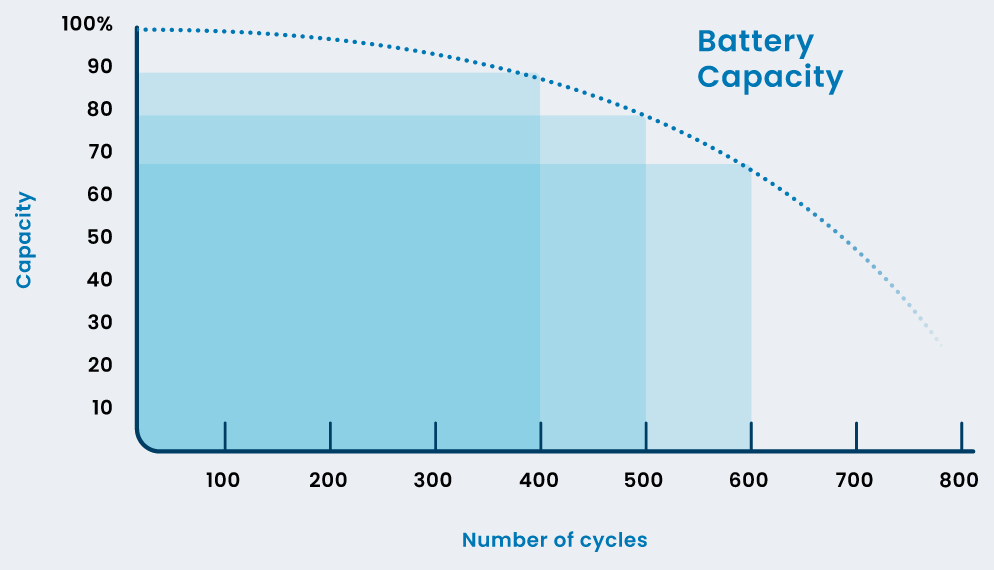
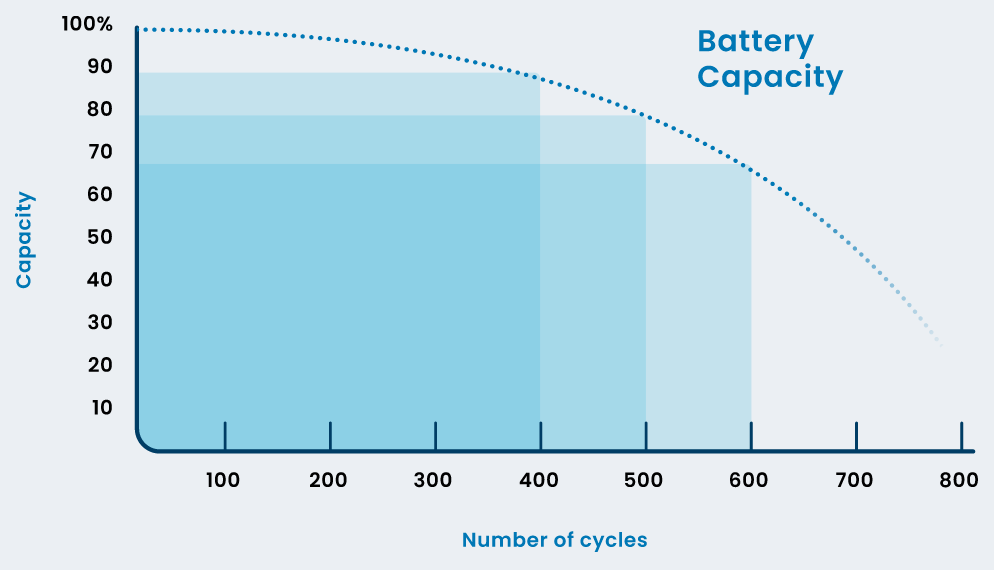
Under the same 1C charge and discharge regime at 100 percent depth-of-discharge, NiMH generally did not match the cycle stability of standard NiCd. The reference notes that capacity loss became more pronounced after roughly 300 cycles in the tested cells. This does not mean every NiMH cell fails at 300 cycles; it means that, in this specific full-depth comparison, the decline became more evident around that point.
Internal resistance also rose as cycling progressed. Rising resistance reduces the ability of a battery to deliver high current without voltage sag. For portable communication equipment, that can be significant because transmit operation often imposes short high-current loads. A pack with increased resistance may trigger low-voltage cutoff earlier, heat more under load, or provide less usable runtime even if measured capacity at a light load appears acceptable.
The test also indicated increasing self-discharge. For equipment kept on standby, self-discharge affects readiness. A battery that loses charge quickly during storage may require more frequent charging and may be less dependable after sitting unused. This was historically one of the disadvantages of conventional NiMH compared with lithium-ion and with some carefully maintained nickel-cadmium systems.
Modern NiMH cells are not identical to early high-self-discharge designs. Low-self-discharge NiMH cells and improved electrode formulations can retain charge better and provide more practical shelf behavior than older cells. Improved designs can also offer better cycle durability than earlier consumer-grade cells. Even so, under aggressive full-depth cycling, NiMH typically remains less stable than standard NiCd in the specific areas highlighted by the reference comparison: capacity retention, resistance stability, and self-discharge behavior.
The engineering decision is therefore application-dependent. NiMH may be attractive where higher capacity, cadmium avoidance, and compatibility with nickel-based charging infrastructure matter. It is less attractive where the primary requirement is extreme cycle endurance at full depth-of-discharge with low resistance growth. In high-cycle professional equipment, the additional initial capacity of NiMH must be weighed against faster aging and changing impedance over service life.
Lithium-Ion: Improved Chemistry but Sensitive to Stress
Lithium-ion changed portable equipment design because it provides high energy storage with relatively low self-discharge compared with nickel-based rechargeable systems. It also avoids the maintenance routines associated with some nickel chemistries. The cycling comparison, however, shows that lithium-ion endurance depends strongly on stress conditions.
In the reference test, lithium-ion cells showed capacity fade during cycling, and higher discharge rates could accelerate the apparent loss of capacity. This is important because lithium-ion aging is not controlled by cycle count alone. The severity of each cycle matters. A shallow, cool, moderate-current cycle is not equivalent to a full-depth, high-current, warm cycle.
Lithium-ion cell chemistry has improved substantially over time. Electrolyte additives, electrode coatings, optimized formulations, and better manufacturing controls have helped improve cycling performance, reduce harmful side reactions, manage impedance growth, and improve stability. These improvements do not eliminate aging, but they can shift the balance between capacity retention, power capability, safety margin, and operating range.
Self-discharge is generally low for lithium-ion compared with nickel-based chemistries. That is one reason lithium-ion became attractive for portable electronics and standby-ready devices. For a protected battery pack, however, stored-pack behavior may also include the small current drawn by protection electronics or monitoring circuits. A cell can have low chemical self-discharge while the complete pack still loses charge over long storage because of electronics attached to it.
Internal resistance growth is another central aging mechanism. As a lithium-ion cell ages through cycling and time, impedance can increase because of changes at electrode surfaces, electrolyte decomposition products, loss of active lithium, and other degradation processes. The practical effect is familiar: more voltage sag under load, more heat generation at a given current, and less usable capacity at higher discharge rates.
Lithium-ion cycle life varies widely by chemistry and design. Lithium cobalt oxide, nickel-manganese-cobalt, nickel-cobalt-aluminum, lithium iron phosphate, lithium manganese oxide blends, and other variants do not age in the same way. Even within a named chemistry family, cell design, electrode loading, electrolyte package, separator choice, formation process, and intended application can change cycle behavior.
Operating conditions are equally important. The main stress factors include:
- Temperature, especially prolonged heat exposure.
- Depth-of-discharge, with full cycles generally more stressful than shallow cycles.
- Upper charge voltage, because high state-of-charge can accelerate aging.
- Fast-charge exposure, particularly when the cell is cold, aged, or near high state-of-charge.
- Load profile, including high-current pulses that increase heat and voltage sag.
- Storage conditions, especially long storage at high state-of-charge and elevated temperature.
Fast charging and high-load currents can shorten lithium-ion life if not well controlled. The mechanisms include heat generation, accelerated impedance growth, and the risk of lithium plating under unfavorable conditions. Lithium plating is especially associated with charging too quickly when the cell cannot intercalate lithium into the graphite anode fast enough, such as at low temperature or high state-of-charge. Battery management systems reduce these risks by limiting current, monitoring temperature, and adjusting charge profiles, but they cannot make a stressed operating profile equivalent to a gentle one.
Why Lab Cycle Results Differ From Field Life
Laboratory cycle tests are designed for control and repeatability. The analyzer applies defined C-rates, known discharge limits, consistent rest intervals, and stable measurement conditions. That makes it possible to compare capacity fade, resistance increase, and self-discharge trends without the uncontrolled variation of daily use.
Real devices age in a more complicated way. A fielded lithium-ion pack may spend much of its life at partial state-of-charge, then receive short top-up charges. It may sit fully charged in a warm vehicle, operate in cold weather, experience standby drain, or supply irregular current pulses. Calendar aging continues even when the battery is not cycling, and it is strongly influenced by temperature and state-of-charge. Mechanical vibration, enclosure heat, charger behavior, and protection-circuit drain can also affect pack-level results.
Because of this, field life can be better or worse than a full-depth laboratory cycling result. A device that uses shallow cycles, avoids heat, limits maximum charge voltage, and rarely fast charges may outlast expectations based on severe 100 percent depth-of-discharge testing. Conversely, a device exposed to heat, high state-of-charge storage, frequent fast charging, and heavy current pulses may age faster than a simple cycle-count rating suggests.
The same caution applies when comparing chemistries. NiCd’s strong laboratory cycling durability does not automatically make it the best choice for every product, because energy density, environmental restrictions, maintenance, and application standards also matter. NiMH may offer useful capacity advantages despite faster aging in severe cycling. Lithium-ion can provide excellent energy and low self-discharge, but it requires careful control of voltage, current, and temperature to achieve long service life.
The practical conclusion for engineering use is to treat cycle data as a controlled benchmark. It reveals how a chemistry behaves under a defined load and depth-of-discharge, but final battery selection should be based on the actual duty cycle, storage conditions, allowed maintenance, safety requirements, and end-of-life performance needed by the equipment.
References
- Battery University | BU-208: Cycling Performance
- NiMH vs Lithium Ion Batteries: A Comprehensive Comparison for Engineers
- Synergistic Influence of electrolyte additives on the cycling …
- Effect of Electrolyte Additives on Cycling Performance of …
- Battery Technology in Aviation: Current State and Future …
- Analysis and Performance Evaluation of Li-Ion Batteries …
- Battery Cells and Materials Performance Evaluation
- BU-808: How to Prolong Lithium-based Batteries
- Enabling fast charging of high energy density Li-ion cells with …
- Electrolyte Development for Safe Li-Ion Battery Fast Charging