A battery is useful because it can store energy chemically and deliver it later as electrical power. During discharge, the cell or battery pack supplies current to a load: a motor, inverter, radio transmitter, phone, power tool, vehicle drive system, or any other electrical device. The details are simple at the terminals but complex inside the cell, where electrode reactions, electrolyte transport, internal resistance, and temperature all influence how much usable energy is delivered.
Electrochemical batteries are only one form of energy storage. Supercapacitors can accept and deliver power very quickly, flywheels store kinetic energy, and compressed-air systems store energy mechanically. Each has a different balance of energy retention, power capability, response time, cost, and system complexity. Batteries remain widely used because they offer a practical combination of stored energy, controlled voltage, portability, and manageable discharge behavior.
Discharging is not just about using energy until a device stops. The rate and depth of discharge affect voltage sag, heat generation, usable capacity, and service life. This is why two batteries with the same amp-hour rating can behave very differently in a drone, power tool, electric vehicle, backup system, or low-current remote-control device.
How Battery Discharge Works in Practice
When a battery is connected to a load, chemical energy is converted into electrical energy. Electrons move through the external circuit, while ions move through the electrolyte inside the cell. The terminal voltage seen by the load depends on the chemistry, state of charge, internal resistance, temperature, cell age, and the amount of current being drawn.
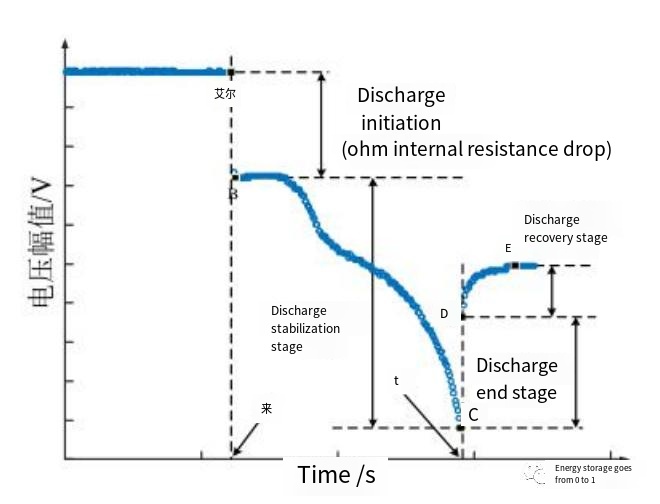
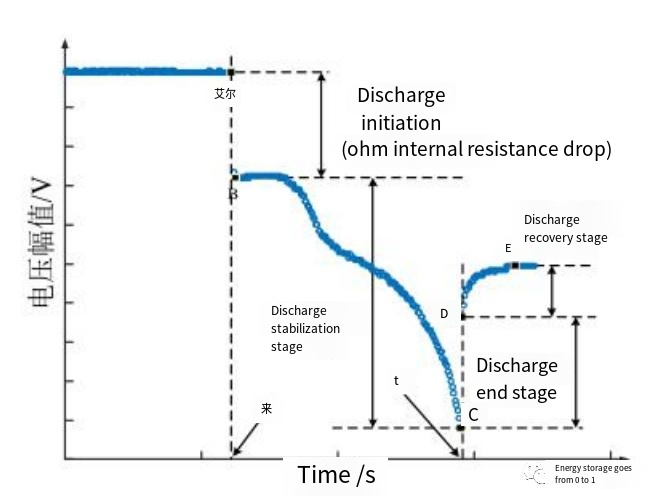
A light load allows the battery voltage to stay closer to its normal operating curve. A heavy load causes a larger internal voltage drop, commonly called voltage sag. This sag can make a battery appear empty even when chemical energy remains. Once the load is removed or reduced, the terminal voltage often rises again because the internal electrochemical system has time to relax.
Source: Battery University
Discharge rate is usually discussed in relation to capacity. A battery discharged at a high rate must move charge quickly through internal materials. That can increase losses and heat, and it may reduce the amount of capacity the device can actually use before reaching its cutoff voltage. Some cells are designed for energy density and moderate current; others are built for power delivery with lower internal resistance and better thermal behavior.
This distinction matters in practical applications:
- Power tools may demand bursts of high current, especially under stall or heavy mechanical load.
- RC hobbies and drones often value high discharge capability because motors can draw large currents during acceleration, climbing, or aggressive maneuvering.
- Electric vehicles require controlled high-power discharge but normally operate inside a managed state-of-charge window.
- Low-current electronics may run efficiently from cells optimized for capacity rather than peak power.
High discharge capability is useful, but it is not a free benefit. Running cells near their maximum discharge rating can increase temperature and accelerate wear if thermal management, cell design, and pack protection are not adequate. A pack that performs well in a short high-current run may not have the same long-term life as one used more conservatively.
Electrochemical batteries also differ from supercapacitors and mechanical storage systems in how they retain and deliver energy. Supercapacitors can deliver very high power but generally store less energy for a given size than batteries. Flywheels and compressed-air systems can be effective in specialized installations, but they require mechanical components, containment, or pressure systems. Batteries are often favored where compact stored energy and controlled electrical output are more important than instantaneous power alone.
Discharge performance should therefore be evaluated as a system property, not only as a cell label. Chemistry, cell format, pack design, temperature, age, state of charge, interconnect resistance, and protection circuitry all affect what the load actually receives.
Depth of Discharge and End-of-Discharge Voltage
Depth of discharge, or DoD, is the percentage of rated capacity that has been removed from a battery. State of charge, or SoC, is the percentage that remains. In a simplified calculation, SoC plus DoD is approximately 100 percent.
For example, if a 100Ah battery has delivered 40Ah, it is at about 40 percent DoD and 60 percent SoC. In real systems, this estimate can be affected by discharge rate, temperature, cell condition, measurement accuracy, and whether amp-hours or watt-hours are being tracked.
DoD is important because most rechargeable batteries experience more stress when they are discharged deeply. The severity depends on chemistry and design. Lithium-ion systems are commonly managed by electronics that prevent operation below a defined lower voltage. Lead-acid batteries are also sensitive to repeated deep discharge, which can reduce useful life and increase the risk of capacity loss.
A battery should not be discharged indefinitely. Each chemistry has an end-of-discharge region where most usable energy has been removed and voltage will fall rapidly if discharge continues. Typical end-of-discharge voltages under normal load include:
| Battery chemistry | Typical nominal voltage per cell | Typical end-of-discharge voltage under normal load |
|---|---|---|
| Lead acid | about 2.00V per cell | about 1.75V per cell |
| Nickel-cadmium / nickel-metal hydride | about 1.20V per cell | about 1.00V per cell |
| Many lithium-ion cells | about 3.60V per cell | about 3.0–3.3V per cell |
| Lithium iron phosphate | about 3.20V per cell | about 2.70V per cell |
These values are typical reference points, not universal rules. A manufacturer specification or battery management system setting should always take priority for a real design.
End-of-discharge voltage changes with operating conditions. Under a heavy load, internal resistance causes additional voltage sag. In very cold conditions, internal resistance rises and voltage also tends to drop more readily. For this reason, some systems use lower cutoff thresholds under heavy load or low temperature to avoid shutting down too early. The tradeoff is that the battery must still be protected from damaging over-discharge.
A power tool is a useful example. Drilling into concrete can demand much higher current than spinning freely. The pack voltage may fall below a normal cutoff point during that heavy load even though the pack still has usable energy. A well-designed controller must distinguish between temporary voltage sag and a genuinely depleted pack.
After the load is removed, a healthy battery often shows voltage recovery. The terminal voltage rises toward a more relaxed value, sometimes close to a nominal voltage range. This does not mean the battery has regained meaningful capacity. It mainly reflects reduced load-induced voltage drop and electrochemical relaxation inside the cell.
Voltage recovery can mislead users. A battery that rebounds after a heavy discharge may still be nearly empty. If the load is reconnected, voltage can drop quickly again. This is why voltage alone is an imperfect fuel gauge, especially during or immediately after high-current operation.
Protection against over-discharge is especially important for lithium-ion packs. Devices and battery management systems commonly disconnect or limit the load when cell voltage falls below a specified threshold. This prevents cells from being driven into damaging voltage ranges and helps avoid imbalance in multi-cell packs. In series-connected packs, one weak cell can reach the lower limit earlier than the others, so cell-level monitoring is often needed.
Lead-acid systems require a different kind of caution. During normal discharge, lead sulfate forms as part of the battery chemistry. Recharging reverses much of this process, but repeated deep discharge or leaving a battery discharged can contribute to lasting capacity loss. In addition, abusive charging, severe overcharge, damaged batteries, or incorrect charging methods can create hazardous venting conditions. Lead-acid batteries should be charged with suitable equipment, ventilation, and safety practices appropriate to the installation.
The practical lesson is that depth of discharge and cutoff voltage must be considered together. DoD estimates how much capacity has been removed; cutoff voltage helps prevent operation beyond the safe or useful lower limit. Neither value is completely independent of load, temperature, and battery condition.
What Counts as a Battery Discharge Cycle?
A discharge cycle is often described simply as one discharge followed by one recharge. That definition is easy to understand, but it is not precise enough for every application. In practice, cycle counting depends on the battery type, test method, device electronics, and how much capacity is removed before charging.
Many batteries are rated using a defined depth of discharge, commonly 80 percent DoD in published cycle-life comparisons. This does not mean every battery should always be used to exactly 80 percent DoD. It means the test or rating uses a repeatable discharge window so products and chemistries can be compared. It also leaves some reserve capacity rather than treating absolute empty as the normal operating endpoint.
Cycle counting becomes more complicated when batteries are used in partial cycles. If a battery is discharged 20 percent and recharged, that may not be equivalent to a full deep cycle. Some systems accumulate partial cycles into equivalent full cycles. For example, several shallow discharges may be counted together as one full-cycle equivalent after the total removed capacity reaches a defined amount.
Smart batteries and devices may also use threshold rules. A system might not count a cycle unless the battery has been discharged by a meaningful amount after charging. The supplied reference example notes that some smart batteries may require about a 15 percent discharge after charge before recording a cycle. Smaller charge-and-discharge events may be ignored by that cycle counter even though they still represent some energy throughput.
This is why cycle count should be interpreted carefully. A pack showing 300 counted cycles in one device may not have experienced the same wear as another pack showing 300 cycles under a different counting method. Temperature, charge voltage, discharge depth, current, storage conditions, and time at high or low state of charge can all influence aging.
Application-specific definitions are common:
- Satellites may use shallow daily discharge windows. The reference example describes typical satellite operation around 30–40 percent DoD before recharge during the satellite day.
- Electric vehicles usually do not expose the entire electrochemical capacity directly to the driver. A new EV battery may operate within a controlled state-of-charge band rather than cycling from absolute full to absolute empty.
- Consumer electronics may count equivalent full cycles internally, while the user sees only a simple battery percentage.
- Industrial and backup batteries may define cycles according to a commissioning test, warranty condition, or site-specific operating profile.
EV battery management illustrates the difference between displayed range and cell-level operation. Software can restrict the top and bottom of the usable charge window to reduce stress. As the battery ages, that usable window may be adjusted to help maintain consistent driving range. The driver may see a normal 0–100 percent display, while the actual cells are kept inside a narrower operating band.
Avoiding both full charges and deep discharges generally reduces stress in lithium-ion batteries. Keeping cells away from extreme state-of-charge limits can reduce some aging mechanisms, although the best operating window depends on chemistry and system design. Lead-acid batteries also benefit from avoiding repeated deep discharge, and they should not be left in a discharged state.
Coulomb counting is another way to evaluate battery use. Instead of relying only on the number of cycles, a system measures charge moving into and out of the battery, usually in amp-hours. More advanced systems may combine coulomb counting with voltage, temperature, and model-based estimation to improve state-of-charge and state-of-health calculations.
Coulomb counting is useful because battery wear is related to throughput as well as cycle labels. A battery that delivers many shallow cycles can move the same total charge as one that delivers fewer deep cycles, but the aging outcome may still differ because depth, voltage limits, current, and temperature matter. For engineering work, cycle count is a helpful shorthand, not a complete description of battery history.
The most practical way to use cycle information is to read it in context. Ask what DoD was used for the rating, what cutoff voltage defined the end of discharge, what temperature and load were used, and whether the cycle counter records full cycles, equivalent full cycles, or only events that exceed a minimum threshold. Without those details, a cycle number can be directionally useful but technically incomplete.
References
- Battery University | BU-501: Basics about Discharging. (n.d.). http://www.batteryuniversity.com/article/bu-501-basics-about-discharging
- Battery University | BU-501a: Discharge Characteristics of Li-ion. (n.d.). http://www.batteryuniversity.com/article/bu-501a-discharge-characteristics-of-li-ion
- Battery Basics. (n.d.). https://www.progressivedyn.com/battery-basics
- BU-808: How to Prolong Lithium-based Batteries. (n.d.). http://www.batteryuniversity.com/article/bu-808-how-to-prolong-lithium-based-batteries
- What Is Depth of Discharge? Your Complete Guide to Battery Performance. (n.d.). https://www.rdbatteries.com/blog/post/what-is-depth-of-discharge.html
- Depth of Discharge (DoD) Explained: Extend Battery Life. (n.d.). https://www.solaxpower.com/blogs/depth-of-discharge.html
- Lithium Battery Depth of Discharge, State Of Charge, and The Affect On Battery Capacity | RELiON. (n.d.). https://relionbattery.com/blog/tech-tuesday-depth-of-discharge
- TIL Lead Acid batteries can produce Hydrogen Sulfide gas .... (n.d.). https://www.reddit.com/r/todayilearned/comments/nyxwrc/til_lead_acid_batteries_can_produce_hydrogen
- Lead–acid battery. (n.d.). https://en.wikipedia.org/wiki/Lead%E2%80%93acid_battery
- Good morning all. I have a question about lead acid .... (n.d.). https://www.facebook.com/groups/2573968699280898/posts/24923372340580548