Electrolyte loss is a failure mechanism that affects several battery chemistries, but the way it occurs differs substantially between flooded lead-acid, sealed lead-acid, nickel-based, and lithium-ion cells. In flooded lead-acid batteries, the main issue is usually loss of water through gassing and venting. The electrolyte then becomes more concentrated, and the correct remedy is normally to restore the water balance with clean water rather than adding more electrolyte.
Sealed batteries present a different problem because lost water is difficult to replace without opening the cell. Overcharging, incorrect float voltage, and high temperature can accelerate dry-out and reduce performance. Nickel-based cells can also lose electrolyte through repeated venting, while lithium-ion cells are designed to contain their electrolyte and should not normally emit gas. Gas generation in a lithium-ion cell is instead a sign of abnormal chemical or electrical conditions that can increase internal pressure.
Understanding the chemistry and construction of the battery is essential before attempting maintenance. Adding liquid to the wrong type of battery, continuing to charge a damaged cell, or bypassing a safety device can create additional damage and safety risks.
Electrolyte Loss in Flooded Lead-Acid Batteries
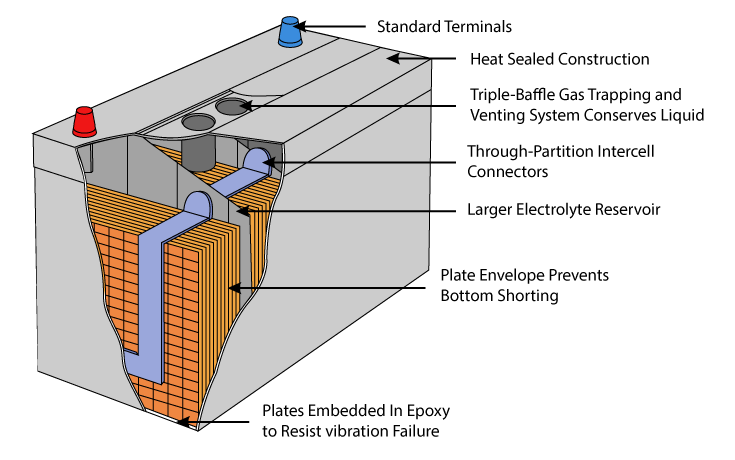
A flooded lead-acid battery contains liquid electrolyte and has vents through which gases can escape. During charging, and also under some charging or discharging conditions, gassing can allow hydrogen and some water to leave the battery. Continued loss of water changes the balance between water and sulfuric acid in the electrolyte.
As water is lost, the remaining electrolyte becomes more concentrated. This affects the battery’s operating condition and can contribute to reduced service life. The concentration change is not corrected by simply adding more acid. Instead, after the battery has been safely taken out of service and the electrolyte level has been assessed, lost water is normally replaced with clean water appropriate for battery maintenance.
Adding electrolyte to compensate for water loss can disturb the battery’s specific gravity. A solution that is too concentrated can also promote corrosion and accelerate deterioration of the internal components. The result may be a shorter battery life even if the liquid level initially appears correct.
The practical distinction is therefore important:
- Water loss changes the concentration of the existing electrolyte.
- Adding clean water restores part of the lost solvent and helps return the mixture toward its intended balance.
- Adding electrolyte increases the acid content and can produce an incorrect specific gravity.
Gassing is often associated with charging, particularly when charging conditions drive reactions beyond the normal battery reaction. The amount of gassing depends on the battery design, its condition, and the charging process. Excessive or persistent gassing should not be treated as a normal sign that the battery is being charged effectively. It may indicate an inappropriate charging voltage, a charging control problem, or a battery that is already deteriorated.
A flooded battery should not be topped up casually with an unknown liquid. Contamination can affect the electrolyte and the electrodes. Maintenance procedures must also account for the condition of the case, venting system, and terminals. If the battery is cracked, leaking, severely deformed, or unusually hot, adding water is not a substitute for removing the battery from service.
Source: Battery University
.png)
Electrolyte Loss in Sealed Lead-Acid and Nickel-Based Batteries
In sealed lead-acid batteries, including valve-regulated lead-acid (VRLA) designs, electrolyte loss is commonly associated with overcharging. Incorrect charging voltage, an unsuitable float voltage, or elevated operating temperature can increase internal gas generation and cause water loss. Because the battery is sealed or valve-regulated, the lost liquid cannot normally be restored as easily as it can in a flooded design.
The typical progression is dry-out followed by declining performance. As the available electrolyte is reduced, the electrochemical reactions become less effective and the battery may lose capacity or fail to deliver its expected current. The battery may still show a reasonable voltage while providing poor runtime, so voltage alone does not prove that the electrolyte condition is healthy.
Attempts have been made to replenish lost liquid in VRLA cells by adding water. Such repairs have limited success. Opening or tampering with the cells converts a low-maintenance battery into a high-maintenance project that requires continued supervision. It can also alter the original construction and sealing arrangements. A battery that has dried out because of incorrect charging or high temperature is usually better treated as a failed battery than as a normal maintenance candidate.
The most useful preventive measures are operational rather than corrective:
- Set charging and float voltages correctly for the battery design.
- Avoid charging conditions that cause sustained overcharge.
- Control the operating temperature where possible.
- Investigate abnormal heating, swelling, venting, or rapid capacity loss.
Nickel-based batteries can lose electrolyte through repeated venting. Excessive pressure during extreme charge or discharge, overcharge, inaccurate full-charge detection, and elevated trickle charge can all contribute. The problem can become more likely as a battery ages and its condition changes.
A nickel-based cell may vent repeatedly through a spring-loaded seal. After recurring venting, the seal may no longer close properly. A white powder deposit around the seal opening is a visible indication that electrolyte has escaped and dried around the vent area. Leakage can also result from seal damage, aging, or poor manufacturing.
A dry nickel-based cell may exhibit a misleading electrical symptom. During charging, its voltage can rise abnormally because the cell has lost the ability to clamp the voltage through normal chemical activity. At the same time, it may no longer accept current effectively. High charge voltage in this situation does not demonstrate that the cell is fully charged; it can indicate that the cell is dry and no longer functioning chemically.
Leakage, vent deposits, abnormal charge voltage, and poor current acceptance should therefore be considered together. Repeated charging of a suspected dry or leaking cell may increase damage without restoring useful capacity. The charging system should be checked for incorrect full-charge detection or excessive trickle charge, and the affected cell or pack should be evaluated before further use.
Gas Generation and Electrolyte Containment in Lithium-Ion Cells
A properly designed lithium-ion cell should not normally emit gas or lose electrolyte during ordinary operation. Its electrolyte is contained inside the cell, and visible leakage, swelling, venting, or gas release indicates an abnormal condition rather than routine maintenance.
Gas can be generated when the cell is overcharged, held at excessive voltage, overheated, or affected by an internal fault. Chemical side reactions involving the electrolyte and electrode materials can also produce gaseous products. These reactions increase internal pressure and can further degrade the cell. Conditions that damage the internal structure may make containment more difficult and increase the chance of a safety event.
Lithium-ion cells therefore incorporate protective features intended to interrupt the electrical or mechanical process when pressure or another unsafe condition becomes excessive. Depending on the cell design, these features can include:
- Electrical disconnects, which interrupt the current path when an abnormal condition is detected or pressure operates the mechanism.
- Pressure-relief mechanisms, which provide a controlled means of releasing excessive internal pressure.
- Safety membranes, which can respond to pressure or abnormal internal conditions and help limit further operation.
These features are protective devices, not resettable maintenance components. A safety mechanism may activate only once. After activation, the cell can be permanently interrupted, rendered inoperable, or left in a condition that is no longer suitable for normal use. Bypassing the device or forcing the cell back into service removes part of the protection that was designed into the cell.
Gas generation can also accompany internal chemical degradation without producing an immediately obvious external leak. For this reason, a cell that is swollen, has released gas, shows signs of electrolyte leakage, or has experienced severe overheating should not be treated as an ordinary charging problem. Continuing to charge it can worsen the internal condition.
The correct response depends on the cell and pack design, but the general principle is straightforward: lithium-ion electrolyte is not intended to be replenished by the user. Unlike a flooded lead-acid battery, a lithium-ion cell should not be opened and refilled. A cell with evidence of gas generation, pressure buildup, or activated protection should be isolated and assessed using procedures suitable for damaged lithium-ion batteries.
Why Overcharging Makes a Battery Gas
In a water-based battery, sustained overcharging can drive electrolysis. Instead of all of the charging energy being used to restore the intended electrochemical state, part of it drives the splitting of water into hydrogen and oxygen. The battery then behaves, in effect, like a water-splitting device powered by an external electrical source.
The simplified concept is:
- Water is separated into hydrogen and oxygen.
- Hydrogen can escape through the battery’s venting path.
- The loss of water changes the concentration of the remaining electrolyte.
- Continued overcharge can increase gassing and accelerate deterioration.
This is different from normal battery operation. During discharge, a battery uses a spontaneous redox reaction to produce electrical energy as electrons move through the external circuit and ions move through the electrolyte. During charging, an external source forces the battery’s chemical reactions in the reverse direction. If charging continues beyond the useful restoration of the active materials, side reactions such as water electrolysis become increasingly important in water-based systems.
A fuel cell illustrates the reverse relationship at a system level. In a hydrogen fuel cell, hydrogen and oxygen participate in electrochemical reactions that produce electricity and water. An electrolyzer uses electricity to drive the opposite process, separating water into hydrogen and oxygen. A rechargeable water-based battery is not simply an electrolyzer or a fuel cell, but excessive charging can cause water-splitting reactions that resemble electrolysis.
This comparison explains why correct charge control matters. Normal charging restores the battery’s chemical state. Overcharging supplies energy after that process is substantially complete, so the additional energy can generate gas, remove water, increase pressure, or promote corrosion depending on the battery chemistry and construction. Preventing sustained overcharge is therefore one of the principal ways to limit electrolyte loss in batteries that contain water-based electrolyte.
References
- Battery University | BU-803c: Loss of Electrolyte. (n.d.). http://www.batteryuniversity.com/article/bu-803c-loss-of-electrolyte
- Battery University | BU-210: How does the Fuel Cell Work?. (n.d.). http://www.batteryuniversity.com/article/bu-210-how-does-the-fuel-cell-work
- Batteries vs Fuel Cells: Exam Guide & Real-World Comparison. (n.d.). https://www.sciencegears.com.au/blogs/batteries-vs-fuel-cells-exam-guide-real-world-comparison
- Why Does Electrolyte Loss Occur in Lithium Batteries. (n.d.). https://www.large-battery.com/blog/loss-of-electrolyte-in-lithium-battery-causes-and-effects-2
- Batteries, supercapacitors and fuel cells - What is the difference?. (n.d.). https://www.biolinscientific.com/blog/what-is-the-difference-between-a-battery-a-supercapacitor-and-a-fuel-cell
- Batteries Comparing to Hydrogen Fuel Cells - IEEE Smart Grid. (n.d.). https://smartgrid.ieee.org/bulletins/february-2023/batteries-comparing-to-hydrogen-fuel-cells
- Electrolysers, Fuel Cells and Batteries: Analytical Modelling. (n.d.). https://open.umn.edu/opentextbooks/textbooks/electrolysers-fuel-cells-and-batteries-analytical-modelling
- 2025_04_Tafili.pdf. (n.d.). https://www.politesi.polimi.it/retrieve/62da59d7-829d-4b8d-b706-40054aa4b061/2025_04_Tafili.pdf
- Electrolysers, Fuel Cells and Batteries analytical modelling. (n.d.). https://jwhaverkort.weblog.tudelft.nl/files/2024/04/Electrolysers_Fuel_Cells_and_Batteries_JWHaverkort.pdf
- Electrode Degradation in Polymer Electrolyte Fuel Cells. (n.d.). https://research.chalmers.se/publication/534158/file/534158_Fulltext.pdf