A battery fuel gauge is the part of a battery system that estimates how much useful charge remains and, in more advanced systems, whether the battery can still support the job expected of it. The familiar percentage icon on a phone, laptop, power tool, medical device, or electric vehicle display is not a direct measurement of liquid in a tank. It is an estimate produced from electrical measurements, temperature information, battery history, and assumptions about the cell chemistry and load.
This distinction matters because battery life is strongly affected by use. A pack that is repeatedly exposed to high temperature, deep discharge, high current, or long storage at unfavorable charge levels will not age the same way as a pack used gently. As the battery ages, its usable capacity falls, its voltage behavior changes, and its ability to deliver power may decline. A fuel gauge therefore has two related but different tasks: estimating present charge and helping the host system understand whether the battery remains fit for service.
Smart batteries add another layer by communicating battery information to the equipment they power or to a battery-management system. SMBus is a common interface in smart battery applications, especially in many portable-computer-style battery packs, but it is not the only possible communication method. Modern battery systems may also use other serial interfaces, pack-specific protocols, or integrated BMS communication depending on voltage, cell count, safety requirements, and application.
Battery Fuel Gauges, SoC, and Smart Battery Communication
A conventional fuel tank has a relatively fixed volume. If the tank contains half its rated volume of fuel, the gauge can reasonably show half full. A rechargeable battery is less straightforward. Its “tank size” changes with temperature, discharge rate, cell aging, chemistry, and the voltage limits selected by the system designer. A battery fuel gauge therefore estimates remaining usable capacity rather than measuring a fixed stored volume.
The most common user-facing value is state-of-charge, usually abbreviated SoC. SoC is normally shown as a percentage of the battery’s available charge relative to a defined full condition. A display reading of 60% means the gauge estimates that about 60% of the usable charge basis remains under the assumptions used by the system. It does not necessarily mean the battery has 60% of its original factory capacity, nor does it guarantee a specific runtime under every load.
This is one of the most common misunderstandings in battery diagnostics. A weak old battery can still show 100% SoC immediately after charging, but its full-charge capacity may be much lower than when new. In that case, 100% represents a smaller usable energy reservoir. Conversely, a healthy battery at low temperature may show a reasonable SoC yet provide less power or runtime than expected because chemical reaction rates and voltage behavior are temperature dependent.
A useful fuel gauge must account for several changing factors:
- Voltage: Open-circuit voltage and loaded voltage provide information about charge state, but the relationship between voltage and SoC is chemistry-dependent and can be flat over much of the discharge curve.
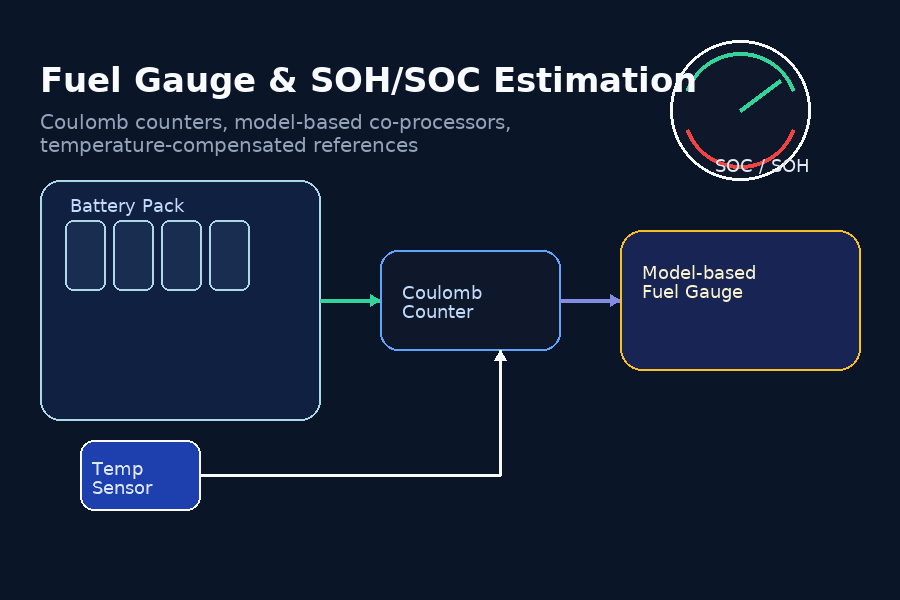
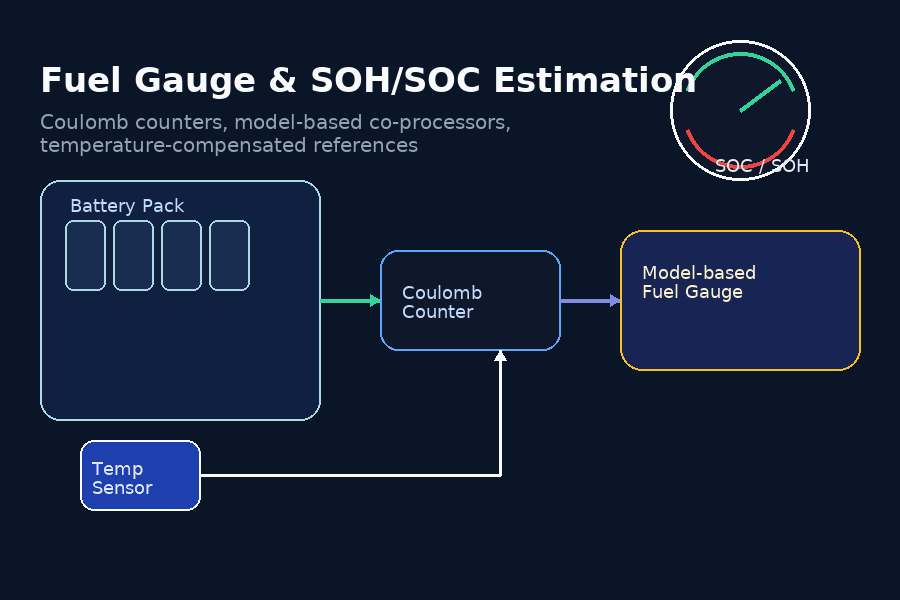
- Current: Measuring charge flowing into and out of the pack allows the gauge to perform coulomb counting, which tracks accumulated ampere-hours or coulombs over time.
- Temperature: Battery voltage, available capacity, internal resistance, and charge acceptance all vary with temperature.
- Learned capacity: Many gauges update their estimate of full-charge capacity as the battery ages and as complete or partial charge-discharge events provide new information.
- Internal resistance or impedance: Increased resistance affects voltage sag under load and can indicate aging or reduced power capability.
- Battery model: More advanced systems combine measurements with a model of the cell chemistry and pack behavior to improve estimates during partial cycles, pulsed loads, and changing temperatures.
Source: Battery University
Simple battery indicators may rely mainly on terminal voltage. This can be acceptable for low-cost products where approximate indication is enough, but voltage alone has limitations. Lithium-ion cells, for example, can maintain a relatively flat voltage through much of their discharge, and the measured terminal voltage changes with load current and temperature. A high current pulse can temporarily pull the voltage down even when the battery still has usable charge remaining.
Coulomb counting improves the estimate by integrating current over time. If the gauge knows the battery started from a known full condition and measures how much charge leaves the pack, it can estimate the remaining charge more directly. However, coulomb counting also accumulates error from current-sensor offset, self-discharge, charge efficiency assumptions, and uncertainty about the true full capacity. For this reason, practical fuel gauges often combine coulomb counting with voltage relaxation data, temperature correction, learned capacity, and model-based adjustment.
Smart battery communication allows these estimates to be shared with the host device. A laptop, charger, industrial instrument, or vehicle controller can request values such as remaining capacity, full-charge capacity, voltage, current, temperature, cycle information, warning flags, or state-of-health indicators, depending on the battery design. SMBus is widely associated with smart battery packs because the Smart Battery System architecture uses SMBus-style communication, but many battery-management systems use other communication arrangements. The important point is not the specific bus name; it is that the battery or BMS can communicate measured and learned information rather than acting as a passive energy source.
SoC is valuable, but it should not be treated as a complete measure of battery health. A fuel gauge percentage answers the question, “How much charge does the system estimate is available now?” It does not fully answer these questions:
- How much capacity has the battery lost since new?
- Can the pack deliver the required peak current without excessive voltage sag?
- How will runtime change at low or high temperature?
- Is the battery near end of service life?
- Does the battery meet a warranty or maintenance threshold?
Those questions require additional information such as state-of-health, resistance growth, capacity fade, error flags, and application-specific performance limits. A battery may be charged but no longer strong enough for a demanding load. That distinction leads to the idea of state-of-function.
Tri-State Fuel Gauges and State-of-Function
A tri-state fuel gauge is a simplified display concept that presents battery condition using a small number of visible states rather than a detailed numerical readout. In the reference example, the gauge reads “learned” battery information from the smart battery interface, commonly SMBus in that type of system, and displays the result on a multicolor LED bar. The display uses green, unlit, and red indications to give a quick view of battery status.
In its simplest interpretation, the LED states communicate whether the battery is in an acceptable, intermediate, or poor condition. A green indication suggests that the battery has sufficient charge or function for the intended task. An unlit or neutral segment can indicate a middle state, depending on the implementation. A red indication warns that the battery is low, weak, or no longer able to meet the required operating condition. The exact meaning of each LED depends on the product design, but the value of the tri-state approach is that it converts complex battery data into an immediate service decision.
The important technical idea behind this display is state-of-function, often abbreviated SoF. State-of-function is not identical to state-of-charge. SoC describes how charged the battery is relative to its current usable capacity estimate. SoF asks a more practical question: can this battery still perform the required task?
For example, consider two battery packs that both show 100% SoC after charging. One is new and can deliver the expected runtime and current. The other has aged and now stores much less energy, with higher internal resistance and greater voltage sag under load. Both may be “full” according to SoC, but they do not have the same function. The aged pack may shut down early, fail under a pulse load, or trigger a low-voltage cutoff much sooner. A state-of-function indication attempts to capture that difference.
This is particularly useful where the battery is part of a mission-critical or service-managed system. In medical equipment, communications devices, field instruments, backup power modules, and transportation applications, the relevant question is not only whether the battery has charge at the moment. It is whether the battery can complete the expected duty cycle with suitable margin. A tri-state display can help a technician or user distinguish a normally charged battery from one that should be serviced, tested, or replaced.
The data behind SoF can include several learned or measured parameters:
- present SoC and remaining capacity estimate;
- full-charge capacity compared with the battery’s earlier learned or rated capacity;
- voltage behavior under load;
- internal resistance or impedance growth;
- temperature limits and recent operating conditions;
- cycle history and aging indicators;
- protection or fault flags reported by the battery electronics.
A useful SoF indicator must be tied to the load requirement. A battery that is no longer suitable for a high-power tool may still operate a lower-power device. A pack that cannot meet an automotive traction requirement may still have possible use in a less demanding stationary application, subject to safety assessment and system design. Therefore, SoF is best understood as application-specific fitness, not as a universal percentage that applies equally to every load.
Warranty interpretation is another area where SoC and SoF should not be confused. Reduced capacity over time is normal battery aging. Rechargeable batteries are consumable electrochemical systems, and gradual capacity fade is expected even when the product is used correctly. A battery showing 100% SoC after charging is not necessarily “as good as new”; it may simply be full relative to its present reduced capacity.
Replacement eligibility depends on the warranty language or maintenance policy, not on SoC alone. A manufacturer or service organization may define replacement criteria using remaining capacity, runtime under a specified load, resistance, fault conditions, or inability to meet a defined function test. Some industries use a significant drop from original capacity as a service-life benchmark. Around 80% of original capacity is often used as a practical reference point in battery service discussions, including some EV and industrial contexts, but it is not a universal rule. Electric-vehicle warranties and service policies can define their own capacity-retention thresholds, time periods, mileage limits, measurement procedures, and exclusions.
A careful service decision therefore needs the correct comparison basis. The question is not simply, “Does the battery charge to 100%?” A better set of questions is:
- What is the present full-charge capacity compared with the rated or learned new capacity?
- Does the pack maintain voltage under the required load?
- Are temperature and current limits being respected?
- Has the battery-management system logged faults or abnormal behavior?
- Does the battery meet the warranty or maintenance threshold defined for that application?
Tri-state LED gauges are only one way to communicate this information. They are attractive because they are simple, quick to read, and useful for users who do not need detailed diagnostics. However, they are not a universal standard across the battery industry. Many modern products use percentage displays, runtime estimates, mobile or service software, diagnostic tools, or BMS-reported state-of-health values instead of a three-color LED bar. Electric vehicles, for example, generally present more detailed range, charge, warning, and battery-health information through vehicle software rather than through a simple standalone tri-state indicator.
The engineering challenge remains the same regardless of display style. The system must convert imperfect measurements into a reliable estimate of remaining charge and usable function. It must also adapt as the battery ages. If the gauge does not learn capacity fade, it may overstate runtime. If it ignores temperature or load current, it may misread available energy. If it reports only SoC, it may miss a battery that is fully charged but too weak for the job.
A well-designed battery fuel gauge is therefore both a measurement system and a decision aid. The SoC display helps users manage charging and runtime. Smart battery communication allows the host system to act on battery data. State-of-function adds a practical layer by asking whether the battery can still deliver the required performance. For users and technicians, the most reliable interpretation comes from reading these values together rather than relying on a single percentage icon.
References
- BU-602: How does a Battery Fuel Gauge Work?. (n.d.). https://www.batteryuniversity.com/article/bu-602-how-does-a-battery-fuel-gauge-work
- BU-602: How does a Battery Fuel Gauge Work?. (n.d.). http://www.batteryuniversity.com/article/bu-602-how-does-a-battery-fuel-gauge-work
- What is a Battery Fuel Gauge and How Does It Function — Large Battery. (n.d.). https://www.large-battery.com/blog/battery-fuel-gauge-function-and-importance
- Battery Fuel Gauges: Accurately Measuring Charge Level. (n.d.). https://www.analog.com/en/resources/technical-articles/battery-fuel-gauges-accurately-measuring-charge-level.html
- Fuel Gauges for Battery Pack Assemblies - Accuracy and Cost Factors. (n.d.). https://www.epectec.com/batteries/fuel-gauges-for-battery-packs.html
- Automotive Fuel Gauge Market Trends 2025 to 2035. (n.d.). https://www.futuremarketinsights.com/reports/automotive-fuel-gauge-market
- Are electric vehicle batteries being underused? A review of current practices and sources of circularity. (n.d.). https://pmc.ncbi.nlm.nih.gov/articles/PMC10126315
- Ultrasensitive Fuel Gauges Could Improve Electric Vehicle Batteries. (n.d.). https://www.scientificamerican.com/article/ultrasensitive-fuel-gauges-could-improve-electric-vehicle-batteries
- Battery fuel gauges | TI.com. (n.d.). https://www.ti.com/product-category/battery-management-ics/battery-fuel-gauges/overview.html
- Battery Electric Vehicles | NIST. (n.d.). https://www.nist.gov/el/applied-economics-office/manufacturing/circular-economy/battery-electric-vehicles