Rapid battery tests are useful because a complete controlled charge-and-discharge test is often too slow or disruptive for field service. However, a rapid result is normally an estimate rather than a direct measurement of every aspect of battery condition. State of charge, recent charging or discharging, temperature, storage history, and the design and chemistry of the battery can all affect the result. A partially charged healthy battery may therefore appear different from a fully charged battery whose capacity or power capability has degraded.
Battery health is also multidimensional. A useful assessment may need to consider stored capacity, resistance under load, self-discharge, cell balance, temperature behavior, and safety condition. No single rapid measurement reliably represents all of these properties, so the test method must be matched to the decision being made.
Battery Health Indicators: Capacity, Resistance, Self-Discharge, and Cell Balance
Capacity is the principal indicator of how much charge or energy a battery can store and deliver under defined conditions. It determines practical runtime and generally declines progressively with aging. A capacity result is meaningful only when the test conditions, current, voltage limits, temperature, and measurement method are known.
Internal resistance describes how strongly the battery opposes current flow. Higher resistance produces greater voltage drop during loading, can reduce power delivery, increase heat generation, and cause equipment to reach its low-voltage limit sooner. Resistance and capacity are related through some aging mechanisms, but they are not interchangeable. A battery may retain useful energy capacity while no longer supporting a high-current load, or it may deliver current adequately while providing less total runtime.
Self-discharge is the loss of stored charge while the battery is not supplying an external load. An unusual self-discharge rate can indicate cell leakage, internal contamination, damage, or other integrity problems. Its diagnostic significance depends on chemistry, construction, temperature, storage state, and the time over which it is measured. It is therefore better treated as a diagnostic symptom than as a universal single-number state-of-health measurement.
In a series or parallel pack, cell balance and cell-to-cell variation are also important. Cells do not age identically, and a weak cell can limit the usable voltage window, charge acceptance, runtime, or power capability of the complete pack. Monitoring individual cell voltages and, where available, cell temperatures and balancing activity can reveal conditions that are hidden by a pack-level voltage measurement.
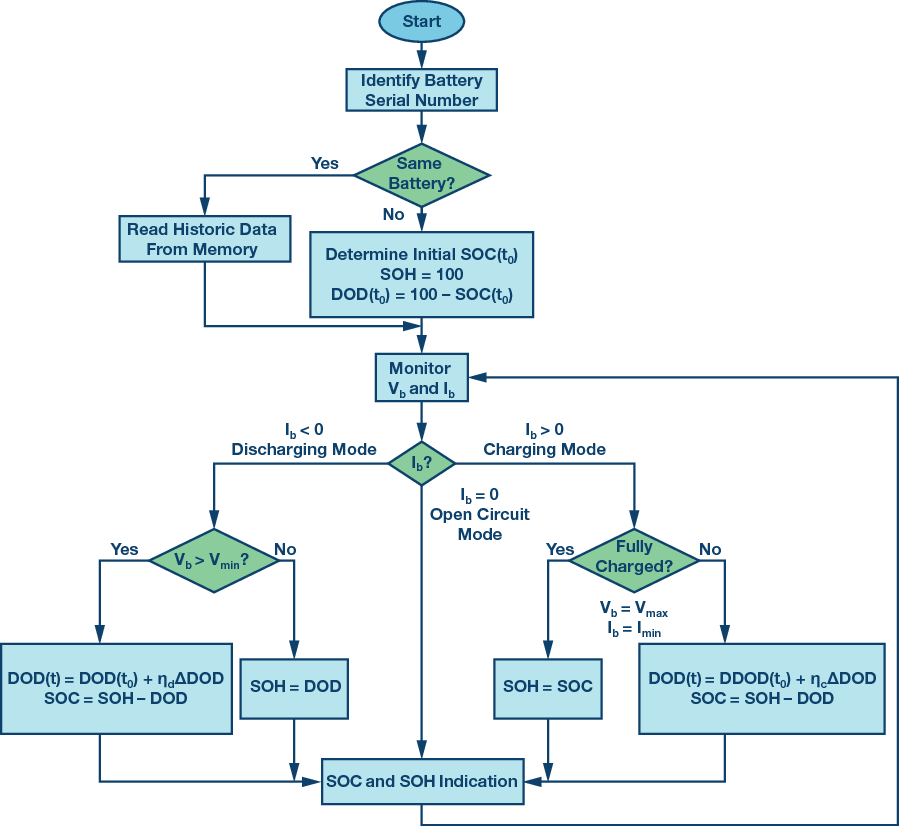
State of charge and state of health must be kept separate. State of charge (SoC) describes how full the battery is at a particular time. State of health (SoH) describes how the aged battery compares with a reference condition, but the reference may concern capacity, resistance, power capability, self-discharge, or a combined model. A battery can be at a high SoC while having substantially reduced SoH.
Source: Battery University

Direct Electrical Tests and Smart-Battery Estimation
Direct electrical testing applies a known electrical condition and observes the battery response. A controlled load or discharge records voltage and current over time. A full discharge, performed within the manufacturer’s limits, can measure usable capacity more directly than a short snapshot. The voltage response during a load step or pulse can also provide information related to resistance and power delivery.
The limitation is time and service disruption. A capacity test may require the battery to be fully charged, stabilized, discharged to a defined cutoff, and sometimes recharged before the battery returns to service. The result also describes performance under the selected test conditions rather than every possible duty cycle.
Smart-battery systems use electronics and software to estimate battery condition during operation. Typical inputs include:
- pack or cell voltage;
- current entering or leaving the battery;
- temperature;
- operating history and charge or discharge events; and
- a chemistry- and design-specific battery model.
A fuel gauge may use coulomb counting, which integrates current over time. One coulomb is one ampere-second. In principle, integrating current gives the charge transferred into or out of the battery, but sensor offset, measurement noise, charge inefficiency, temperature, aging, and incomplete knowledge of the true full and empty points can cause the estimate to drift.
Calibration events or known operating reference points can help bring the electronic estimate back into agreement with the electrochemical battery. Model parameters may also need updating as the battery ages. A smart battery is therefore a combination of an electrochemical energy store and a digital estimator; the two can diverge when the model, sensors, or stored capacity no longer match actual conditions.
The distinction between direct and digital testing is not absolute. Modern systems often combine direct voltage, current, and temperature measurements with model-based estimation. They may identify abnormal behavior without independently measuring usable capacity with the accuracy of a controlled discharge.
Battery Test Methods from Voltage Checks to Advanced Diagnostics
Battery test methods range from simple field measurements to instrumented electrochemical analysis. Their speed, invasiveness, calibration requirements, chemistry dependence, and diagnostic output differ substantially.
| Method | Primary information | Main strengths | Important limitations |
|---|---|---|---|
| Voltage check | Approximate SoC under suitable conditions | Fast and inexpensive | Recent load or charge can distort the result; voltage alone does not establish capacity |
| AC or DC ohmic test | Resistance or impedance-related behavior | Quick indication of some degraded or high-resistance batteries | Results depend on method and conditions; not a direct capacity measurement |
| Controlled full-cycle test | Usable capacity | More direct and comparatively accurate | Time-consuming and may remove the battery from service |
| Pulse or dynamic response test | Transient voltage, resistance, and model parameters | Faster than a full cycle | Requires suitable reference data and interpretation |
| EIS or frequency-domain test | Frequency-dependent impedance behavior | Can separate several electrochemical responses | Requires specialized instrumentation and validated models |
| BMS or snapshot estimate | Estimated SoC, SoH, or remaining capacity | Can operate during normal use | Accuracy depends on sensors, calibration, model quality, and battery history |
Voltage testing
Terminal or open-circuit voltage is mainly useful for estimating SoC after the battery has had enough time to approach a representative resting condition. The necessary stabilization period varies with chemistry, construction, temperature, and the preceding load or charge event, so a universal rest time should not be assumed.
A recently charged battery can show surface-charge effects, while a recently discharged battery can show voltage recovery. Temperature and current-related voltage drop can create additional error. Voltage by itself cannot establish the battery’s capacity, internal resistance, self-discharge rate, or ability to support a demanding load.
Ohmic testing
Ohmic methods use either alternating-current or direct-current techniques to characterize resistance or impedance-related behavior. An AC instrument may report impedance at a selected frequency, while a DC or pulse test may calculate resistance from a change in voltage divided by a change in current. These values are not automatically interchangeable. The result depends on frequency, pulse duration, current level, temperature, SoC, connections, and the condition of the battery.
Resistance-based testing can identify some severely degraded batteries, particularly when the measured value is far outside the calibrated range. It should not be treated as a universal predictor of remaining capacity, especially when comparing different lithium-based or lead-based batteries.
Controlled full-cycle testing
A controlled full-cycle test charges and discharges the battery under defined limits and measures the delivered charge or energy. This is the most direct way to determine usable capacity among the methods discussed here, but it can take hours and may accelerate wear if performed unnecessarily. The test must specify cutoff voltage, current, temperature, charge procedure, rest periods, and whether the result is reported in ampere-hours or watt-hours.
Time-domain pulse and frequency-domain analysis
Time-domain methods apply a load or current pulse and analyze the immediate voltage change, transient response, and recovery behavior. The measured response can be compared with a battery model or reference data to estimate resistance, polarization behavior, power capability, or selected health indicators.
Frequency-domain methods apply signals at multiple frequencies and examine how impedance changes. A Nyquist-style plot can help separate resistive, capacitive, and diffusion-related features, but interpreting those features requires an appropriate electrochemical or equivalent-circuit model. The result is not automatically a direct capacity measurement.
Battery-specific quick-sort and model-specific testing
Some rapid systems use battery-specific calibration, reference tables, parameters, or matrices. These approaches can sort batteries within a defined population more effectively than a generic resistance limit, provided the battery design, chemistry, temperature, SoC range, and aging patterns match the calibration basis. A model developed for one population should not be assumed to classify another population reliably.
Electrochemical dynamic response testing
Dynamic-response systems use load pulses and examine the transient voltage behavior and subsequent recovery. The response can contain information about charge-transfer and polarization effects that are not visible in a single voltage reading. Practical interpretation still depends on reference data, test repeatability, and the relationship between the measured response and the target property, such as power capability or capacity.
Electrochemical impedance spectroscopy
Electrochemical impedance spectroscopy, or EIS, measures the battery response over a range of frequencies. It can provide a richer electrochemical signature than a single resistance value and can support model-based estimates of selected battery properties. EIS requires suitable signal generation, voltage and current measurement, frequency control, connections, and data analysis.
EIS is not automatically reliable across all chemistries, form factors, production batches, or aging states. Frequency range, temperature, SoC, measurement amplitude, and model selection affect the result. A model that fits laboratory cells may not predict capacity or power capability accurately across a diverse production population without validation.
Battery-management systems
A battery-management system combines measurements of voltage, current, and temperature. Some systems also integrate coulomb counts and maintain estimates of SoC, SoH, or available power. A BMS can detect abnormal cell voltage, temperature, current response, or imbalance and can protect the pack from unsafe operating conditions.
However, fault detection is not the same as accurate capacity measurement. A BMS may identify a defective cell or an implausible operating condition while still having uncertainty about the total usable capacity, particularly when the pack has not experienced a suitable calibration event or when its aging model is no longer representative.
Snapshot and battery-parser methods
Snapshot or battery-parser methods estimate residual charge with a state estimator, measure charge entering the battery until a defined full condition, and use a calibrated model to infer usable capacity. This can be less disruptive than a complete discharge, but the estimate depends on the quality of the model, the definition of full, current and temperature measurement, and the battery’s prior history.
State-of-life indicators
A state-of-life indicator can track delivered charge or energy against an expected lifetime model. Such an indicator may support remaining-useful-life estimates and maintenance planning, particularly when operating data are collected over many cycles. The prediction remains probabilistic: it depends on the quality and representativeness of the historical data, the future duty cycle, and the aging mechanisms affecting the battery.
Why Rapid-Test Results Require Context and Validation
No single rapid test simultaneously measures capacity, power capability, self-discharge, cell balance, thermal condition, and safety status. Instruments that focus mainly on voltage and resistance have limited ability to infer remaining capacity. This limitation is especially important when a test result is converted into a precise-looking percentage without stating what the percentage represents.
A credible diagnostic claim should identify:
- the battery chemistry and cell construction;
- the pack design and series or parallel configuration;
- the calibration population and reference condition;
- temperature, SoC, rest period, and recent charge or discharge history;
- the measured property or modeled estimate; and
- uncertainty, including possible false positives and false negatives.
Repeatability is affected by recent electrochemical activity. Charging, discharging, recovery, and storage can change the measured voltage and impedance even when the underlying degradation has not changed. Temperature also affects reaction rates, resistance, voltage, and available capacity. Tests performed at different temperatures or SoC levels should not be compared as though they were identical.
Battery age must be described carefully. Calendar aging results from time, storage conditions, and temperature even when the battery is not cycled. Cycle aging results from charge and discharge use, including depth of discharge, current, and temperature. Field-aged batteries experience combinations of these factors and variable duty cycles. Accelerated laboratory aging is useful for controlled experiments, but it may not reproduce every degradation pathway found in service.
Different aging mechanisms can separately affect capacity, resistance, power delivery, and self-discharge. Two batteries with the same capacity loss may therefore have different load performance, while two batteries with similar resistance may have different remaining runtime. Diagnostic algorithms and instruments should be validated against the specific chemistry, battery population, application duty cycle, and aging patterns for which they are intended.
Interpreting Rapid-Test Results for Capacity and Replacement Decisions
Rapid-test results can produce outliers. New batteries may not yet be fully conditioned, stored packs may have an unusual SoC or recovery state, and a battery tested at low SoC may appear weaker than it is after proper charging and stabilization. A single unexpected result should normally trigger a controlled retest or a more direct test rather than an immediate replacement decision.
Rapid-test predictions should be treated as probabilistic results supported by validation, not as infallible diagnoses. Capacity is central to runtime and many end-of-life decisions, but a capacity percentage has meaning only in relation to the application. A pack retaining a high fraction of its original energy may still fail a high-power duty, while a pack with lower capacity may remain acceptable where the required runtime and reserve are modest.
An approximately 80 percent capacity threshold is used as an end-of-life reference in some applications, but it is not universal. The appropriate limit depends on required runtime, power demand, thermal margin, reserve policy, safety requirements, and the consequences of failure. Starter-battery replacement criteria should be kept separate from energy-storage applications because engine starting emphasizes short-duration power delivery, whereas many storage systems emphasize energy, runtime, and reserve.
The practical decision is whether the weakest cell, battery, or pack still meets the required operating target. That target may include:
- minimum runtime at the specified load;
- minimum starting or peak power;
- reserve energy for an outage or emergency;
- acceptable voltage stability;
- thermal and safety limits; and
- sufficient margin for expected future aging.
User-adjustable reserve criteria can make maintenance decisions more relevant to the actual duty cycle. Diagnostic charging systems and analyzers can also help separate low SoC from permanent degradation, schedule service before failure, and avoid replacing batteries solely because of an ambiguous rapid reading. Better classification can improve utilization, reliability, maintenance planning, cost control, and material efficiency, although those benefits depend on correct validation and implementation.
The appropriate battery test is therefore determined by the diagnostic target, chemistry, pack design, application duty cycle, and acceptable uncertainty. Use voltage checks for limited SoC information, resistance or pulse methods for selected power-related screening, controlled cycling for capacity measurement, and model-based or advanced electrochemical methods only with calibration and validation appropriate to the battery population.
References
- BU-907a: Battery Rapid-test Methods. (n.d.). http://www.batteryuniversity.com/article/bu-907a-battery-rapid-test-methods
- Battery Power Online | Battery Rapid-Test Methods. (n.d.). https://www.batterypoweronline.com/articles/battery-rapid-test-methods
- Battery University | How to Improve the Battery Fuel Gauge. (n.d.). http://www.batteryuniversity.com/article/how-to-improve-the-battery-fuel-gauge
- Experimental Methods, Health Indicators, and Diagnostic .... (n.d.). https://arxiv.org/pdf/2512.01294
- Battery State of Health (SOH): What It Is and How to Measure It. (n.d.). https://battlebornbatteries.com/blogs/articles/battery-state-of-health-soh
- Battery Management System – Zhang’s Research Group. (n.d.). https://ziang.binghamton.edu/battery-management-system
- Battery management systems as a core power component ⋆ Electronics Weekly. (n.d.). https://www.electronicsweekly.com/news/business/battery-management-systems-as-a-core-power-component-2026-09
- Four Essential Aspects of SOH Battery Health Evaluation. (n.d.). https://www.linkedin.com/pulse/four-essential-aspects-soh-battery-health-evaluation-rachel-tsang-ifvsc
- How To Improve BMS SOC Accuracy Under Temperature Variation and Cell Aging. (n.d.). https://eureka.patsnap.com/blog/research-reports/improve-bms-soc-accuracy-temperature-variation-cell-aging
- Understanding Battery Management System (BMS) | Dorleco. (n.d.). https://dorleco.com/understanding-battery-management-system-bms