Batteries are built from a wide range of materials, but those materials are not exotic in the chemical sense. Their elements ultimately come from the earth’s crust and from the same elemental inventory that supports plants, animals, water, minerals, and living systems. What makes a battery useful is not the mere presence of these elements, but the way they are purified, combined, proportioned, and arranged inside a cell.
A practical view of battery raw materials therefore has to connect geology, chemistry, and electrochemical design. Metals, carbon materials, salts, polymers, and oxides each have a role. Some store charge through chemical reactions; others conduct electrons or ions; others keep the positive and negative electrodes apart while allowing the cell to function. If the material system is poorly balanced, the result can be lower capacity, weak power delivery, shorter service life, higher variation between cells, or a reduced safety margin.
This article is a technical primer on the material and chemistry side of batteries. It is not a mining economics review or a detailed supply-chain analysis. The focus is on where battery materials originate, why balance matters inside a cell, what oxides mean in battery chemistry, and how recycling is becoming a secondary source of useful battery materials.
Where Battery Raw Materials Come From
Battery raw materials begin with elements and compounds found in the earth’s crust. Ores, brines, mineral deposits, carbon sources, and industrial chemical streams are processed into materials suitable for electrochemical cells. The final battery-grade material may look far removed from the original mineral, but it is still based on naturally occurring elements.
The same broad elemental inventory also appears throughout living systems. Carbon, oxygen, hydrogen, nitrogen, sulfur, phosphorus, sodium, potassium, calcium, magnesium, iron, copper, zinc, and many other elements are present in biological materials, soils, water, and minerals. Batteries do not use these elements in the same forms or concentrations as living organisms, but they draw from the same periodic table.
In a battery context, raw materials are usually transformed into highly controlled functional materials. Examples of material roles include:
- Active electrode materials, which participate directly in charge and discharge reactions.
- Conductive materials, which provide electronic pathways through electrodes.
- Electrolyte materials, which allow ion transport between electrodes.
- Separator materials, which prevent direct electrical contact between electrodes.
- Current collectors, which carry current between the electrode coating and the external circuit.
- Casings, terminals, binders, and additives, which support mechanical integrity, processing, and long-term stability.
The material may be a metal, oxide, salt, carbon, polymer, or composite. For example, aluminum and copper are widely used as electrically conductive current-collector materials in many battery designs. Graphite is an important carbon material in lithium-ion cells. Nickel, manganese, cobalt, lithium, and other elements may appear in active materials depending on the chemistry. Lead-acid, nickel-based, lithium-ion, alkaline, and other battery families all use different combinations.
The important point is that a battery is not made from one raw material. It is a coordinated electrochemical system. A change in one material often affects the usable performance of the entire cell.
Why Material Balance Matters in Batteries
Battery performance depends on carefully balanced materials. The positive electrode, negative electrode, electrolyte, separator, conductive network, current collectors, and casing must work together over many charge and discharge cycles. A cell is not only a container of chemicals; it is a controlled structure for moving ions and electrons while preventing an internal short circuit.
In a rechargeable cell, the active materials at the two electrodes must be matched so that one side does not consistently limit the other. The electrolyte must be compatible with the voltage range and electrode surfaces. The separator must allow ions to pass while maintaining electrical isolation. Conductive additives and current collectors must move electrons efficiently without becoming the dominant mass or source of degradation.
A material imbalance can show up in several ways:
| Area of imbalance | Possible effect on cell behavior |
|---|---|
| Active material ratio | Lower usable capacity or premature limiting of one electrode |
| Poor electronic conduction | Reduced power capability and higher internal resistance |
| Incompatible electrolyte | Faster degradation, gas generation, or loss of stable operation |
| Separator weakness or contamination | Increased risk of internal leakage paths or inconsistent performance |
| Impurities in active materials | Capacity loss, higher self-discharge, or shorter cycle life |
| Inconsistent coating or mixing | Cell-to-cell variation and uneven current distribution |
Contamination is especially important because electrochemical systems can be sensitive to small quantities of unwanted material. Metallic particles, residual moisture, undesirable ions, or poorly controlled reaction byproducts may alter the electrode surface or electrolyte behavior. The exact tolerance depends on chemistry and cell design, but the general principle is the same: cleaner and more consistent materials support more predictable performance.
Balance is also mechanical. Electrode coatings must adhere to current collectors, porous structures must allow electrolyte access, and the separator must remain positioned between the electrodes. A material that performs well in isolation may still be unsuitable if it swells excessively, cracks, reacts with another component, or cannot be manufactured consistently.
This is why battery-grade materials are not equivalent to ordinary industrial materials with the same elemental name. Battery-grade lithium salts, graphite, nickel compounds, manganese compounds, cobalt compounds, aluminum foils, copper foils, electrolytes, and separators are produced and qualified for electrochemical use. Purity, particle size, surface chemistry, moisture content, and physical uniformity can matter as much as the basic chemical identity.
Material balance also affects the tradeoff between energy, power, life, and safety margin. A design optimized for high energy may use different electrode loading, separator thickness, or electrolyte formulation than a design optimized for high power or long cycle life. No raw material automatically provides all desired properties. The cell designer combines materials to meet a target operating envelope.
What Oxides Are in Battery Chemistry
An oxide is a chemical compound in which oxygen is bonded with another element. Oxides are widespread in minerals, corrosion products, ceramics, catalysts, and battery electrode materials. In battery chemistry, oxides are important because many useful electrode materials contain oxygen bonded to metals.
The basic naming of oxides often reflects the number of oxygen atoms or the oxygen-to-element ratio in the compound. Common naming patterns include:
| Oxide type | General meaning | Example style |
|---|---|---|
| Monoxide | One oxygen atom per formula unit in a simple compound | carbon monoxide, CO |
| Dioxide | Two oxygen atoms per formula unit in a simple compound | manganese dioxide, MnO₂ |
| Trioxide | Three oxygen atoms per formula unit in a simple compound | sulfur trioxide, SO₃ |
| Mixed or complex oxide | Oxygen combined with more than one metallic or nonmetallic element | lithium metal oxides used in electrode materials |
The simple prefixes are useful for introductory chemistry, but battery materials are often more complex than the name alone suggests. A compound may contain lithium, transition metals, and oxygen in a crystal structure that supports ion movement and redox reactions. In such cases, the formula and structure are more informative than a simple monoxide or dioxide label.
Metal oxides are important in batteries because oxygen can help form stable crystal frameworks with metals. These frameworks can support electrochemical reactions while maintaining enough structural integrity for repeated cycling. The details depend strongly on the chemistry. In some systems, a metal oxide is used as a positive electrode material. In others, oxide formation or reduction is part of the reaction mechanism.
Manganese dioxide is a familiar example of a dioxide material in primary battery systems. Lithium metal oxides are important in many lithium-ion positive electrodes. Other battery families also rely on oxide or hydroxide chemistry in different ways. The common thread is that oxygen-containing compounds can provide useful combinations of voltage, capacity, stability, and manufacturability when paired with the right electrolyte and counter-electrode.
It is also useful to distinguish oxide chemistry from ordinary surface oxidation. When iron rusts, oxygen and water participate in corrosion that damages the metal. In a battery electrode material, oxygen may be part of the intended active compound. Whether an oxide is harmful or useful depends on where it forms, what structure it has, and how it behaves electrochemically.
The reference statement that noble metals such as gold and platinum are exceptions to oxide formation should be understood with nuance. Gold and platinum are called noble because they strongly resist oxidation and corrosion under ordinary conditions. They remain comparatively stable in air and water and have little tendency to form oxides compared with more reactive metals.
However, noble metals are not absolutely incapable of forming oxides. Under sufficiently strong chemical or electrochemical conditions, platinum and gold can form surface oxide species, and strong oxidizing environments can attack noble metals. Platinum also has well-known oxidation states in chemical compounds. So the practical rule is not that gold and platinum never oxidize, but that they resist oxidation strongly under normal conditions.
This distinction matters in electrochemistry. Battery and electrode behavior often depends on surface reactions, potential, electrolyte composition, and time. A material that appears inert in ordinary air may behave differently when held at high electrochemical potential in a reactive electrolyte. Engineers therefore evaluate materials in the actual operating environment rather than relying only on broad chemical categories such as noble, base, oxide, or metal.
For battery materials, the useful questions are:
- Is the oxide an intended active material or an unwanted reaction product?
- Does the oxide structure support reversible electrochemical reactions?
- Is the material stable in the intended electrolyte and voltage range?
- Does it maintain electrical and ionic pathways during cycling?
- Are impurities or side reactions likely to reduce capacity, power, or life?
Oxides are therefore not a single class of behavior. They are a broad chemical category. Some oxides are active and useful; some are insulating or resistive; some protect surfaces; and some indicate degradation. Their role must be interpreted within the full battery system.
Recycling as a Secondary Source of Battery Materials
Used batteries can become a secondary source of battery raw materials. This is especially relevant for lithium-ion batteries because they contain valuable materials such as lithium, nickel, manganese, cobalt, copper, aluminum, and graphite. Recycling does not eliminate the need for primary raw-material production, but it can return part of the material inventory to industrial use.
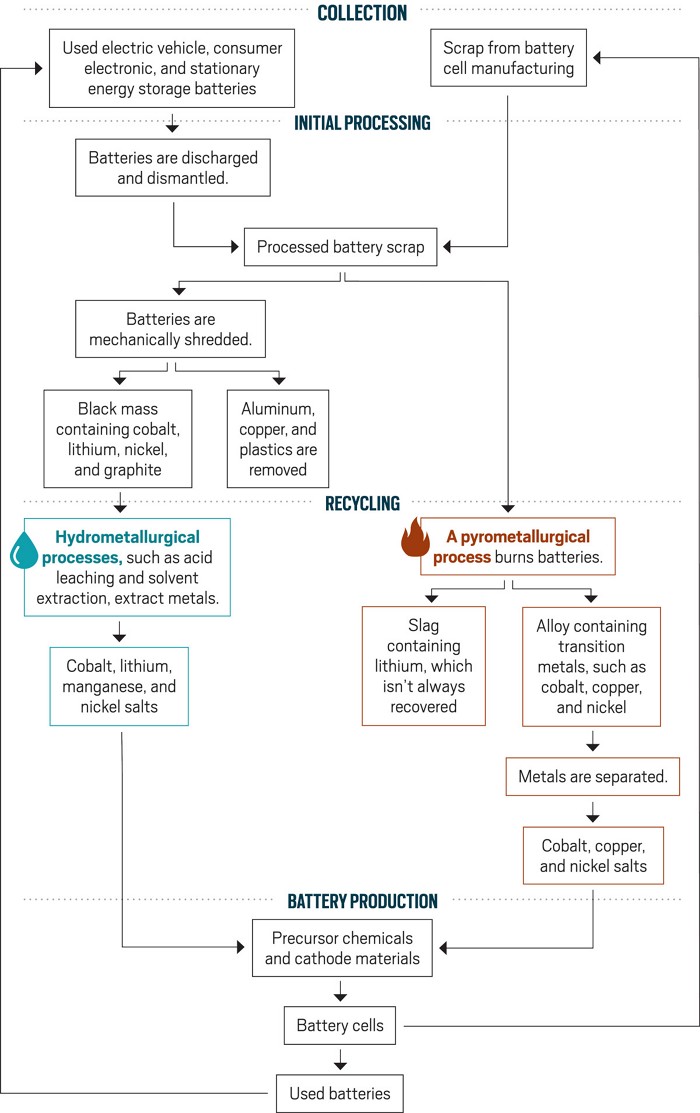
Source: Battery University
A typical lithium-ion battery recycling route may include several stages:
- Collection and sorting by battery type, format, and condition.
- Electrical discharge or safe preparation before mechanical processing, depending on the process design.
- Disassembly of packs or modules where practical, especially for larger battery systems.
- Shredding or crushing to separate mixed battery fractions.
- Black-mass production, in which a powdery mixture contains valuable electrode materials such as lithium, nickel, manganese, cobalt, and graphite.
- Material recovery, often using hydrometallurgical processes, pyrometallurgical processes, or a combination of both.
Hydrometallurgical processing uses aqueous chemistry to dissolve and separate target metals. Pyrometallurgical processing uses high-temperature treatment to concentrate certain metals into recoverable fractions. Mechanical pretreatment can also recover aluminum, copper, plastics, steel, and other pack or cell components before deeper chemical processing.
The exact recycling route depends on battery chemistry, pack design, economics, safety requirements, and the quality needed for the recovered output. Some recovered materials may be refined for new battery production, while others may enter different industrial streams. Graphite recovery is also an area of interest, although purification and reuse requirements can be demanding.
Recycling should be viewed as part of the broader battery material system. It can reduce waste, recover valuable elements, and provide an additional source of supply as more batteries reach end of life. At the same time, recycling volumes depend on the number of used batteries available, the design of those batteries, and the ability to process mixed chemistries efficiently.
From an engineering perspective, recycling reinforces the same principle seen inside the cell: materials matter most when they are correctly identified, separated, purified, and recombined. Raw materials from the ground and recovered materials from used batteries both require controlled processing before they can become reliable battery components.
References
- BU-311: Battery Raw Materials. (n.d.). http://www.batteryuniversity.com/article/bu-311-battery-raw-materials
- Noble metal | Definition, List, Properties, Examples, Types, Gold, Platinum, & Facts | Britannica. (n.d.). https://www.britannica.com/science/noble-metal
- Battery Raw Materials - Where from and Where to?. (n.d.). https://pmc.ncbi.nlm.nih.gov/articles/PMC8390110
- How to Polish Glassy Carbon, Gold & Platinum Electrodes. (n.d.). https://www.sciencegears.com.au/blogs/how-to-polish-and-maintain-glassy-carbon-gold-and-platinum-electrodes
- Formation and Growth of Oxide Layers at Platinum and Gold .... (n.d.). https://pubs.acs.org/doi/10.1021/ac101728a
- Formation and growth of oxide layers at platinum and gold .... (n.d.). https://pubmed.ncbi.nlm.nih.gov/20687588
- Noble metal - Wikipedia. (n.d.). https://en.wikipedia.org/wiki/Noble_metal
- A Comparative Study on Gold and Platinum Dissolution in .... (n.d.). https://iopscience.iop.org/article/10.1149/2.0881412jes
- Noble Metals: Definition, Properties, Use, and Types | Xometry. (n.d.). https://www.xometry.com/resources/materials/noble-metals
- What are noble metals with 2 examples.. (n.d.). https://www.facebook.com/groups/kohatianchemist/posts/6003293509685823