Battery recycling is often discussed as if all batteries form one waste stream, but the business reality is strongly chemistry-dependent. A lead-acid starter battery, a nickel-cadmium tool pack, an electric-vehicle lithium-ion module, and an alkaline AA cell contain different materials, create different hazards, and require different collection and processing systems.
The economics are just as uneven. Some batteries contain dense, high-value metals that are already supported by mature collection channels. Others are produced in very high volume but contain materials whose recovered value may not pay for transportation, sorting, and processing. Regulation also changes the calculation: a battery may be recycled because it is hazardous or strategically important, even when the immediate material recovery margin is weak.
As a business, battery recycling sits between waste management, metallurgy, environmental compliance, and critical-mineral supply. The most viable operations combine reliable feedstock, correct chemistry sorting, safe handling, high process yield, and a market for recovered material. The following sections compare the major chemistries and explain why the best technical recycling option is not always the most profitable one.
Lead-Acid Batteries: The Most Established Recycling Business
Lead-acid batteries remain the benchmark for battery recycling because the product is heavy, material-rich, easy to identify, and supported by decades of collection infrastructure. Automotive starting-lighting-ignition batteries, industrial traction batteries, and backup-power batteries are commonly returned through retailers, service shops, distributors, scrap channels, and industrial users. That closed-loop habit is one reason lead-acid recycling is much more mature than most other battery recycling sectors.
The core business advantage is simple: a lead-acid battery contains a large fraction of recoverable lead, and lead is dense. Battery University notes that roughly 70% of a lead-acid battery’s weight is lead-containing material. Weight matters because recycling revenue is closely tied to recoverable mass per unit handled. A pallet of spent lead-acid batteries contains far more saleable metal than a similar volume of mixed consumer alkaline cells or small lithium-ion packs.
A typical lead-acid recycling route includes:
- Collection and transport to an approved recycler.
- Battery breaking or crushing in controlled equipment.
- Separation of lead metal, lead paste, plastic cases, and electrolyte.
- Smelting and refining of lead fractions.
- Reuse of lead and polypropylene in new products, including new batteries.
This maturity does not make the process benign. Lead is toxic, persistent, and harmful to human health, especially for children and workers exposed through dust, fumes, or contaminated soil. Poorly controlled informal recycling can release lead during battery breaking, open burning, crude smelting, or acid dumping. In such operations, the apparent profit comes partly from avoiding the controls that make responsible recycling safe.
Regulated lead recycling requires containment, worker protection, emissions control, wastewater and acid management, residue handling, and monitoring. In the United States, EPA hazardous-waste and air-emissions frameworks apply to lead handling and recycling operations, while spent lead-acid batteries may be managed under specific reclamation or universal-waste provisions when handled according to the rules. Many jurisdictions also use deposit systems, retailer take-back, or extended producer responsibility to keep lead-acid batteries out of municipal waste.
For business analysis, lead-acid recycling is the clearest example of a chemistry where environmental need and material value align. The main risks are not a lack of recoverable value, but unsafe operations, poor compliance, price volatility, and competition for feedstock.
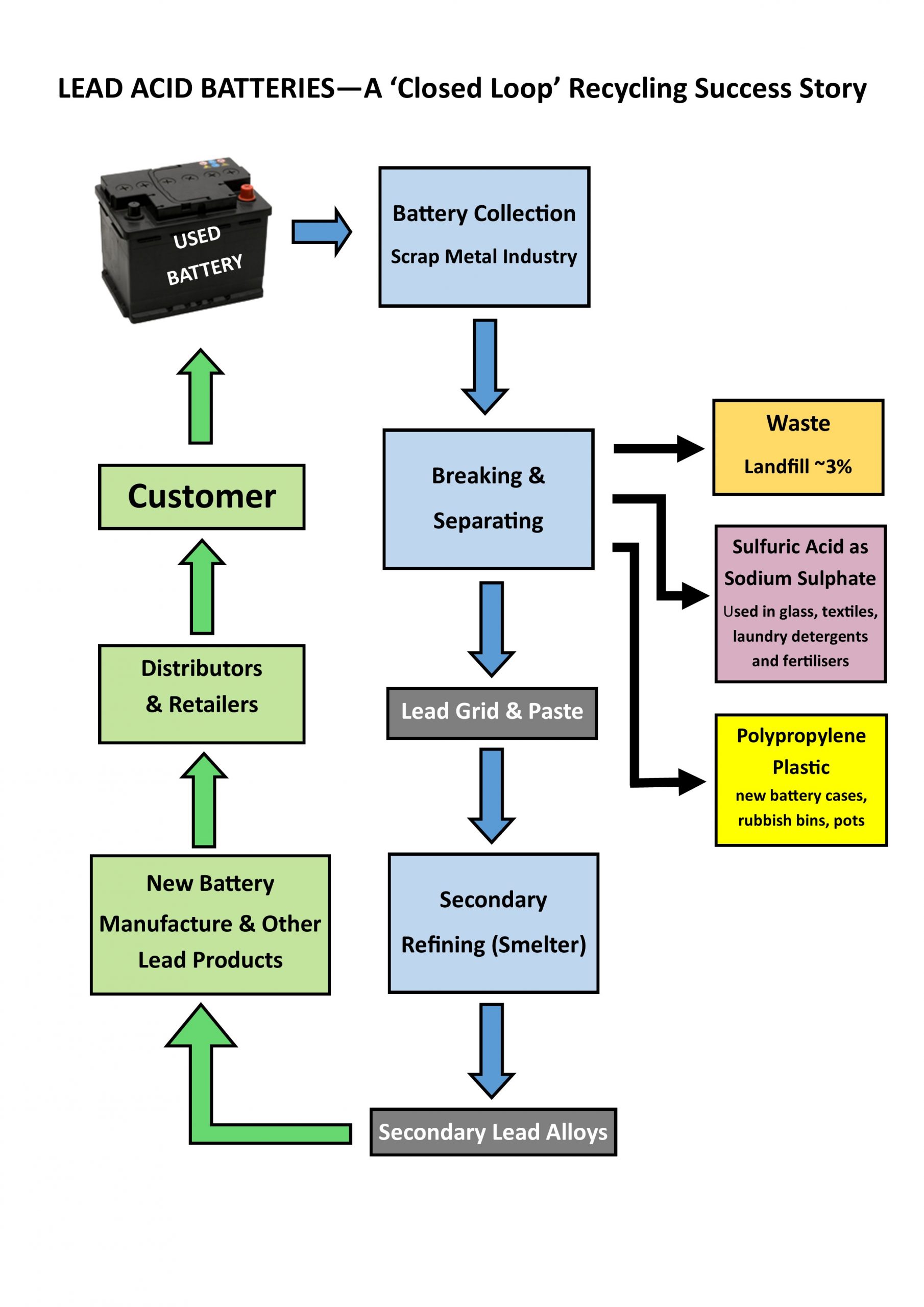
Source: Battery University

Nickel-Based Batteries: Recoverable Metals With Mixed Economics
Nickel-based battery recycling covers two important but different chemistries: nickel-cadmium and nickel-metal-hydride. Both contain recoverable nickel, but their business cases differ because cadmium toxicity, battery use patterns, collection rates, and market demand are not the same.
Nickel-cadmium batteries were widely used in power tools, emergency lighting, aviation, industrial equipment, and earlier portable electronics. Their recycling importance is driven not only by nickel recovery but also by cadmium. Cadmium is toxic and subject to strict controls in many regions. Even when cadmium recovery is not highly profitable, regulation and environmental protection make NiCd collection and recycling important. A recycler must prevent cadmium exposure during handling and processing and must manage residues under applicable hazardous-waste rules.
Nickel-metal-hydride batteries avoid cadmium and became common in hybrid vehicles, consumer cells, and some industrial applications. They contain nickel and rare-earth-bearing metal hydride alloys. Large-format hybrid-vehicle NiMH packs can be attractive because they are identifiable, relatively concentrated, and collected through automotive channels. Small consumer NiMH cells are harder: they are dispersed, mixed with other chemistries, and costly to collect per unit of recovered material.
The economics of nickel-based recycling depend on several variables:
- Nickel price and demand, especially from stainless steel and battery supply chains.
- Cadmium handling cost for NiCd, including compliance and worker protection.
- Collection volume, because small scattered cells are expensive to aggregate.
- Sorting accuracy, since mixed battery streams reduce process efficiency and increase safety risk.
- Format, because large industrial or vehicle packs are easier to trace than loose household cells.
Compared with lithium-ion recycling, nickel-based recycling can be less complex in pack electronics and chemistry diversity, but it may also face weaker growth in some consumer segments. Lithium-ion dominates modern portable electronics and electric vehicles, so future feedstock growth is more strongly tied to lithium-ion. However, nickel-rich lithium-ion cathodes also compete for nickel recovery attention, and recyclers may prioritize streams with higher cobalt and nickel value.
Nickel-based batteries therefore sit in the middle ground. They contain recoverable metals and can justify recycling, especially where regulation requires it or where large packs are available. But they do not have the universally strong business position of lead-acid batteries, and their profitability can weaken when collection is fragmented or metal prices fall.
Lithium-Ion Batteries: Fast-Growing Demand, Complex Recycling Economics
Lithium-ion batteries are the fastest-growing focus for battery recycling because they power electric vehicles, stationary energy storage, power tools, phones, laptops, and many industrial systems. They also contain critical minerals needed for clean-energy supply chains. The business opportunity is large, but the technical and economic challenges are greater than for lead-acid batteries.
A lithium-ion battery is not one standard product. Packs vary by cell format, cathode chemistry, state of charge, mechanical design, electronics, adhesives, cooling hardware, and fire-protection features. Common cathode families include cobalt- and nickel-containing chemistries as well as lithium iron phosphate. These differences matter because the value of the recovered material can change sharply by chemistry. Cobalt- and nickel-rich cathodes generally offer stronger recovered-metal value than lower-value chemistries such as LFP, even though LFP is widely used and important to recycle for environmental and supply-chain reasons.
Lithium-ion recycling also has safety constraints. Damaged, swollen, misused, or improperly stored cells can short circuit, vent, ignite, or contribute to thermal runaway. Transport rules, state-of-charge management, packaging, fire detection, and trained handling are therefore central to the business model. A recycler is not only buying feedstock; it is accepting a safety and logistics problem.
Conventional lithium-ion recycling routes include pyrometallurgy and hydrometallurgy. Mechanical preprocessing is often used before either route to discharge, dismantle, shred, separate, and concentrate valuable fractions.
| Route | Main idea | Strengths | Limitations |
|---|---|---|---|
| Pyrometallurgy | High-temperature smelting recovers metal alloy fractions | Tolerates mixed feedstock better than some routes and can destroy organics | Energy-intensive; lithium, aluminum, and some other materials may require further recovery steps or may be lost depending on process design |
| Hydrometallurgy | Leaching and chemical separation recover metals from processed material | Can recover cobalt, nickel, manganese, lithium, and other metals with high selectivity when optimized | Requires reagents, wastewater control, careful chemistry management, and good feed preparation |
| Direct recycling | Preserves and refurbishes active cathode material for reuse | May reduce energy use and retain more cathode value | Requires cleaner sorting by chemistry and is still developing commercially |
The EPA describes direct recycling, also called cathode-to-cathode recycling, as an approach being tested at smaller scale to preserve the engineered cathode structure rather than breaking it fully down into elemental constituents. The promise is important: the cathode is one of the most valuable and energy-intensive parts of a lithium-ion cell, so preserving its structure could reduce processing energy and manufacturing steps. Recent technical reviews also describe direct recycling as promising but not yet broadly mature at industrial scale.
The commercial challenge is that direct recycling needs a more orderly feedstock than many recyclers receive today. Cathode powders must be identified, separated, cleaned, relithiated or otherwise regenerated, and qualified for performance and safety. A mixed stream of unknown lithium-ion packs is much harder to process directly than a controlled stream of manufacturing scrap or known end-of-life packs from a single application.
For lithium-ion recycling, the strongest near-term business cases are often linked to manufacturing scrap, cobalt- and nickel-rich batteries, large EV packs, and regions with strong critical-mineral or producer-responsibility policies. LFP recycling, small consumer battery collection, and highly mixed pack streams may still be essential, but they require scale, automation, policy support, or improved technology to become consistently profitable.
Alkaline Batteries: High Volume but Low Material Value
Alkaline batteries are produced and discarded in very large numbers because they remain common in remote controls, toys, flashlights, instruments, and other low- to moderate-drain devices. Their recycling challenge is not lack of volume; it is low recovered value per cell.
A typical alkaline cell contains zinc, manganese compounds, steel, electrolyte, paper or polymer separators, and other minor components. These materials can be recovered technically, and some recycling processes produce zinc- and manganese-bearing products, steel scrap, or material for industrial uses. The problem is that alkaline batteries generally do not contain precious metals or high-value battery cathode metals comparable to cobalt or nickel-rich lithium-ion cells.
Collection cost is a major barrier. Household alkaline cells are small, widely dispersed, and often mixed with other battery chemistries. Sorting and transport can cost more than the value of the recovered zinc, manganese, and steel. This is why alkaline battery recycling is frequently policy-driven rather than purely market-driven.
Regional rules differ. In some jurisdictions, alkaline batteries are accepted in municipal battery recycling programs or included in producer-responsibility schemes. In others, modern alkaline cells may be allowed in household waste, while rechargeable or hazardous chemistries must be separated. Local rules matter because the same cell can be treated differently depending on landfill policy, collection infrastructure, and available recycling plants.
Recent recycling development has focused on improving mechanical separation, zinc and manganese recovery, and end markets for recovered material. These projects show that alkaline recycling is technically possible and can be environmentally useful. They do not prove that alkaline recycling is broadly profitable everywhere. A viable business usually needs dense collection, automated sorting, low logistics cost, supportive regulation, and stable buyers for the recovered fractions.
Battery Production, Recycling Costs, and Environmental Tradeoffs
Battery recycling economics should not be judged only by whether a process can recover material. A complete comparison must include production complexity, disposal risk, transport, processing energy, recovered-material value, and environmental benefit.
| Chemistry | Business recycling position | Main recoverable value | Main challenge |
|---|---|---|---|
| Lead-acid | Mature and usually strongest | Lead and plastic | Lead toxicity and strict pollution control |
| NiCd | Important but regulation-driven | Nickel and cadmium | Cadmium toxicity and declining use in many applications |
| NiMH | Viable in concentrated streams | Nickel and alloy metals | Collection and market variability |
| Lithium-ion | Rapidly growing but complex | Cobalt, nickel, lithium, copper, aluminum, cathode material | Chemistry variation, fire risk, pack design, and process cost |
| Alkaline | High volume but weak value | Zinc, manganese, steel | Low value per cell and dispersed collection |
Older comparisons sometimes present fixed carbon dioxide values for producing or recycling each battery type. Such figures should be used carefully. Emissions vary widely with battery chemistry, plant energy source, mining and refining assumptions, cell design, transport distance, recycling route, yield, and allocation method. A hydrometallurgical process using low-carbon electricity in one region cannot be assumed to have the same footprint as a high-temperature process powered by fossil energy elsewhere.
The same caution applies to cost figures. Recycling cost is not a universal number per battery. It depends on:
- Feedstock availability and consistency.
- Chemistry mix and contamination.
- Manual versus automated disassembly.
- Fire prevention and transport requirements.
- Reagent, energy, labor, and permitting costs.
- Process yield and product purity.
- Market prices for lead, nickel, cobalt, lithium, manganese, zinc, steel, copper, and plastics.
- Local regulation, landfill restrictions, and producer responsibility.
Environmental value and financial return can diverge. Recycling NiCd batteries may be necessary because cadmium must be controlled, even if the immediate metal value is modest. Recycling LFP lithium-ion batteries may support lithium recovery, waste reduction, and supply-chain resilience, even when the absence of cobalt and nickel weakens short-term revenue. Alkaline recycling may reduce landfill burden and recover useful materials, but still require program funding.
For an engineering business plan, the first question is not simply, Can this battery be recycled? It is: Can this specific stream be collected safely, identified accurately, processed at scale, and sold into a reliable recovered-material market while meeting environmental rules?
Outlook for Battery Recycling as a Business
Lead-acid batteries remain the clearest business case because they combine high recoverable mass, established collection, recognizable design, and strong end markets for recycled lead. The sector is mature, but responsible operation depends on strict control of lead emissions, worker exposure, wastewater, slag, and contaminated residues.
Lithium-ion recycling is the most dynamic growth area. Electric vehicles, stationary storage, consumer electronics, and clean-energy policies are increasing future end-of-life volumes. Critical-mineral strategies also give lithium-ion recycling strategic value beyond near-term scrap revenue. However, the industry still has to solve practical problems in pack handling, safe logistics, automated disassembly, chemistry identification, and recovery from lower-value chemistries.
Nickel-based batteries will continue to require recycling where they remain in service, especially NiCd because of cadmium toxicity and NiMH where large hybrid or industrial packs are available. Alkaline batteries will remain a high-volume but low-margin stream, with success depending heavily on collection design, regulation, and local markets for zinc- and manganese-bearing outputs.
The most important future improvements are likely to include:
- Better consumer and industrial collection systems.
- More accurate sorting by chemistry and format.
- Battery designs that reduce adhesives, simplify disassembly, and improve labeling.
- Safer transport and storage procedures for damaged lithium-ion batteries.
- Improved hydrometallurgical selectivity and lower reagent burden.
- Direct lithium-ion recycling for suitable, well-characterized feedstocks.
- Automation and robotics for pack dismantling.
- Producer responsibility and recycled-content policies that stabilize demand.
Battery recycling is essential for environmental protection and resource recovery, but it is not automatically profitable. Profitability varies sharply by chemistry, process scale, technology, regulation, logistics, and recovered-material prices. The strongest businesses will be those that treat recycling not as generic waste disposal, but as a controlled materials-recovery system designed around the chemistry of the battery stream.
References
- BU-705a: Battery Recycling as a Business. (n.d.). http://www.batteryuniversity.com/article/bu-705a-battery-recycling-as-a-business
- A Systematic Review of Battery Recycling Technologies: Advances, Challenges, and Future Prospects. (n.d.). https://www.mdpi.com/1996-1073/16/18/6571
- Battery University | BU-705: How to Recycle Batteries. (n.d.). https://www.batteryuniversity.com/article/bu-705-how-to-recycle-batteries
- Li-ion Battery Recycling Market 2025-2045: Markets, Forecasts, Technologies, and Players: IDTechEx. (n.d.). https://www.idtechex.com/en/research-report/li-ion-battery-recycling-market/1090
- Lithium-Ion Battery Recycling. (n.d.). https://www.epa.gov/hw/lithium-ion-battery-recycling
- Recent Advancements in Artificial Intelligence in Battery Recycling. (n.d.). https://www.mdpi.com/2313-0105/10/12/440
- Recycling technologies, policies, prospects, and challenges for spent batteries. (n.d.). https://pmc.ncbi.nlm.nih.gov/articles/PMC10589888
- Current and Future State of the European Li-ion Battery .... (n.d.). https://www.diva-portal.org/smash/get/diva2:1705600/FULLTEXT01.pdf
- How Advanced Battery Recycling Technology Works - Green Li-ion. (n.d.). https://www.greenli-ion.com/post/advanced-battery-recycling-technology-process
- Lithium-ion battery recycling: a perspective on key challenges and opportunities | npj Materials Sustainability. (n.d.). https://www.nature.com/articles/s44296-025-00083-7