A battery separator is a thin component, but it has a large influence on cell safety and performance. It sits between the positive and negative electrodes, prevents them from touching, and still allows the electrochemical reaction to proceed through ionic movement in the electrolyte. If the separator fails mechanically, thermally, or chemically, a cell can develop high self-discharge, excessive internal leakage current, or a direct internal short circuit.
In lithium-ion cells, the separator also has a special safety role. Many commercial Li-ion separators are designed so that, at elevated temperature, their pores close and ion transport is reduced or stopped. This shutdown behavior can slow or interrupt current flow inside an overheating cell. It is not a complete protection system by itself, but it is an important part of cell-level safety engineering.
What a Battery Separator Does
A conventional electrochemical cell contains four essential functional elements:
- Cathode, the positive electrode during discharge
- Anode, the negative electrode during discharge
- Electrolyte, the ion-conducting medium
- Separator, the porous insulating barrier between the two electrodes
The separator’s first job is physical separation. The cathode and anode must be close enough for efficient ion transport, but they must not make direct electronic contact. If the electrodes touch, the cell can short internally. Depending on chemistry, state of charge, cell size, and fault severity, an internal short may cause rapid self-heating, gas generation, venting, fire, or permanent cell damage.
The separator’s second job is controlled ionic access. The separator is porous and is wetted by electrolyte. During discharge, ions move through the electrolyte-filled pores from one electrode region to the other as the cell reaction proceeds. During charge, the direction of the relevant ion movement reverses. In a lithium-ion cell, lithium ions move through the electrolyte and separator between the intercalation host materials in the two electrodes.
Electrons should not pass through the separator. They are intended to move through the external circuit, where they can do useful work or be controlled by charging electronics. For this reason, the separator must be an electrical insulator while remaining permeable to ions. This combination—electrically insulating but ionically permeable—is the central design challenge of separator engineering.
Separator quality affects several practical cell characteristics:
- Internal resistance: Poor electrolyte wetting, low porosity, blocked pores, or nonuniform pore distribution can increase ionic resistance.
- Self-discharge and leakage current: Defects, contamination, metallic particles, or dendrite penetration can create local leakage paths or soft shorts.
- Cycle reliability: The separator must tolerate electrode swelling, compression, winding or stacking stresses, and repeated electrochemical cycling.
- Safety margin: Dimensional stability, puncture resistance, and thermal behavior help determine whether the separator continues to isolate the electrodes under abuse conditions.
In normal operation, the separator is passive in the sense that it does not provide energy storage capacity like the electrodes. However, it is not optional and it is not merely packaging. A cell with excellent electrode materials but a weak or poorly matched separator can be unsafe, inefficient, or short-lived.
Common Separator Materials and Design Requirements
Separator materials depend strongly on battery chemistry. The separator used in a lead-acid battery is not the same as the separator used in a lithium-ion pouch cell, and flow batteries use ion-selective membranes or separators suited to liquid electrolyte systems. The shared requirement is to keep electrochemically active regions separated while allowing ionic charge transfer.
For many lithium-ion cells, the most common separator base materials are microporous polyolefin polymers, especially:
- Polyethylene (PE)
- Polypropylene (PP)
- Multilayer PP/PE/PP structures
These materials are widely used because they can be manufactured as thin, porous membranes with useful mechanical properties and suitable chemical stability in common Li-ion electrolytes. Their pores hold electrolyte and create pathways for lithium-ion movement, while the polymer framework remains electronically insulating.
Important separator design properties include the following.
Porosity and pore consistency. Porosity must be high enough to support ion transport, but not so high that mechanical strength is lost. Pore size distribution also matters. Large defects or highly nonuniform pores can create weak points, uneven current distribution, or greater vulnerability to penetration.
Electrolyte wettability. The separator must absorb and retain electrolyte well enough to provide continuous ionic pathways. Poor wetting can raise impedance, reduce rate capability, and contribute to uneven cell behavior. Some separators receive surface treatments or coatings to improve wetting with specific electrolyte formulations.
Mechanical strength. Separators must resist tearing, puncture, and deformation during cell assembly and service. Cylindrical and prismatic cells may impose winding and compression stresses, while pouch cells may experience stack pressure and swelling. Mechanical weakness can become a safety issue if it permits electrode contact.
Dimensional stability. A separator should not shrink excessively in the machine or transverse direction during thermal exposure or long-term operation. Shrinkage can uncover electrode areas, distort the electrode stack, or increase the risk of internal short circuits.
Thinness. A thinner separator can reduce ionic path length and improve volumetric energy density, but making the separator too thin can reduce puncture resistance and thermal margin. Separator thickness is therefore a trade-off among energy density, impedance, manufacturability, and safety.
Thermal stability. The separator must remain functional over the cell’s intended temperature range and should behave predictably during abnormal heating. In lithium-ion cells, this includes both shutdown behavior and the ability to maintain physical separation after shutdown.
Functional separators extend these basic requirements. Ceramic-coated separators, for example, use inorganic particles or thermally stable layers on a polymer separator to reduce shrinkage and improve high-temperature dimensional stability. Such coatings can help the separator preserve electrode separation at temperatures where an uncoated polymer film may deform more severely. Other functional separator designs may aim to improve electrolyte affinity, suppress dendrite growth in advanced metal-anode systems, or increase oxidation resistance.
These improvements do not make the separator an independent safety device in the way a fuse, vent, current interrupt device, battery management system, or pack-level protection circuit is. Instead, they improve one of the cell’s internal safety barriers. Separator selection must be evaluated together with electrode chemistry, electrolyte formulation, cell format, manufacturing cleanliness, and intended abuse tolerance.
How Li-ion Separators Act as a Thermal Safety Fuse
Lithium-ion separators can provide a shutdown function at elevated temperature. In a typical polyolefin separator, heat softens or melts part of the polymer structure. As the polymer changes shape, the pores collapse or close. Once the pores close, lithium-ion transport through the separator is strongly reduced. Because the internal electrochemical current path depends on ionic transport through the electrolyte-filled pores, pore closure can help stop or reduce current flow inside the cell.
This is why Li-ion separators are often described as acting like a thermal safety fuse. The comparison is useful, but it should be understood carefully. A conventional electrical fuse opens an external circuit by melting a conductor. A separator shutdown mechanism instead blocks internal ionic conduction by closing separator pores. It is a materials-based thermal response, not a resettable electronic control system.
For polyethylene separators, shutdown is commonly associated with temperatures around 130°C, with some sources citing PE shutdown behavior near 130–135°C depending on separator construction and test method. At this temperature range, the PE layer can soften or melt enough to close pores and interrupt ion transport. Battery University’s reference description gives 130°C for PE separator melting and pore closure.
Polypropylene has a higher melting point than polyethylene. Common separator discussions cite PP melting behavior around 155–165°C, again depending on material grade, structure, and measurement method. This difference in thermal behavior is used in multilayer shutdown separators.
Source: Battery University

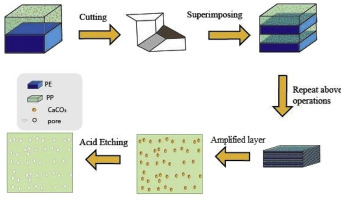
A common design is the PP/PE/PP trilayer separator. In this structure, a polyethylene layer is sandwiched between two polypropylene layers:
- The PE middle layer provides the lower-temperature shutdown response.
- The PP outer layers remain structurally intact to a higher temperature than PE.
- When the cell overheats, the PE layer closes its pores first, reducing ion transport.
- The PP layers help maintain mechanical separation for longer, reducing the likelihood that the electrodes will contact immediately after PE shutdown.
This design uses the different thermal properties of PE and PP to provide staged behavior. The PE layer responds earlier, while the PP layers provide added high-temperature mechanical support compared with a single PE separator. The goal is to stop or slow the internal electrochemical process before the separator loses dimensional integrity.
Ceramic-coated separators and other thermally stable separator designs address a related problem: shrinkage and loss of mechanical integrity at elevated temperature. A separator can shut down ion flow yet still become unsafe if it shrinks, ruptures, or exposes electrode edges. Ceramic coatings can improve heat resistance and help preserve the separator’s shape, giving the cell more tolerance against internal electrode contact during abnormal heating.
However, separator shutdown is not a guarantee against thermal runaway. Several limitations are important:
- If heating continues after shutdown, other cell components can decompose and generate additional heat.
- If the separator shrinks or ruptures, the electrodes may still contact each other.
- If metallic contamination, lithium plating, dendrite growth, crush damage, or manufacturing defects create a local short, shutdown may not stop the fault quickly enough.
- If the temperature rises rapidly beyond the separator’s mechanical stability range, the separator can fail before it can provide useful protection.
Thermal runaway in lithium-ion cells is a chain of heat-generating reactions. Separator shutdown may slow the chain or reduce current contribution, but it cannot remove heat from the cell, repair internal damage, or replace external protection systems. Good Li-ion safety design therefore combines separator behavior with stable electrode materials, suitable electrolyte formulation, controlled manufacturing, current interruption devices where applicable, vents, battery management electronics, pack spacing, thermal design, and abuse testing.
Separator shutdown also matters in the context of transportation safety. Lithium cells and batteries shipped commercially are subject to UN 38.3 transport testing under the UN Manual of Tests and Criteria. These tests are intended to screen batteries for hazards that may occur during transport by air, road, rail, or sea. The commonly referenced UN 38.3 sequence includes:
- Altitude simulation
- Thermal cycling
- Vibration
- Shock
- External short circuit
- Impact or crush, depending on cell type
- Overcharge for rechargeable batteries
- Forced discharge where applicable
Passing these tests depends on the whole cell and battery design, not only on the separator. Still, the separator’s ability to maintain electrode isolation and, in Li-ion cells, to shut down ion transport under excessive heat contributes to the cell’s overall abuse tolerance. In an external short-circuit test, for example, current and heat generation can rise quickly. Internal shutdown behavior may help limit further reaction, but the battery must still avoid prohibited outcomes such as fire, rupture, or dangerous disassembly under the applicable test conditions.
The engineering lesson is that the separator is both a performance component and a safety component. It must be thin enough and porous enough for efficient ion movement, strong enough to prevent electrode contact, chemically compatible with the electrolyte, stable over the operating range, and predictable under abnormal heat. In lithium-ion cells, the best separator is not simply the thinnest membrane or the one with the highest porosity; it is the separator whose electrical insulation, ionic transport, mechanical integrity, wettability, and thermal response are properly matched to the cell design.
References
- Battery University | BU-306: What is the Function of the Separator?. (n.d.). http://www.batteryuniversity.com/article/bu-306-what-is-the-function-of-the-separator
- Separator Testing for Lithium-Ion Batteries - TA Instruments. (n.d.). https://www.tainstruments.com/applications/battery-material-testing/separator
- UN/DOT 38.3 Transportation Testing - Lithium Batteries | TÜV SÜD. (n.d.). https://www.tuvsud.com/en-us/industries/automotive/automotive-testing-solutions/un-dot-38-3
- A Review of Functional Separators for Lithium Metal Battery Applications. (n.d.). https://pmc.ncbi.nlm.nih.gov/articles/PMC7603034
- Li-ion batteries, Part 4: separators - Battery Power Tips. (n.d.). https://www.batterypowertips.com/li-ion-batteries-part-4-separators-faq
- The Basics of UN 38.3 and the Requirements for the Transportation of Lithium Batteries. (n.d.). https://www.youtube.com/watch?v=CP71HLVP3I0
- About Battery Separators | Battery Council International. (n.d.). https://batterycouncil.org/battery-facts-and-applications/about-battery-separators
- UN 38.3 Lithium Battery Transport Safety Test Standard Guide -KOMEG. (n.d.). https://www.komegtek.com/knowledgeblog/un-38-3-lithium-battery-transport-safety-test-standard-guide
- UN 38.3 Testing for Lithium Batteries. (n.d.). https://www.intertek.com/batteries/un-38-3-testing
- UN38.3-Lithium battery UN transport test - IMV CORPORATION. (n.d.). https://we-are-imv.com/en/business/cases/item/21035