A lithium-ion battery pack is more than a group of cells connected together. A usable pack must meet a voltage target, deliver the required runtime, survive its load profile, fit the product envelope, and remain safe during charging, operation, storage, and transport. These requirements influence the cell format, series and parallel configuration, interconnect design, protection electronics, enclosure, thermal path, and certification plan.
Pack design also has a practical business dimension. A cell that looks attractive on a datasheet may be difficult to source long term, may require a different charger profile, or may force a new round of safety and transport testing if it replaces an older cell in an approved pack. For engineering teams, the safest approach is to treat electrical design, mechanical design, supplier qualification, and regulatory planning as one integrated process rather than as separate tasks.
Start with pack requirements and cell format choices
The starting point for a lithium-ion pack is not the cell model; it is the application requirement. The designer first defines the operating voltage range, required energy, peak and continuous current, expected runtime, allowable recharge time, environmental limits, size constraints, weight target, and mechanical interface to the host product. Only then does it make sense to select a cell format and decide how many cells must be placed in series and parallel.
A pack voltage is mainly determined by the number of cells in series. Runtime and current capability are influenced by cell capacity, parallel cell count, allowable discharge current, temperature, aging, and the cutoff limits enforced by the protection circuit or battery management system. The enclosure must then provide mechanical support, insulation, venting strategy where applicable, strain relief, connector retention, and protection against foreseeable abuse.
Important early design questions include:
- What is the normal operating current, and what are the short-duration peak currents?
- Will the pack be used continuously, intermittently, or in high-pulse service?
- What are the minimum and maximum charging and discharging temperatures?
- Is the product handheld, wearable, vehicle-mounted, stationary, or exposed to vibration?
- Is low thickness more important than cell replacement cost or sourcing flexibility?
- Does the product require fuel gauging, cell balancing, communication, authentication, or fault logging?
Cell format has a strong effect on the mechanical and manufacturing approach. Slim consumer products often favor prismatic or pouch cells because they can use the available volume efficiently and support thin product profiles. Phones, tablets, and compact portable electronics commonly benefit from a flat cell geometry that conforms to the product shape.
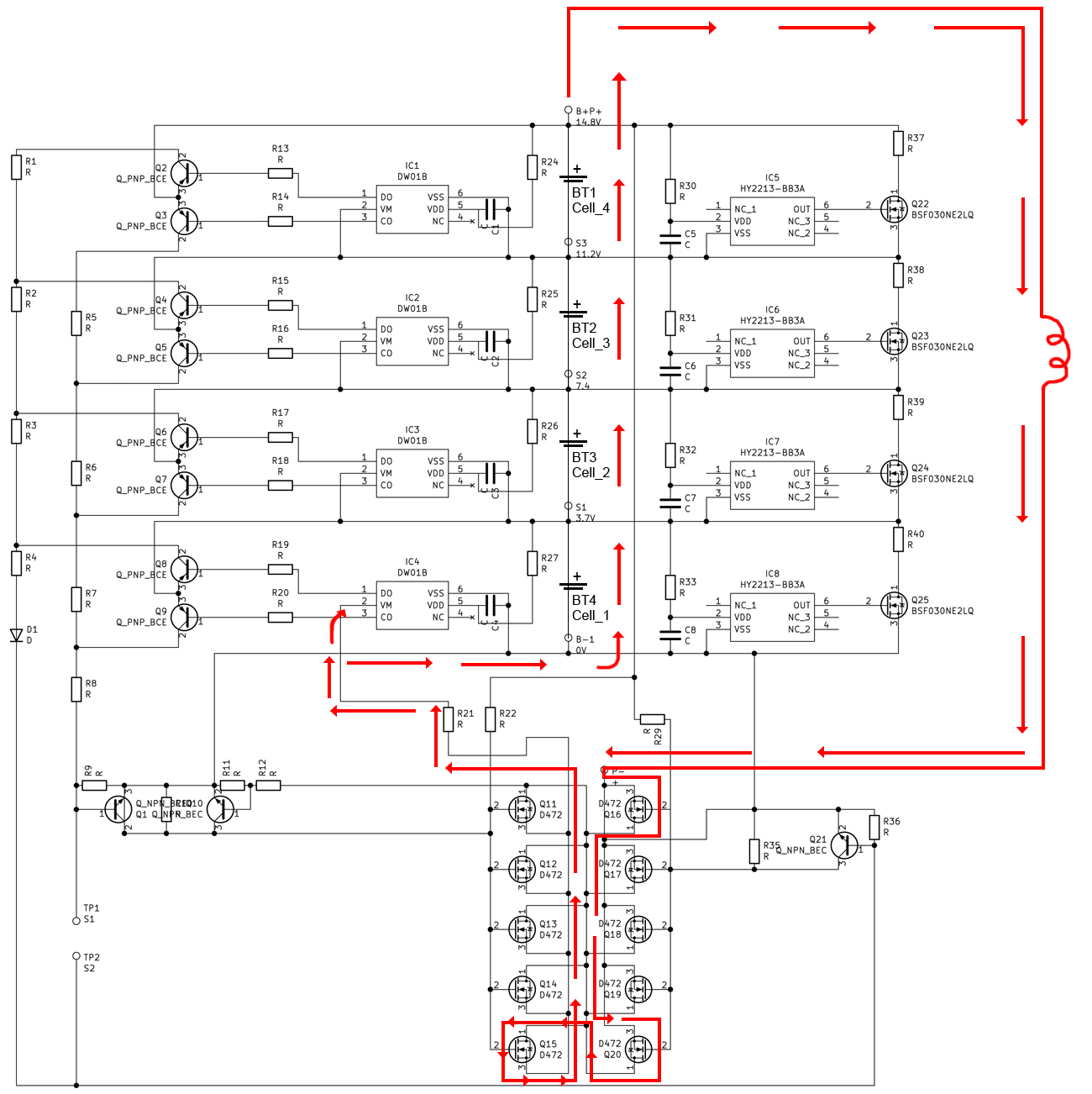
Cylindrical cells, historically including the 18650 format, have been widely used where cost, availability, manufacturing maturity, safety history, and durability are important. The 18650 cell became common in many packs because it offered a mature supply chain and a robust metal can format. Medical devices, power tools, e-bikes, and some electric-vehicle powertrains have commonly used cylindrical cells, although modern EV platforms may use larger cylindrical cells, prismatic cells, or pouch cells depending on energy density, pack integration, thermal management, manufacturing strategy, and service goals.
Source: Battery University
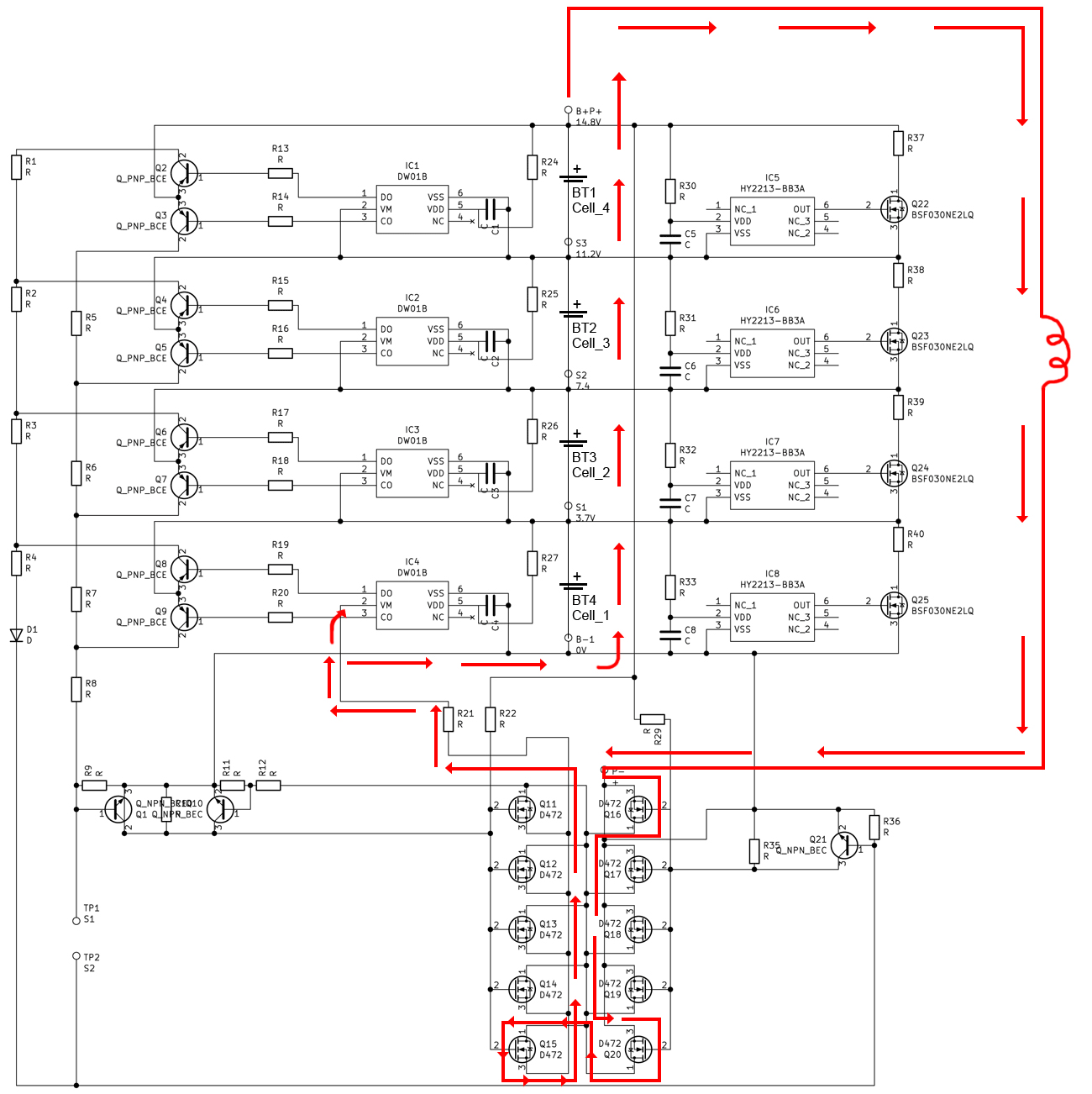
Each format has tradeoffs. Cylindrical cells are mechanically consistent and can be assembled into modular arrays, but they leave void space between cells and require many interconnects in high-energy packs. Pouch cells can provide high packaging efficiency and low thickness, but they require careful compression, swelling allowance, edge protection, and puncture protection. Prismatic cells reduce part count in some larger packs, but they still require robust mechanical support and thermal management.
The electrical configuration must be designed with realistic tolerances. Cells in parallel should be closely matched and connected with low-resistance, repeatable interconnects. Cells in series require monitoring to prevent one cell group from being overcharged or overdischarged relative to the others. Poor welds, undersized conductors, inadequate insulation, and uncontrolled heat paths can create pack-level failure modes even when the individual cells are reputable.
Protection electronics are central design elements, not accessories. Depending on the pack, the protection circuit or BMS may provide overcharge protection, overdischarge protection, overcurrent protection, short-circuit protection, temperature sensing, cell balancing, state-of-charge estimation, and communication with the host system or charger. Small packs may use a simple protection circuit, while multi-cell industrial, mobility, or vehicle packs often require a more capable BMS.
Thermal design also belongs at the beginning of the project. A cell that performs well on a bench can behave differently when surrounded by neighboring cells, foam pads, plastic walls, adhesive, or a sealed housing. Heat generated during high-current discharge or fast charging must be conducted away without creating local hot spots. Temperature sensors should be positioned where they can detect realistic worst-case conditions, not merely convenient locations.
The final pack is therefore a system: cells, interconnects, insulation, sensors, electronics, enclosure, charger, host product, and operating instructions. A safe design considers all of these elements together.
Safety approvals and transport certification
Lithium-ion pack approval is a significant part of product development. Reputable cell suppliers and customers commonly expect pack assemblers to use qualified processes, certified or evaluated designs, and suitable protection circuitry. The reason is straightforward: even a high-quality lithium-ion cell can become unsafe if it is charged beyond its voltage limit, discharged below its safe range, short-circuited, overheated, crushed, or connected into a poorly controlled pack.
A common mistake is assuming that certification of the cell automatically certifies the finished battery pack. It does not. Cell-level evaluation is important, but the finished pack introduces new risks: series and parallel connections, welds, fuses, wiring, connectors, protection electronics, firmware, enclosure materials, insulation spacing, labels, and the way the battery is installed in equipment. A change in cell model, layout, electronics, enclosure, capacity, or configuration can trigger new pack-level evaluation or retesting.
Approval cost and timing vary widely. The reference material notes that authorizing a lithium-ion battery pack for the commercial market and air transport can cost in the range of USD 10,000 to USD 20,000. Other industry certification examples show narrower ranges for specific tests, such as several thousand dollars for UN 38.3 transport testing, while UL, IEC, CB, CE, or other evaluations may have different sample counts, costs, and lead times. These figures should not be treated as universal prices. Actual cost depends on the standard, pack design, capacity, chemistry, sample availability, laboratory, geography, certification scope, and whether failures require redesign and retest.
Transport certification is especially important because lithium cells and lithium batteries are regulated dangerous goods for shipping. UN/DOT 38.3 is a key lithium-cell and lithium-battery transport safety test framework used internationally for shipment classification. It is associated with the United Nations Recommendations on the Transport of Dangerous Goods, Manual of Tests and Criteria, Part III, subsection 38.3. In practice, shipment also involves rules and documentation used by authorities and organizations such as DOT, IATA, and related dangerous-goods systems, especially for air transport.
UN 38.3 is not a performance approval and not a consumer endurance test. It evaluates whether cells or batteries can withstand defined transport-related abuse conditions without dangerous outcomes. Passing the tests does not prove long cycle life, high power capability, or suitability for every application. In some test descriptions, the battery only needs to avoid hazardous failure; it is not necessarily required to remain fully functional afterward.
Source: Battery University
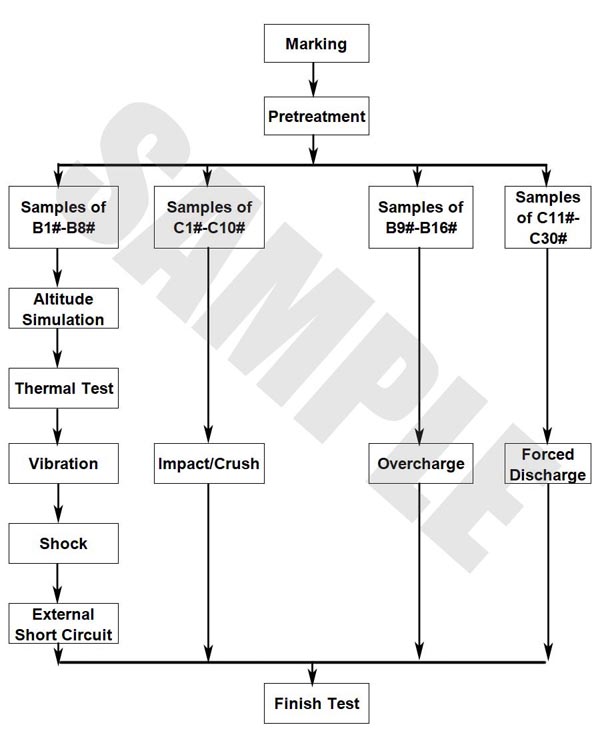
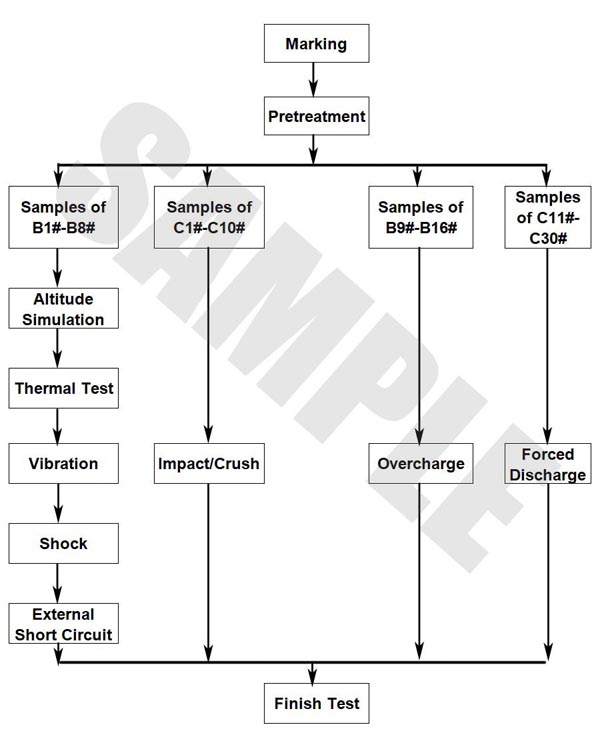
The UN 38.3 test family includes the following general test categories, with applicability depending on whether the item is a cell or battery and whether it is rechargeable or primary:
- Altitude simulation: exposes the cell or battery to low pressure representative of air transport conditions.
- Thermal test: subjects samples to temperature cycling to check integrity under rapid or extreme temperature changes.
- Vibration: simulates vibration conditions that may occur during transportation.
- Shock: simulates mechanical shocks that may occur during handling and transport.
- External short circuit: evaluates response to a short circuit applied at the external terminals.
- Impact or crush, where applicable: applies mechanical abuse to cells or certain battery configurations according to the test rules.
- Overcharge, where applicable: evaluates rechargeable batteries under an overcharge condition.
- Forced discharge, where applicable: evaluates cells under forced discharge conditions.
Sample counts, preconditioning, cycling requirements, documentation, and sequence rules have changed across editions and may differ with cell or pack type. Older descriptions may mention 50 cycles before testing for certain rechargeable packs, while current laboratory guidance may apply different cycling requirements depending on the current standard edition and product category. Designers should verify the applicable edition, sample requirements, state-of-charge requirements, and test-summary obligations with the selected laboratory before freezing the design.
Certification planning should begin before production tooling. If a supplier discontinues an older cell and offers a higher-capacity replacement, the replacement may not be a drop-in approval equivalent even when it has similar dimensions. A new cell may have different internal construction, protection behavior, energy content, maximum current, impedance, venting behavior, or thermal response. These differences can require engineering review and new testing.
Good pack-development practice includes:
- selecting cells from qualified suppliers with stable documentation;
- maintaining cell traceability and incoming inspection records;
- qualifying weld schedules, soldering processes where used, insulation materials, and assembly procedures;
- designing protection circuits for foreseeable charger, load, and fault conditions;
- reviewing creepage, clearance, insulation, and mechanical retention;
- budgeting for samples, lead time, test fixtures, labels, shipping documentation, and possible retest;
- controlling any design change after approval.
Commercial approval and transport approval should be treated as schedule-critical tasks. A pack that is electrically complete but not approved for shipment or sale may still block product launch.
Safe handling guidelines for lithium-ion packs
Lithium-ion packs should be handled as stored-energy devices with chemical and thermal hazards. A charged pack can deliver high current into a short circuit, and many lithium-ion cells contain flammable electrolyte. Abuse, manufacturing defects, contamination, charger faults, or physical damage can cause venting, ignition, or thermal runaway.
Safe handling begins with terminal protection. Never allow exposed terminals to contact conductive tools, loose hardware, jewelry, foil, metal benches, or other battery terminals. Even a brief short circuit can damage cells, melt conductors, trip protection devices, or initiate heating. Packs should be transported and stored with terminals insulated or connectors protected against accidental bridging.
Polarity must be controlled during assembly and testing. Reverse polarity can damage protection electronics, chargers, loads, and cell groups. When building or servicing test fixtures, use keyed connectors where possible, verify wiring before connection, and avoid temporary clip leads in high-current circuits unless they are properly rated and secured.
Do not crush, puncture, open, modify, or disassemble lithium-ion packs unless the work is being performed by trained personnel under controlled procedures. The pack may contain live cell groups even if the output connector reads zero because a protection circuit has opened. Cutting into an enclosure, prying cells apart, or removing insulation can create internal shorts. Pouch cells are especially vulnerable to puncture and edge damage, while cylindrical and prismatic cells can still become hazardous if their cans, vents, or terminals are damaged.
Charging requires the correct charger and charge profile. Lithium-ion cells are typically charged under controlled constant-current and constant-voltage methods matched to the cell chemistry and pack configuration. A charger intended for another chemistry or voltage can overcharge the pack. The pack should use its intended protection circuit or BMS, and the charger should be approved for that pack or product. Protection electronics are a last line of defense, not a substitute for a correct charger.
Overcharge, overdischarge, excessive current, and operation outside the specified temperature range are major hazards. Overcharge can drive cells beyond safe voltage limits. Overdischarge can damage cells and may make later charging unsafe. Excessive current can overheat cells, welds, tabs, connectors, or PCB traces. Charging at temperatures outside the specified range can degrade cells or create unsafe conditions, especially if the pack is very cold or already hot.
Practical handling rules include:
- Use only chargers specified for the pack voltage, chemistry, and protection architecture.
- Do not bypass fuses, thermistors, current sensors, protection boards, or BMS wiring.
- Do not charge unattended in an unsuitable area during engineering tests or after suspected damage.
- Keep packs away from combustible clutter during testing and initial qualification.
- Use current-limited power supplies and appropriate fusing when testing prototypes.
- Monitor temperature during first article testing, high-current discharge, and charge validation.
- Store packs within the manufacturer-specified temperature and state-of-charge limits.
- Keep damaged or suspect packs electrically isolated and physically separated from good inventory.
A pack that becomes unusually hot, swollen, deformed, leaking, smoking, noisy, or emits a chemical odor should be taken out of service immediately. Do not continue charging or discharging it to see if the symptom clears. Move it only if it can be done safely, isolate it from combustible materials, and follow the site procedure for lithium-ion battery incidents and disposal. Local regulations and waste handlers may require specific packaging, labeling, and recycling procedures for damaged lithium batteries.
Engineering teams should also distinguish between normal validation work and abuse testing. Short-circuit, overcharge, crush, thermal, and forced-discharge tests can be destructive and should only be performed with proper fixtures, fire control measures, ventilation, remote monitoring, and trained personnel. These are not ordinary bench experiments.
For users, the safest lithium-ion pack is one used within its specified limits. For designers, the safest pack is one whose limits are defined early, protected by hardware and software where appropriate, verified by test, and documented clearly for assembly, transport, operation, storage, and end-of-life handling.
References
- Battery University | BU-305: Building a Lithium-ion Pack. (n.d.). http://www.batteryuniversity.com/article/bu-305-building-a-lithium-ion-pack
- Battery Pack Certifications – Costs, Timelines & Key Standards. (n.d.). https://www.epectec.com/batteries/battery-pack-certifications.html
- UN 38.3 Battery Testing and Certification for Lithium Batteries — HYBA - Smart Battery Solutions (Copy). (n.d.). https://www.hyba.eu/battery/un-383-battery-testing
- UN 38.3 Testing for Lithium Batteries. (n.d.). https://www.intertek.com/batteries/un-38-3-testing
- Why DOT/UN 38.3 is Required for Lithium Batteries. (n.d.). https://blog.epectec.com/why-dot-un-38.3-is-required-for-lithium-batteries
- Ensuring Safe Transit: Understanding UN 38.3 Battery Testing - Excell Battery Co.. (n.d.). https://excellbattery.com/ensuring-safe-transit-understanding-un-38-3-battery-testing
- Lithium-ion Battery Test Standards -. (n.d.). https://belltestchamber.com/lithium-ion-battery-test-standards.html
- Research summary – Evaluation and analysis of substandard lithium-ion batteries by UN 38.3 testing. (n.d.). https://tc.canada.ca/en/dangerous-goods/publications/lithium-battery-transport-research/research-summary-evaluation-analysis-substandard-lithium-ion-batteries-383-testing
- How much does un38.3 testing cost | JJRLAB. (n.d.). https://www.jjrlab.com/news/how-much-does-un383-testing-cost.html
- Lithium-Ion Battery Testing: The Complete Guide to Safety, Performance, and Certification | The Kite Guide. (n.d.). https://www.kitecompliance.ai/vertical-compliance/lithium-ion-battery-testing