Battery restoration is possible in some cases, but it is not a universal repair method. A battery may be weak because it is discharged, imbalanced, sulfated, poorly calibrated, or temporarily disabled by protection electronics. It may also be weak because active material has been consumed, plates have corroded, cells have shorted, electrolyte has been lost, or lithium-ion cells have aged beyond safe operating limits. The first group may sometimes be recovered or repurposed. The second group usually cannot be restored economically or safely.
The business opportunity comes from the difference between perceived failure and measured failure. Many batteries are replaced because runtime has become inconvenient, a device reports poor health, a vehicle fails to start once, or a service counter follows a replacement-first workflow. In those cases, testing can reveal whether the pack is truly at end of life, suitable for restoration, suitable only for a lower-demand application, or ready for recycling.
Battery University reports that service providers have found many replaced mobile-phone packs to be still usable, and cites an estimate of more than $650 million per year in unnecessary mobile-battery replacement cost in the United States. Those figures should be treated as application-specific and dependent on test method, battery type, user behavior, and what counts as restorable. The larger point is sound: restoration decisions should be based on measured condition, not assumption.
Portable Device Batteries
Portable-device batteries are often replaced before their electrochemical end of life. Phones, tablets, handheld instruments, barcode scanners, medical devices, and other mobile equipment are usually judged by runtime and convenience rather than by controlled capacity tests. If runtime drops below user expectations, the battery may be labeled bad even when it still has useful energy storage capability.
For consumer mobile phones, several factors increase early replacement:
- Runtime expectations are high. A phone that no longer lasts a full day may be considered unacceptable even if its battery still retains substantial capacity.
- State-of-health reporting is imperfect. Software estimates depend on coulomb counting, voltage models, temperature history, and calibration. They can drift.
- Charging habits vary widely. High temperature, frequent full charge, and deep discharge accelerate aging, but the degree of aging differs from user to user.
- Service workflows favor replacement. A quick pack swap is easier to sell and faster to perform than a controlled diagnostic cycle.
Battery University states that service providers have discovered that nine out of ten replaced mobile-phone packs are good and can be restored. That claim is useful as a warning against blind replacement, but it should not be generalized to all phone models, all chemistries, or all service channels. A pack removed because of swelling, abnormal heating, physical damage, liquid ingress, or repeated protection trips should not be treated as a routine restoration candidate.
For lithium-ion portable packs, restoration is usually not a matter of reversing aging. It is more often one of the following:
- Recharging an over-discharged pack if the protection circuit and cell voltage allow safe recovery.
- Recalibrating the fuel gauge by controlled charge-discharge cycling where the device or pack manufacturer supports it.
- Screening packs by capacity and internal resistance to identify those still suitable for service.
- Replacing a failed pack assembly rather than attempting cell-level repair in sealed consumer devices.
The design trend toward sealed or non-user-replaceable devices changes the economics. When a battery is glued, welded, software-paired, or embedded behind fragile parts, labor becomes a major part of the replacement cost. That can make diagnostic screening more valuable for service providers, but it can also make true restoration less practical. In some products, the battery is technically replaceable but not economically worth rebuilding.
Healthcare-device battery packs are a different case. Packs used in medical monitors, infusion pumps, portable diagnostic equipment, emergency carts, and similar equipment may have higher replacement cost and stricter reliability expectations than consumer electronics. In these applications, restoration should be interpreted conservatively: testing, grading, recalibration, and documented acceptance are more important than squeezing extra life from a marginal pack.
A practical screening process for portable packs should include:
- Visual inspection for swelling, corrosion, leakage, cracked casing, damaged leads, or heat marks.
- Verification that the pack voltage and protection circuit are within the charger or analyzer limits.
- Controlled charge and discharge to measure delivered capacity.
- Internal resistance or voltage-sag measurement under a suitable load.
- Temperature observation during charge and discharge.
- Application-specific decision: return to service, downgrade, recycle, or replace.
Safety note: A swollen lithium-ion pouch cell, a pack that becomes hot during light load, or a pack with evidence of mechanical damage should not be restored for reuse. The correct path is safe isolation and recycling through an appropriate battery channel.
EV and Wheeled-Mobility Batteries
Batteries used for electric powertrains are designed for much longer service than most consumer-device batteries. Electric vehicles, forklifts, industrial mobility platforms, scooters, wheelchairs, and other traction applications typically use larger packs, more sophisticated battery management systems, stronger thermal and electrical protection, and operating windows intended to slow degradation.
Battery University notes that rugged industrial electric-powertrain batteries may still have up to about 70 percent capacity after 10 years of service or 160,000 km of electric driving. Other current EV reuse discussions commonly describe retired EV packs as retaining roughly 70–80 percent of original capacity at vehicle end of life, depending on age, use, thermal history, charge habits, chemistry, and pack condition. This remaining capacity may no longer meet the power, range, warranty, or safety requirements of the vehicle, but it can still be valuable.
The important distinction is between vehicle end of life and battery end of usefulness. A traction battery removed from a vehicle may have one of several paths:
| Path | Typical condition | Main decision factors |
|---|---|---|
| Reuse in a similar vehicle application | Pack still meets vehicle requirements | Capacity, power capability, BMS compatibility, safety history |
| Refurbishment or module replacement | Some modules or cells are weaker than others | Cell matching, diagnostics, labor cost, warranty risk |
| Repurposing for second-life storage | Pack no longer ideal for traction but still stores energy | State of health, integration cost, fire safety, controls, economics |
| Recycling | Pack unsafe, too degraded, damaged, or uneconomic | Material value, transport rules, recycler availability |
Second-life applications are usually less demanding than traction service. Stationary energy storage, backup power, grid-support demonstrations, building energy management, and renewable-energy buffering can tolerate lower power density and larger physical volume than a vehicle. In these systems, a retired EV pack may be operated at gentler charge and discharge rates, within a narrower state-of-charge window, and under better-controlled thermal conditions.
However, second-life use is not automatic. A retired pack must be evaluated carefully because the pack may have hidden damage, uneven module aging, uncertain service history, obsolete electronics, or incomplete documentation. High-voltage packs also require qualified handling, isolation checks, fault diagnostics, and appropriate fire-risk controls.
A second-life evaluation normally asks:
- What is the measured capacity of the pack or modules?
- How much variation exists between modules or cell groups?
- Is internal resistance low enough for the intended load?
- Does the battery management system remain usable, or must it be replaced?
- Has the pack experienced crashes, flooding, thermal events, or severe overdischarge?
- Do transport, installation, and safety requirements make reuse economical?
Businesses and utilities may therefore evaluate retired EV and industrial mobility batteries for reuse, repurposing, or recycling. The best route depends on measured state of health, safety condition, available application, regulatory handling requirements, and total cost. A pack with 75 percent capacity can be valuable in one application and unsuitable in another.
Starter Batteries: CCA, Capacity, and Resale Value
Starter batteries, also called starter, lighting, and ignition batteries, are often judged by whether they can crank an engine. In service shops and resale channels, the common checks are a load test or a conductance-type tester that estimates cold cranking amps, or CCA. These tests are fast and useful, but they do not tell the whole story.
CCA is a measure related to starting ability. It reflects the battery’s ability to deliver high current at low temperature and is strongly influenced by internal resistance. A battery with low internal resistance can produce a strong cranking pulse even if its total energy capacity has faded. That is why a battery may pass a starting test and still have limited reserve.
Capacity is different. It measures how much charge the battery can deliver over time compared with its rated value. For a lead-acid starter battery, capacity declines gradually with age, cycling, corrosion, sulfation, shedding of active material, and time spent at partial state of charge. Internal resistance often remains low through much of the battery’s life, while capacity may be falling in the background.
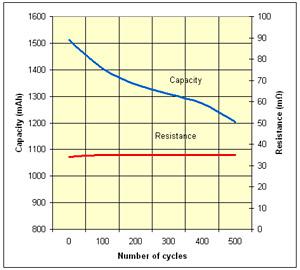
Source: Battery University

This creates a resale problem. A used starter battery that cranks an engine today may still fail in real service if the vehicle sits, if temperatures drop, if accessory loads are high, or if the alternator cannot quickly replace charge. Battery University describes a CCA-only test as a gamble and states that adding capacity measurement can command a higher resale value. The logic is straightforward: a buyer has more confidence when the battery has been tested for both starting power and stored energy.
A simplified comparison is useful:
| Test focus | What it reveals | What it may miss |
|---|---|---|
| CCA or conductance | Cranking ability and internal resistance estimate | Remaining reserve capacity and runtime margin |
| Load test | Voltage behavior under high current | Slow capacity fade if test duration is short |
| Capacity test | Delivered amp-hours under controlled conditions | Instant high-current performance unless separately tested |
| Visual inspection | Case damage, leakage, terminal corrosion | Internal plate condition and true state of health |
Some starter batteries can still crank at surprisingly low capacity. Battery University notes that vehicle cranking may still be possible at 30 percent capacity or lower, and that a capacity reading above 40 percent may provide a limited grace period in some service contexts. These values should not be treated as universal acceptance limits. Climate, vehicle type, engine condition, alternator performance, parasitic drain, and driver expectations all matter.
For resale or fleet screening, the strongest practical approach is to combine tests:
- Inspect the case, terminals, venting, and electrolyte condition where accessible.
- Confirm open-circuit voltage after rest or after removing surface charge.
- Measure CCA or conductance for starting capability.
- Perform a capacity or reserve-capacity test where time and equipment allow.
- Reject batteries with leakage, bulging, severe corrosion, internal short symptoms, or abnormal heating.
- Label the battery according to measured performance, not just pass or fail.
This approach does not turn a worn starter battery into a new one. It reduces uncertainty. A used battery with documented CCA and capacity has a clearer application window than one that merely started a vehicle once.
Stationary Batteries and Sulfation Recovery
Stationary batteries are used in backup power, telecommunications, uninterruptible power supplies, emergency lighting, substations, security systems, data centers, and energy-storage installations. Many stationary systems still use lead-acid batteries, including flooded lead-acid and valve-regulated lead-acid designs, although lithium-ion is increasingly common in newer energy-storage systems.
The restoration question is especially important for stationary systems because failure may not be visible during normal operation. A backup battery can sit fully charged for months or years and appear healthy until a power outage demands runtime. If the battery has lost capacity, the system may fail exactly when it is needed.
For lead-acid stationary batteries, sulfation is one of the most common recoverable or partially recoverable problems. Sulfation occurs when lead sulfate crystals remain on the plates instead of being converted back during normal charging. Some sulfate formation is part of normal discharge chemistry, but prolonged partial state of charge, undercharging, long storage without maintenance charging, and elevated temperature can make sulfate more persistent. As sulfation progresses, capacity falls and internal resistance can rise.
Corrective action depends on battery type and condition. Possible restoration or maintenance steps include:
- Capacity testing to establish whether the battery can meet the required backup duration.
- Corrective charging where manufacturer instructions allow it.
- Equalization charging for suitable flooded lead-acid batteries to reduce imbalance and acid stratification.
- String-level and block-level resistance checks to identify weak units.
- Temperature and float-voltage verification to prevent repeated undercharge or overcharge.
- Replacement of failed units when a cell or block is too degraded, shorted, dry, swollen, or unsafe.
Equalization is not appropriate for every battery. Flooded lead-acid batteries may permit controlled equalization under the correct procedure, but many sealed VRLA batteries have tighter limits. Overcharging a sealed battery can cause gas generation, dry-out, venting, thermal stress, and permanent damage. The manufacturer procedure and site safety rules should control the method.
Climate has a major influence on stationary battery life. Elevated operating temperature accelerates chemical reactions and corrosion, which can shorten service life. Cold temperature reduces available capacity during discharge even if aging is not severe. A battery room that is too hot may age batteries quickly; a battery installed in a cold outdoor cabinet may fail to deliver expected runtime during winter loads. Restoration decisions must therefore consider both measured capacity and the temperature at which the battery must perform.
A practical decision matrix for stationary batteries is based on four questions:
| Decision factor | Why it matters |
|---|---|
| Measured capacity | Determines whether the battery can support the required load for the required time |
| Internal resistance or impedance | Helps identify weak cells, poor connections, and aging trends |
| Safety condition | Leakage, swelling, corrosion, heat, or venting can make reuse unacceptable |
| Application requirement | A telecom site, UPS, or emergency system may require a larger reserve margin than a noncritical load |
Restoration is most defensible when the failure mode is reversible or manageable, the battery passes safety inspection, and testing proves that it meets the minimum performance required by the application. It is not defensible when the battery is physically damaged, repeatedly overheating, severely capacity-depleted, internally shorted, or needed for a critical backup role that it can no longer support with margin.
In stationary systems, the most valuable practice is not heroic recovery. It is routine measurement. Capacity trends, resistance trends, temperature records, float-voltage checks, and documented discharge tests allow operators to replace only what must be replaced while avoiding the risk of leaving weak batteries in service. That is the practical boundary of battery restoration: recover what can be safely recovered, repurpose what still has useful life, and recycle what no longer meets a measured requirement.
References
- Battery University | BU-803: Can Batteries Be Restored?. (n.d.). http://www.batteryuniversity.com/article/bu-803-can-batteries-be-restored
- Battery University | BU-803: Can Batteries Be Restored?. (n.d.). https://www.batteryuniversity.com/article/bu-803-can-batteries-be-restored
- Battery University | BU-901b: How to Measure the Remaining Useful…. (n.d.). http://www.batteryuniversity.com/article/bu-901b-how-to-measure-the-remaining-useful-life-of-a-battery
- Mobile Battery Replacement Services Market. (n.d.). https://dataintelo.com/report/mobile-battery-replacement-services-market
- Can EV Batteries Be Used Again? - Union of Concerned Scientists. (n.d.). https://blog.ucs.org/jessica-dunn/can-ev-batteries-be-used-again
- How to Measure the Remaining Useful Life of a Battery. (n.d.). https://www.large-battery.com/blog/how-to-measure-the-remaining-useful-life-of-a-battery-guide
- A Review on Battery Market Trends, Second-Life Reuse, and Recycling. (n.d.). https://www.mdpi.com/2673-4079/2/1/11
- Battery Rebuild Service Market Share & YoY Growth Rate, 2033. (n.d.). https://www.coherentmarketinsights.com/market-insight/battery-rebuild-service-market-5813
- What happens to EV batteries at the end of their useful life in a vehicle? - Electric Vehicle Council. (n.d.). https://electricvehiclecouncil.com.au/docs/what-happens-to-ev-batteries-at-the-end-of-their-useful-life-in-a-vehicle
- Economic Impact of the U.S. Battery Industry. (n.d.). https://batterycouncil.org/policy-initiatives/industry-impact/economic-impact