Battery packs are built from cells that look identical on the outside but are never perfectly identical electrically. Even cells from the same manufacturer, chemistry, model, and production lot vary in capacity, impedance, self-discharge, state of charge, and aging rate. In a single-cell product these differences are usually handled by normal charge and discharge limits. In a multi-cell pack, however, the weakest cell or weakest parallel group can determine how much energy the entire pack can safely deliver.
Cell matching and balancing are two related but different controls. Matching is the selection and grouping of cells with similar characteristics before pack assembly. Balancing is the ongoing process of keeping series-connected cells or cell groups at similar voltage or state of charge during operation. Good matching reduces the amount of correction the pack needs later; good balancing helps maintain usable capacity and protects cells as they age.
The subject is especially important for industrial batteries, medical equipment, professional power tools, electric vehicles, e-bikes, backup systems, and other applications where packs see high current, long service life, or wide temperature exposure. A pack that is poorly matched at the beginning, or that drifts badly with age, may show reduced runtime, early charge termination, excessive stress on weak cells, and shorter service life.
Why Cell Matching Matters in Battery Packs
No two electrochemical cells are exactly the same. Manufacturing processes control cell properties within a range, but they do not produce perfect clones. Two new cells with the same nominal rating may differ in:
- Capacity: the amount of charge the cell can store and deliver under specified conditions.
- Internal resistance or impedance: the voltage drop and heat generation under load.
- Self-discharge: how quickly the cell loses charge while stored.
- Open-circuit voltage or state of charge at the time of assembly.
- Aging behavior: how capacity, resistance, and leakage change with cycles, calendar time, and temperature.
In a series string, the same current passes through every cell group. If one cell group has less usable capacity than the others, it reaches its discharge limit first and its charge limit first. The stronger cells do not compensate automatically; instead, the pack control system must stop discharge or charge when the weakest group reaches a limit. This is why a multi-cell pack is often limited by its weakest cell or weakest parallel group.
The importance of matching increases with pack voltage and load. A small low-power pack may tolerate more variation because currents are modest and the consequences of reduced capacity are limited. In contrast, high-voltage, high-load, or safety-critical packs need tighter control. Professional power tools and medical equipment, for example, depend on reliable current delivery and predictable runtime. EV and large stationary systems add another challenge: many cells must operate together over years while exposed to temperature gradients and different local cooling conditions.
Cell quality also affects how well a pack stays matched over time. High-quality cells tend to show more uniform capacity and lower self-discharge when new, and their aging is usually more even and controlled. Lower-grade cells may diverge faster with use and time. A pack assembled from cells that initially pass a basic voltage check may still become unbalanced if the cells differ significantly in capacity, impedance, or self-discharge.
Matching is therefore more than sorting cells by voltage. Voltage can indicate approximate state of charge under controlled conditions, but it does not fully describe capacity, resistance, or future aging. Practical pack manufacturing may include capacity testing, impedance screening, voltage grouping, and control of cell lot history. The tighter the pack requirements, the more valuable this screening becomes.
What Happens When Cells Are Mismatched
A mismatched series pack behaves as if the weakest cell group sets the safe operating window. During discharge, the lower-capacity group empties first. During charge, it fills first. If the pack is controlled only by total pack voltage, the weak group can be pushed outside its safe range while the overall pack voltage still appears acceptable.
The usual sequence is straightforward:
- A lower-capacity cell group reaches low voltage before the others during discharge.
- If discharge continues, that group is over-discharged relative to the rest of the pack.
- On the next charge, the same group reaches full charge earlier because it has less capacity to fill.
- If charging continues based only on total pack voltage, that group may spend more time at high voltage or overcharge stress.
- Repeated stress accelerates capacity loss, resistance rise, and further imbalance.
This effect is not limited to lithium-ion chemistry, but lithium-ion packs require particular care because cell overvoltage and undervoltage can damage cells and may create safety risks. Nickel-based and lead-acid packs also suffer from mismatch through reduced runtime, reversal risk in severe discharge, sulfation, water loss, heating, and shortened cycle life depending on chemistry and operating conditions.
For industrial batteries, the reference guideline is that capacity tolerance between cells should be about ±2.5 percent. Packs designed for high voltage, heavy loads, or wide temperature operation should use even tighter matching where practical. This is not because a small difference causes instant failure, but because small differences can grow over time, especially when cells age at different rates.
A useful way to think about mismatch is to compare two battery sections in the same pack. In reported cycling of aged lithium-ion packs, sections with capacity differences of 5, 6, 7, and 12 percent all showed capacity loss over 18 cycles, but the pack with the 12 percent mismatch showed the greatest decrease. The example illustrates a practical point: imbalance and aging reinforce each other. As mismatch increases, the weak section is stressed harder, and as it degrades further, mismatch becomes worse.
Cycling does not reliably make poor-quality cells become well matched. Some nickel-based cells may adapt modestly after a few charge and discharge cycles, but weak cells remain weak. A low-capacity cell cannot be converted into a high-capacity cell simply by cycling it in a pack. If cells have elevated self-discharge or faster aging, repeated cycling can expose the difference rather than correct it.
The practical consequences of mismatch include:
- Reduced usable capacity because charge or discharge must stop when the first cell group reaches a limit.
- Early charger termination if one group reaches high voltage before the rest are full.
- Excessive heat in higher-resistance cells under load.
- Accelerated aging of weaker groups that repeatedly operate near limits.
- False confidence from pack voltage because total voltage can hide individual cell imbalance.
- Increased service variability between packs built from the same nominal cells.
In parallel groups, cells tend to share current according to their voltage and resistance, but matching still matters. A cell with higher resistance may contribute less current under load, while cells with lower resistance may work harder. A cell with elevated self-discharge can drain its parallel group during storage. Once parallel groups are connected in series, the weakest group still limits the whole string.
Balancing Methods and the Role of the BMS
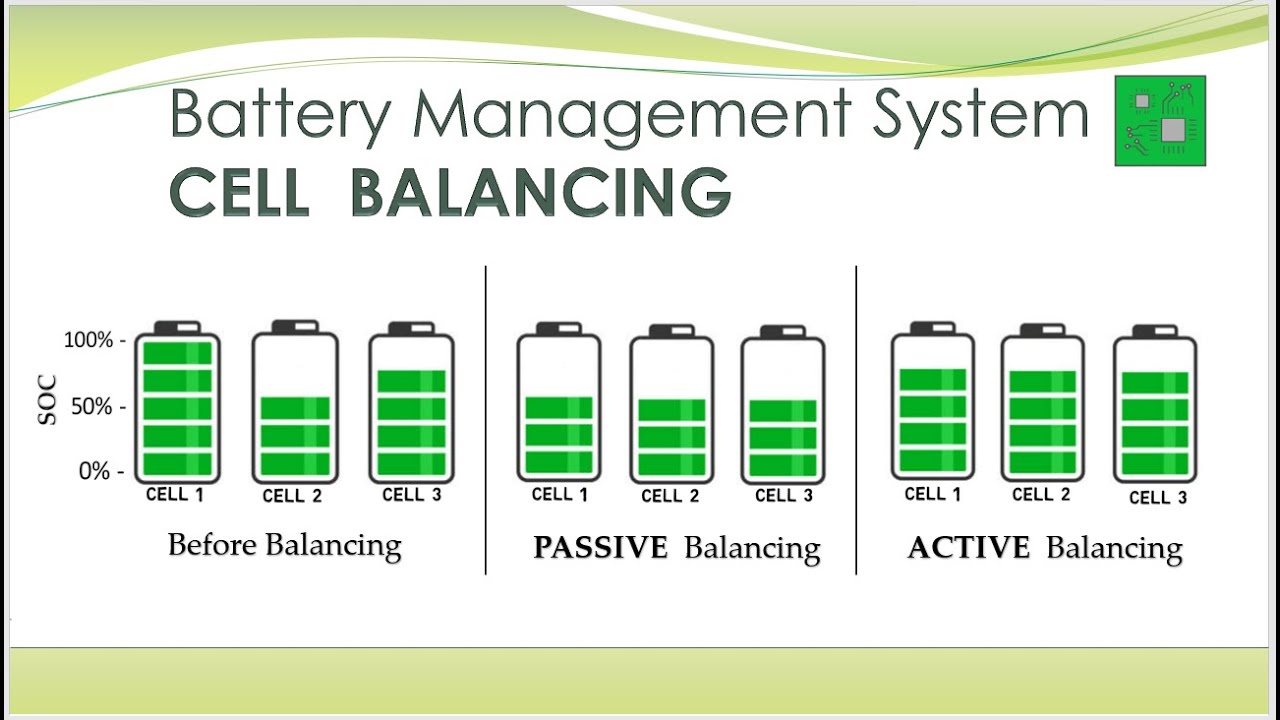
Cell balancing is the process of keeping series-connected cells or cell groups at similar state of charge or voltage. It is not a cure for bad cells, and it does not restore lost capacity. Instead, balancing helps the pack make better use of the capacity that remains while keeping individual cells inside safe limits.
Source: Battery University

Two broad balancing methods are commonly discussed: passive balancing and active balancing.
| Method | Basic principle | Main advantage | Main limitation |
|---|---|---|---|
| Passive balancing | Bleeds energy from higher-voltage cells through resistors | Simple, compact, relatively low cost | Wastes energy as heat and usually provides limited balancing current |
| Active balancing | Redistributes charge from higher-energy cells to lower-energy cells | Better efficiency and can improve usable runtime in larger packs | Higher cost, more circuitry, more control complexity |
Passive balancing is the simpler and more common approach in many lithium-ion battery management systems. When one cell group reaches a higher voltage than the others, the BMS connects a bleed resistor across that group or otherwise diverts a small current. The extra energy is dissipated as heat. Passive balancing often occurs near the top of charge because voltage differences are easier to detect and because the goal is to let lower-voltage groups continue charging while higher-voltage groups are held back.
Passive balancing is useful, but it has limits. It cannot add energy to a low cell group; it can only remove energy from higher groups. Its balancing current is often small compared with the pack charge current, so correcting a severely imbalanced pack can take a long time. It also creates heat that must be considered in BMS layout and pack thermal design.
Active balancing uses inductors, capacitors, transformers, or converter circuits to move charge from higher-energy cells or groups to lower-energy ones. This can improve efficiency because less energy is deliberately burned as heat. Active balancing can be valuable in high-value or large battery systems where small improvements in usable capacity and thermal efficiency justify added complexity. The tradeoff is cost, control sophistication, board space, and validation effort.
The battery management system, or protection circuit in simpler packs, is central to safe balancing. Depending on pack design, the BMS may:
- Monitor individual cell-group voltages.
- Estimate pack current, temperature, and state of charge.
- Stop charge when a cell reaches an upper voltage limit.
- Stop discharge when a cell reaches a lower voltage limit.
- Enable passive or active balancing circuits.
- Detect abnormal conditions such as overtemperature, overcurrent, or sensor faults.
For lithium-ion packs, monitoring individual cell groups is especially important. A pack-level voltage measurement can look normal while one group is too high and another is too low. Without cell-level supervision, the charger or load may continue operating based on an average value that hides the weak group.
Balancing improves pack consistency, but it should not be confused with repair. If a cell group has lost capacity, developed high resistance, or has elevated self-discharge, balancing can temporarily align its voltage with the rest of the pack, but the group will still reach empty or full sooner than healthier groups. In that case, balancing may reduce symptoms but cannot restore the lost capacity.
Some simple or low-cost packs may include limited balancing or no true balancing at all. In those designs, initial cell matching becomes even more important because there is little correction available after assembly. Even in packs with balancing, good initial matching reduces heat, shortens balancing time, improves charge completion behavior, and reduces stress on the BMS.
A practical engineering approach is to treat matching and balancing as complementary controls:
- Use matching to start with cells that have similar capacity, impedance, voltage, and quality.
- Use BMS monitoring to prevent individual groups from exceeding safe limits.
- Use balancing to manage normal drift during service.
- Use diagnostics to identify when imbalance is caused by real degradation rather than ordinary state-of-charge differences.
This distinction matters during troubleshooting. If a pack repeatedly becomes unbalanced soon after balancing, the cause may be a weak cell group, elevated self-discharge, a temperature hot spot, an interconnect problem, or a measurement fault. Rebalancing alone may not solve the root cause.
Equalizing Lead-Acid Batteries
Lead-acid batteries use a different balancing practice known as equalization. In flooded lead-acid batteries, an equalizing charge is a controlled overcharge used periodically or as needed to correct cell imbalance, reduce acid stratification, and bring lagging cells closer to full charge. It is not the same as lithium-ion cell balancing, and it must be applied only according to the battery manufacturer’s instructions.
Flooded lead-acid cells in a string can drift apart because of differences in capacity, self-discharge, temperature, electrolyte concentration, and plate condition. If the charger controls only the total string voltage, some cells may remain undercharged while others receive too much charge. Over time, this can split the battery into weak and strong sections.
Conditions that can justify equalization include:
- Uneven specific gravity readings between cells in a flooded battery.
- Cells that do not reach full charge during normal charging.
- Evidence of acid stratification, where electrolyte concentration varies with height in the cell.
- High self-discharge differences between cells.
- Long service in partial-state-of-charge operation, where sulfation risk is higher.
The failure mechanisms are different on each side of the imbalance. An undercharged section can develop sulfation because lead sulfate is not fully converted during recharge. Sulfation reduces active plate area and makes the cell harder to recharge. Meanwhile, an overcharged section can suffer corrosion, gassing, heating, and water loss. In flooded batteries, water loss must be corrected with proper maintenance using the recommended water type and procedure.
Equalization intentionally raises the battery above normal finishing conditions for a controlled period. That makes it useful but also potentially damaging if misapplied. Excessive equalization can accelerate grid corrosion, shed active material, consume water, and generate explosive hydrogen and oxygen gas. Temperature also matters: a battery that becomes too hot during equalization can be damaged and may require the process to be stopped.
A safe equalization procedure should follow manufacturer limits for:
- Equalization voltage.
- Maximum time or termination criteria.
- Battery temperature.
- Ventilation.
- Electrolyte level and watering schedule.
- Personal protective equipment and acid-handling precautions.
- Whether loads must be disconnected during the process.
Equalization practices differ by lead-acid type. Flooded batteries are the usual candidates because electrolyte can be measured and water can be replaced. Sealed lead-acid batteries, including many AGM and gel designs, generally cannot be treated the same way because lost water is not normally replaceable and excessive gas generation can damage the valve-regulated system. Some manufacturers specify limited conditioning procedures for certain sealed products, but these should not be assumed from flooded-battery practice.
Equalizing lead-acid batteries should also not be transferred to lithium-ion packs. Lithium-ion cells do not tolerate controlled overcharge in the same way flooded lead-acid cells can under specified conditions. Lithium-ion packs require cell-level voltage limits and BMS-controlled balancing, not equalization by overcharging the whole string.
For any chemistry, the underlying lesson is the same: a multi-cell pack is only as dependable as the cells or cell groups that make up the string. Careful matching at assembly, appropriate balancing during operation, and chemistry-specific maintenance practices all reduce the risk that one weak cell will limit or damage the entire battery.
References
- Battery University | BU-803a: Cell Matching and Balancing. (n.d.). http://www.batteryuniversity.com/article/bu-803a-cell-matching-and-balancing
- Help! Bought a used ebike with battery/BMS issues.. | Electric Bike Forums. (n.d.). https://forums.electricbikereview.com/threads/help-bought-a-used-ebike-with-battery-bms-issues.58139
- Calibrating Smart Batteries with Impedance Tracking. (n.d.). https://incompliancemag.com/calibrating-smart-batteries-with-impedance-tracking
- Battery University | BU-302: Series and Parallel Battery…. (n.d.). http://www.batteryuniversity.com/article/bu-302-series-and-parallel-battery-configurations
- Why is cell balancing necessary in a lithium battery pack?. (n.d.). https://www.reddit.com/r/batteries/comments/v4mitc/why_is_cell_balancing_necessary_in_a_lithium
- What’s the truth behind cell balancing in EV batteries, and .... (n.d.). https://www.quora.com/What-s-the-truth-behind-cell-balancing-in-EV-batteries-and-why-is-it-important-to-occasionally-charge-fully
- Balancing Matched VS. Mismatched Cells - How the BMS Does it and More!. (n.d.). https://www.youtube.com/watch?v=Fv8V6lCdQ0g
- Cell Balancing - Battery Design. (n.d.). https://www.batterydesign.net/battery-management-system/battery-management-system-algorithms/cell-balancing
- Cell balancing buys extra run time and battery life. (n.d.). https://www.ti.com/lit/pdf/slyt322
- Active Battery Cell Balancing | Analog Devices. (n.d.). https://www.analog.com/en/resources/technical-articles/active-battery-cell-balancing.html