Charging is usually more temperature-sensitive than discharging. A battery may still deliver useful power in cold or hot conditions, but accepting charge safely and efficiently depends on ion transport, reaction kinetics, gas recombination, pressure behavior, and the charger’s termination method. The result is that the permissible charging window is often narrower than the discharge window.
Older rechargeable systems such as lead-acid and nickel-cadmium generally tolerate a wider range of charging abuse than many modern high-energy lithium-ion cells, but they are not immune to temperature effects. Cold reduces charge acceptance and raises internal resistance. Heat may make reactions appear faster in the short term, yet it usually reduces charge efficiency, accelerates aging, and can increase pressure or gas generation.
Typical temperature guidance must always come from the cell or battery-pack manufacturer. As a practical comparison, standard lithium-ion cells are commonly specified for charging from about 0°C to 45°C, while discharge may be allowed over a wider range such as about -20°C to 60°C. Specialty cells and engineered packs may differ, especially when heaters, derating, thermal insulation, or active cooling are part of the system.
| Battery type | Cold charging concern | Hot charging concern | Practical control |
|---|---|---|---|
| Lead-acid | Slower acceptance; higher required charge voltage at low temperature | Overcharge risk if voltage is not reduced as temperature rises | Temperature-compensated voltage and manufacturer current limits |
| Nickel-based | Poor charge acceptance; pressure rise; possible false full-charge behavior | Reduced charge efficiency; less reliable voltage-based termination | Room-temperature charging for consumer cells; temperature sensing for fast chargers |
| Lithium-ion | Lithium plating below the approved charging limit | Faster aging; gas generation, swelling, venting, or safety risk in severe cases | BMS charge-temperature cutoffs, preheating, and datasheet current limits |
Charging Batteries in Cold Conditions
Cold charging is difficult because low temperature slows electrochemical processes and increases internal resistance. A battery that can discharge at low temperature may not be able to accept charge at the same temperature without damage or poor efficiency. This distinction is especially important for lithium-ion systems, but it also affects nickel-based and lead-acid batteries.
For nickel-cadmium and nickel-metal-hydride cells, low temperature reduces charge acceptance. During fast charging, gases generated inside the cell must be recombined efficiently. In the cold, recombination becomes less effective and internal pressure can rise. This pressure behavior can interact with voltage-based charge termination, creating a condition where a poorly accepting cold battery appears to the charger as if it has reached full charge.
Many nickel-based chargers use negative delta voltage, commonly written as NDV or -ΔV, as a full-charge detection method. In normal fast charging, the cell voltage reaches a peak and then drops slightly near full charge. Detecting that voltage drop can help terminate charge. At low temperature, however, poor charge acceptance and pressure buildup can mimic full-charge behavior. NDV therefore provides some protection, but it is not a guarantee that the cell has accepted the intended amount of energy.
For this reason, ordinary consumer nickel-based chargers are best used near room temperature unless the charger and cells are explicitly rated for cold operation. Industrial systems may use different controls. Some reduce the charge rate according to battery temperature; others use heating blankets or controlled preheating to bring the pack into an acceptable charging range before fast charge begins. These provisions are system-level design features, not assumptions that should be applied to general-purpose cells.
Lead-acid batteries are generally more tolerant of cold charging than standard lithium-ion cells, but charger settings still matter. At low temperature, charge acceptance is reduced and the voltage required to reach a given electrochemical state changes. Correct charging therefore depends on the manufacturer’s specified current limits and voltage compensation. Applying normal warm-temperature settings in a cold environment can result in incomplete charge, slow recovery, or excessive stress depending on the battery design and state of charge.
The safest lead-acid approach is to use a charger intended for the battery type—flooded, AGM, gel, or other construction—and to enable the manufacturer’s temperature-compensation function if provided. Current should be limited according to the datasheet, especially when the battery is deeply discharged or has been stored cold. If temperature compensation is not available, the acceptable operating range becomes narrower and manual charging requires greater caution.
Lithium-ion cells require the strictest cold-charging control. Standard lithium-ion batteries should not be charged below 0°C unless the cell manufacturer specifically permits it. The reason is not simply that the battery charges slowly. At low temperature, lithium-ion diffusion and intercalation into the graphite anode are slowed. If charging current continues, lithium can deposit as metallic lithium on the anode surface instead of being properly stored in the anode structure. This process is known as lithium plating.
Lithium plating is a serious degradation mechanism. Plated lithium is often no longer available for normal cycling, causing permanent capacity loss. It can also increase cell impedance, reducing power capability and increasing heat generation under load. In more severe cases, plated lithium can form dendritic structures that raise the risk of an internal short circuit. An internal short can create a safety hazard, especially if the cell is later charged, discharged, or heated under stressful conditions.
Reducing charge current may reduce plating risk in certain cell designs, but it is not a universal permission to charge below freezing. The correct rule is to follow the cell or pack datasheet. Some lithium-ion chemistries and specialty low-temperature cells are engineered for charging below the limits of standard consumer cells, but those products use specific electrode designs, electrolyte formulations, current limits, and control strategies. The existence of specialty cells does not change the limit for ordinary lithium-ion batteries.
Practical cold-charging guidance is straightforward:
- Warm the battery before charging when it is below the approved charge-temperature range. Warming should be controlled and even; avoid localized overheating.
- Use the BMS temperature cutoff. A well-designed lithium-ion battery management system should block charge below the minimum permitted cell temperature.
- Measure cell or pack temperature, not only ambient temperature. A battery stored overnight outdoors may remain colder than the surrounding air for some time.
- Do not rely on discharge behavior as proof that charging is safe. A lithium-ion pack may power a load below freezing yet still be unsafe to charge.
- Apply reduced current only when approved. Current derating must come from the manufacturer’s specification or a validated system design.
For field systems, electric vehicles, outdoor energy-storage cabinets, medical equipment, and instruments used in cold climates, the engineering solution is usually not to ignore the limit. It is to add temperature sensing, inhibit charging when necessary, and preheat the battery until it reaches the approved charging range.
Charging Batteries in Hot Conditions
Heat often creates the opposite impression from cold: the battery may initially appear easier to charge because chemical reactions proceed faster. In practice, elevated temperature usually reduces useful charge efficiency and shortens service life. Heat accelerates side reactions, increases corrosion or electrolyte degradation depending on chemistry, and can make charge-termination signals less reliable.
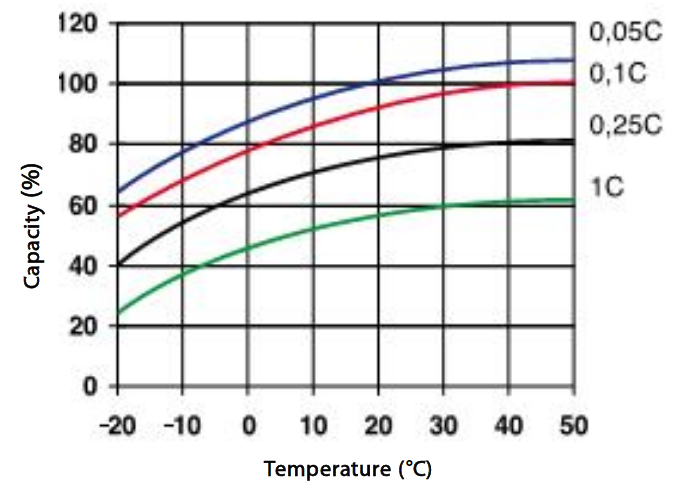
Lead-acid batteries are strongly affected by charge voltage at high temperature. As temperature rises, the correct charge voltage should be reduced. Without this compensation, a voltage that is appropriate at moderate temperature can become excessive in a hot battery. The result can be overcharge, water loss in flooded designs, dry-out in valve-regulated designs, accelerated grid corrosion, and shortened life.
Source: Battery University
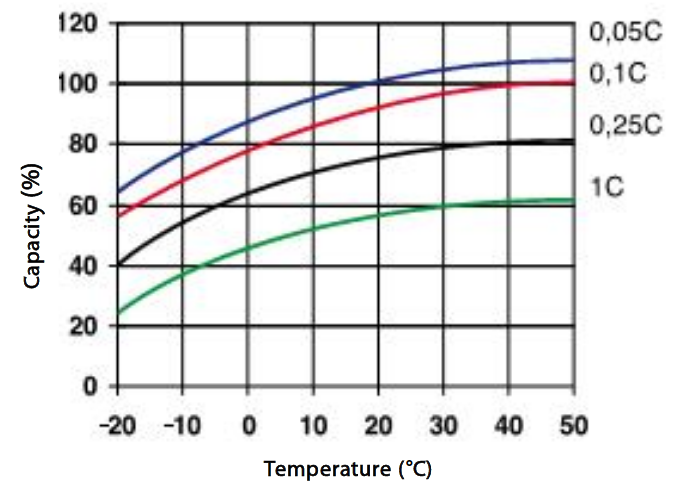
Temperature-compensated lead-acid charging is therefore not an optional refinement in demanding applications; it is part of correct charger design. The charger should sense battery temperature or use a validated compensation method recommended by the battery manufacturer. The compensation must match the specific battery construction because flooded, AGM, gel, standby, and cycling batteries may not share identical voltage recommendations.
Nickel-based batteries also lose charge efficiency as temperature rises. Data for nickel-cadmium cells show a strong departure from ideal charge efficiency above about 30°C. At 45°C, charge acceptance may fall to roughly 70 percent of full capacity, and at 60°C it may fall to roughly 45 percent. Commercial nickel-metal-hydride cells can show severe loss of charge efficiency at high temperature as well; reported values at 55°C for commercial NiMH are about 35–40 percent, while newer industrial NiMH designs may reach about 75–80 percent under comparable high-temperature conditions.
This behavior explains why a nickel-based battery may become warm, trigger charger termination, and still not be fully charged. At elevated temperature, oxygen generation and pressure behavior change, and the voltage signature used for NDV termination becomes less dependable. The charger can interpret heat-related voltage behavior as a full-charge condition or fail to terminate at the correct point. Temperature sensing is therefore essential as a backup for fast chargers, especially above normal room-temperature conditions.
For consumer nickel-cadmium and nickel-metal-hydride cells, the practical recommendation is simple: charge at moderate room temperature whenever possible. If batteries are hot from use, allow them to cool before fast charging. If they are in an enclosed device, confirm that the charger is designed for that thermal condition. Industrial packs can be charged at elevated temperatures only when the pack, charger, sensors, and termination algorithms are designed for that service.
Lithium-ion batteries can often operate at elevated temperature, but operation is not the same as long-term health. Prolonged heat exposure accelerates aging and reduces longevity. During charge and discharge at high temperature, side reactions may generate gas. In cylindrical cells this can contribute to venting under severe conditions; in pouch cells it can appear as swelling. These outcomes indicate chemical and mechanical stress, not normal healthy operation.
Many lithium-ion chargers or battery-management systems block charging above roughly 45–50°C, depending on the cell specification. The exact threshold should be treated as a design parameter from the datasheet, not as a universal number. Some cells may specify a lower maximum charge temperature; specialized cells or packs may specify different limits when supported by testing, thermal design, and protection circuits.
High-temperature lithium-ion charging also interacts with state of charge. Charging to a high voltage while the battery is hot is generally more stressful than partial charging at moderate temperature. This is why thermal management matters in electric vehicles, portable electronics, power tools, and stationary storage systems. A system that can delay charging, reduce current, run cooling, or stop charge entirely will usually preserve the battery better than one that forces charge whenever external power is available.
A few applications intentionally expose batteries to unusually high temperatures, but these are exceptions. Medical-tool battery packs may be designed to tolerate brief sterilization cycles in an autoclave. Oil-and-gas tools may require batteries that can survive high-temperature downhole environments. These applications require purpose-built cells, materials, mechanical design, validation testing, and conservative protection controls. They should not be used as evidence that standard lithium-ion, nickel-based, or lead-acid batteries can be charged outside their specified temperature range.
Good hot-weather charging practice includes:
- Avoid charging immediately after heavy discharge if the pack is already hot.
- Provide ventilation or active cooling where the charger and battery are enclosed.
- Use temperature-compensated voltage for lead-acid batteries.
- Use temperature backup termination for nickel-based fast charging.
- Let the BMS block lithium-ion charging above the approved limit.
- Treat swelling, venting, unusual odor, or excessive heat as fault conditions.
Temperature limits are not merely comfort recommendations for batteries. They define where the cell chemistry, mechanical design, and charger controls can work together safely. Cold charging mainly threatens acceptance and lithium plating; hot charging mainly threatens efficiency, aging, gas generation, and overcharge stress. Across all chemistries, the reliable engineering answer is the same: measure temperature, obey the datasheet, and use chargers designed for the battery chemistry and operating environment.
References
- Battery University | BU-410: Charging at High and Low Temperatures. (n.d.). http://www.batteryuniversity.com/article/bu-410-charging-at-high-and-low-temperatures
- BU-409: Charging Lithium-ion - Battery University. (n.d.). http://www.batteryuniversity.com/article/bu-409-charging-lithium-ion
- Charge And Discharge Design of Low Temperature Battery. (n.d.). https://www.grepow.com/blog/charge-and-discharge-design-of-low-temperature-battery.html
- How Different Battery Charging Methods Impact Performance. (n.d.). https://www.large-battery.com/blog/battery-charging-types-performance-impact
- Universal Programmable Battery Charger with Optional Battery Mana.pdf. (n.d.). https://digitalcommons.calpoly.edu/context/theses/article/2518/viewcontent/UNIVERSAL_PROGRAMMABLE_BATTERY_CHARGER_WITH_OPTIONAL_BATTERY_MANAGEMENT_SYSTEM_rev4.pdf
- Lithium-Ion Battery Safe Temperature Range: What You Need to Know. (n.d.). https://www.eblofficial.com/blogs/battery-101/lithium-ion-battery-temperature-range
- Designing for Li-ion Battery Longevity | Celltech. (n.d.). https://celltech.fi/wp-content/uploads/2026/02/designing-for-li-ion-longevity.pdf
- Studies on Charging Lithium-Ion Cells at Low Temperatures. (n.d.). https://www.researchgate.net/publication/234954127_Studies_on_Charging_Lithium-Ion_Cells_at_Low_Temperatures
- Charging Temperature: The Overlooked Battery Datasheet Factor. (n.d.). https://sunlithenergy.com/charging-temperature-battery-datasheets
- How Operating Temperature Affects Lithium-Ion Batteries | Amprius Technologies. (n.d.). https://amprius.com/operating-temperature