Charging a battery from an adjustable DC power supply is possible, but it is not the same as using a dedicated charger. A charger usually contains chemistry-specific charge control, termination logic, temperature compensation, safety timers, and protection functions. A laboratory or bench supply normally provides only controlled voltage and current limiting, leaving the operator responsible for selecting the correct limits and stopping the charge at the right time.
Manual power-supply charging is most practical with lead acid and many lithium-ion cells when the required voltage and current limits are known and the process is closely supervised. Nickel-cadmium and nickel-metal-hydride cells are less straightforward because their end-of-charge behavior is harder to detect with a simple regulated supply. In every case, the battery manufacturer’s datasheet and pack protection requirements take priority over generic charge values.
Power-Supply Charging Basics and Safety Precautions
A suitable power supply for battery charging must provide adjustable DC voltage and a reliable current-limit setting. The voltage setting establishes the maximum charge voltage; the current limit prevents excessive current when the discharged battery is first connected. Without current limiting, a low-impedance or deeply discharged battery may draw more current than the cells, wiring, or supply can safely handle.
For manual charging, the basic sequence is:
- Identify the battery chemistry, nominal voltage, number of series cells, rated capacity, and manufacturer charge limits.
- Calculate the correct voltage limit from the cell count and allowed per-cell voltage.
- Set the power supply voltage and current limit before connecting the battery where practical.
- Connect the battery with correct polarity and adequately rated leads.
- Monitor voltage, current, battery temperature, and time during the charge.
- Stop the charge, or switch to an appropriate float condition where allowed, when the correct termination point is reached.
This process should not be left unattended. A bench supply does not necessarily know whether a battery is full, damaged, too hot, reversed, imbalanced, or outside its safe operating range. The user must recognize abnormal behavior such as unexpected heating, swelling, venting, failure of current to taper, excessive voltage on one cell in a series string, or charge current that remains higher than expected.
Lead acid and lithium-ion batteries are commonly charged with a current-limited constant-voltage profile, so an adjustable power supply can approximate part of the normal charging method. The risk is that the supply lacks the termination and protection features of a proper charger. Nickel-based cells are more difficult because the full-charge indication depends on a voltage signature that changes with current and cell condition; temperature and time become more important when a dedicated charger is not used.
Safety note: Never use a power supply to charge an unknown, damaged, swollen, leaking, frozen, overheated, or mechanically compromised battery. Use fusing, insulated connections, correct polarity, and a nonflammable work area appropriate to the battery size and chemistry.
Charging Lead Acid Batteries with a Power Supply
Lead acid batteries are among the more practical chemistries to charge manually because the charge voltage can be calculated from the number of cells in series. A nominal 12V lead acid battery has six cells. If the chosen charge limit is 2.40V per cell, the supply voltage is:
6 cells × 2.40V/cell = 14.40V
Set the voltage and current limit before connecting the battery. The current limit should be selected according to battery capacity and manufacturer recommendations. A common manual-charging range for lead acid is about 10 to 30 percent of rated capacity. Expressed as C-rate, 10 percent is 0.1C and 30 percent is 0.3C.
Examples:
| Battery rating | 0.1C current | 0.3C current |
|---|---|---|
| 10Ah | 1A | 3A |
| 80Ah | 8A | 24A |
In practice, many lead acid batteries are charged below the upper end of this range, especially if they are small sealed batteries, warm, aged, deeply discharged, or not specified for high charge current. The examples show the calculation method, not a universal permission to use the highest current.
During charge, the power supply may initially operate in current limit. The battery voltage rises gradually until it approaches the voltage setting. Once the voltage limit is reached, the supply transitions toward constant-voltage operation and the charge current begins to taper. This taper is an important indication that the battery is approaching full charge.
Monitor three parameters throughout the charge:
- Voltage: Confirm that the battery terminals do not exceed the intended limit.
- Current: Confirm that the current tapers after the voltage limit is reached.
- Temperature: Stop or reduce charging if the battery becomes abnormally warm or shows signs of distress.
A lead acid battery charged by constant voltage is typically considered near full when it has reached the selected voltage limit and the current has fallen to a low value appropriate for that battery type. Exact termination current depends on the battery design and manufacturer instructions. If a manufacturer specifies a full-charge current threshold, use that value.
For standby service, lead acid batteries may be held at a lower float voltage rather than disconnected immediately after charge. Typical float guidance is about 2.25 to 2.30V per cell, depending on battery type, temperature, and manufacturer recommendations. For a six-cell 12V battery, this corresponds approximately to 13.5 to 13.8V. Float voltage is not the same as the higher cyclic charge voltage; using too high a voltage for long-term float can accelerate water loss, corrosion, and aging.
Equalizing is a special case. It is a controlled overcharge used on appropriate lead acid batteries to help correct cell imbalance or stratification. It is generally associated with flooded lead acid batteries and should not be applied indiscriminately to sealed designs unless the manufacturer explicitly permits it.
When equalizing with a power supply:
- Use only the manufacturer-approved battery type and voltage limit.
- Remove or isolate sensitive loads connected to the battery.
- Provide ventilation suitable for gassing batteries.
- Monitor battery temperature, voltage, current, and time continuously.
- Stop if the battery overheats, vents excessively, or behaves abnormally.
A bench supply can apply the required controlled voltage, but it does not make the procedure automatic or inherently safe. Equalization should be treated as a supervised maintenance operation, not a routine substitute for correct charging.
Charging Lithium-Ion Batteries with a Power Supply
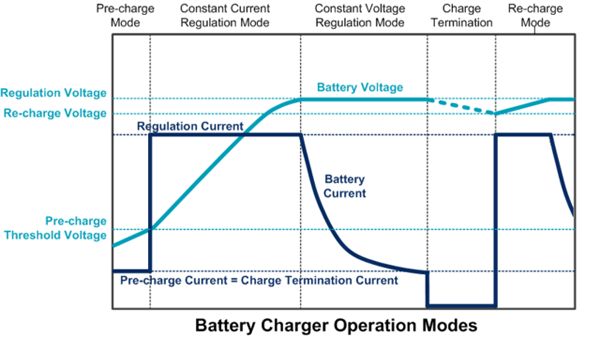
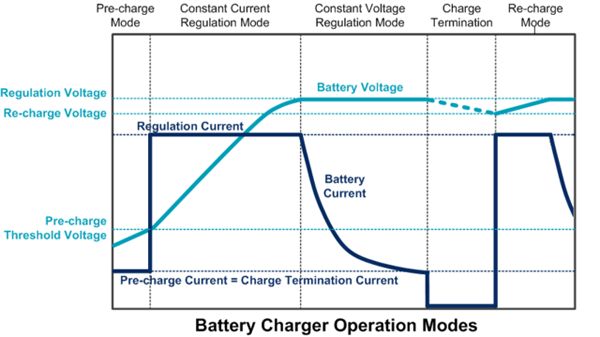
Lithium-ion charging resembles lead acid charging in that it commonly uses a constant-current phase followed by a constant-voltage phase. A current-limited power supply can reproduce this basic CC/CV behavior: first the supply limits current while cell voltage rises, then it holds the voltage limit while current tapers. The difference is that lithium-ion requires much stricter voltage control and more careful termination.
Source: Battery University
Most cobalt-blended lithium-ion cells, including many cells based on cobalt, nickel, manganese, or aluminum cathode materials, charge to 4.20V per cell. The commonly cited tolerance is tight, about ±50mV per cell. This is not a general value for every lithium-ion chemistry. Some nickel-based varieties may use lower limits such as 4.10V per cell, some high-capacity specialty cells may be specified for 4.30V per cell or higher, and lithium iron phosphate uses a lower charge-voltage range than typical 4.20V lithium-ion cells. The cell datasheet or pack specification controls.
For a single 4.20V lithium-ion cell, set the supply voltage to the specified maximum cell voltage and set a suitable current limit. For cells in series, the total pack voltage is the per-cell voltage multiplied by the number of series cells, but this calculation alone is not enough. No individual cell in the series string may exceed its specified maximum voltage. A commercial lithium-ion pack normally relies on protection circuitry or a battery management system to prevent cell overvoltage, undervoltage, overcurrent, and other unsafe conditions.
A power supply connected across a multi-cell lithium-ion string cannot see the voltage of each individual cell unless additional monitoring is used. A pack may show the correct total voltage while one cell is too high and another is too low. For this reason, manual charging of bare series-connected lithium-ion cells is risky without cell-level monitoring and balancing.
Full charge is reached when the cell or pack reaches the specified voltage limit and the current tapers to a low termination value. A common reference point is when current drops to about 3 percent of rated capacity, or when the current has bottomed out and cannot fall further under the selected voltage condition. For example, for a 2Ah cell, 3 percent of rated capacity corresponds to about 60mA. If the manufacturer specifies a different cutoff current, use the specified value.
Once full, disconnect the lithium-ion battery. Lithium-ion does not tolerate continuous trickle charging in the way some other chemistries might. Holding a 4.20V cell at full charge voltage for extended periods increases stress, and cells should not dwell at that voltage for more than a few hours. A dedicated charger normally terminates charge and may restart only under controlled conditions when the voltage falls.
Lithium-ion overcharge is a serious safety concern. Charging above the specified maximum can destabilize the cell, promote unwanted reactions, and compromise safety. The safest practical rule is simple: set the correct voltage before connection, verify it with a meter if necessary, monitor the charge, and disconnect at the proper termination point.
Charging NiCd and NiMH Batteries with a Power Supply
Nickel-cadmium and nickel-metal-hydride batteries are the least convenient of the common rechargeable chemistries to charge with a simple regulated power supply. Their full-charge detection is based on voltage behavior that depends strongly on charge current, cell temperature, age, and chemistry. A voltage limit alone is usually not a reliable termination method.
Dedicated NiCd and NiMH chargers often look for a change in voltage near full charge, sometimes called negative delta V for suitable charge rates. The difficulty with a bench supply is that it does not automatically interpret this signature, and the voltage behavior is weaker or less dependable at low charge currents. If the user simply applies a fixed voltage or current without proper termination, the cells can overcharge and heat.
If NiCd or NiMH cells must be charged with a regulated power supply and a proper charger is not available, temperature rise can be used as a practical full-charge indication during a 0.3C to 1C rapid charge. As the cell approaches full charge, charge efficiency falls and more input energy becomes heat. A noticeable temperature rise therefore indicates that the cell is nearing or has reached full charge. This method requires close supervision and is less precise than a chemistry-specific charger.
At lower charge currents, the voltage signature may be too unclear and the temperature rise too gradual to provide a clean cutoff. In that case, the operator must estimate the remaining capacity and calculate charge time. This requires knowing the approximate state of charge before starting, the applied charge current, and the cell capacity. Because charge efficiency is not perfect, time calculations are approximate and should be conservative.
One practical reference example is an empty 2Ah NiMH battery charged at about 750 to 1,000mA. That corresponds to roughly 0.375C to 0.5C, and the charge time is about 3 hours. This example illustrates how capacity and current determine the charging window, but it should not be generalized to all nickel batteries without considering the manufacturer’s charge instructions.
For maintenance charging after the main charge, the current must be much lower. Trickle or maintenance charge should be reduced to about 0.05C. For a 2Ah cell, 0.05C is 100mA. Even at low current, long-term overcharge can generate heat and pressure, particularly in sealed cells, so manufacturer limits still apply.
A chemistry-specific charger is usually the better option for NiCd and NiMH. It can combine appropriate current control with termination methods such as voltage-change detection, temperature sensing, timers, and safety cutoffs. A bench supply can deliver current, but it cannot by itself determine full charge reliably across different nickel cells and charge rates.
Manual charging of nickel batteries should therefore be reserved for controlled situations where the operator understands the cell condition, current level, estimated charge time, and thermal behavior. When those conditions are uncertain, use a proper NiCd or NiMH charger instead of a general-purpose power supply.
References
- Battery University | BU-405: Charging with a Power Supply. (n.d.). https://www.batteryuniversity.com/article/bu-405-charging-with-a-power-supply
- BU-405: Charging with a Power Supply. (n.d.). http://www.batteryuniversity.com/article/bu-405-charging-with-a-power-supply
- Battery University | BU-409: Charging Lithium-ion. (n.d.). http://www.batteryuniversity.com/article/bu-409-charging-lithium-ion
- Charging Information For Lead Acid Batteries - Battery University | PDF. (n.d.). https://www.scribd.com/document/371876550/Charging-Information-for-Lead-Acid-Batteries-Battery-University
- Charging Lithium-Ion Batteries – Battery University. (n.d.). http://dolgin.net/Charging%20Lithium-Ion%20Batteries.html
- Charging NiCd/NiMh Batteries With Power Supply - Instructables. (n.d.). https://www.instructables.com/Charging-NiCdNiMh-Batteries-With-Power-Supply
- Battery University | BU-407: Charging Nickel-cadmium. (n.d.). http://www.batteryuniversity.com/article/bu-407-charging-nickel-cadmium
- Practical guide to charging batteries by chemistry. (n.d.). https://www.microbattery.com/battery-charging-guide
- How to Charge a Lead Acid Battery | Power Sonic. (n.d.). https://www.power-sonic.com/how-to-charge-a-lead-acid-battery
- temperature effects on sealed lead acid batteries and .... (n.d.). https://www.osti.gov/servlets/purl/975252