Lead acid batteries are normally charged with a controlled current followed by a controlled voltage. This constant-current constant-voltage approach is simple in principle, but the settings matter: too little voltage leaves the battery undercharged and vulnerable to sulfation, while too much voltage accelerates gassing, water loss, grid corrosion, and heat generation.
A correct charging process is therefore not just about restoring amp-hours. It must bring the battery close to full charge, avoid excessive time at high voltage, compensate for temperature, and account for battery type. Flooded starter batteries, stationary cells, cylindrical lead acid designs, and sealed VRLA batteries can all require different voltage limits and maintenance practices.
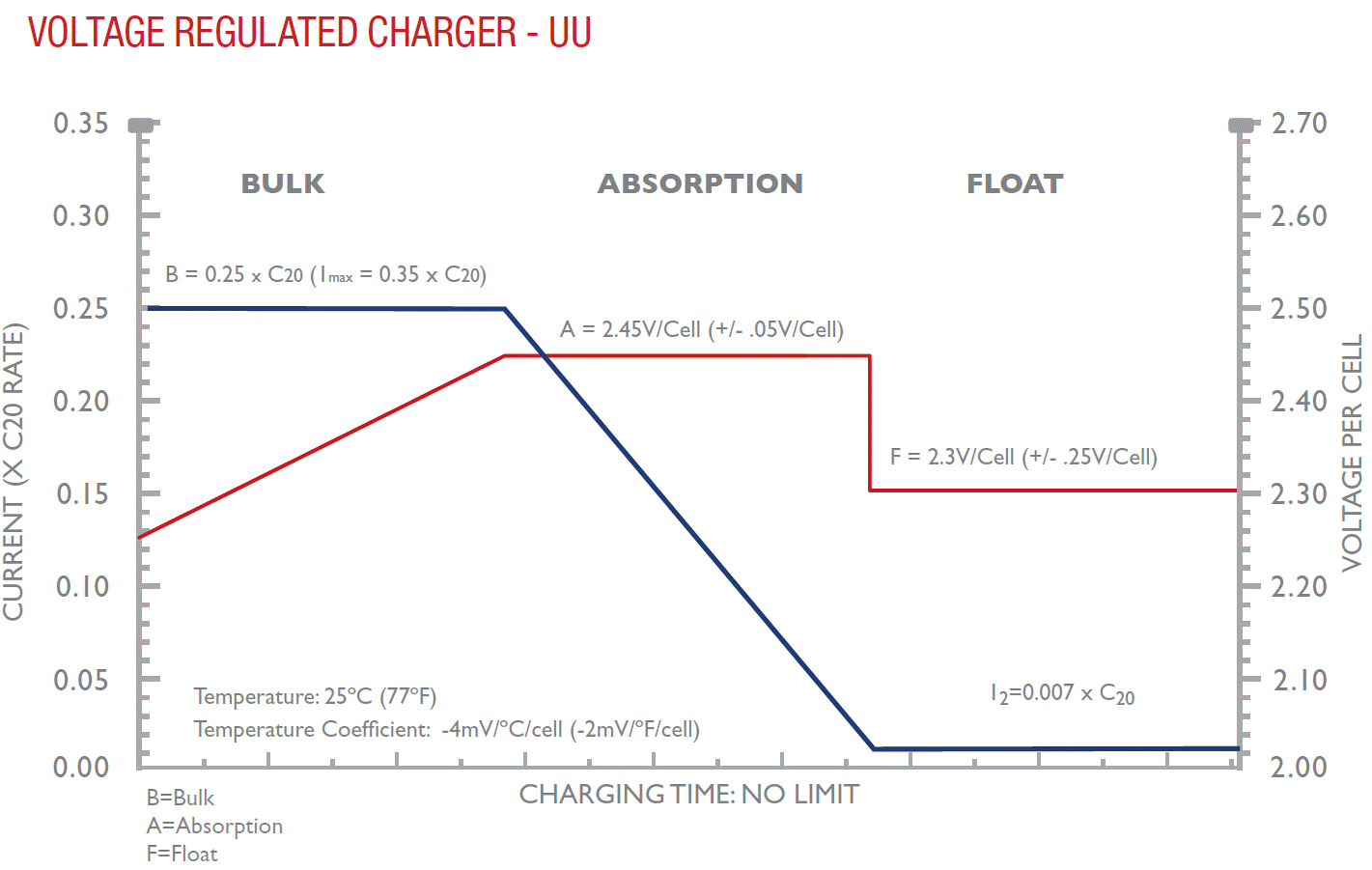
Source: Battery University
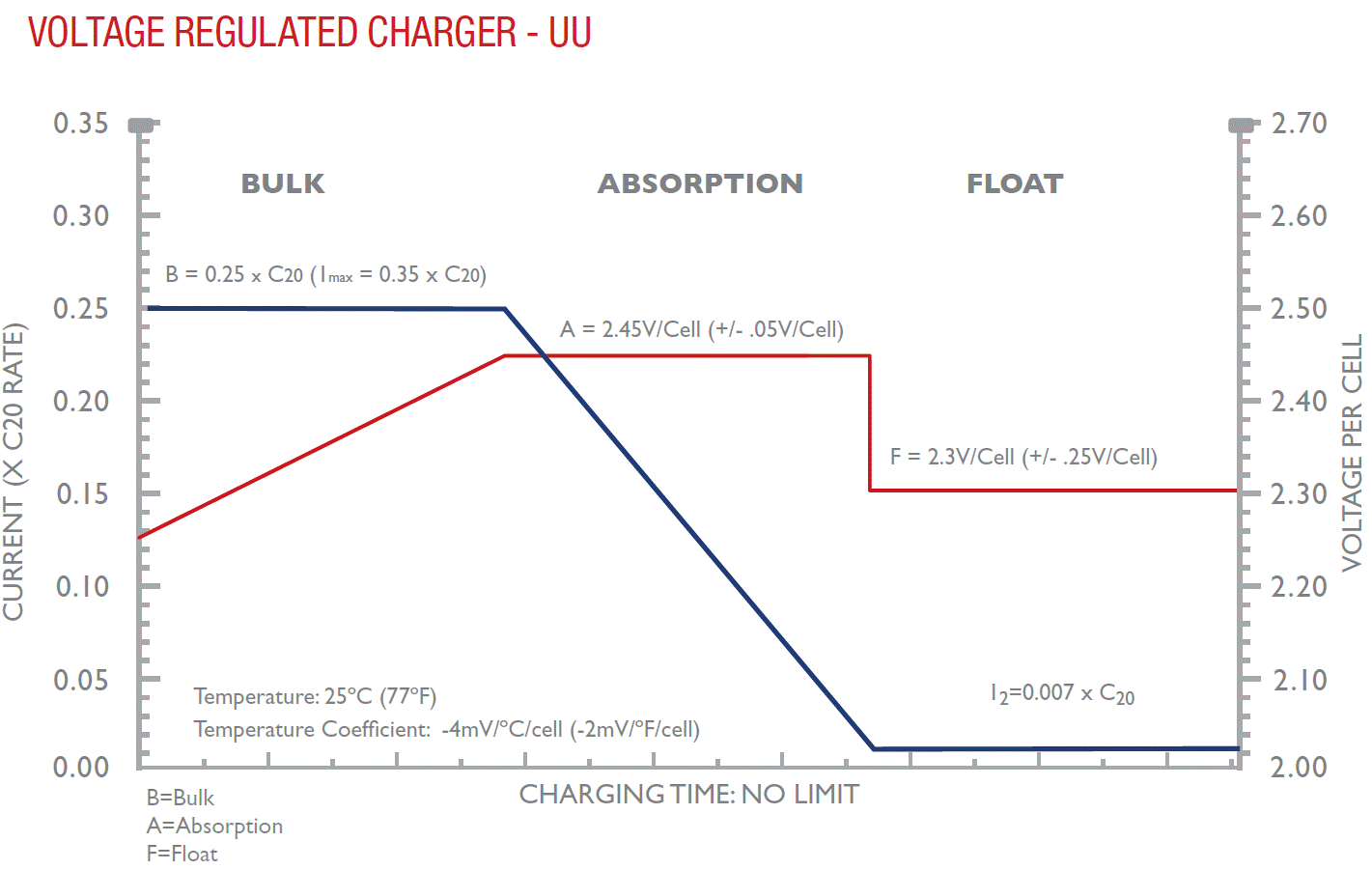
How CCCV Charging Works for Lead Acid Batteries
The standard charging method for lead acid batteries is constant current constant voltage, often shortened to CCCV. A regulated charger first supplies a controlled current. As charge accumulates, battery terminal voltage rises until it reaches the charger’s upper voltage limit. The charger then holds voltage approximately constant while charge current tapers downward as the battery approaches saturation.
For practical charging, this process is usually described in three stages:
- Constant-current bulk charge — The charger supplies a controlled current and the battery voltage rises. This stage restores much of the discharged capacity.
- Topping or absorption charge — The charger holds the upper voltage limit while current gradually declines. This stage completes the charge and helps reduce sulfation from chronic undercharge.
- Float charge — Once the battery is fully charged, the charger reduces voltage to a lower maintenance level that offsets self-discharge without continuing aggressive overcharge.
The topping stage is especially important for lead acid chemistry. If charging stops immediately after the bulk stage, the battery may appear usable but remain below full state of charge. Repeated partial charging encourages sulfation on the negative plate, reducing capacity and charge acceptance over time. For batteries in standby or cyclic service, proper absorption is therefore part of long-term maintenance, not merely a finishing step.
The difficulty is that the absorption voltage is also a stress condition. If a fully charged battery remains at the topping voltage too long, surplus energy is converted into gas and heat. In flooded batteries this causes water loss; in sealed VRLA batteries, excessive overcharge is more serious because the cell has limited ability to replace lost water. High-voltage dwell also contributes to positive-grid corrosion. Once full charge has been reached, the charger should transition to float rather than holding the battery indefinitely at absorption voltage.
Typical lead acid charging is not fast compared with many newer battery systems. A regular battery may require about 12–16 hours to charge, while large stationary batteries may require 36–48 hours. Higher charge currents and multi-stage methods can reduce charge time to roughly 8–10 hours, but this often comes without a complete topping charge. In other words, high current can shorten the bulk portion, but it does not eliminate the electrochemical time needed to reach full saturation.
Voltage limits are application-specific. Peak charge voltage is commonly in the approximate range of 2.30–2.45V per cell, depending on battery construction, duty cycle, temperature, and manufacturer recommendations. For a six-cell 12V lead acid battery, this corresponds to roughly 13.8–14.7V. Cylindrical lead acid cells may use higher voltage settings than some VRLA and starter batteries, so a single universal voltage should not be assumed.
For float service, most flooded lead acid batteries commonly use about 2.25–2.27V per cell, although the correct value still depends on design and service condition. Large stationary batteries at 25°C are often floated near 2.25V per cell. Aging strings can be harder to manage because individual cells may no longer behave identically; a voltage that is adequate for one cell may be excessive or insufficient for another.
Lead acid batteries should also be stored charged. Allowing the open-circuit voltage to fall too low during storage promotes sulfation. A practical maintenance approach is to apply periodic topping charges when needed; the supplied reference material notes a topping charge every six months to prevent voltage from dropping below about 2.05V per cell.
Charge Voltage, Float Voltage, and Temperature Compensation
Temperature changes the correct charging voltage. A warmer battery requires a lower charge and float voltage; a colder battery requires a higher voltage. This is why fixed-voltage charging can be acceptable in a controlled room but problematic in an outdoor cabinet, vehicle compartment, or unconditioned equipment room.
A common compensation rule for lead acid batteries is approximately -3mV per cell per °C relative to 25°C. With this convention, voltage is reduced by about 3mV per cell for every degree Celsius above 25°C and increased by about 3mV per cell for every degree below 25°C. Charger documentation and battery manufacturer specifications should always control the final setting, but the rule illustrates the scale of the correction.
For example, if a float setting is 2.30V per cell at 25°C, then at 35°C the compensated setting would be about 2.27V per cell. At 15°C, it would be about 2.33V per cell. Across a six-cell 12V battery, that 10°C change represents roughly 0.18V of pack-level correction.
The consequences of ignoring temperature are predictable:
- In cold conditions, a fixed-voltage charger may undercharge the battery because the required voltage is higher.
- In hot conditions, the same charger may overcharge the battery because the required voltage is lower.
- In fluctuating environments, both failure modes can occur seasonally.
Temperature-compensated chargers use a sensor at or near the battery to adjust the voltage automatically. This is particularly useful for stationary systems, standby power, renewable-energy systems, and batteries installed where ambient temperature varies widely.
Sealed VRLA batteries deserve extra caution. They are designed to recombine much of the gas generated internally, but they are less tolerant of sustained overcharge and heat than flooded batteries. Excessive voltage can dry the cell, raise internal pressure, and shorten service life. When temperature compensation is not available, a conservative voltage setting is generally safer than an aggressive one, provided the battery still receives adequate periodic full charge.
Fast-Charging Limits and Trade-Offs
Lead acid batteries can accept higher charge current when they are deeply discharged, but charge acceptance declines as state of charge rises. This behavior is central to fast charging: the early part of the charge can be accelerated, but the later absorption portion becomes progressively slower.
The supplied evidence states that a healthy lead acid battery may be charged at up to about 1.5C if current is moderated as the battery approaches full charge and voltage reaches about 2.3V per cell, or about 14.0V for a six-cell 12V battery. This should not be read as a universal recommendation for every lead acid battery. It describes what a healthy battery may tolerate under controlled conditions, not what every manufacturer allows for every product.
A practical fast-charge strategy must limit both current and voltage. High current is least problematic at low state of charge, where the battery can accept charge efficiently. As voltage rises, the charger must reduce current to avoid excessive gassing, heat, and overvoltage. Continuing to force high current into a nearly charged lead acid battery is inefficient and damaging.
Important factors that affect fast-charge acceptance include:
- State of charge: low SoC gives the highest charge acceptance; high SoC gives the lowest.
- State of health: aged, sulfated, or imbalanced batteries accept charge less predictably.
- Temperature: hot batteries are more vulnerable to thermal stress and overcharge; cold batteries require higher voltage but may accept charge more slowly.
- Battery design: flooded, AGM, gel, starter, deep-cycle, and stationary cells are not interchangeable in charge limits.
Charging above the manufacturer’s recommended C-rate requires close monitoring. The battery should not boil, heat excessively, emit heavy gas, or remain at saturation voltage longer than necessary. Flooded batteries may show gas bubbles as they approach full charge, but vigorous or sustained gassing indicates that settings or timing may be too aggressive.
Fast charging also has a basic limitation: it can reduce the time spent in the bulk stage, but it does not remove the need for proper absorption if a full charge is required. A battery charged rapidly to a voltage threshold may be usable, yet not fully saturated. For applications where maximum capacity and sulfation control are important, the absorption stage still has to be completed or scheduled periodically.
Watering Flooded Lead Acid Batteries
Watering applies to flooded lead acid batteries, not sealed VRLA batteries. Flooded cells lose water through normal gassing and electrolysis, especially when charged frequently, held at elevated temperature, or operated near the upper end of the voltage range. Maintaining the electrolyte level is essential because the plates must remain covered.
If the electrolyte falls below the top of the plates, exposed plate material can sulfate, heat unevenly, and lose active capacity. Continued operation in this condition shortens battery life and can cause permanent damage. Regular inspection is therefore part of flooded battery maintenance, although the correct inspection interval depends on battery design, duty cycle, charge settings, and operating temperature.
When electrolyte is low, add distilled or de-ionized water. Tap water may be acceptable in some regions if its mineral content is suitable, but it is not the safest general recommendation. Minerals and contaminants introduced with unsuitable water can affect battery chemistry and increase maintenance problems. For technical and fleet practice, distilled or de-ionized water is the more reliable default.
Watering should be done with attention to charge state. Do not fill a discharged flooded battery to the final level before charging unless the plates are exposed and water is needed immediately to cover them. Electrolyte expands and rises during charging; filling to the final level too early can cause overflow. Overflow removes acid, contaminates the battery top and tray, and changes cell balance.
The usual approach is:
- Inspect the cells before charging.
- If plates are exposed, add just enough distilled or de-ionized water to cover them.
- Charge the battery.
- After charging, top up to the correct level specified by the battery manufacturer.
Do not add electrolyte during routine watering. Adding acid changes specific gravity and can promote corrosion or cell imbalance. Electrolyte is only adjusted under specific service procedures, not as a normal response to low level; ordinary water loss is replaced with water.
Automatic watering systems can reduce maintenance errors in larger flooded-battery installations. They help prevent low electrolyte levels by delivering the correct amount of water to each cell, reducing the chance of missed cells, overfilling, or inconsistent manual practice.
Practical Guidelines for Safe Lead Acid Charging
Safe lead acid charging starts with the battery manufacturer’s specifications. Voltage limits, charge current, absorption time, float voltage, equalization practice, and temperature compensation can vary by construction and application. A charger configured for one type of lead acid battery may not be correct for another.
Use these guidelines as practical engineering checks:
- Use a regulated charger. Unregulated trickle chargers can overcharge lead acid batteries over time, especially when left connected indefinitely.
- Match the charge profile to the battery type. Flooded, AGM, gel, starter, stationary, and cylindrical lead acid batteries can require different voltage settings.
- Do not hold absorption voltage indefinitely. After full charge, the charger should reduce to float voltage.
- Store batteries charged. Avoid deep discharge during storage and apply topping charges when needed.
- Inspect flooded batteries. Keep electrolyte above the plates and water only with suitable water.
- Compensate for temperature. Lower voltage in hot conditions and raise it in cold conditions according to approved specifications.
Ventilation is important when charging flooded batteries. Hydrogen can be emitted during gassing, and hydrogen-air mixtures can be explosive. Charge in a well-ventilated area and keep sparks, flames, cigarettes, and other ignition sources away from batteries. Make and break charger connections with the charger off when possible, and avoid shorting terminals with tools or jewelry.
Gas bubbles in a flooded battery can indicate that the battery is nearing full state of charge. That observation should not be confused with permission to overcharge. Excessive bubbling, audible boiling, strong odor, rising case temperature, or rapid water loss are warning signs. They can indicate excessive voltage, excessive current, high ambient temperature, an aged battery, or charger malfunction.
Temperature also affects standby service. Manufacturer guidance cited in the supplied research recommends lowering float charge when ambient temperature rises above roughly 29°C / 85°F. This is consistent with the broader rule that warmer batteries require lower voltage. Without compensation, a float voltage that is reasonable at room temperature can become excessive in a hot cabinet or engine compartment.
Flooded batteries tolerate some overcharge better than sealed types because lost water can be replaced, but that does not make overcharge harmless. It still wastes energy, increases maintenance, promotes corrosion, and can create a gas hazard. VRLA batteries are more sensitive because water loss is not routinely serviceable. For VRLA batteries, correct voltage regulation and temperature control are especially important.
Stationary lead acid systems add another complication: cell-to-cell variation. In a long series string, weak or aged cells can drift away from the average. The charger regulates total string voltage, but individual cells may not share voltage equally. Periodic inspection, voltage checks, and maintenance procedures appropriate to the installation are necessary for reliable standby service.
The practical goal is a controlled compromise. Lead acid batteries need enough voltage and time to reach full charge and avoid sulfation, but not so much voltage or time that they gas heavily, lose water, corrode, or overheat. CCCV charging, correct float settings, temperature compensation, and maintenance of flooded electrolyte levels are the main tools for keeping that compromise under control.
References
- Battery University | BU-403: Charging Lead Acid. (n.d.). https://batteryuniversity.com/article/charging-the-lead-acid-battery
- Battery University | BU-403: Charging Lead Acid. (n.d.). https://www.batteryuniversity.com/article/bu-403-charging-lead-acid
- Battery University | BU-403: Charging Lead Acid. (n.d.). http://www.batteryuniversity.com/article/bu-403-charging-lead-acid
- Battery University | BU-410: Charging at High and Low Temperatures. (n.d.). https://www.batteryuniversity.com/article/bu-410-charging-at-high-and-low-temperatures
- Battery Float Voltage: Practical Settings for Every Chemistry – Banshee Battery. (n.d.). https://bansheebatteries.com/blogs/news/what-is-battery-float-voltage
- Temperature compensated lead acid battery float charger. (n.d.). https://www.radiolocman.com/shem/schematics.html?di=667187
- Battery University | BU-808b: What Causes Li-ion to Die?. (n.d.). https://www.batteryuniversity.com/article/bu-808b-what-causes-li-ion-to-die
- Learn how to lead-acid battery voltage optimize charging conditions to extend service life.. (n.d.). https://www.bullsbattery.com/industry-news/lead-acid-battery-voltage.html
- Temperature compensated lead acid battery float charger. (n.d.). https://radiolocman.com/shem/schematics.html?di=667187
- Float charging 12v lead acid battery - Electrical Engineering Stack Exchange. (n.d.). https://electronics.stackexchange.com/questions/568151/float-charging-12v-lead-acid-battery