Lithium iron phosphate batteries, often abbreviated LFP or LiFePO4, are part of the lithium-ion family but do not use the same voltage limits as many common 3.6 V nominal lithium-ion cells. They are charged with a voltage-limited method, but the correct terminal voltage is lower. This distinction is central to charger selection: a charger intended for a conventional lithium-ion pack can overcharge an LFP pack, while an LFP charger can leave a higher-voltage lithium-ion pack undercharged.
LFP also overlaps with lead-acid systems in a practical way. At the pack level, a four-cell LFP battery has a voltage close enough to a six-cell lead-acid battery that both are commonly discussed as 12 V-class batteries. Similar comparisons apply in 6 V-class systems. This does not make the chemistries electrically identical, but it explains why LFP is often considered as a replacement for sealed lead-acid batteries in applications such as small energy storage, mobility, backup power, and low-voltage DC systems.
The main charging questions are therefore practical rather than theoretical: which voltage limit is acceptable, whether a lead-acid charger can be used, how float charging affects lithium-based batteries, and what role the battery management system plays. The answers depend on the pack design and manufacturer limits, but the engineering principles are consistent: use the correct charge voltage, avoid unnecessary time at high voltage, and do not assume the BMS can compensate for an unsuitable charger.
How LFP Charging Compares with Other Lithium-Ion Batteries
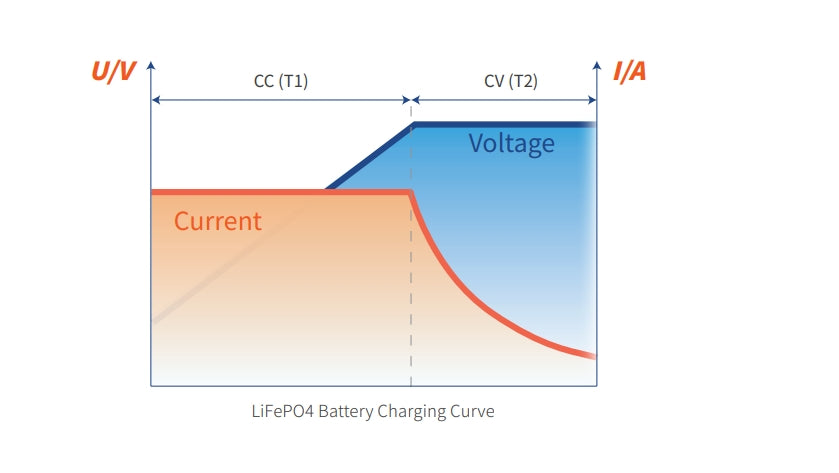
LFP batteries use the same broad charging concept as other lithium-ion batteries: a charger applies current until the battery reaches a set voltage limit, then holds voltage while current tapers. This is commonly described as constant-current/constant-voltage charging, or CC/CV charging.
The important difference is the voltage. A typical LFP cell is about 3.2 V nominal and is commonly charged to about 3.65 V maximum per cell. By comparison, many conventional lithium-ion cells are described as about 3.6 V nominal and require a charger designed around their own higher voltage profile. The two charger families are not interchangeable.
Battery University describes this mismatch clearly: a conventional 3.6 V nominal lithium-ion battery placed in a charger designed for lithium phosphate would not receive a full charge, while a lithium phosphate battery placed in a regular lithium-ion charger could be overcharged. The risk is not that the cells look similar externally; the risk is that the voltage thresholds are different enough to create either undercharge or overcharge.
For a single LFP cell, the difference between nominal voltage and full-charge voltage is modest in absolute terms, but it matters greatly to cell stress and safety. For a pack, the difference multiplies by the number of series cells. A four-cell LFP pack, for example, has a typical full-charge voltage of about 14.6 V when charged to 3.65 V per cell. A charger intended for a different lithium-ion chemistry may target a voltage that is inappropriate for that same four-cell LFP pack.
The practical rule is simple: match the charger to the chemistry and the series-cell count. A charger label that says “lithium-ion” is not specific enough unless it also identifies a voltage profile compatible with the battery. For LFP packs, the battery datasheet or BMS documentation should state the acceptable charge voltage, maximum current, temperature range, and any special requirements for balancing or charge termination.
Why LFP Can Fit Some Lead-Acid Pack Voltages
LFP can resemble lead acid at the pack-voltage level even though the cells inside the batteries are entirely different. Lead-acid cells are commonly treated as about 2 V nominal each. A 12 V lead-acid battery uses six cells in series. A 12 V-class LFP battery typically uses four cells in series, each about 3.2 V nominal.
That gives the following approximate comparison:
| Battery type | Typical series cells in a 12 V-class pack | Nominal cell voltage | Approximate nominal pack voltage |
|---|---|---|---|
| Lead acid | 6 | 2.0 V | 12.0 V |
| LFP | 4 | 3.2 V | 12.8 V |
This similarity is why LFP batteries are often sold into applications originally designed around 6 V or 12 V lead-acid packs. It is also why some systems can accept an LFP replacement with little change to the load side. However, this is only voltage-class compatibility. It does not automatically prove charger compatibility, alternator compatibility, inverter compatibility, low-voltage cutoff compatibility, or safe operation in all temperature conditions.
The advantages that make LFP attractive as a lead-acid replacement are substantial. Compared with lead acid, LFP can offer:
- higher cycle count,
- lower weight,
- smaller size for comparable delivered energy,
- better usable capacity in many applications,
- less sensitivity to partial-state-of-charge operation.
The supplied reference states that LFP provides a higher cycle count and can deliver more than twice the capacity of lead acid. That statement is best understood in a practical-use context rather than as a universal nameplate rule. Lead-acid batteries are often not used to their full rated capacity if long life is required, while LFP batteries can typically provide a larger usable fraction of their rated capacity. In systems where physical size, weight, cycle life, and usable amp-hours matter, those differences can offset the higher purchase price of an LFP pack.
The compatibility question becomes more delicate on the charging side. A lead-acid charger may reach a voltage range that can charge a 12 V-class LFP battery, but lead-acid charging behavior includes features that are not always appropriate for lithium chemistry. The most important of these is float charging.
Using Lead-Acid Chargers with LFP Batteries
Both lead-acid and lithium-based batteries use voltage-limited charging, but they use it for different electrochemical systems and with different end-of-charge behavior. Lead-acid charging commonly includes three broad stages: bulk charging, absorption or saturation at a voltage limit, and float. Float is used because lead-acid batteries self-discharge and may also support small parasitic loads while connected to equipment.
LFP batteries generally do not need that kind of continuous maintenance charge. Once an LFP battery is full, the preferred approach is usually to stop charging or reduce charging in accordance with the battery manufacturer’s specification. Holding a lithium-based battery at an elevated voltage for long periods can shorten service life, and in some systems it may create safety concerns. The reference material specifically notes that lithium-based batteries do not tolerate the lead-acid-style practice of remaining indefinitely on float in the same way lead-acid batteries do.
A lead-acid charger may be usable with an LFP battery only when several conditions are satisfied:
- The charger voltage limits are within the LFP pack’s allowed range. For a four-cell LFP pack, the common full-charge limit is about 14.6 V if charging to 3.65 V per cell, but some battery manufacturers specify lower everyday absorption voltages.
- The charger does not apply an unsuitable long-term float. If the charger cannot disable float, the float voltage must be explicitly allowed by the battery manufacturer.
- The battery manufacturer permits that charging method. Some LFP drop-in batteries are designed for partial compatibility with lead-acid chargers; others are not.
- Charge current is within specification. LFP can often accept higher charge rates than sealed lead acid, but the allowed current is still determined by the cells, interconnects, thermal design, and BMS.
- Temperature limits are respected. The BMS may block charging under unsafe conditions, but the charger and system design should not rely on repeated protective trips as normal operation.
A common mistake is to assume that because the BMS is present, almost any charger is acceptable. The BMS is a protective system, not a universal charger adapter. Depending on the pack, it may protect against overvoltage, undervoltage, overcurrent, short circuit, and temperature extremes. Some LFP packs may also include provisions intended to tolerate certain lead-acid chargers. But if the charger voltage is too high, if it holds the battery at float indefinitely, or if it behaves unpredictably after the BMS disconnects, the system can still be unsuitable.
The correct design goal is for the charger to terminate or reduce charge normally before the BMS has to intervene. BMS cutoff should be treated as a last line of defense, not as routine charge control.
A related issue is parasitic load during charging. If a load remains connected while a charger is trying to detect taper current, the load can prevent the current from falling as expected. The charger may interpret this as the battery still needing charge, extending the high-voltage stage. For lithium-based batteries, unnecessary time at high voltage increases stress. In systems where loads must remain connected, charger settings and system architecture should be selected with that operating mode in mind.
Recommended Voltage Limits and Charging Settings
LFP charging settings should always come from the battery datasheet first. General voltage values are useful for understanding the system, but the manufacturer’s specification controls the actual installation.
Source: Battery University

For engineering comparison, the main voltage relationships are:
| Chemistry | Typical nominal cell voltage | Charging implication |
|---|---|---|
| Lead acid | about 2.0 V per cell | Six cells form a 12 V-class battery; charging often includes absorption and float. |
| LFP / LiFePO4 | about 3.2 V per cell | Four cells form a 12 V-class battery; typical maximum is about 3.65 V per cell. |
| Common 3.6 V nominal lithium-ion | about 3.6 V per cell | Requires a charger profile for that chemistry; not interchangeable with LFP charging. |
For an LFP battery, the typical method is CC/CV charging:
- In the constant-current stage, the charger supplies current up to its programmed limit while battery voltage rises.
- At the voltage limit, the charger changes to constant-voltage operation and current tapers.
- When the battery is full, charge current should stop or fall to a manufacturer-approved maintenance behavior.
For a four-cell 12 V-class LFP pack, a per-cell maximum of about 3.65 V corresponds to about 14.6 V at the pack level. This is a common maximum charge figure, but it should not be interpreted as the best daily setting for every installation. Many LFP battery and system manufacturers recommend lower absorption voltages for routine use, longer life, balancing strategy, inverter compatibility, or to avoid unnecessary high-voltage dwell time.
Lead-acid chargers require separate interpretation. A supplied charging source for sealed lead-acid batteries notes that a 12 V sealed lead-acid charger may keep Stage 2 charging below about 14.7 V and may use float around 13.8 V. Those values help explain why some lead-acid chargers can appear electrically close to the needs of a four-cell LFP battery. However, voltage closeness alone is not enough. The charger’s algorithm, float duration, restart behavior, temperature compensation, and response to BMS disconnects all matter.
Float is the clearest difference:
- Lead acid: float is commonly used to offset self-discharge and support small standby loads.
- LFP: float is usually unnecessary and should be used only if the battery manufacturer specifies an acceptable float voltage and operating mode.
Lithium battery stress increases near full charge. The high-voltage stage should therefore be kept as short as practical, and the battery should not be held at the top of charge longer than needed unless the system manufacturer has designed and approved that behavior. This is especially important in standby systems where a battery may remain connected to a charger for months.
A conservative LFP charging approach is therefore:
- Use an LFP-specific charger when possible.
- Set the charger to the battery manufacturer’s recommended absorption voltage, not merely the theoretical maximum.
- Disable float unless the manufacturer permits it.
- If float is required by the charger or system, verify the exact voltage against the battery datasheet.
- Ensure charge current, temperature range, and low-temperature charge protection are handled by the complete system.
- Confirm how the charger behaves if the BMS disconnects the battery.
For replacement applications, the safest conclusion is not “lead-acid chargers work” or “lead-acid chargers never work.” The correct conclusion is narrower: some lead-acid chargers may be compatible with some LFP packs when their voltage limits and charging behavior match the LFP manufacturer’s requirements. Where the charger cannot be verified, an LFP-specific charger or a programmable charger set to the battery datasheet is the better engineering choice.
References
- Battery University | BU-409b: Charging Lithium Iron Phosphate. (n.d.). http://www.batteryuniversity.com/article/bu-409b-charging-lithium-iron-phosphate
- Battery University | BU-409: Charging Lithium-ion. (n.d.). https://www.batteryuniversity.com/article/bu-409-charging-lithium-ion
- BU-409: Charging Lithium-ion - Battery University. (n.d.). http://www.batteryuniversity.com/article/bu-409-charging-lithium-ion
- BU-409b: Charging Lithium Iron Phosphate - Battery University. (n.d.). https://www.batteryuniversity.com/article/bu-409b-charging-lithium-iron-phosphate
- LiFePO4 Charging Guidelines: What is 100%? What is 0%?! How to Balance??. (n.d.). https://www.youtube.com/watch?v=K9Tfivf5bAI&vl=en
- BU-409 - Charging Lithium-Ion - Battery University | PDF - Scribd. (n.d.). https://www.scribd.com/document/604361612/BU-409-Charging-Lithium-ion-Battery-University
- Charging Lithium (LiFePO4) Batteries | RELiON | RELiON. (n.d.). https://www.relionbattery.com/blog/charging-lithium-batteries
- The Rules of LiFePO4: The 3 Most Common Causes of Failure and General Guidelines for Long Term Use. (n.d.). https://www.youtube.com/watch?v=UbZiHzflKMY&vl=en
- How to Charge Lithium Iron Phosphate Batteries | Power Sonic. (n.d.). https://www.power-sonic.com/how-to-charge-lithium-iron-phosphate-lifepo4-batteries
- The Comprehensive Guide to LiFePO4 Voltage Chart. (n.d.). https://www.litime.com/blogs/blogs/lithium-battery-voltage-chart