Nickel-cadmium batteries are older than lithium-ion systems, but they remain important in applications that value ruggedness, high discharge capability, wide operating tolerance, and predictable abuse behavior. Charging them correctly is less simple than applying a fixed voltage and waiting for the current to taper. A NiCd cell is normally charged with controlled current while its voltage is allowed to rise according to cell condition, temperature, state of charge, and charger behavior.
This is a major difference from lithium-ion and lead-acid charging practice. Lithium-ion and lead-acid batteries are commonly charged by applying regulated current until a defined voltage limit is reached, followed by a voltage-regulated saturation or absorption period. Sealed nickel-based batteries do not provide the same straightforward voltage endpoint. Their full-charge condition is usually detected indirectly, using temperature behavior, voltage signature, time limits, or combinations of these methods.
New NiCd batteries, or cells that have been stored for a long time, may also need careful initial charging and several charge-discharge cycles before they deliver their best practical performance. During charging, sealed cells generate gases near full charge; healthy cells can recombine much of this gas internally, but sustained overcharge increases pressure and heat. Safety vents are included to relieve excessive pressure, but venting can permanently remove electrolyte and reduce battery health. For this reason, the charger must match both the NiCd chemistry and the intended charge rate.
NiCd Charging Basics and Initial Conditioning
The basic NiCd charging method is constant-current charging. The charger sets the charge current, and the battery voltage is allowed to rise freely rather than being clamped to a precise final voltage in the way used for many lithium-ion and lead-acid systems. This does not mean voltage is ignored; it means voltage is used mainly as a diagnostic signal or safety reference rather than as the primary charging regulator for sealed NiCd cells.
A typical charging strategy depends on the cell type and charge rate:
- Slow or overnight charging uses low current and often relies on time and conservative design.
- Fast charging uses a much higher current and requires reliable end-of-charge detection.
- Maintenance or trickle charging applies a small current after charge completion to offset self-discharge.
- Flooded NiCd charging follows a different voltage-and-current procedure because the cells are vented and serviceable.
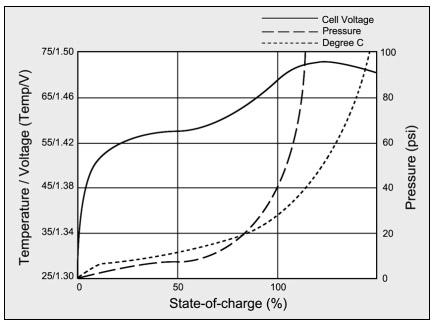
Full-charge detection is the hard part. In a sealed NiCd cell, the terminal voltage does not simply rise to a fixed safe limit and stay there. Near full charge, the chemistry shifts toward oxygen generation and recombination. This produces heat and pressure effects that can be used for charge termination, but those signals depend on charge rate, cell design, temperature, age, and charger sensing quality.
Initial conditioning matters because NiCd batteries may not deliver full capacity immediately after manufacturing, long storage, or deep inactivity. Several normal charge-discharge cycles can help the pack reach stable operating performance. This is not a reason to abuse the battery; it is a reason to avoid judging a new or long-stored pack from a single first cycle.
Sealed NiCd cells contain pressure-relief vents. These vents are a safety feature, not a routine operating mechanism. During properly controlled charging, gases generated near full charge are largely recombined inside the cell. If overcharge continues, internal pressure and temperature rise. If the vent opens, gas and electrolyte can be lost. Once electrolyte is lost, it cannot be restored in a sealed consumer cell, and capacity, internal resistance, and cycle life can suffer.
Practical caution: use a charger designed for NiCd cells and for the pack size and charge rate involved. A charger intended for lithium-ion, lead-acid, or even a different nickel-based charging algorithm may terminate incorrectly or fail to provide the safety limits the pack requires.
Temperature-Based Full-Charge Detection
Temperature is one of the oldest ways to detect the end of charge in nickel-based batteries. As a NiCd cell approaches full charge, more of the charging energy is converted into heat instead of stored chemically. A charger can sense this temperature behavior using a thermistor in contact with the cell or battery pack.
A simple absolute-temperature cutoff is easy to understand: stop charging when the pack reaches a selected temperature. The weakness is that temperature rise can lag behind the actual full-charge condition. By the time the surface temperature reaches the cutoff point, the cell may already have spent significant time in overcharge. This is especially undesirable during fast charging, where energy input is high and pressure can build quickly near the end of charge.
More responsive methods look at temperature change rather than only temperature level. Two common approaches are:
- Delta temperature, which terminates when the battery temperature has risen by a specified amount from its starting point.
- Rate of temperature rise, often expressed as dT/dt, which terminates when temperature begins increasing rapidly over time.
These methods can keep the battery cooler than a fixed high-temperature cutoff because they detect the onset of heating rather than waiting for a high final temperature. Some charger designs still include an absolute cutoff, such as around 60°C, as a backup safety limit if the expected temperature-rise signal is not detected.
Temperature-based detection has an important requirement: the pack must be charged fast enough for a clear temperature-rise signature to appear. If the charge current is too low, heat may dissipate as quickly as it is generated, and the charger may not see a strong dT/dt signal. In that case, termination may depend on a timer, an absolute temperature limit, or another backup method.
A common failure mode occurs when a fully charged NiCd pack is repeatedly removed from and reinserted into a temperature-based charger. Because the battery is already full, additional current immediately becomes overcharge energy. However, the charger may wait for a temperature signature before terminating. Each reinsertion can add another overcharge interval before the sensor response becomes large enough. This repeated overshoot increases stress, gas generation, heating, and the chance of venting.
Temperature sensing is still useful, especially as a safety layer. It is less ideal as the only precision termination method for fast charging sealed NiCd packs. The best practical chargers usually combine several checks: temperature behavior, maximum temperature, voltage behavior, time limits, and sometimes pack-specific information.
Source: Battery University

Voltage-Signature Full-Charge Detection
A more precise method for sealed NiCd full-charge detection is the voltage signature known as negative delta voltage, or NDV. During charge, the terminal voltage of a NiCd cell rises. At full charge, the voltage reaches a peak and then drops slightly. A charger that can detect this small drop can terminate the fast charge close to the true full-charge point.
NDV is useful because it responds directly to an electrochemical transition at end of charge. Compared with temperature-only termination, it can reduce unnecessary overcharge when the sensing electronics are stable and the charge current is appropriate. It also handles one important use case better: inserting an already full battery. In a suitable NDV charger, the terminal voltage rises quickly and then drops, allowing the charger to identify the ready state rather than waiting for a large temperature increase.
Reliable NDV detection is not automatic. The charger must be designed to distinguish a real voltage drop from noise, contact resistance changes, pack imbalance, and normal voltage fluctuation. The signal is easier to detect at an adequate charge rate. If the charge current is too low, the voltage peak may be weak or difficult to separate from measurement noise. Good pack contacts, stable current control, and appropriate filtering are important.
Charge efficiency changes strongly across the charge process. During roughly the first 70 percent of charge, NiCd charge efficiency is close to 100 percent; most of the electrical energy is stored chemically, and the pack remains relatively cool. Past this region, efficiency falls, more gas generation and recombination occur, and heat increases. For this reason, some chargers reduce current after about 70 percent state of charge to reduce stress while still completing the charge.
Fast charging can also be more efficient than slow charging. Reported values for a standard NiCd are about 91 percent efficiency at a 1C charge rate, giving a charge time of about 66 minutes under those conditions. At 0.1C, efficiency may be about 71 percent, extending charge time to roughly 14 hours. These figures illustrate an important characteristic of NiCd charging: slower is not always gentler if the slow charge causes long exposure to inefficient overcharge conditions.
NiCd cells designed for fast charging can tolerate high charge rates better than many other rechargeable chemistries when the charger terminates correctly. This does not mean every NiCd pack can be charged at any high current. The cell design, pack construction, heat removal, and charger algorithm all matter. Fast charging without reliable termination is damaging because once the cell is full, continued current mainly produces heat, gas, and pressure.
Fast Charging, Pulse Charging and Trickle Maintenance
Fast charging is useful when the charger can reliably detect the end of charge and stop or reduce current promptly. A proper fast charger may use NDV as the main termination method, with temperature and time as backup safeguards. The higher the charge current, the more important it becomes to terminate correctly. Overcharge at high current can quickly drive temperature rise, pressure buildup, and venting.
Some nickel-based charging systems use pulse charging, where current is delivered in pulses rather than as a continuous DC level. In some approaches, brief discharge pulses are inserted between charge pulses. This can improve charge acceptance in nickel-based batteries under certain conditions. However, this is chemistry-specific behavior. Pulse-charging practices used for NiCd or NiMH should not be assumed to apply to lithium-ion or lead-acid batteries, which use different charging rules and safety constraints.
After a sealed NiCd pack reaches full charge, it is common to apply a small maintenance current to compensate for self-discharge. The reference range for NiCd trickle charge is typically about 0.05C to 0.1C. This current is much lower than the fast-charge current, but it is still not harmless if applied unnecessarily for long periods.
The practical goal is to use the lowest effective trickle current that maintains readiness without keeping the cell warm. A warm battery on trickle charge can indicate that the maintenance current is too high, that the charger failed to terminate correctly, or that the pack is no longer accepting charge normally. Nickel-based batteries should not be left in a charger indefinitely when avoidable. A practical recommendation is to avoid leaving them on charge for more than a few days; remove the pack after charge completion and recharge shortly before use if maximum runtime is needed.
This is particularly relevant for simple consumer chargers. Some low-cost chargers rely heavily on timers or crude temperature thresholds and may continue applying current after the pack is full. If a charger consistently makes NiCd cells hot rather than mildly warm near the end of charge, it should be treated with caution.
Charging Flooded Nickel-Cadmium Batteries
Flooded NiCd batteries are charged differently from sealed NiCd packs. They are vented, serviceable cells used in industrial and standby applications, and their charging procedure is based on controlled current and cell voltage targets rather than sealed-cell NDV behavior.
A typical flooded NiCd charging protocol is:
- Charge with constant current until the cell voltage reaches about 1.55 V per cell.
- Reduce the current to about 0.1C.
- Continue charging until the cell voltage again reaches about 1.55 V per cell.
- Apply a trickle charge if required, while allowing the voltage to float freely.
Higher charge voltages can be used in some circumstances, but they increase gas generation. In flooded cells, gas evolution leads directly to water consumption. Excessive voltage therefore accelerates water depletion and increases maintenance burden. Unlike sealed cells, flooded cells are designed for electrolyte service, but unnecessary gassing is still undesirable because it wastes energy, increases ventilation requirements, and shortens maintenance intervals.
NDV termination is not suitable for flooded NiCd batteries. The negative delta voltage behavior used in sealed NiCd charging depends on the pressure and gas recombination behavior of sealed construction. Flooded cells are not pressurized in the same way and do not absorb gases internally in the same manner. Their end-of-charge behavior must therefore be managed according to the flooded-cell charging procedure and the manufacturer’s instructions.
Maintenance is a central part of flooded NiCd operation. Water level, electrolyte condition, ventilation, and charging voltage all matter. Applying excessive voltage to force faster completion may appear convenient, but the result is more gassing and faster water loss. In industrial installations, this can create avoidable maintenance work and reduce reliability if water replacement is neglected.
Because flooded NiCd designs vary by manufacturer and application, the final authority should always be the battery manufacturer’s charging manual. The 1.55 V per cell and 0.1C steps describe the general method, but standby, cycling, aviation, rail, emergency power, and other industrial uses may have specific limits for temperature, current, commissioning, equalizing, and maintenance charging. Matching the charger to the actual flooded NiCd type is as important as matching it to the chemistry itself.
References
- Battery University | BU-407: Charging Nickel-cadmium. (n.d.). https://batteryuniversity.com/article/charging-nickel-based-batteries
- BU-407: Charging Nickel-cadmium. (n.d.). http://www.batteryuniversity.com/article/bu-407-charging-nickel-cadmium
- BU-407: Charging Nickel-cadmium. (n.d.). https://batteryuniversity.com/article/bu-407-charging-nickel-cadmium
- How to charge nickel cadmium batteries in cells or packs. (n.d.). https://www.powerstream.com/NiCd.htm
- NiCd Charging: Nickel Cadmium Recharging » Electronics Notes. (n.d.). https://www.electronics-notes.com/articles/electronic_components/battery-technology/nicad-nicd-nickel-cadmium-recharging.php
- Battery University | BU-408: Charging Nickel-metal-hydride. (n.d.). http://www.batteryuniversity.com/article/bu-408-charging-nickel-metal-hydride
- How Much Voltage is Needed to Charge a NiCd Battery? | Redway Tech. (n.d.). https://www.redway-tech.com/what-voltage-is-needed-to-charge-a-nicd-battery
- [PDF] Nickel–cadmium battery. (n.d.). https://ia802807.us.archive.org/10/items/Electricity-prep/Batteries/NiCD/Nickel_Cadmium_Battery-2016.pdf
- NiMH / NiCd Chargers | Nova Battery Systems. (n.d.). https://novabatterysystems.com/product-category/chargers/oem-charging-solutions/nimh-nicd-chargers
- Battery University | BU-408: Charging Nickel-metal-hydride. (n.d.). https://batteryuniversity.com/article/charging-nickel-metal-hydride