Nickel-metal hydride (NiMH) batteries use charging methods that are closely related to nickel-cadmium (NiCd) batteries, but they are less forgiving when the charger gets the termination point wrong. A charger that works well enough for NiCd may overcharge NiMH cells because NiMH has a smaller voltage signature at full charge and is more sensitive to sustained trickle current.
Good NiMH charging is therefore less about applying a fixed voltage and more about controlling current, watching the cell response, and terminating charge at the right time. Modern NiMH chargers commonly combine voltage behavior, temperature behavior, timers, and safety cutoffs rather than relying on one signal alone. This is especially important in consumer AA/AAA chargers, cordless tool packs, emergency-lighting packs, and other nickel-based systems where cells may be partially charged, aged, or mismatched.
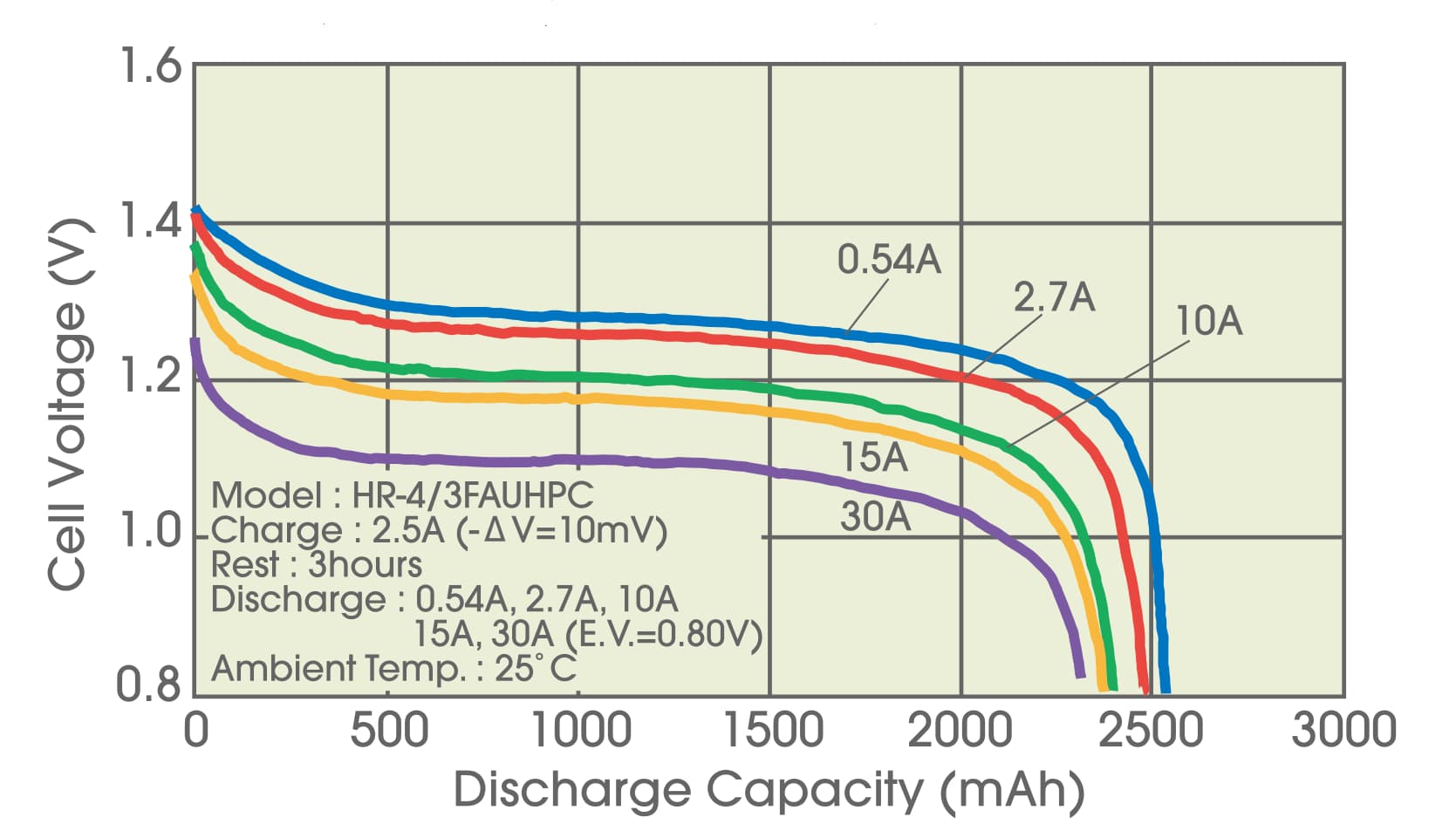
Source: Battery University
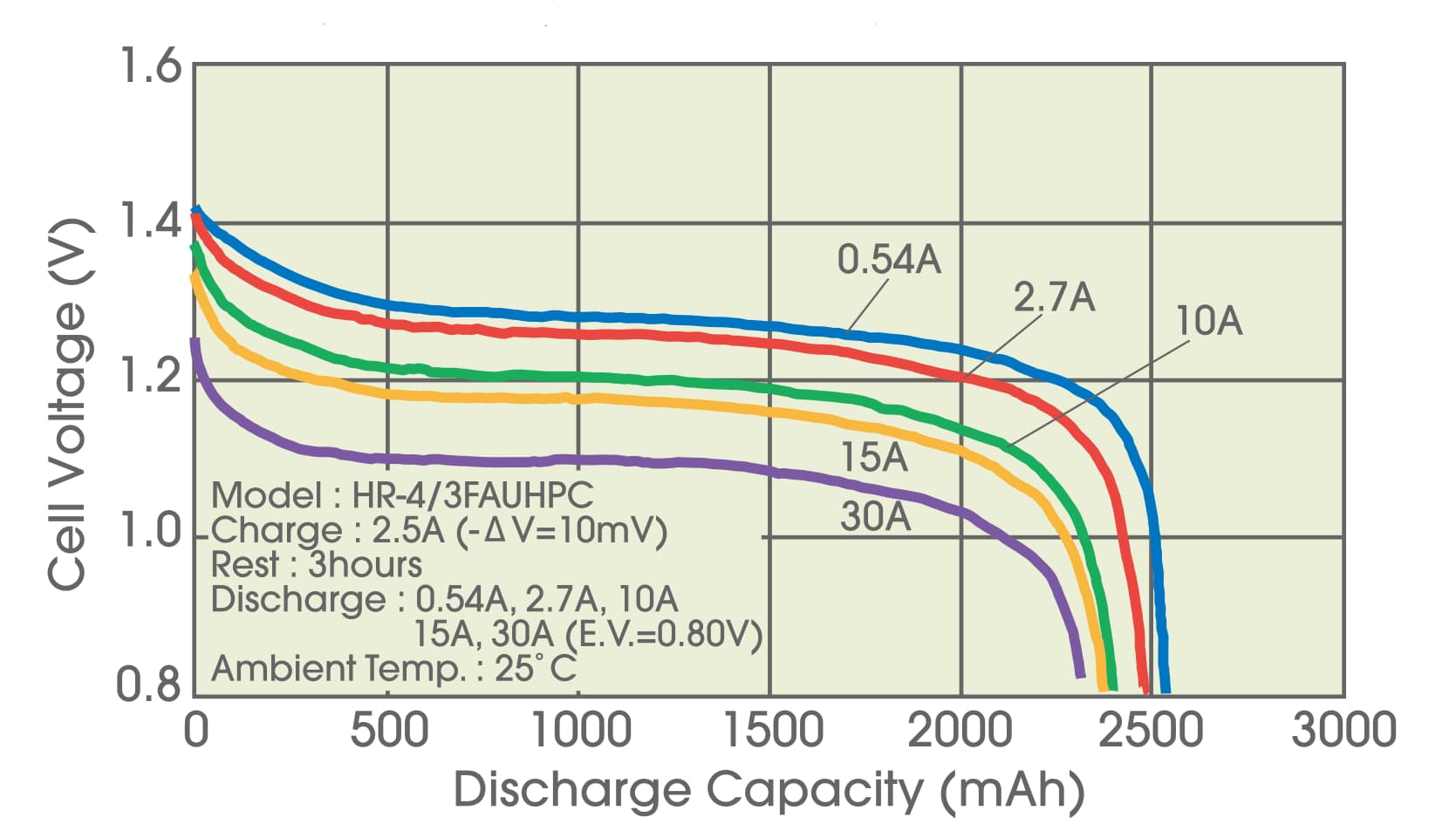
How NiMH Chargers Detect Full Charge
NiMH and NiCd cells are both nickel-based rechargeable chemistries, so their charger designs have a family resemblance. In normal fast charging, the charger supplies a controlled current and looks for signs that the cell is approaching full charge. The important difference is that NiMH full-charge detection is more delicate.
A common termination method is negative delta V detection, often written as -ΔV. As a NiMH cell reaches full charge, its terminal voltage stops rising and may fall slightly. The charger interprets this small voltage drop as a signal to stop the main charge current. For NiMH, the voltage drop can be only a few millivolts per cell; the commonly cited design value is about 5 mV per cell. That is much smaller than the signal historically used for many NiCd chargers, which is why a charger designed only around NiCd behavior may miss the correct NiMH cutoff point.
Because the voltage change is small, the charger’s measurement system matters. The charger must distinguish a real electrochemical trend from:
- electrical noise from the charger power stage,
- contact resistance changes at the cell terminals,
- cell-to-cell variation in a series pack,
- temperature-related voltage movement,
- temporary voltage sag caused by load or current switching.
This is why electronic filtering is important in NiMH chargers. Filtering smooths short-term noise so the charger does not terminate early because of a false voltage dip. At the same time, filtering cannot be so slow that it hides the real -ΔV signal and allows the cell to remain on fast charge after it is already full. In practical charger design, voltage detection is usually part of a broader control strategy rather than a standalone decision.
Modern NiMH chargers may use several termination and safety methods together:
| Detection or cutoff method | What it watches | Practical role |
|---|---|---|
| Negative delta V | Small voltage drop after peak | Main fast-charge termination method in many smart chargers |
| Voltage slope | Rate of voltage rise or flattening | Helps identify the approach to full charge |
| Temperature rise | Cell or pack warming | Indicates falling charge efficiency near full charge |
| Absolute temperature | Maximum safe temperature threshold | Safety cutoff if the pack gets too hot |
| Timer | Maximum allowed charge duration | Backup protection against missed termination |
| Capacity or current limit | Charge delivered over time | Helps prevent excessive input on known cell sizes |
Temperature behavior is useful because nickel-based cells are relatively efficient through much of the charge, then increasingly convert excess charging energy into heat as they approach full charge. Battery University’s guidance states that charge efficiency is close to 100 percent up to roughly 70 percent state of charge, after which efficiency decreases and the pack begins to warm. This warming is useful information, but it should not be the only signal in a fast charger because ambient temperature, pack construction, sensor placement, and charge current all influence the measured result.
Some charger designs use a step-differential or stepped-current approach. In this concept, the charger applies charge in controlled current steps and observes the cell’s voltage response between or during those steps. The goal is to read the battery’s condition more accurately than with a simple constant-current timer. Sources describing this method associate it with improved charge completeness, but the supplied evidence does not support a precise percentage capacity gain. The practical point is that stepped or adaptive charging can be useful, but it still requires reliable termination and thermal safeguards.
There is also a tradeoff between fast charging and service life. NiMH cells can often be fast charged effectively when the charger is designed for NiMH, but aggressive charging raises stress. One cited comparison warns that aggressive chargers may reduce pack life to about 300 cycles instead of an expected 350–400 service cycles. The exact result depends on cell design, temperature, current, depth of discharge, and termination accuracy, so the number should be treated as an example rather than a universal limit.
For engineering practice, the safest interpretation is simple: NiMH fast charging is acceptable only when the charger can detect full charge reliably and stop or reduce current promptly. A crude charger that merely applies current for a fixed time is much more likely to overcharge cells in real use.
Overcharge, Trickle Charge, and Slow-Charge Risks
NiMH batteries are less tolerant of overcharge than NiCd batteries. This difference explains many charger compatibility problems. Older or simpler NiCd chargers may use termination thresholds that are not sensitive enough for NiMH, and some rely on relatively high trickle currents after the main charge. Battery University notes that original NiCd charger trickle charge was commonly around 0.1C, a level that NiMH cells may not tolerate well for extended periods.
Overcharge does not always announce itself immediately. A cell can be damaged even if it does not become extremely hot during every event. Repeated overcharge accelerates aging, increases pressure and heat generation, and can reduce usable capacity. In consumer use, this is often described as the charger “cooking” the cells: the batteries come out hot, the charger never seems to shut down correctly, and the cells lose runtime after repeated cycles.
The charger mismatch can be summarized as follows:
| Charger situation | Risk for NiMH cells |
|---|---|
| NiCd-only charger with insensitive -ΔV detection | May miss the smaller NiMH full-charge signal |
| NiCd charger with high trickle current | May keep NiMH cells warm and overcharged after full charge |
| Timer-only charger | May overcharge partially charged or aged cells |
| Smart charger rated for NiMH | Better chance of correct termination and safer maintenance current |
| Lithium-ion charger | Not suitable; different chemistry and charge algorithm |
NiMH and lithium-ion chargers are not interchangeable. Lithium-ion cells are normally charged with a constant-current/constant-voltage algorithm and require strict voltage limits. NiMH cells are not charged by holding a fixed lithium-style voltage per cell. Using the wrong charger type can create a serious safety hazard or destroy the battery.
Slow charging NiMH cells also has a specific problem. At about 0.1C to 0.3C, the voltage and temperature profiles may be too weak or poorly defined for reliable full-charge detection. A fast charge produces clearer voltage and temperature signals, while a slow charge can make the end-of-charge point difficult to recognize. As a result, slow chargers often depend on timers.
Timer-based charging is simple but fragile. It assumes that the cell begins at a known state of charge and has its rated capacity. Real batteries often violate both assumptions:
- The cell may already be partially charged. A fixed timer may deliver a near-full charge again, causing overcharge.
- The cell may have lost capacity with age. A timer sized for the original capacity may now push more charge than the reduced-capacity cell can safely accept.
- Cells in a pack may not be balanced. The weakest cell reaches full charge first and experiences the most overcharge.
- Ambient temperature may be unsuitable. Charging a hot cell reduces charge acceptance; charging near freezing can also be unsafe or ineffective.
The reduced-capacity case is particularly important. If an old cell can hold only half its original charge, a timer programmed to deliver a full rated charge no longer matches the battery. The charger may apply energy as though the full original capacity still exists, while the aged cell has nowhere useful to store it. This is one reason old NiMH cells may become warm sooner than expected and may perform poorly even after a long charge.
Trickle charge should also be treated carefully. Nickel-based cells may be maintained at a low current in some applications, but the current must be low enough that the cell cools rather than remains warm. If a NiMH cell stays warm on trickle charge, the maintenance current is probably too high. For consumer cells, removing the batteries after charge is often better than leaving them in a low-cost charger for convenience.
Practical Charging Guidelines for Nickel-Based Batteries
Nickel-based batteries should be charged under moderate conditions and with a charger intended for their chemistry. For NiMH cells, this usually means a smart charger that explicitly supports NiMH and uses proper termination. A charger that supports both NiMH and NiCd can be acceptable if it applies the correct algorithm for each chemistry; a charger designed only for NiCd should not be assumed safe for NiMH.
Charge temperature is a basic control point. Charge NiMH and other nickel-based batteries at room temperature when possible. Do not charge cells when they are hot from use, hot from the environment, or at freezing temperatures. Let a warm pack cool before charging. If a charger or device encloses the pack tightly, pay extra attention because heat may not escape quickly.
During much of the charge, nickel-based batteries should remain relatively cool. As charge efficiency drops near full charge, warming becomes more noticeable. A cell that becomes lukewarm near the end of a controlled fast charge may simply be nearing full charge. A cell that becomes hot, or a charger that repeatedly leaves cells hot, indicates a problem.
Practical checks for consumer chargers include:
- Remove cells when they are presumed full, especially in low-cost chargers.
- If cells become warm to the touch near the expected end of charge, do not leave them charging indefinitely.
- Stop using a charger that makes batteries hot or repeatedly “cooks” them.
- Do not leave NiMH cells in a charger for long periods unless the charger is designed for safe maintenance and the cells remain cool.
- Keep cell sets matched in multi-cell devices where possible, especially in series packs.
For low-cost timer chargers, the user has to compensate for the charger’s lack of intelligence. Estimate the battery’s state of charge before charging. If the batteries were only lightly used, avoid running a full timer cycle. It is generally safer to remove cells a little early and recharge before the next use than to leave them in a charger continuously for storage.
Fast charging is not automatically harmful for NiMH. In fact, NiMH can often be charged more effectively by a suitable smart fast charger than by a crude slow charger, because the fast charger produces clearer termination signals and can stop at the right point. The problem is not speed alone; the problem is uncontrolled speed, poor termination, excessive temperature, and prolonged overcharge.
Slow charging should not be treated as inherently gentle. A lingering slow charge can be harmful when the charger cannot identify full charge and simply continues applying current. At 0.1C to 0.3C, NiMH voltage and temperature signatures may not be distinct enough for dependable automatic termination, so a timer-only approach must be used with caution.
Trickle charging requires similar caution. A proper maintenance current should not keep the battery warm. If the pack remains warm after the main charge has ended, the trickle current is too high or the charger is not terminating correctly. For loose consumer cells, removing them after charge is often the most practical protection.
Finally, keep charger chemistry boundaries clear. Nickel-based and lithium-based batteries require different charging algorithms. NiMH cells need a NiMH-compatible charger with sensitive full-charge detection, thermal awareness, and appropriate safety limits. NiCd chargers may overcharge NiMH unless they are explicitly designed for both systems, and lithium-ion chargers should not be used for NiMH at all.
References
- Battery University | BU-408: Charging Nickel-metal-hydride. (n.d.). http://www.batteryuniversity.com/article/bu-408-charging-nickel-metal-hydride
- Battery University | BU-408: Charging Nickel-metal-hydride. (n.d.). https://batteryuniversity.com/article/charging-nickel-metal-hydride
- Battery University | BU-408: Charging Nickel-metal-hydride. (n.d.). https://batteryuniversity.com/article/bu-408-charging-nickel-metal-hydride
- Charging NiMH batteries - Motors, Mechanics, Power and CNC - Arduino Forum. (n.d.). https://forum.arduino.cc/t/charging-nimh-batteries/1142691
- Charging Nickel-metal-hydride. (n.d.). https://www.godsontechnology.com/news/charging-nickel-metal-hydride.html
- Ultimate Guide To Charging Nickel Metal Hydride Batteries: Principles, Methods, And Safety Tips. (n.d.). https://www.tycorunenergy.com/charging-nickel-metal-hydride-batteries
- Nickel Metal Hydride (NiMH) Appl Manual Datasheet by Energizer Battery Company | Digi-Key Electronics. (n.d.). https://www.digikey.fr/htmldatasheets/production/2094832/0/0/1/nickel-metal-hydride-nimh-appl-manual.html
- Custom Nickel Metal Hydride & Cadmium Battery Charging Pack. (n.d.). https://emergingpower.com/custom-battery-design/custom-nickel-metal-hydride-battery-pack
- NiMH battery technology, how to charge Nickel Metal Hydride Batteries tutorial for design engineers, as well as NiMH chargers.. (n.d.). https://www.powerstream.com/NiMH.htm
- Nickel Metal Hydride Battery - an overview | ScienceDirect Topics. (n.d.). https://www.sciencedirect.com/topics/engineering/nickel-metal-hydride-battery