A battery can appear to operate normally while its usable capacity, power capability, or reliability is declining. For applications that depend on predictable energy delivery, a simple voltage check or an observation that the battery still starts a vehicle is not enough. The more important question is whether degradation is proceeding in a measurable and manageable way—or whether an unexpected failure is approaching.
This distinction matters as batteries support electrified transport, backup systems, portable equipment, and other critical loads. Systematic condition assessment is the basis of reliability-centered maintenance: maintenance decisions should reflect the actual condition and duty requirements of the equipment rather than rely only on age, fixed replacement intervals, or failure after the fact.
Battery diagnostics aim to make that condition more transparent. One approach is electrochemical impedance spectroscopy (EIS), which examines how a battery responds to an electrical stimulus over a range of frequencies. Combined with operating data and validated reference models, the result can support decisions about service, continued use, reserve capacity, and replacement.
Why Battery Condition Assessment Matters
A battery’s ability to deliver some energy does not prove that it can meet its intended duty cycle. A starter battery may still crank an engine but have little reserve after repeated starts. A portable lithium-ion pack may power a device briefly while no longer meeting its original runtime. A stationary battery may remain on float charge while its capacity has deteriorated.
Condition assessment separates several questions that are often treated as one:
- Is the battery presently functional?
- How much capacity or power capability remains?
- Can it meet a specified load or duty cycle?
- Is its degradation predictable?
- Is corrective service appropriate, or is replacement the safer decision?
Without this information, organizations may replace batteries too early, retain weak batteries too long, or discover a failure only when the equipment is needed. Historical failures in infrastructure and aviation illustrate the broader engineering lesson: equipment that appears serviceable can contain hidden weaknesses, and inspection methods must be designed to reveal failure mechanisms before they become operational failures. The exact diagnostic method depends on the battery chemistry, construction, environment, and application.
Reliability-centered maintenance applies the same principle to batteries. Instead of replacing every unit on an identical schedule, maintenance planners can combine condition data, usage history, consequences of failure, and required performance. This does not eliminate the need for scheduled inspections or safety controls, but it can make maintenance decisions more evidence-based.
Electrochemical Impedance Spectroscopy for Rapid Battery Screening
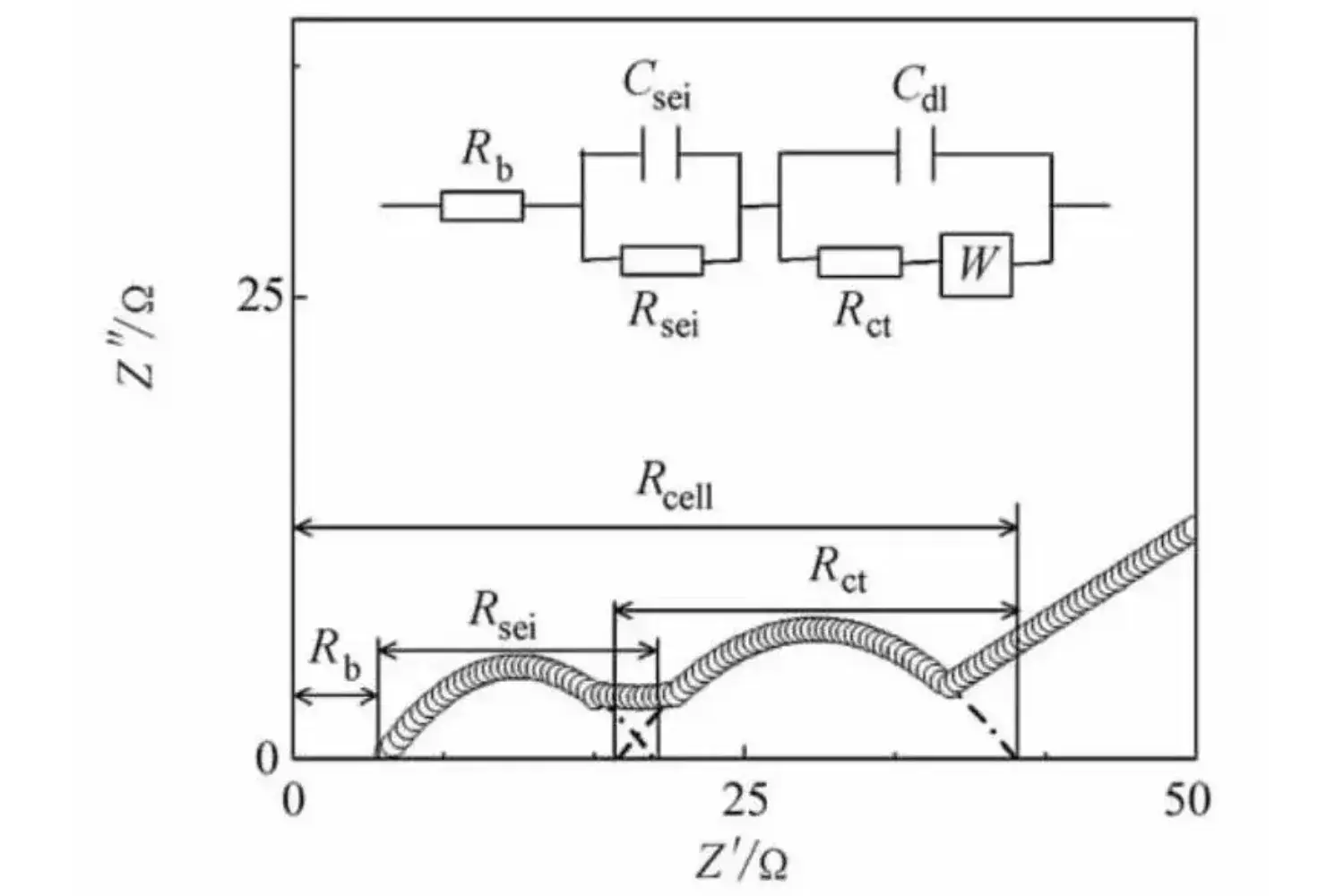
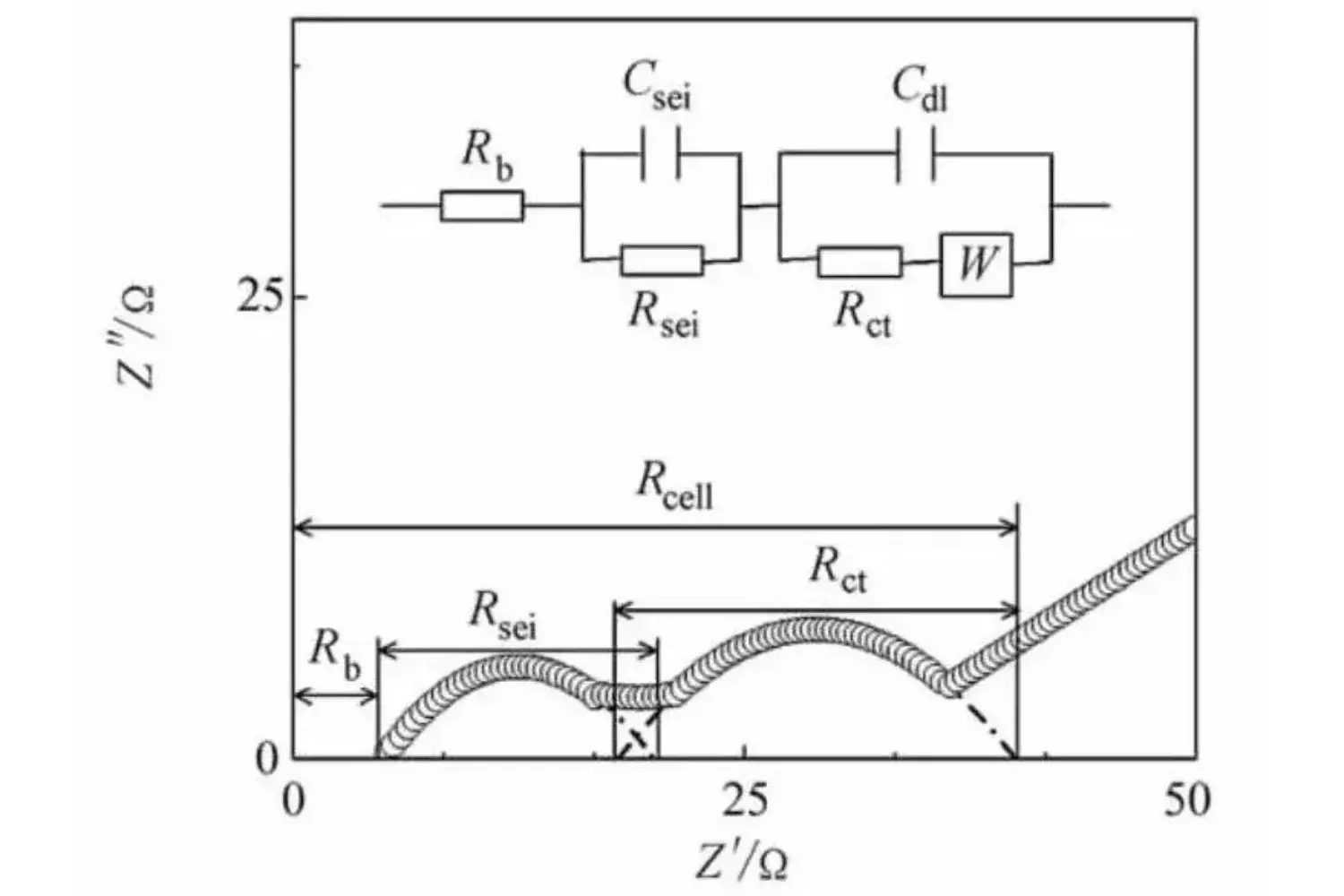
Electrochemical impedance spectroscopy measures the relationship between an applied electrical perturbation and the battery’s response over multiple frequencies. The response reflects contributions from processes such as ohmic resistance, charge transfer, and ion transport. The method is different from a voltage check, a capacity test, or a conventional load test.
A voltage measurement records an electrical condition at a particular state of charge and temperature. A capacity test measures delivered energy or ampere-hours during a controlled discharge, but it can take substantial time and may stress or interrupt the battery. EIS instead produces a frequency response that can be interpreted as a condition signature. It is generally intended as a minimally invasive screening method, not as a universal replacement for full performance testing.
The measured data are commonly displayed as a Nyquist plot, which plots the real and imaginary components of impedance. The shape and position of the curve can change with battery age, temperature, state of charge, internal resistance, and degradation mechanism. A useful diagnostic system compares the result with reference data from batteries of the same chemistry and model, including examples with different known performance levels.
Source: Battery University
A frequency scan can be relatively rapid when it is limited to a range suitable for screening. A scan that extends to lower frequencies generally takes longer because the instrument must observe slower electrochemical responses. The exact test time, frequency range, and diagnostic usefulness depend on the instrument, battery type, connection method, and test conditions; figures from one commercial system should not be treated as universal EIS specifications.
EIS also has practical limitations. Results can be affected by temperature, state of charge, contact resistance, cabling, rest time, current history, and the battery’s operating condition. Lead-acid and lithium-ion batteries have different electrochemical behavior, so a model trained for one chemistry should not automatically be applied to another. Screening results should be confirmed with appropriate electrical, visual, and safety tests when the consequences of failure are high.
How Impedance Data Becomes a Battery Health Estimate
Raw impedance data normally requires processing before it can support a maintenance decision. A typical interpretation workflow may include:
- Filtering and quality checks: Remove noise, identify unstable readings, and detect poor connections or measurements taken outside the intended test conditions.
- Feature or magnitude extraction: Convert the frequency response into characteristics that a model can use, such as resistance-related values, curve features, or frequency-dependent changes.
- Modeling: Compare the extracted features with reference data or a validated statistical or electrochemical model.
- Data fusion: Combine the impedance result with temperature, state of charge, age, usage history, charge records, and other battery-management information.
Possible outputs include an estimate of capacity, cold-cranking capability, state of charge (SoC), or state of health (SoH). These outputs must be described accurately. EIS does not directly measure every one of these quantities during a short scan. In most systems, capacity, SoH, and cranking capability are model-based estimates inferred from the measured response and supporting data.
A reference matrix or model should account for the variables that influence the signal. At minimum, this can include:
- battery chemistry and cell design;
- model, rated capacity, and construction;
- age and accumulated cycles;
- temperature and recent thermal exposure;
- state of charge and rest history;
- charging and discharge history;
- connection quality and measurement configuration.
Cold-cranking assessment is especially application-specific. A correlation developed for a lead-acid starter battery cannot be assumed to predict the high-power behavior of a lithium-ion traction pack. Similarly, a capacity estimate for a portable pack may not answer whether that pack can safely meet a short, high-current pulse. Validation against controlled reference tests is therefore essential.
The most useful result is not a falsely precise percentage. It is a condition assessment with a known confidence range and a clear indication of what should happen next: continue in service, recharge and retest, perform a controlled capacity test, apply approved corrective maintenance, or remove the battery from service.
Operational Reserve and Remaining Useful Life
Portable lithium-ion batteries may expose capacity-related information through battery-management communication interfaces such as SMBus. The available data depends on the battery-management system, firmware, host device, calibration, and access to the communication bus. Reported full-charge capacity, remaining capacity, cycle count, and related values should therefore be treated as measured or calculated battery-management data, not automatically as independent laboratory measurements.
A practical maintenance decision should be linked to the required task. Minimum operational reserve can be defined as the energy that must remain available for a specified duty cycle. For example, the requirement might be enough energy to complete a mission, keep a medical or communications device operating for a defined interval, or provide backup power until another source is available.
A capacity threshold or target selector can compare the estimated available capacity with that task requirement. The logic is straightforward:
- define the duty cycle and required load;
- establish the minimum energy reserve, including an appropriate margin;
- estimate the battery’s available capacity under relevant conditions;
- determine whether the battery meets the threshold;
- account for temperature, aging, and uncertainty before approving continued use.
Terms such as “minimum operational reserve energy” and “target selector” may describe a useful product feature or analytical concept, but they are not necessarily universal industry terminology. The underlying engineering requirement is broadly applicable: a battery should be judged against the energy and power needed by its actual application, not only against its nameplate rating.
Remaining useful life (RUL) is a forecast of how long a battery is expected to remain suitable for a defined service requirement. It is not simply the difference between a manufacturing date and a replacement date. A forecast may use present condition, degradation rate, operating profile, environmental exposure, required reserve, and historical data. Manufacturer specifications can establish expected performance boundaries, while field records can improve the estimate of how a particular population is aging.
Neither source guarantees future life. Changes in temperature, charging practice, duty cycle, storage conditions, or failure mechanism can invalidate a projection. RUL should therefore be updated as new measurements become available and should be reported with assumptions and uncertainty.
Deploying Diagnostics in Chargers, Analyzers, and Monitoring Systems
Diagnostic algorithms can be integrated into battery chargers, service analyzers, vehicle maintenance equipment, and stationary battery-monitoring systems. The same general architecture can support portable, mobile, automotive, and fixed installations, but the sensors, electrical interfaces, test limits, and safety procedures must match the application.
There are three common deployment arrangements:
- Local operation: The instrument performs the measurement and displays a result without requiring a network connection.
- Host-assisted operation: A charger or analyzer sends data to a computer or service application for processing, storage, and reporting.
- Connected monitoring: Measurements and operating records are transmitted to a server or cloud analytics platform for remote review and fleet management.
Smart batteries with embedded communication may provide voltage, current, temperature, state-of-charge, capacity, and event data through a battery-management interface. Non-smart batteries require direct electrical measurements, controlled test signals, or other data-acquisition methods. A parser or communication adapter can interpret available battery data, but it does not create information that the battery or instrument cannot measure.
Cloud connectivity is optional, not a prerequisite for battery assessment. A local analyzer may be preferable where connectivity is unreliable, data must remain on site, or the application has strict cybersecurity requirements. Connected systems can improve access to records and enable remote comparison, but they introduce additional concerns:
- protection of operational and asset data;
- user authentication and access control;
- secure data transmission and storage;
- interoperability between vendors and battery-management protocols;
- retention, ownership, and privacy policies;
- continued operation if the network or cloud service is unavailable.
Vendor-specific models may perform well within their validated ecosystem, but results should not be assumed to transfer across instruments, chemistries, or battery designs without evidence.
Scaling From Individual Battery Checks to Fleet Analytics
At the individual-user level, a diagnostic system may provide a simple condition result such as healthy, service required, monitor, or pass/fail. This format is useful when the user needs a quick decision rather than a detailed impedance plot. The underlying measurement can still be complex, but the output should be clear about its meaning and limitations.
Fleet-level systems use the same type of information differently. They aggregate records by battery, vehicle, site, charger, operating route, or equipment type. This can help maintenance teams identify:
- batteries approaching a defined reserve threshold;
- groups experiencing abnormal degradation;
- equipment with repeated charging or storage problems;
- assets requiring priority inspection;
- replacement patterns that indicate a maintenance or design issue.
Fleet analytics can support service scheduling and reduce unnecessary replacement, but a fleet average should not hide an individual outlier. A result for one battery is not automatically representative of the entire pack, vehicle, or battery population. Pack-level imbalance, thermal gradients, cell-level faults, and differences in duty cycle may require additional measurements.
Remote monitoring also cannot guarantee prediction of every future failure. It improves visibility when measurements are reliable and interpreted in context. Chemistry, model, environment, communication quality, and operating history must remain part of the analysis.
Why Better Diagnostics Can Reduce Waste and Improve Battery Utilization
Batteries are sometimes removed from service because their condition is uncertain, because they have been inactive, or because preventable degradation was discovered too late. A battery that cannot be trusted for its intended duty may still contain recoverable value, but reuse or corrective service must be based on appropriate testing and safety controls rather than appearance alone.
Lead-acid sulfation is one example of an inactivity-related condition. When a lead-acid battery remains deprived of a full charge, sulfate deposits can form and reduce performance. Some sulfation-related loss may be mitigated when the condition is identified early and an approved recovery or charging procedure is suitable for the battery. Recovery is not guaranteed, and a severely damaged, unsafe, or end-of-life battery should not be returned to service merely because a restoration process exists.
Better condition data can support a sequence of decisions: test the battery, identify the likely condition, apply only appropriate corrective maintenance, retest under controlled conditions, and decide whether to reuse, repurpose, recycle, or replace it. This can reduce premature disposal and replacement costs while improving confidence in equipment readiness.
Published military and vehicle-fleet examples illustrate the potential scale of the problem, but they should be treated as documented case studies rather than universal rates. Reports have described large numbers of batteries being discarded, frequent replacement of batteries in armored vehicles, and substantial procurement costs associated with fleet battery populations. Such figures depend on the date, fleet definition, operating conditions, accounting method, and source quality; they should not be generalized to every battery program.
The broader engineering principle is more durable than any single statistic: transparent condition data allows maintenance teams to distinguish irreversible failure from inactivity, misuse, temporary undercharge, or other potentially correctable conditions. When combined with safe service procedures and realistic duty-cycle requirements, diagnostics can support longer useful service, better reuse decisions, less waste, and more economical battery management.
References
- Battery University | BU-916: Deep Battery Diagnostics. (n.d.). http://www.batteryuniversity.com/article/bu-916-deep-battery-diagnostics
- Battery University | BU-409: Charging Lithium-ion. (n.d.). https://batteryuniversity.com/article/charging-lithium-ion-batteries
- Battery University | Safety of Lithium-ion Batteries. (n.d.). http://www.batteryuniversity.com/article/safety-of-lithium-ion-batteries
- Battery University | Safety of Lithium-ion Batteries. (n.d.). https://www.batteryuniversity.com/article/safety-of-lithium-ion-batteries
- Battery University | Safety of Lithium-ion Batteries. (n.d.). https://batteryuniversity.com/article/safety-of-lithium-ion-batteries
- What share of lithium-ion batteries are recycled?. (n.d.). https://hannahritchie.substack.com/p/battery-recycling-myth
- U.S. Recycling Regulations for Lithium-Ion Batteries. (n.d.). https://beasfa.com/us-lithium-ion-battery-recycling-regulations
- Recycling Lithium Ion Batteries : How to Recycle Batteries. (n.d.). https://genoxusa.com/recycling-lithium-ion-batteries
- Used Lithium-Ion Batteries | US EPA. (n.d.). https://www.epa.gov/recycle/used-lithium-ion-batteries
- All About Lithium-Ion Battery Recycling | Amprius Technologies. (n.d.). https://amprius.com/battery-recycling