Innovation in electricity and batteries is often told through famous names, but the technical record is more complicated than a list of lone inventors. Benjamin Franklin, Thomas Edison, Emile Berliner, Alessandro Volta, Gaston Planté, Waldemar Jungner, and many others contributed to systems that were later refined, commercialized, and sometimes displaced by competing designs.
That pattern matters in battery engineering. A useful cell is not only an electrochemical idea; it also requires suitable materials, manufacturable electrodes, stable separators, safe containment, repeatable charging behavior, and a market that values its strengths. The history of batteries is therefore a history of both invention and practical engineering: discoveries became products only when the chemistry, manufacturing method, cost, reliability, and application aligned.
Early Inventors and the Business of Innovation
Benjamin Franklin is remembered primarily for his work with electricity, but his technical influence extended beyond a single experiment or device. His inventions included the Franklin stove, bifocal eyeglasses, and the lightning rod. Each addressed a practical problem: heating efficiency, vision correction, and protection from lightning-induced fire and structural damage. In the electrical context, the lightning rod was especially important because it translated an understanding of electrical discharge into a protective engineering device.
Franklin’s reputation also shows how invention credit is shaped by documentation, public communication, and cultural memory. His name became strongly attached to the study of electricity in colonial America, even though electrical research was also developing in Europe through experimental work on static charge, storage, and conduction.
Thomas Edison later became the archetype of the inventor-industrialist. He was not only an experimenter but also a system builder and businessman. That distinction is important. Edison’s success often came from improving incomplete or impractical inventions, organizing development teams, controlling manufacturing, and creating commercial infrastructure around a technology.
The electric light is the common example. Edison did not invent the first light bulb. Earlier inventors had already demonstrated electric lamps, and the concept was decades old. Edison’s contribution was to improve the design in ways that made electric lighting more commercially viable. Battery University’s account emphasizes the use of a small carbonized filament operating in an improved vacuum. Just as important, Edison pursued the surrounding system: power generation, distribution, sockets, meters, installation practice, and business organization.
This is a recurring lesson in energy technology. A working prototype can prove a principle, but broad adoption usually depends on the complete system around it. A battery cell, for example, may demonstrate high energy density in the laboratory but still fail commercially if it is hard to manufacture, unsafe under abuse, intolerant of temperature variation, or incompatible with practical charging methods.
Emile Berliner’s work in sound recording shows the same pattern from a different field. Edison’s phonograph used a cylinder format. Berliner moved recording toward the flat disc gramophone, a change that reshaped production and distribution. The disc format was more compatible with duplication, storage, labeling, and consumer selection than the earlier cylinder system. The improvement was not merely a different geometry; it changed how recorded sound could be manufactured and sold.
The cases of Franklin, Edison, and Berliner illustrate a practical engineering point: invention credit often goes to the person who makes a technology usable, reproducible, and economically scalable, not necessarily to the first person who demonstrates the underlying phenomenon.
Competing Technologies: Sound Recording, AC vs. DC, and Battery Systems
Edison’s phonograph was initially directed toward business and office applications, including dictation and record keeping. Entertainment later became a major use case, but the early commercial vision was more administrative than musical. This difference between intended use and eventual dominant use is common in technology history. A device may enter the market for one function and become important for another once users identify a more compelling application.
Berliner’s gramophone challenged Edison’s cylinder-based approach because the disc record was better suited to mass production and retail handling. Cylinders could record and play sound, but discs offered manufacturing and distribution advantages. They were flatter, easier to store in quantity, and more convenient for cataloging and selection. For a consumer music market, those non-electrical details mattered as much as the acoustic mechanism.
Edison was also central to the better-known competition between direct current and alternating current power systems. Edison promoted DC distribution, while Nikola Tesla’s work, commercialized through alternating-current systems, supported long-distance transmission through voltage transformation. The result should not be reduced to a simple personal duel. Many engineers, companies, patents, installations, and financial interests shaped the outcome. Still, the technical difference was decisive: AC could be transformed to higher voltage for lower-current transmission and then stepped down for use, making it better suited to expanding electric grids of the period.
The AC-versus-DC contest is relevant to batteries because it highlights an enduring engineering tradeoff: a technology can be excellent in one domain and poorly matched to another. DC was natural for many loads and for electrochemical storage, but early centralized electric networks needed efficient transmission over distance. In modern systems, DC has regained importance inside electronics, battery packs, photovoltaic arrays, data centers, and high-voltage DC transmission links, while AC remains dominant in many grid-distribution contexts.
Edison also entered battery development with the nickel-iron cell. Introduced in the early twentieth century, the nickel-iron battery competed with the established lead-acid battery. Edison promoted nickel-iron technology for demanding applications, particularly where durability and long service life were valued. However, lead-acid batteries already had strong advantages: established manufacturing, relatively low cost, high surge-current capability, and a growing installed base.
The nickel-iron battery is therefore an example of how technically attractive features do not automatically displace an incumbent chemistry. A competing battery must satisfy the whole application envelope:
- Energy and power requirements for the load
- Charge acceptance and efficiency in the intended duty cycle
- Material and manufacturing cost
- Maintenance burden
- Mechanical robustness
- Safety and abuse tolerance
- Compatibility with existing equipment
Lead-acid technology remained dominant in many starting, lighting, ignition, backup, and industrial applications because it met practical needs at acceptable cost. Nickel-iron cells survived in niche roles but did not replace lead-acid as a broad general-purpose storage system.
Why Battery Invention Is Rarely a One-Person Story
Battery history is especially vulnerable to oversimplified invention stories. A cell may be associated with one named inventor, but the final technology usually reflects multiple layers of work: electrochemical discovery, electrode formulation, separator development, electrolyte control, sealing, venting, charging protocols, manufacturing methods, and field experience.
Credit is also affected by national, cultural, commercial, and documentation biases. Countries often emphasize their own inventors in schoolbooks and public memory. Companies may promote the contributor most closely tied to a successful product. Patent records may preserve one version of priority, while laboratory notebooks, academic publications, or field prototypes show a more distributed development path. Some inventions were also developed in parallel because the same scientific conditions and industrial needs existed in several regions at the same time.
This is why battery invention is better understood as a chain than as a set of isolated breakthroughs. Volta’s pile depended on earlier electrical experiments. Daniell’s cell improved practical current delivery by addressing polarization problems of earlier cells. Planté’s lead-acid battery introduced rechargeability in a form that could later be refined by electrode-grid and paste developments. Nickel-cadmium, nickel-iron, alkaline-manganese, valve-regulated lead-acid, nickel-metal hydride, and lithium-ion systems all required later materials and manufacturing improvements before they became broadly useful.
Modern battery advancement is even less likely to be a one-person story. Research teams, companies, universities, and national laboratories contribute to electrode materials, electrolyte additives, separators, binders, formation processes, diagnostics, pack controls, and safety standards. A modern lithium-ion cell, for instance, is not defined only by the fact that lithium ions shuttle between electrodes. It also depends on engineered cathode and anode materials, current collectors, electrolyte formulation, separator shutdown behavior, cell balancing, protection electronics, and manufacturing quality control.
This collaborative pattern does not diminish the importance of individual inventors. Rather, it places them in the technical environment that made their work possible. Battery history becomes clearer when individual milestones are treated as nodes in a larger development network.
Battery Innovation Timeline: From Early Electrochemistry to Modern Rechargeables
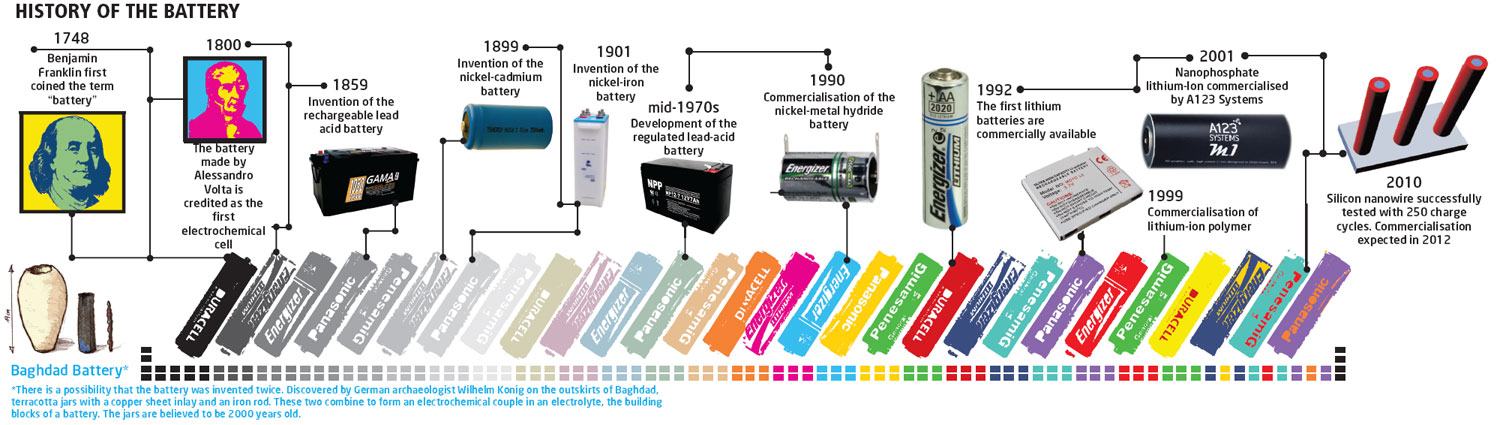
The following milestones show how electrical science and battery engineering evolved from static electricity experiments to rechargeable systems used in portable electronics, vehicles, and stationary storage. Dates in early technology history can vary by source depending on whether the reference point is discovery, publication, patenting, prototype demonstration, or commercialization.
| Year / period | Person or group | Technical significance |
|---|---|---|
| 1600 | William Gilbert | Established early systematic study of electricity and magnetism, helping define the field that later supported electrochemistry. |
| 1745 | Ewald Georg von Kleist | Invented the Leyden jar, an early device for storing static electric charge. |
| 1791 | Luigi Galvani | Reported “animal electricity,” an observation that helped stimulate debate about biological and contact electricity. |
| 1800 | Alessandro Volta | Built the voltaic pile using alternating zinc and copper elements separated by electrolyte-soaked material, providing continuous electrical current. |
| 1802 | William Cruickshank | Developed an early battery arrangement more suitable for production than Volta’s stacked pile. |
| 1820 | André-Marie Ampère | Advanced understanding of electricity and magnetism. |
| 1833 | Michael Faraday | Announced laws of electrolysis, linking electric charge and chemical change in a quantitative framework. |
| 1836 | John F. Daniell | Invented the Daniell cell, a more stable primary cell than many earlier designs. |
| 1839 | William Robert Grove | Demonstrated a hydrogen-oxygen fuel cell concept. |
| 1859 | Gaston Planté | Invented the lead-acid battery, the first widely important rechargeable battery system. |
| 1868 | Georges Leclanché | Developed the Leclanché cell, an important carbon-zinc primary-cell predecessor. |
| 1881 | Camille Alphonse Faure | Improved lead-acid battery plates using a pasted-grid approach that supported practical capacity improvements. |
| 1899 | Waldemar Jungner | Invented the nickel-cadmium battery. |
| 1901 | Thomas Edison | Developed the nickel-iron battery. |
| 1932 | Schlecht and Ackermann | Developed the sintered pole plate, important for nickel-cadmium electrode performance. |
| 1947 | Georg Neumann | Advanced sealed nickel-cadmium battery construction. |
| 1949 | Lewis Urry / Eveready | Developed the alkaline-manganese battery, improving primary-cell performance compared with earlier zinc-carbon designs. |
| 1970s | Group effort | Developed valve-regulated lead-acid battery technology, reducing maintenance requirements compared with flooded lead-acid designs. |
| Late twentieth century | Multiple teams and companies | Nickel-metal hydride and lithium-ion systems became important rechargeable technologies for portable equipment and later larger applications. |
The voltaic pile deserves special attention because it shifted electricity from momentary static discharge toward a sustained electrochemical source. Volta’s use of dissimilar metals and electrolyte introduced the basic principle that chemical potential could produce electrical potential. Later cell designs improved this concept by reducing internal losses, controlling unwanted side reactions, and making construction more reliable.
The Daniell cell was important because it provided steadier voltage than earlier cells affected by polarization. For telegraphy and laboratory use, stability mattered. A cell that works briefly in a demonstration is different from a cell that can support a real electrical load for useful periods.
Lead-acid technology, introduced by Planté in 1859 and later improved through plate design, became one of the most durable battery platforms in history. Its continued use is not due to energy density leadership; modern chemistries can store more energy per unit mass. Lead-acid persists because it is inexpensive, recyclable in established industrial loops, capable of high current, and well understood in applications such as engine starting and standby backup.
Nickel-cadmium, introduced by Jungner, brought a rechargeable alkaline system with good cycle capability and robust power delivery. Later developments such as sintered plates and sealed construction made nickel-cadmium far more practical. Sealing was especially important for portable use because it reduced maintenance and allowed cells to be integrated into consumer and industrial equipment more easily.
Alkaline-manganese primary cells improved the performance of disposable batteries for many consumer devices. Although not rechargeable in their standard form, they are part of the broader battery timeline because they show how electrolyte and electrode refinements can extend the usefulness of an existing electrochemical family.
Valve-regulated lead-acid batteries, developed through group effort in the 1970s, changed how lead-acid batteries could be deployed. By immobilizing or controlling the electrolyte and using pressure-regulated construction, VRLA batteries reduced routine watering and enabled more flexible installation than flooded cells. They became important in uninterruptible power supplies, telecommunications backup, emergency lighting, and other standby applications.
Source: Original source
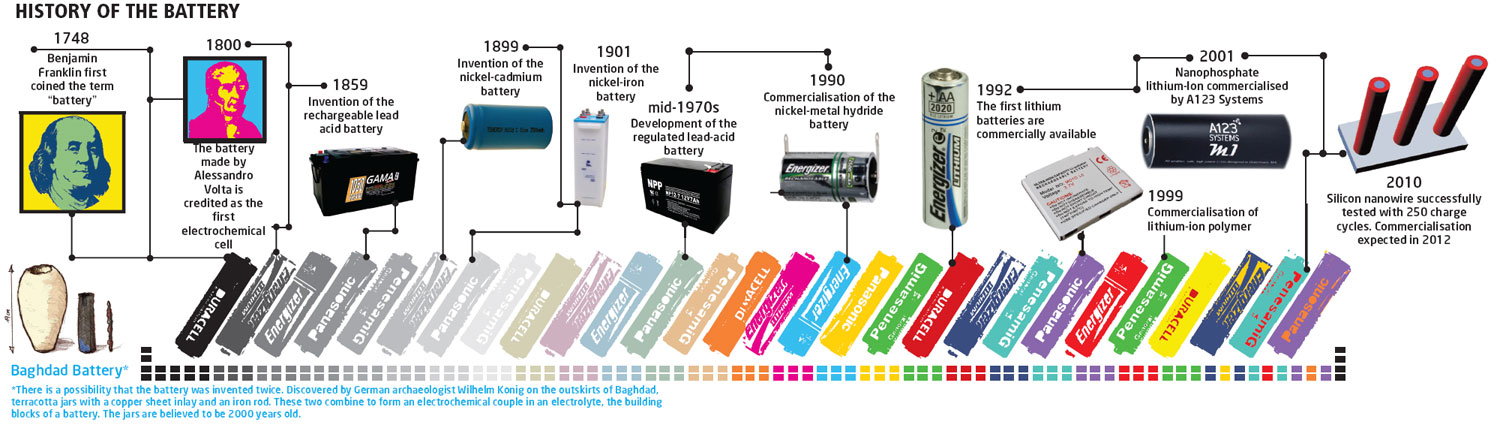
Progress from roughly 1990 to 2002 centered less on the discovery of wholly new mainstream battery families and more on commercialization, refinement, and scale-up of rechargeable systems. Nickel-metal hydride became important in portable electronics and hybrid-vehicle applications because it offered a cadmium-free rechargeable alternative to nickel-cadmium with higher practical energy storage in many use cases. Lithium-ion commercialization in the early 1990s was a major turning point for portable electronics because it combined higher cell voltage and higher energy density than older aqueous rechargeable systems.
Lithium-ion should be viewed as a platform rather than a single fixed chemistry. Cells can use different cathode materials, graphite or other carbon-based anodes, varied electrolytes, and different mechanical formats. Improvements after initial commercialization focused on energy density, cycle life, manufacturing consistency, protection circuits, separator behavior, and abuse tolerance. These refinements were not minor from an engineering standpoint; they determined whether lithium-ion could move from camcorders and laptops into power tools, electric vehicles, and stationary storage.
Claims that no major new battery system emerged after the mid-1990s need careful wording. It is reasonable to say that few entirely new rechargeable battery families achieved the same broad commercial status as lead-acid, nickel-cadmium, nickel-metal hydride, and lithium-ion during that period. However, that does not mean battery innovation stopped. Since lithium-ion commercialization, much of the progress has occurred within established platforms: new electrode materials, better electrolytes, improved separators, more precise manufacturing, safer pack controls, and application-specific cell formats. Emerging chemistries may also be technically promising long before they become mainstream commercial systems.
The technical history of batteries therefore shows two parallel forms of innovation. One is the discovery or introduction of a new electrochemical system. The other is the long process of making that system reliable, safe, manufacturable, affordable, and suitable for real loads. Modern rechargeable batteries are the result of both.
References
- Battery University | BU-102: Early Innovators
- BU 102 - CUNY Queensborough Community College - Course Hero
- BU 102 at ESU - Reviews & Ratings, Fall 2026 professors - Coursicle
- CAS CC 102 » Academics | Boston University
- Creativity/Innovation | BU Hub
- 717-Prior Art Exceptions under AIA 35 U.S.C. 102(b)(1) and (2) - USPTO
- Free online courses from MIT for entrepreneurs and innovators | Open Learning
- BU-102 Principles of Accounting II
- BU 102 Course | Queensborough CC Catalog
- Principles Of Accounting II (BU 102) - Queensborough - Studocu