An equalizing charge is a maintenance procedure used mainly with lead-acid batteries, especially flooded cells in stationary, traction, renewable-energy, and industrial service. It is not a routine charge cycle in the normal sense. It is a deliberate, controlled overcharge intended to correct cell imbalance, reduce sulfation effects, and mix stratified electrolyte.
Because equalization intentionally pushes a battery above its normal finishing voltage, it must be treated as a controlled maintenance operation rather than a casual charger setting. Done at the right time, with the right battery type, it can restore usable capacity and improve cell balance. Done incorrectly, it can overheat the battery, accelerate water loss, cause excessive gassing, or permanently damage sealed designs.
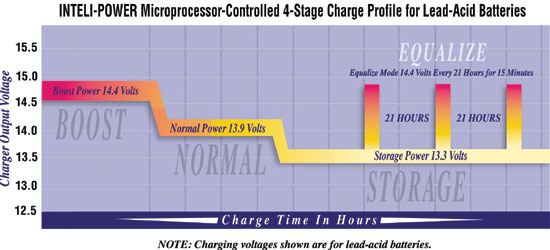
The basic principle is simple: apply a higher-than-normal charging voltage after the battery is fully charged, then monitor the battery until further improvement stops. The details are important, particularly battery type, temperature, ventilation, electrolyte level, and the manufacturer’s limits.
What an Equalizing Charge Does
An equalizing charge is a deliberate, controlled overcharge applied mainly to lead-acid batteries. In a multi-cell battery, individual cells do not always age, charge, and discharge identically. Over time, some cells may become slightly undercharged while others reach full charge earlier. Equalization raises the charging voltage high enough to bring the lower cells closer to full charge and reduce the difference between cells connected in series.
For flooded lead-acid batteries, a commonly cited equalizing level is about 2.50 V per cell, or roughly 10 percent above the recommended charge voltage. In a 12 V nominal lead-acid battery with six cells, that corresponds to an elevated charging voltage compared with normal absorption or finishing charge. The exact value still depends on the battery design and manufacturer’s instructions.
Source: Battery University

Equalization addresses two common lead-acid problems: sulfation and acid stratification.
Sulfation occurs when lead sulfate crystals build up on the battery plates. Some lead sulfate formation is part of normal discharge chemistry, but persistent undercharge or incomplete recharge can allow sulfate deposits to become more difficult to reconvert during normal charging. An equalizing charge can help remove sulfate crystals and recover performance if the sulfation has not progressed too far. If a battery has been severely neglected or has hard, long-term sulfation, equalization may not restore it to useful condition.
Acid stratification is the uneven distribution of electrolyte concentration inside a flooded cell. The acid concentration becomes greater near the bottom of the cell and lower near the top. This matters because plate areas exposed to stronger acid can work harder while other areas remain less active. The result can be reduced performance, uneven plate activity, and misleading electrolyte readings if the cell is not mixed. Equalization produces controlled gassing, which helps stir the electrolyte and reduce the concentration gradient.
In practice, equalization is therefore doing several related jobs:
- bringing series-connected cells closer to the same state of charge;
- helping convert recoverable sulfate on the plates;
- mixing electrolyte in flooded cells to reduce acid stratification;
- improving the usefulness of specific gravity readings after the electrolyte has been mixed.
It is important to keep the scope clear: equalization is primarily a lead-acid maintenance method. It should not be generalized to lithium-ion batteries, nickel-based batteries, or sealed lead-acid batteries unless the battery manufacturer specifically provides an approved procedure.
When Equalization Is Needed
Recommended equalization intervals vary widely. Some experts recommend equalizing as often as once per month, while others recommend once or twice per year. This wide range exists because battery duty cycles, depth of discharge, charging quality, temperature, age, and construction all affect how quickly cells drift apart or develop stratification.
The battery manufacturer’s documentation should take priority over any generic schedule. Equalization requirements for a standby flooded battery may differ from those for a deeply cycled renewable-energy bank or a motive-power forklift battery. Chargers also differ: some systems automatically schedule equalization, while others require manual setup and supervision.
A better trigger than a fixed calendar interval is measurement. For a fully charged flooded lead-acid battery, compare the specific gravity readings of the individual cells with a hydrometer. The reference threshold commonly given is to apply equalization when the specific gravity difference between cells is about 0.030. This indicates that the cells are not reaching the same state of charge or that electrolyte stratification is affecting readings.
Some flooded-battery manufacturers use tighter criteria. For example, some instructions specify equalization when specific gravity readings vary by about ±0.015 from cell to cell on a fully charged battery. This is why the battery documentation matters: the correct threshold depends on the design and service expectations.
Equalization may be needed more often when the battery is heavily cycled or operated in demanding service. Motive-power batteries, such as forklift batteries, are often deeply discharged and recharged on a work schedule. Renewable-energy battery banks may spend time at partial state of charge if charging energy is limited. In these applications, cells can become imbalanced more quickly than in light standby use.
Common reasons to consider an equalizing charge on a flooded lead-acid battery include:
- specific gravity differences between cells after a full charge;
- signs of reduced usable capacity not explained by load or temperature;
- known history of chronic undercharge;
- heavy cycling or deep-discharge service;
- manufacturer-recommended periodic equalization;
- suspected acid stratification in tall flooded cells.
Equalization should not be used as a substitute for correct routine charging. If the normal charger voltage is too low, charge time is too short, water levels are neglected, or the battery is routinely left partially charged, equalization may provide only temporary improvement while the underlying cause continues to damage the battery.
How to Monitor an Equalizing Charge Safely
Equalization should normally be performed only after the battery is fully charged, unless the manufacturer specifies a different procedure. Starting from a fully charged condition allows the elevated voltage to perform the intended maintenance function rather than simply acting as a rough bulk charge. It also makes specific gravity comparison more meaningful.
During equalization, check the specific gravity in each accessible cell about every hour. The goal is not to overcharge for a fixed time regardless of what the battery is doing. The goal is to continue only while measurable improvement is occurring. When specific gravity no longer rises, further overcharge is no longer producing useful improvement and can begin to harm the battery.
A practical monitoring sequence for a flooded lead-acid battery is:
- Confirm that the battery type is suitable for equalization.
- Fully charge the battery using the normal approved charge method.
- Check electrolyte level according to the manufacturer’s procedure.
- Apply the approved equalizing voltage or charger equalize mode.
- Measure and record cell specific gravity about once per hour.
- Watch for abnormal heat rise, excessive venting, or other unusual behavior.
- Stop equalization when specific gravity no longer increases.
- Allow adequate cooldown time before returning the battery to service.
Temperature control is a major safety and life issue. Equalization produces more gassing and heat than normal charging. The battery should be kept cool and observed closely for unusual heat rise. If the battery becomes excessively hot, the process should be stopped or paused according to the manufacturer’s instructions. Industrial and forklift batteries may require longer cooldown periods after equalization than after a normal charge because of the added overcharge energy.
Ventilation is equally important. Gassing during lead-acid charging produces hydrogen, and hydrogen is highly flammable. The reference safety value is that hydrogen becomes explosive in air at about 4 percent concentration. Battery rooms and charging areas therefore need good ventilation, and operators should keep sparks, flames, smoking materials, and unprotected electrical switching away from the battery during and after charging.
Personal protection is also part of the procedure. Flooded lead-acid batteries contain sulfuric acid electrolyte, and equalization increases bubbling and gas release. Operators should use suitable eye and skin protection, avoid leaning over open cells, and follow site procedures for acid exposure, spill response, and hydrometer handling.
Safety controls should include:
- adequate ventilation during and after equalization;
- no open flames or spark-producing work near the battery;
- temperature monitoring and cooldown time;
- checking only batteries designed for this maintenance method;
- manufacturer-approved voltage, time, and termination criteria;
- proper personal protective equipment for acid and electrical hazards.
The most important termination rule is simple: stop when specific gravity no longer rises. Continuing beyond that point adds heat, gassing, and water loss without meaningful recovery.
Why Sealed VRLA Batteries Are Harder to Equalize
Equalizing sealed lead-acid batteries is much less straightforward than equalizing flooded cells. VRLA batteries, including AGM and gel designs, do not provide routine access to the electrolyte, so the operator cannot use a hydrometer to compare cell specific gravity. This removes one of the most useful indicators for deciding when equalization is needed and when it should stop.
Observing cell voltage differences alone is not a conclusive guide. Cell voltage can be affected by state of charge, internal resistance, temperature, recent charge history, and measurement conditions. Without electrolyte access, the operator has less direct information about what is happening inside each cell.
Some manufacturers recommend equalization procedures for certain VRLA batteries, including monthly equalizations lasting 2 to 16 hours. However, this varies by design and must be manufacturer-directed. The existence of a VRLA equalization recommendation for one battery model does not make it safe for another. AGM, gel, standby, cyclic, and high-rate VRLA products may have different voltage limits and failure sensitivities.
A key risk is venting. Many VRLA batteries vent at about 34 kPa, or 5 psi. VRLA batteries are designed to recombine much of the gas generated internally during normal charging, but excessive overcharge can exceed that recombination capability and open the pressure relief valve. Once gas vents, water is lost from the cell. Because sealed VRLA batteries generally cannot be refilled in normal service, repeated venting can deplete electrolyte and contribute to dry-out.
Dry-out is a permanent life-shortening condition. As electrolyte is depleted, internal resistance rises, capacity falls, heat generation can increase, and the battery becomes less able to deliver its rated performance. Equalization that might be recoverable in a flooded cell by replacing water can be destructive in a sealed cell because the lost water is not practically restored.
This is why many flooded-battery equalization instructions explicitly warn not to equalize gel or AGM batteries unless the manufacturer specifically permits it. Gel batteries are particularly sensitive to gas pockets and electrolyte disturbance, while AGM batteries can be damaged by sustained overcharge and water loss.
For sealed lead-acid batteries, safe practice is conservative:
- do not assume flooded-cell equalization settings apply;
- do not rely only on voltage imbalance as proof that equalization is needed;
- use only the battery manufacturer’s published VRLA procedure;
- observe temperature limits carefully;
- avoid any procedure that causes repeated venting;
- replace batteries that cannot be safely recovered by approved charging methods.
In short, VRLA equalization is not impossible in every case, but it is much more dependent on battery-specific instructions. Where the manufacturer does not approve it, equalization should be avoided.
Equipment for Applying an Equalizing Charge
Some battery chargers include an equalize mode or programmable equalization function. In a well-designed charging system, this mode raises the charge voltage to the required level for the correct battery type and may include time limits, current limits, temperature compensation, or automatic termination features. Even with an automatic mode, the operator should confirm that the charger settings match the battery manufacturer’s requirements.
For suitable flooded lead-acid batteries, equalization voltage is commonly set about 10 percent higher than the normal recommended charge voltage, with the reference value of about 2.50 V per cell often cited. This is a general technical value, not permission to override the battery data sheet. Temperature, cell design, electrolyte level, and duty cycle can affect the correct setting.
A suitable adjustable power supply can also be used for equalization, but only by an operator who can correctly set voltage and supervise the process. A power supply usually lacks the battery-specific logic of a charger. That means the operator must monitor time, current, temperature, electrolyte behavior, and specific gravity carefully. The time spent in overcharge is critical; leaving a battery unattended on an adjustable supply can overheat or dry out the battery.
When using any equipment, the essential checks are:
- battery type is approved for equalization;
- voltage is set to the manufacturer’s equalization value;
- current and time limits are appropriate for the battery;
- temperature is monitored and controlled;
- ventilation is active and adequate;
- specific gravity is checked for flooded cells;
- the procedure is stopped when gravity no longer rises or when a safety limit is reached.
Incorrect equalization can damage a battery quickly. Excessive voltage, excessive time, poor ventilation, low electrolyte level, or use on the wrong battery type can lead to overheating, high water loss, pressure venting, dry-out, plate corrosion, or loss of service life.
The best equipment is therefore not simply the charger that can reach the highest voltage. It is the charger or controlled power source that can apply the correct equalizing voltage, under supervision, with limits that match the battery manufacturer’s instructions. Equalization is useful maintenance when applied to the right lead-acid battery under the right conditions, but it should always remain a measured procedure rather than a routine overcharge.
References
- Battery University | BU-404: What is Equalizing Charge?. (n.d.). https://www.batteryuniversity.com/article/bu-404-what-is-equalizing-charge
- BU-404: What is Equalizing Charge?. (n.d.). http://www.batteryuniversity.com/article/bu-404-what-is-equalizing-charge
- Battery University | BU-405: Charging with a Power Supply. (n.d.). http://www.batteryuniversity.com/article/bu-405-charging-with-a-power-supply
- Understanding Forklift Battery Equalization & Why It Is Important. (n.d.). https://orizengroup.com/blog/Understanding-Forklift-Battery-Equalization-&-Why-It-Is-Important.php
- Equalizing Charge — When, Why & How. (n.d.). https://microtex.com/equalizing-charge
- Battery Equalization | Equalizing Charge for Flooded Batteries | Discover Battery. (n.d.). https://discoverbattery.com/support/learning-center/battery-101/how-to-equalize-charge-a-flooded-battery
- Lead-Acid Battery Equalization Charge: A Complete Guide. (n.d.). https://www.hzhmarine.com/news/lead-acid-battery-equalization-charge-a-complete-guide.html
- Question about Equalizing Charge for Light Use Forklift. (n.d.). https://www.reddit.com/r/batteries/comments/1dy9g28/question_about_equalizing_charge_for_light_use
- How to Equalize Charge a Forklift Battery | Toyota Forklifts Blog. (n.d.). https://www.toyotaforklift.com/resource-library/blog/energy-solutions/how-to-equalize-charge-a-forklift-battery
- BU-405: Charging with a Power Supply - Battery University. (n.d.). https://www.batteryuniversity.com/article/bu-405-charging-with-a-power-supply