Lead-acid batteries age through a combination of normal chemical wear, operating stress, and maintenance-related damage. Their useful life depends not only on the battery design, but also on how it is charged, discharged, stored, and loaded. Deep-cycle batteries, starter batteries, flooded batteries, and AGM batteries do not all have identical requirements.
The most effective approach is to keep the battery adequately charged, avoid unnecessary deep discharges and excessive heat, and follow the charging and maintenance limits specified by the manufacturer. Understanding the battery’s life phases and common failure mechanisms helps explain why these practices matter.
How to Extend Lead-Acid Battery Life
A lead-acid battery generally passes through three broad phases: formatting, peak performance, and decline. The formatting phase is an early break-in period in which the battery reaches its expected operating condition. It is particularly important for deep-cycle batteries, which are designed to deliver repeated discharge and recharge service. Starter batteries are less dependent on this process; they normally provide their rated cranking function from the beginning, although early use can still slightly improve cranking performance.
Once formatting is complete, the battery enters its peak-performance phase. Capacity, power delivery, and charging behavior are comparatively stable during this period. Eventually, the battery enters decline as active material is lost and the plates, grids, electrolyte, and separators become less effective.
Battery care cannot stop this aging process, but it can reduce avoidable stress. The main practices are:
- Use the charging profile specified for the battery’s chemistry and construction.
- Allow the battery to receive a fully saturated charge when the system permits it.
- If a complete charge is not possible during normal operation, provide a full saturated charge periodically.
- Avoid leaving the battery chronically undercharged.
- Operate and store it at moderate temperatures where possible.
- Avoid unnecessary deep discharges and excessive discharge currents.
- Match the charging, loading, and depth-of-discharge limits to the battery system.
A fully saturated charge is important because reaching a nominal voltage or a high indicated state of charge does not necessarily mean that the chemical charging process is complete. For the general lead-acid guidance covered by the source material, a saturated charge lasting approximately 14–16 hours is recommended when appropriate. This is not a universal timer for every battery or charger: the manufacturer’s voltage, current, temperature-compensation, ventilation, and termination requirements take priority. A flooded battery may have different requirements from an AGM battery, and an automatic charger may use a staged profile rather than a constant current for the entire period.
When operating schedules do not allow a complete charge on every cycle, a fully saturated charge once every few weeks can help maintain condition. The exact interval should be adapted to the battery type, operating regime, and manufacturer’s instructions. A battery that remains below full charge for long periods is more exposed to sulfation and, in flooded designs, acid stratification.
The Three Phases of Lead-Acid Battery Life
The three life phases describe a general performance pattern rather than a precise service-life guarantee.
Formatting is the initial period in which the active materials and plates settle into their working condition. Deep-cycle batteries benefit most from careful break-in. Manufacturers commonly recommend relatively gentle early operation rather than immediately subjecting a new battery to the most severe available loading and discharge conditions. This helps the battery establish consistent electrochemical behavior before regular deep-cycle service.
Peak performance follows the formatting period. The battery can deliver its intended power or energy more consistently, provided it is charged correctly and is not exposed to avoidable thermal, mechanical, or electrical stress. The length of this phase depends on battery construction, duty cycle, discharge depth, charge quality, temperature, and loading.
Decline begins when aging mechanisms reduce usable active material or increase internal resistance. The battery may still operate, but capacity and power delivery gradually become less reliable. A starter battery may continue to crank an engine until its condition deteriorates sharply, while a deep-cycle battery may show progressively shorter run time or reduced cycle capability.
The distinction between battery types is important. A starter battery is designed to deliver high current for a short period and is normally recharged quickly by the vehicle or charging system. A deep-cycle battery is designed for repeated, deeper discharge and therefore places greater demands on plate structure and active material. Applying starter-battery assumptions to a deep-cycle system, or repeatedly deep-cycling a starter battery, can shorten service life.
Charging and Operating Practices That Preserve Battery Condition
Charging is the most important controllable part of lead-acid battery care. The battery should periodically reach the charging stage required to fully saturate the plates. Repeatedly interrupting charging before saturation leaves the battery in a partial state of charge and can promote sulfation. This is especially relevant in vehicles or backup systems that operate for short periods and do not provide enough time for a complete charge.
Frequent charging is generally preferable to allowing a lead-acid battery to remain heavily discharged. However, charging must use the correct voltage and current limits. Excessive voltage or poorly controlled charging can cause overheating, gassing, water loss, or dry-out. The acceptable charging behavior depends on whether the battery is flooded, AGM, or another lead-acid design.
Moderate temperature also supports longer service life. Elevated temperature accelerates chemical and corrosion processes, while high current demand increases stress on the plates and grids. Battery ventilation and temperature compensation should be provided where required by the battery and charger documentation.
Avoiding deep discharge is another practical way to reduce wear. A deeper discharge removes more active material from the working reaction and usually places greater stress on the battery during recharge. Some deep-cycle batteries are designed for this duty, but even those batteries have specified depth-of-discharge limits. A system should therefore be sized so that normal operation does not repeatedly take the battery beyond its recommended discharge range.
For flooded batteries, maintenance may also include checking electrolyte level and adding only the type of water specified by the manufacturer. AGM batteries are sealed or regulated differently and must not be treated as conventional flooded batteries. Do not apply equalization, topping-up, or other maintenance procedures unless they are approved for that battery design.
Why Lead-Acid Batteries Lose Cycle Life
The primary reason for the relatively short cycle life of a lead-acid battery is depletion of active material. Repeated charging and discharging gradually reduce the amount of material that can participate effectively in the electrochemical reaction. Once enough active material is lost, capacity and power decline even if the battery still appears to accept charge.
Plate and grid deterioration are also important. In the 2010 Battery Council International failure-modes study cited by the source material, plate/grid-related breakdown was reported to have increased from 30 percent five years earlier to 39 percent. The study associated the observed increase with failure modes in batteries removed from service, while noting that the reason for the change was not established beyond the possibility that higher demands on modern starter batteries impose additional stress.
Several related mechanisms can shorten service life:
- Corrosion: Positive-grid corrosion can weaken the internal structure and increase resistance. Heat and sustained charging stress can accelerate corrosion.
- Shedding: Active material can detach from the plates during cycling, vibration, high current operation, or other mechanical and electrochemical stress. Shed material may collect at the bottom of a flooded cell and can contribute to an internal short.
- Internal shorts: Conductive debris or damaged separators can create unwanted electrical paths between plates. A shorted cell reduces voltage and usable capacity and may cause abnormal self-discharge.
- Sulfation: When a lead-acid battery remains undercharged, lead sulfate can become difficult to reconvert during normal charging. Persistent sulfation reduces the active surface available for reaction and can increase charging difficulty.
- Dry-out: Excessive heat, overcharging, or water loss can reduce electrolyte availability. In a flooded battery, low electrolyte can expose plates and cause permanent damage. In AGM designs, loss of electrolyte or drying of the separator is also damaging and is not corrected by adding water.
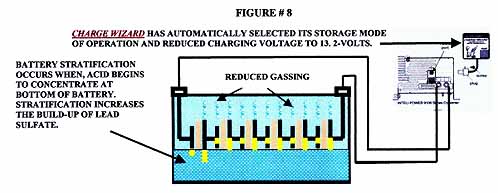
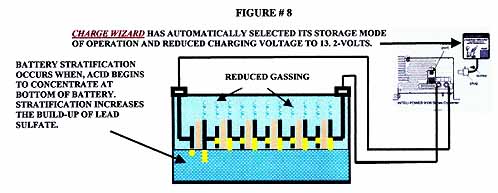
- Acid stratification: In a flooded battery that remains at low charge and receives shallow discharges without a full charge, the electrolyte can become more concentrated at the bottom than at the top. The upper plate area is then starved of acid, while the lower area is exposed to stronger acid and increased sulfation risk.
- Surface charge: A recently charged battery can show an elevated voltage at the plate surfaces that does not represent its stabilized state of charge. Relying on this immediate voltage can lead to an overly optimistic assessment of battery condition.
Source: Battery University
High demand, high discharge currents, elevated temperature, repeated undercharging, and excessive discharge depth can accelerate several of these mechanisms at the same time. For example, a battery used for heavy loads at high temperature and then recharged only briefly may experience faster active-material loss, corrosion, sulfation, and electrolyte stress than the same battery operated at a moderate duty cycle.
Acid stratification and surface charge can also distort measurements. Stratification may make the battery’s open-circuit voltage appear higher than its true overall condition because the stronger acid at the bottom contributes to the measured voltage. Surface charge can likewise produce a temporarily high voltage immediately after charging. For meaningful testing, use the battery manufacturer’s specified rest period and test procedure rather than interpreting a single immediate voltage reading.
AGM batteries are less susceptible to conventional acid stratification because their electrolyte is immobilized, but they still require the correct charging profile and can be damaged by overcharging, overheating, or prolonged undercharging. Battery construction changes the failure mechanisms; it does not eliminate the need for correct operating limits.
Practical Summary for Longer Lead-Acid Battery Service
Each lead-acid battery system has distinct requirements for charging voltage, charge duration, loading, depth of discharge, temperature, and maintenance. The most reliable service practices are to:
- Break in deep-cycle batteries according to the manufacturer’s instructions.
- Provide a complete saturated charge when possible, using the approved charging profile.
- Periodically restore full charge when normal operation prevents a complete charge.
- Avoid chronic undercharging, unnecessary deep discharges, excessive current, and high temperatures.
- Use battery-specific procedures for flooded, AGM, and other lead-acid designs.
- Treat voltage readings cautiously when the battery has just been charged or may be stratified.
- Inspect, test, and maintain the system according to its documentation and safety requirements.
These decisions affect how quickly active material is depleted and how much secondary damage develops around it. Good battery care cannot remove the finite aging process of lead-acid chemistry, but it can reduce avoidable wear and improve the likelihood that the battery will deliver dependable service throughout its useful life.
References
- Battery University | BU-804: How to Prolong Lead-acid Batteries. (n.d.). http://www.batteryuniversity.com/article/bu-804-how-to-prolong-lead-acid-batteries
- Battery University | BU-804: How to Prolong Lead-acid Batteries. (n.d.). https://www.batteryuniversity.com/article/bu-804-how-to-prolong-lead-acid-batteries
- Battery University | BU-804: How to Prolong Lead-acid Batteries. (n.d.). https://batteryuniversity.com/article/how-to-restore-and-prolong-lead-acid-batteries
- Battery University | BU-804: How to Prolong Lead-acid Batteries. (n.d.). https://batteryuniversity.com/article/bu-804-how-to-prolong-lead-acid-batteries
- Battery University | BU-804c: Acid Stratification and Surface Charge. (n.d.). https://www.batteryuniversity.com/article/bu-804c-acid-stratification-and-surface-charge
- Battery University - WeCanFigureThisOut.org. (n.d.). https://wecanfigurethisout.org/ENERGY/Web_notes/Electrochemical/Batteries_and_Fuel_Cells_Supporting_Files/How%20do%20Lithium%20Batteries%20Work%20%E2%80%93%20Battery%20University.pdf
- Battery University | BU-201: How does the Lead Acid Battery Work?. (n.d.). http://www.batteryuniversity.com/article/bu-201-how-does-the-lead-acid-battery-work
- Battery University | BU-201: How does the Lead Acid Battery Work?. (n.d.). https://batteryuniversity.com/article/bu-201-how-does-the-lead-acid-battery-work
- Learn About Batteries | Battery University. (n.d.). http://www.batteryuniversity.com/articles
- Battery University | BU-403: Charging Lead Acid. (n.d.). http://www.batteryuniversity.com/article/bu-403-charging-lead-acid