Fast and ultra-fast charging are attractive because they reduce downtime, especially for electric vehicles, power tools, mobile equipment, and standby systems that must return to service quickly. The technical challenge is that a battery is not a fuel tank. It is an electrochemical system with finite ion-transport speed, heat limits, electrode stress, and aging mechanisms that become more severe as charge current rises.
A useful charger is therefore not only a high-power supply. It must match the cell chemistry, electrode design, pack architecture, thermal system, and battery management system. When those elements are well matched, fast charging can be practical over part of the state-of-charge range. When they are not, the same current can cause excessive heat, lithium plating, imbalance, capacity loss, or safety risk.
Ultra-Fast Charging Demand and Battery Stress
The strongest demand for ultra-fast charging comes from electric vehicles. Drivers are familiar with adding liquid fuel in minutes, so a long charging stop can feel like a major inconvenience even when most daily charging occurs at home or at work. For long-distance travel, commercial fleets, taxis, and high-utilization vehicles, charge time affects route planning and asset productivity.
The comparison with liquid fuel also illustrates the physical difficulty. Fossil fuels store far more energy per unit mass than today’s practical battery packs. The reference example compares filling about 50 liters of fuel with storing hundreds of kilowatt-hours of chemical energy, whereas common lithium-ion cells store energy on the order of hundreds of watt-hours per kilogram at cell level. The comparison is not exact at the vehicle wheels because electric drivetrains are more efficient than combustion drivetrains, but the battery still must move a large amount of energy through electrochemical interfaces in a short time.
Ultra-fast charging increases several stresses at once:
- Current density rises, so electrodes and current collectors must carry more current without local hot spots.
- Ohmic heating increases, because heat generation rises with current and internal resistance.
- Concentration gradients become steeper, making it harder for lithium ions to reach and enter the anode uniformly.
- Cell-to-cell differences matter more, because a weak or high-resistance cell in a pack can be pushed beyond safe limits before the rest of the pack appears fully charged.
- Longevity may decline if repeated high-rate charging accelerates loss of lithium inventory, impedance growth, electrolyte degradation, or mechanical stress.
For these reasons, ultra-fast charging is usually not applied as a constant maximum current from empty to completely full. A common approach is staged charging: high current is used when the battery can accept it, then current is reduced as the state of charge rises and the anode becomes less able to accept lithium safely. The reference guidance notes that ultra-fast charging is mainly applicable during the first charge phase and that current should be reduced after roughly the upper-middle part of the charge range, rather than forced to remain high near full charge.
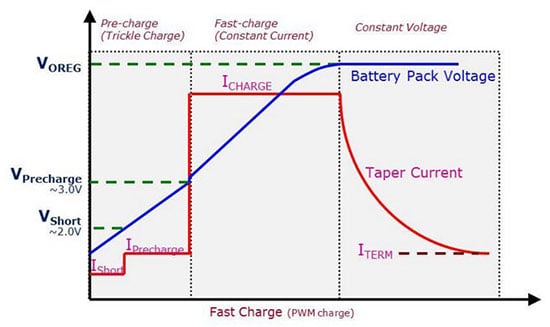
Source: Battery University
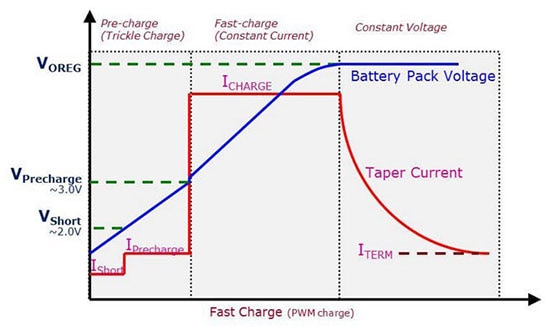
Step charging, multi-stage constant-current charging, and constant-current/constant-voltage profiles all follow the same practical idea: use high power only where the cell has enough charge acceptance, thermal margin, and voltage headroom. This is why public EV charging sessions often add energy quickly at low-to-mid state of charge but slow noticeably as the battery approaches a high state of charge.
The 10-Minute Charge and Emerging Cell Approaches
A 10-minute charge has become a convenient benchmark for EV adoption because it approaches the stop duration that many drivers consider acceptable for long trips. The phrase needs careful interpretation. It may mean adding a useful driving range in 10 minutes, charging a defined fraction of capacity, or charging a specially designed cell under controlled laboratory or manufacturer-specified conditions. It does not automatically mean charging every lithium-ion battery from empty to full in 10 minutes without aging penalty.
One route to faster charging is improved thermal control. Low temperature increases lithium plating risk, but excessive heat also accelerates side reactions and degradation. Some research and reference material report that briefly heating lithium-ion cells to about 60°C during fast charging can reduce lithium plating because elevated temperature improves kinetics. The important qualification is that the exposure is short; prolonged high-temperature operation would normally promote unwanted aging mechanisms such as solid-electrolyte interphase growth and electrolyte decomposition. This technique is therefore a controlled cell-and-system strategy, not a general instruction to heat consumer batteries.
Other approaches focus on the anode, where fast-charge limitations are often severe. In conventional graphite anodes, lithium ions must move through electrolyte-filled pores, cross interfaces, and diffuse into graphite particles. If arrival at the anode surface is faster than intercalation into graphite, metallic lithium can deposit instead.
Aligned Graphite® Technology, associated with Battrion, is one claimed method for improving this path. The reported concept is to organize graphite flakes in a more vertical orientation so lithium ions travel a shorter or less tortuous path through the negative electrode. The reference material reports a claimed reduction in charge time from about 25 minutes to about 15 minutes. This is a manufacturer or technology claim, not proof that all graphite-anode lithium-ion cells can now charge that quickly. Still, it reflects a broader engineering direction: reducing transport resistance and improving electrode architecture rather than relying only on a larger charger.
Emerging fast-charge work also includes:
- thinner or more porous electrodes for shorter ion pathways;
- optimized particle size and morphology;
- electrolyte formulations and additives that stabilize interfaces;
- high-concentration electrolyte research intended to improve kinetics and reduce plating-related problems;
- cell formats designed for better heat rejection and lower current density.
The commercial significance is real, but so is the distinction between demonstration and broad availability. A cell optimized for 10-minute charging may have lower energy density, higher cost, tighter temperature requirements, or shorter life under abuse than a slower-charging energy cell.
Limits of Ultra-Fast Charging in Lithium-Ion Cells
The maximum safe charge current of a lithium-ion cell is limited by several interacting factors, not by a single cathode label. Cell chemistry matters, but electrode and pack design often determine whether a cell can accept high current repeatedly.
Important limits include:
- Lithium-ion transport in electrolyte: ions must move through pores without excessive concentration polarization.
- Anode diffusion and intercalation: lithium must enter the negative electrode structure quickly enough to avoid metallic deposition.
- Electrode thickness and porosity: thick energy electrodes store more energy but can be slower to charge because ion pathways are longer.
- Particle size and surface area: smaller particles can improve kinetics but may increase surface reactions.
- Electrolyte behavior: conductivity, viscosity, additives, and interphase stability affect charge acceptance.
- Impedance: internal resistance turns high current into heat and voltage rise.
- Thermal management: heat must be removed uniformly to avoid accelerated aging or local hot spots.
- Pack balancing: cells in series must remain within voltage and temperature limits even when their capacity and resistance differ.
The difference between a power cell and an energy cell is central. A power cell is designed to deliver and accept high current. It may use thinner electrodes, lower internal resistance, larger conductive pathways, and materials selected for kinetics. The trade-off is usually lower specific energy or higher cost. An energy cell prioritizes watt-hours per kilogram or liter, often with thicker electrodes and higher active-material loading. That improves range or runtime but can make ultra-fast charging more difficult.
| Design emphasis | Typical advantage | Typical fast-charge trade-off |
|---|---|---|
| High-energy lithium-ion cell | Higher capacity and range | Lower charge acceptance at high current, more heat and polarization |
| High-power lithium-ion cell | Better high-current charge and discharge | Lower specific energy or more mass for the same energy |
| LFP cell design | Good thermal stability and long cycle-life potential | Lower cell voltage and lower energy density than some nickel-rich Li-ion designs |
| Lithium titanate cell | Excellent high-rate tolerance and low plating tendency | Much lower energy density and higher cost in many applications |
Stress reduction depends on coordinated control. The charger and battery management system should reduce current as voltage rises, as temperature moves outside the preferred range, or as cell imbalance appears. Modern BMS functions typically monitor pack current, cell-group voltage, temperature sensors, state of charge, state of health, and imbalance. More advanced systems estimate charge acceptance from temperature, aging state, and impedance rather than using a fixed current limit under all conditions.
The practical rule is simple: fast charging must follow the battery, not the charger nameplate. A charger capable of very high power is useful only when the connected pack is designed, conditioned, balanced, and authorized to accept that power.
Lithium Plating During Fast Charging
Lithium plating occurs when lithium deposits as metallic lithium on the negative electrode instead of intercalating into the anode. It is one of the most important failure mechanisms associated with aggressive fast charging of graphite-anode lithium-ion cells.
During a normal charge, lithium ions leave the positive electrode, move through the electrolyte, and enter the graphite structure at the negative electrode. During fast charging, the anode potential can become low enough that metallic lithium deposition becomes favorable. This risk increases when the cell cannot accept lithium as quickly as the charger supplies it.
Common causes and contributors include:
- excessive charge current for the cell design;
- low temperature, which slows reaction kinetics and diffusion;
- high state of charge, where the anode has less remaining capacity to accept lithium;
- high polarization from rapid current flow;
- cell aging and impedance growth;
- poor thermal uniformity across the cell or pack;
- imbalance that pushes one cell group harder than others;
- electrode designs with insufficient porosity or unfavorable transport paths.
Low temperature is especially important. Chemical reactions and diffusion processes slow in the cold, while the charger may still attempt to push high current. The result can be higher polarization, more heat generation in resistive regions, and a greater chance that lithium reaches the anode surface faster than it can intercalate.
Consequences of lithium plating range from performance loss to safety concern. Some plated lithium may become electrically isolated, reducing usable lithium inventory and capacity. Plating can also increase impedance, promote gas generation or swelling in some cells, and create uneven deposits. If dendritic structures grow and penetrate separators, internal short circuits become possible. Not every plating event immediately causes a hazardous failure, but repeated or severe plating is a serious degradation path.
Chemistry and design influence resilience. Lithium titanate cells replace the graphite negative electrode with lithium titanate, which operates at a higher anode potential and is much less prone to lithium plating under high-rate charge. This makes lithium titanate well suited to very high charge rates and long cycle life in demanding applications. The penalty is significantly lower energy density than common graphite-anode lithium-ion cells, so it is not a universal substitute for range-sensitive EV packs.
Other research directions aim to keep graphite or high-energy systems while reducing plating risk. These include engineered graphite orientation, electrolyte additives that form more stable interphases, high-concentration electrolytes that improve interface behavior, optimized anode porosity, and electrode designs that reduce tortuosity. Such improvements help, but they do not eliminate the need for temperature control, current tapering, and conservative operation near high state of charge.
Fast-Charging Best Practices and Trade-Offs
Good fast-charging performance requires the battery to be in the right condition and the system to stay inside its design limits. The best conditions are generally moderate temperature, low cell resistance, balanced cells, healthy electrodes, and limited exposure to maximum current.
Different battery families respond differently:
- Lead acid: can accept higher current when discharged but is limited by gassing, heat, and charge efficiency as voltage rises. It is not well suited to repeated ultra-fast charging to full.
- Nickel-based batteries: tolerate some abuse better than many chemistries but generate heat and need proper charge termination. Fast charging requires temperature and voltage monitoring.
- Conventional graphite-anode lithium-ion: offers high energy density but must avoid lithium plating, overheating, and high-current charging near full state of charge.
- Lithium iron phosphate (LFP): is often valued for stability and cycle life, but fast-charge capability still depends on cell design, temperature, BMS limits, and manufacturer rating.
- Lithium titanate: is among the most fast-charge-tolerant lithium-ion variants, but lower energy density limits its use where mass and volume are critical.
Frequent fast charging is not automatically destructive, but it can accelerate degradation when conditions are poorly matched. A healthy pack charged at a manufacturer-approved high rate, with active thermal management and current tapering, may age acceptably. The same nominal rate applied to an aged, cold, imbalanced, or high-resistance pack can cause disproportionate stress.
The system-level trade-off is unavoidable. More range generally requires more stored energy, which increases pack size, mass, and cost. Higher fast-charge capability may require lower-resistance cells, more thermal hardware, heavier busbars, thicker tabs, additional sensors, or electrode designs that reduce energy density. A smaller battery can be cheaper and lighter, but it may need to charge more often and may experience higher C-rates for the same charger power. A larger battery may accept more absolute charging power while each cell sees a lower relative rate, but it adds mass and cost.
Ultra-fast charging should therefore be treated as a matched-system capability. The cell, module, pack, BMS, charger, connector, cable, cooling system, and software limits all determine safe performance. If one element is not rated for the current, the entire system must operate at the lower limit.
Simple Charger Guidelines
Use moderate-rate charging when time allows. Lower current usually produces less heat, less polarization, and less stress on weak cells. Ultra-fast charging is best reserved for situations where the time saving is valuable and the battery is within the allowed operating window.
Practical guidelines include:
- Follow the manufacturer’s rating. Use chargers, adapters, and charge modes approved for the specific battery or vehicle.
- Avoid fast charging when the battery is very cold. Low temperature slows charge acceptance and increases lithium plating risk in lithium-ion cells.
- Avoid fast charging when the battery is very hot. High temperature can accelerate side reactions and aging, even if plating risk is lower.
- Do not fast charge damaged or suspect batteries. Swelling, leakage, abnormal heating, impact damage, corrosion, or repeated faults require inspection or replacement.
- Respect BMS warnings. If the system reduces power, delays charging, or requests conditioning, it is protecting the cells.
- Expect tapering at higher state of charge. Ultra-fast charging is usually most effective in the low-to-middle state-of-charge range and should slow as the battery approaches full.
- Be cautious with aged batteries. Cells age unevenly; weaker cells may have lower capacity and higher resistance, so they heat more and reach voltage limits sooner during high-current charging.
For lithium-ion packs, practical temperature guidance should remain chemistry- and product-specific. Some EVs actively heat or cool the pack before fast charging, while small consumer batteries may simply block charging outside a permitted range. The correct limit is the one specified by the manufacturer and enforced by the BMS.
The safest technical view is that a charger is only one part of the charging system. High current is acceptable only when the battery chemistry, cell design, state of health, temperature, state of charge, balance condition, and control electronics all agree that the battery can accept it.
References
- BU-401a: Fast and Ultra-fast Chargers. (n.d.). http://www.batteryuniversity.com/article/bu-401a-fast-and-ultra-fast-chargers
- DAFTAR PUSTAKA. (n.d.). http://scholar.unand.ac.id/120357/4/%5B4%5D%20Daftar%20Pustaka.pdf
- Blog. (n.d.). https://www.large-battery.com/blog/page/49
- Ultra-Fast Li-Ion Charging: Core Limitations Exposed. (n.d.). https://www.patsnap.com/resources/blog/articles/ultra-fast-li-ion-charging-core-limitations-exposed
- Lithium-ion battery fast charging performance influence factors and solutions – TYCORUN. (n.d.). https://www.tycorun.com/blogs/news/battery-fast-charging
- Does Fast Charging Ruin Li-ion and LFP Batteries?. (n.d.). https://thebatteryshop.eu/Does-Fast-Charging-Ruin-Li-ion-and-LFP-Batteries
- Fast charging of energy-dense lithium-ion batteries. (n.d.). https://www.osti.gov/biblio/2418024
- Fast Charging of Li-Ion Cells: Part IV. Temperature Effects and .... (n.d.). https://research-hub.nlr.gov/en/publications/fast-charging-of-li-ion-cells-part-iv-temperature-effects-and-quo
- Modular Approach to Ultra-fast Charging Stations. (n.d.). https://link.springer.com/article/10.1007/s42835-021-00757-x
- Research shows improvements for fast-charging of Li-ion batteries - Battery Power Tips. (n.d.). https://www.batterypowertips.com/research-shows-improvements-for-fast-charging-of-li-ion-batteries