Flooded lead-acid batteries use liquid sulfuric-acid electrolyte and serviceable cells in which water can be added as needed. As these batteries age, sulfation, corrosion, shedding of active material, and other forms of deterioration can reduce capacity and starting performance. Chemical additives have long been used as an inexpensive attempt to extend the service life of some aging batteries.
The most commonly discussed treatments include magnesium sulfate, commonly called Epsom salt, caustic soda, and EDTA. These chemicals may temporarily change electrolyte conductivity or reduce some effects associated with sulfate deposits, but they are not a general repair method. Their results are uncertain, and adding the wrong substance or concentration can create additional corrosion or reduce battery capacity.
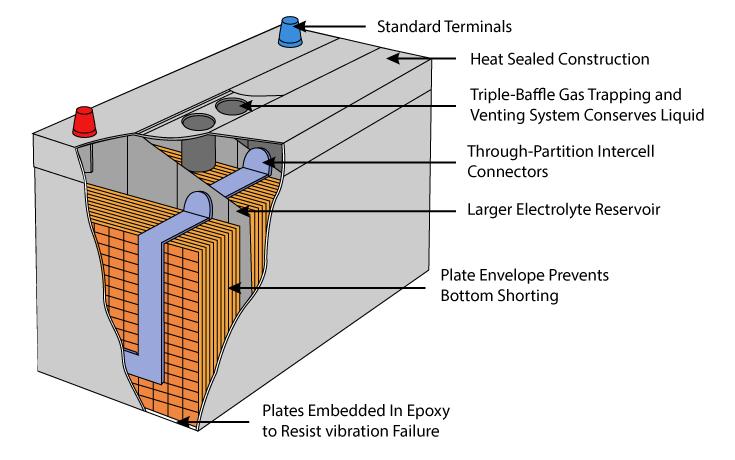
Source: Battery University
.png)
Extending Flooded Lead-Acid Battery Life With Additives
Lead sulfate is a normal product of discharge in a lead-acid cell. During appropriate charging, much of it is converted back into the active materials. If a battery remains partly discharged for a long period, some sulfate can become difficult to reconvert. This condition, commonly called sulfation, can contribute to higher internal resistance and reduced ability to deliver current.
Additives are sometimes used in an attempt to alter this condition. Magnesium sulfate may increase electrolyte conductivity or reduce the apparent internal resistance of a weak battery. In some cases, that can produce a temporary improvement in voltage behavior or starting performance. Such an improvement should not be confused with restoration of the original plate structure, capacity, or expected service life.
Other treatments have also been used historically:
- Epsom salt: Magnesium sulfate added to the electrolyte of a serviceable flooded battery.
- Caustic soda: A strong alkaline chemical sometimes used in very small quantities as an alternative experimental treatment.
- EDTA: Ethylenediaminetetraacetic acid, a crystalline acid used industrially and historically applied to sulfate deposits in lead-acid cells.
These treatments are associated with older battery-repair practices rather than with a universally accepted maintenance procedure. Their possible benefit is limited to particular failure conditions, and even then the outcome is not guaranteed. A battery that has lost performance because of mild sulfation may respond differently from one that has suffered physical damage or extensive corrosion.
Battery failure is not caused by sulfation alone. With use, active material can shed from the plates and collect at the bottom of the container. The accumulated material can form a conductive path, potentially producing a soft internal short. Shedding also reduces the effective plate material and can increase internal resistance. An additive cannot reliably rebuild material that has fallen from the plates or remove every type of internal short.
Chemical treatments may also cause harm. A heavy concentration of Epsom salt can increase corrosion of lead plates and internal connectors. EDTA can dissolve sulfate deposits, but the dissolved material is no longer available in the same form for normal battery operation. The resulting change in electrolyte composition can reduce specific gravity and battery capacity. Residual chemical products may also accelerate corrosion inside the cell.
For these reasons, additives are rarely a dependable way to extend battery life. A battery that appears to improve after treatment may only have gained a short period of usable operation. Its capacity under load, self-discharge rate, and ability to start an engine in unfavorable conditions may remain poor.
The more reliable approach is to identify the failure mode first. Correct charging, avoiding prolonged partial discharge, maintaining the electrolyte at the proper level, and replacing a battery that has sustained irreversible damage are generally preferable to adding unverified chemicals. Additives may be considered an experiment on an old, serviceable battery whose replacement is already planned, but they should not be treated as a substitute for a sound battery or a correct charging system.
How to Apply an Epsom Salt Treatment
The following procedure describes the commonly reported Epsom salt treatment for a flooded starter battery. It is an experimental procedure, not a guaranteed repair, and it should only be considered for a battery designed to permit access to its liquid electrolyte. Do not open or modify a sealed or maintenance-free battery for this purpose.
- Work in a suitable area. Use good ventilation, keep sparks and flames away, and wear appropriate eye and skin protection. A flooded lead-acid battery contains sulfuric-acid electrolyte, which can cause serious chemical burns.
- Prepare distilled water. Warm approximately 250 ml, or one cup, of distilled water to about 66°C (150°F). The water should be hot but not boiling.
- Dissolve the salt separately. Add a small amount of Epsom salt to the warm water and stir until it dissolves. The reference procedure describes using as much as the water can absorb, characterized as a few tablespoons, but concentration should not be increased indiscriminately. Excess salt can increase corrosion.
- Inspect the cells. If the battery is damaged, leaking, badly corroded, swollen, or otherwise unsafe, do not attempt treatment. The procedure is intended for a serviceable flooded battery, not for a physically failed one.
- Add only dissolved solution. Add the solution carefully to the cells. Do not place dry, undissolved Epsom salt directly into the battery because it does not dissolve well in the electrolyte.
- Avoid overfilling. Adding the water-and-salt solution raises the electrolyte level. Do not remove electrolyte simply to make room, and do not fill the cells beyond the appropriate level. The battery must have room for electrolyte expansion and gassing during charging.
- Charge the battery. Charge it after the treatment using a charger and procedure appropriate for the battery. Monitor the battery for excessive heating, vigorous gassing, leakage, or other abnormal behavior.
- Evaluate rather than assume success. Any result may take time; the treatment may require weeks, and the outcome is not guaranteed. Check actual starting performance and battery condition instead of judging success only from a temporary open-circuit voltage increase.
The amount of electrolyte already in the battery makes a universal salt-to-water ratio unsuitable. Cell design, electrolyte volume, battery condition, and the amount of existing contamination all affect the result. A precise concentration that promises reliable restoration is not established by the supplied evidence, so stronger mixtures should not be assumed to work better.
Do not add tap water or well water. Dissolved minerals and contaminants can interfere with lead-acid battery operation. Use only distilled water when water addition is permitted by the battery design. Also avoid mixing Epsom salt with other chemicals unless their compatibility and effect on the cell chemistry are known.
Charging after treatment can produce hydrogen and oxygen gases. Keep ignition sources away, and never lean directly over open cells while charging. If electrolyte contacts skin or eyes, immediately flush the affected area with plenty of clean water and obtain medical assistance. Contaminated clothing should be removed while flushing the affected area.
Limits of Additives in Older and Modern Batteries
Older flooded batteries were often serviceable: the caps could be removed, water could be added, and the electrolyte was accessible. This made chemical treatments physically possible, although not necessarily reliable. Some owners and repairers used additives when a battery was already weak and replacement was costly or inconvenient.
Modern batteries may be sealed, maintenance-free, or designed with construction that does not permit routine access to the electrolyte. Such batteries should not be opened or treated with additives. Doing so can compromise the case, expose the operator to acid, alter the intended electrolyte balance, and create a safety hazard.
More importantly, an accessible battery is not necessarily a repairable battery. Additives cannot reliably correct:
- Severe plate corrosion
- Extensive shedding of active material
- A hard or soft internal short circuit
- Damaged separators
- A cracked case or leaking cell
- Irreversible loss of active material
- A failed connection between internal components
They also cannot restore a battery to new condition merely by changing the conductivity of its electrolyte. A short-term reduction in apparent internal resistance may help a marginal starter battery deliver current, but it does not demonstrate that the battery has regained its original ampere-hour capacity or dependable service life.
EDTA illustrates this limitation. It may interact with sulfate deposits, but dissolving material from a heavily discharged plate can reduce the amount of material available for normal electrochemical operation. Changes to the electrolyte can lower specific gravity and capacity, while residual chemical products may accelerate corrosion. A treatment that produces an initial improvement can therefore contribute to a shorter remaining life.
The same caution applies to caustic soda. It has been cited as a historical alternative additive, but it is a hazardous chemical and its use does not make an otherwise failed battery dependable. Strong alkaline materials can also create handling risks and should not be added casually to an acid electrolyte.
Current battery practice generally places greater emphasis on correct charging, suitable charge control, regular inspection, and timely replacement. Improvements in battery construction and manufacturing, together with sealed and maintenance-free designs, have reduced the practical role of chemical additives. In industrial, automotive, and energy-storage applications, predictable capacity and safety are normally more important than attempting to recover an uncertain amount of life from a failing cell.
The practical decision is therefore based on risk and battery value. If a flooded battery is old but physically sound, an additive experiment may produce a temporary benefit, particularly where sulfation is the main problem. If the battery is needed for reliable service, has signs of structural failure, or is part of a critical system, replacement and proper maintenance are the safer choices. Chemical additives should never be used to conceal a charging-system fault or to return a damaged battery to critical operation.
References
- Battery University | BU-805: Additives to Boost Flooded Lead Acid. (n.d.). http://www.batteryuniversity.com/article/bu-805-additives-to-boost-flooded-lead-acid
- Safety Additives to Boost Dead (Flooded) Lead Acid Batteries and make them new.. (n.d.). https://www.linkedin.com/pulse/safety-additives-boost-dead-flooded-lead-acid-batteries-terry-penney
- Additives - Battery Boys (352) 643-1241. (n.d.). https://www.batteryboys.us/battery-education/additives
- The Ultimate Guide to Epsom Salt to Water Ratio for Battery Maintenance and Revival - ToolingIdeas. (n.d.). https://toolingideas.com/what-is-the-ratio-of-epsom-salt-to-water-for-a-battery
- Epsom salts?. (n.d.). https://diysolarforum.com/threads/epsom-salts.12319
- How to Restore Golf Cart Batteries with Epsom Salt and Desulfation. (n.d.). https://www.large-battery.com/blog/golf-cart-battery-restoration-epsom-salt-desulfation-guide
- What additives can improve lead acid battery performance?. (n.d.). https://www.facebook.com/groups/1122952058281800/posts/1586386475271687
- Battery Additive-Introduction, Quantity and Desulfation | LARGE. (n.d.). https://www.large.net/news/8wu43nq.html
- Epsom salt in lead-acid batteries?. (n.d.). https://endless-sphere.com/sphere/threads/epsom-salt-in-lead-acid-batteries.49859
- Successful Approaches For Epsom Salt Car Battery That You Could Use Beginning Today - Pyra Wiki. (n.d.). https://pyra-handheld.com/wiki/index.php/Successful_Approaches_For_Epsom_Salt_Car_Battery_That_You_Could_Use_Beginning_Today