Battery development is not moving toward one universal replacement for lithium-ion. Several chemistries and manufacturing methods are advancing in parallel, each balancing energy density, cost, cycle life, safety, raw-material availability and production difficulty.
Some technologies, such as lithium manganese iron phosphate and sodium-ion, are evolutionary changes that can use parts of today’s lithium-ion manufacturing base. Others, such as lithium-air and some solid-state lithium-metal systems, aim for larger gains but still face fundamental materials and engineering barriers. Dry battery electrode manufacturing is different: it is a production method that may improve cost, factory efficiency and electrode design across multiple cell types.
The key distinction is theoretical versus practical performance. A reaction may have very high specific energy on paper, but a commercial cell also needs current collectors, electrolyte, separator or solid electrolyte, casing, pressure control, thermal management, safety margin and, in some systems, air or gas-handling hardware. Pack-level results are always lower than ideal chemistry values.
Lithium-Air Batteries
Lithium-air, often described in research as lithium-oxygen or Li-O2 when pure oxygen is used, is a metal-air battery concept. The cell uses lithium at the negative electrode and oxygen at the positive electrode. In principle, it can draw oxygen from surrounding air instead of storing all active material inside the cell. That is the source of its unusually high theoretical specific energy.
The appeal is clear. Lithium-air is often cited at about 13 kWh/kg when calculated on the lithium metal basis, putting it in the same broad discussion as gasoline energy content. Gasoline is also roughly in the 12–13 kWh/kg range as chemical energy. However, an internal-combustion powertrain converts only a fraction of fuel energy into wheel power, commonly around 25–30 percent, while an electric drivetrain can exceed 90 percent motor efficiency. A battery with lower stored energy can still compete at the vehicle level.
The practical problem is that a lithium-air battery is not just lithium and oxygen. A real system needs an air electrode, electrolyte, current collectors, casing, oxygen transport paths, filtration or air-management equipment, and controls for moisture and carbon dioxide. These parts reduce pack-level energy density. The oxygen electrode must remain open for gas transport while supporting electrochemical reactions and solid discharge products.
The major technical barriers remain severe:
- Discharge product buildup. Lithium and oxygen form products such as lithium peroxide or lithium oxide, depending on the pathway. Insoluble products can block cathode pores and restrict oxygen transport.
- Sudden capacity loss. Film formation and pore clogging can cause abrupt decline rather than gradual fade.
- Electrolyte instability. Many electrolytes react with reduced oxygen species or lithium-metal surfaces.
- High overpotential. Charging can require substantially more voltage than discharge, reducing round-trip efficiency and accelerating side reactions.
- Oxygen management. Laboratory cells often use purified oxygen, but practical air operation introduces moisture, nitrogen, carbon dioxide and contaminants.
- Limited cycle life. Older laboratory reports in the reference material cite only about 50 cycles. Current research has improved materials understanding, but long-life lithium-air cells remain a major challenge.
Research has continued since early concepts in the 1970s and later non-aqueous lithium-air demonstrations. Work now includes catalysts, redox mediators, protective lithium interfaces, solid or hybrid electrolytes, additives to control peroxide formation, and alternative pathways involving lithium oxide. The chemistry remains attractive where mass dominates other constraints, but it is not a near-term drop-in replacement for lithium-ion packs.
Lithium-Metal Batteries
Lithium metal is attractive because it is the lightest metal and has extremely high theoretical capacity. A graphite anode has a theoretical capacity of about 372 mAh/g, while lithium metal is about 3,860 mAh/g. Replacing graphite with lithium metal can reduce anode mass and volume, which is why lithium-metal anodes are often paired with high-energy cathodes or solid electrolytes.
The reference material cites lithium-metal rechargeable cells around 300 Wh/kg, compared with older examples of NCA cells at about 250 Wh/kg and lower specific-energy durable EV chemistries. Those comparisons are historical context, because lithium-ion designs have continued to improve. The core point remains: lithium metal offers one of the strongest routes to higher specific energy.
The obstacle is lithium plating behavior. During repeated charge and discharge, lithium does not always deposit smoothly. It can form mossy or dendritic structures. Dendrites may penetrate the separator, create internal short circuits and trigger thermal or safety events. Even without a hard short, irregular deposition consumes electrolyte and active lithium, lowers Coulombic efficiency and reduces cycle life.
Lithium-metal rechargeable batteries have been attempted before. Early commercialization was limited by safety problems linked to dendrite growth and unstable lithium surfaces. Today’s approaches are more sophisticated, but the same core failure modes must be controlled.
Current strategies include:
- electrolyte additives that form more stable solid-electrolyte interphases;
- highly concentrated or localized high-concentration electrolytes;
- solid or hybrid electrolytes that resist dendrite penetration;
- protective coatings on lithium metal;
- 3D host structures that guide lithium deposition;
- external pressure control to maintain interface contact;
- anode-free designs, where lithium is plated from the cathode inventory during formation and cycling.
Lithium-metal cells are best described by readiness level. Coin cells and small laboratory pouch cells can show impressive data under controlled conditions. Pilot and early commercial programs are progressing. Broad EV deployment requires durable large-format cells, stable manufacturing yield, abuse tolerance, fast-charge performance and validated safety over years of operation.
Solid-State Lithium Batteries
Solid-state lithium batteries replace the liquid electrolyte, and often the porous separator, with a solid ion-conducting material. The term covers several material families rather than one chemistry. Common categories include sulfide, oxide or ceramic, halide and polymer electrolytes.
Solid-state cells are often discussed with lithium-metal anodes because the solid electrolyte may help enable lithium metal while removing flammable liquid electrolyte. That pairing targets higher energy density than conventional graphite-based lithium-ion. Silicon-rich anodes and anode-free designs are also being investigated.
Compared with conventional lithium-ion, solid-state batteries offer possible advantages:
- higher cell-level energy density when paired with lithium metal or high-capacity anodes;
- reduced leakage risk because there is no conventional liquid electrolyte;
- improved thermal stability in some designs;
- thinner separators or electrolyte layers if manufacturing can control defects;
- packaging opportunities for premium electronics, EVs or aerospace systems.
The challenges are equally important. Solid electrolytes are not automatically dendrite-proof; lithium can still penetrate along defects, grain boundaries or mechanically weak regions. Interfaces between solid electrolyte and electrode particles can develop high resistance as electrodes expand and contract. Brittle ceramics are hard to process into large, thin, defect-free layers. Some sulfide electrolytes have high ionic conductivity but can be moisture sensitive and require careful dry-room handling. Polymer electrolytes can be easier to process but may have lower room-temperature conductivity depending on formulation.
Manufacturing is the central question. A conventional lithium-ion factory is built around slurry coating, drying, calendering, electrolyte filling and formation. Solid-state cells may need different powder processing, lamination, sintering, hot pressing, stack pressure control or dry handling. Fast charging and low-temperature operation remain design-dependent rather than guaranteed advantages.
Commercialization should be viewed cautiously. Government and industry support is strong, and pilot lines and early premium applications are progressing. But mass-market success requires not only a good lab cell but a manufacturable, safe, high-yield, cost-competitive product.
Lithium-Sulfur Batteries
Lithium-sulfur batteries replace the intercalation cathode used in most lithium-ion cells with sulfur-based conversion chemistry. Sulfur has a high theoretical capacity of about 1,672 mAh/g, and when paired with lithium metal it can support very high gravimetric energy targets. Sulfur is abundant and relatively low cost, and it avoids nickel and cobalt in the cathode.
Li-S operation differs from conventional lithium-ion. Instead of lithium ions moving in and out of a layered or olivine host structure, sulfur is converted through intermediate lithium polysulfides and ultimately lithium sulfide species. This enables high theoretical capacity but introduces difficult side reactions.
The main limitations are:
- Polysulfide shuttle. Soluble polysulfides can migrate between electrodes, causing self-discharge and loss of active material.
- Lithium-metal instability. Most high-energy Li-S concepts depend on lithium metal, bringing dendrite and interphase challenges.
- Low sulfur conductivity. Sulfur and discharge products conduct poorly, so conductive hosts are needed.
- Volume change. Conversion between sulfur and lithium sulfide changes electrode volume and can damage cathode structure.
- Cycle life. Historically, Li-S cells have had shorter cycle life than established lithium-ion chemistries.
Research progress includes porous carbon hosts, polar host materials, catalyst additives, electrolyte optimization, separator coatings, lithium-protective layers and solid-state lithium-sulfur concepts. Some all-solid-state Li-S studies report theoretical paths above 900 Wh/kg at the materials level, while practical designs above 300 Wh/kg are discussed when using thin lithium and solid-electrolyte membranes. Those values should not be read as routine commercial pack performance.
Li-S may be attractive where low mass matters more than maximum cycle life, such as aerospace, drones, high-altitude platforms and specialized mobility. For mainstream EVs and stationary storage, cycle life, self-discharge, lithium-metal handling and manufacturing maturity remain decisive.
Sodium-Ion Batteries
Sodium-ion batteries use sodium ions rather than lithium ions as the charge carrier. In architecture and manufacturing concept, they resemble lithium-ion cells: sodium ions move between a positive electrode and a negative electrode through an electrolyte during charge and discharge. The substitution changes material choices and performance limits.
The main attraction is supply chain. Sodium is far more abundant than lithium and can reduce dependence on lithium, nickel and cobalt depending on cathode chemistry. Sodium-ion cells may use hard-carbon anodes and cathodes based on layered oxides, Prussian blue analogues or polyanion materials. Some production steps can overlap with lithium-ion manufacturing, helping scale-up compared with completely new systems.
Sodium-ion is not simply a higher-performance lithium-ion replacement. Sodium ions are larger than lithium ions, which affects diffusion, electrode strain and achievable energy density. Hard carbon is widely used because graphite does not host sodium in the same practical way it hosts lithium under standard carbonate-electrolyte conditions. Cathode choice strongly affects voltage, cost, cycle life, power and temperature behavior.
Likely applications include:
- low-cost electric vehicles where range requirements are moderate;
- two- and three-wheelers;
- stationary storage;
- backup power;
- cold-temperature applications where a given sodium-ion design performs well;
- replacement of lead-acid in selected uses if cost, safety and cycle life align.
Commercial introductions and manufacturer scale-up efforts show that sodium-ion has moved beyond laboratory curiosity. Its strongest role is likely where cost, resource availability and safety matter more than maximum energy density. High-range EVs and weight-sensitive products will continue to favor higher-energy lithium-ion or lithium-metal systems unless sodium-ion energy density improves substantially.
Lithium Manganese Iron Phosphate Batteries
Lithium manganese iron phosphate, or LMFP, is an evolution of lithium iron phosphate chemistry. Standard LFP is valued for safety, long life, low cost and the absence of nickel and cobalt, but its voltage and energy density are lower than many nickel-rich lithium-ion cathodes. LMFP adds manganese to raise operating voltage and improve energy density while preserving many of LFP’s cost and safety advantages.
The appeal is practical rather than speculative. LMFP can fit into the broader lithium-ion manufacturing ecosystem and targets EVs that need more energy than basic LFP packs without the cost and supply-chain exposure of high-nickel cathodes. It is especially relevant for mid-range and cost-sensitive electric vehicles.
Benefits include:
- higher energy density potential than standard LFP;
- cobalt-free and nickel-free cathode composition;
- good thermal-stability characteristics compared with some high-nickel systems;
- compatibility with established lithium-ion cell formats and production knowledge;
- potential cost advantage where manganese and iron remain cheaper and more available than nickel and cobalt.
The technical issues are not trivial. Manganese can dissolve and migrate, contributing to capacity fade. Electronic conductivity is lower than ideal and often requires coatings, dopants or conductive networks. Voltage fade and uneven reaction behavior can appear if the material is not well controlled. Manufacturing must optimize particle morphology, carbon coating, electrolyte compatibility and electrode formulation.
LMFP is one of the more credible near-term battery improvements, but it is still a tradeoff. Compared with LFP, it can improve energy density. Compared with NMC or NCA, it may give up some maximum energy performance while gaining cost, safety and supply-chain advantages.
Dry Battery Electrode Manufacturing
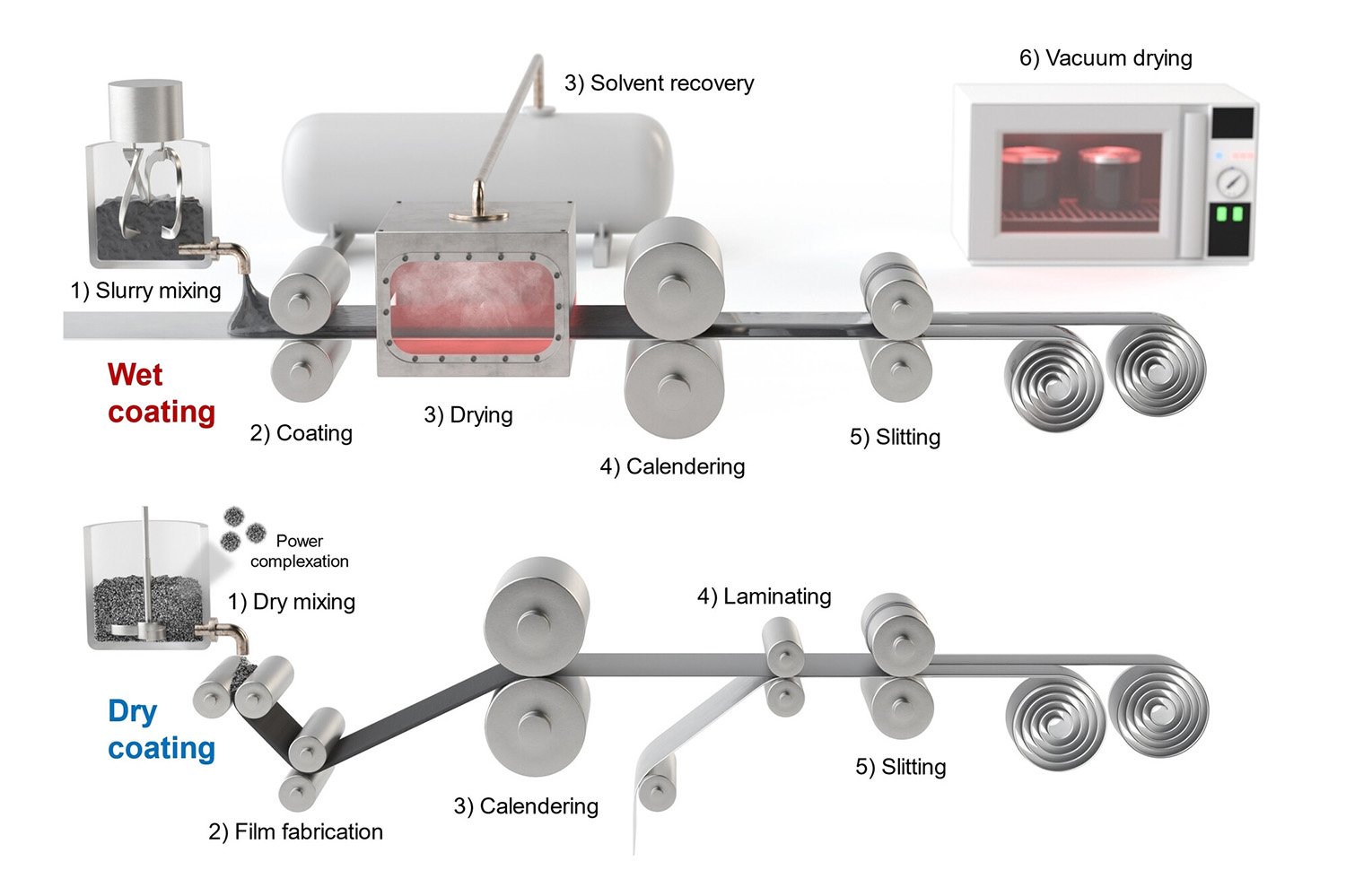
Dry battery electrode manufacturing is a process innovation rather than a battery chemistry. Conventional lithium-ion electrodes are usually made by mixing active material, binder, conductive carbon and solvent into a slurry, coating that slurry onto metal foil, then drying and recovering solvent. Dry electrode processing reduces or eliminates the solvent and drying steps.
The potential manufacturing advantages are significant:
- smaller factory footprint because large drying ovens may be reduced or removed;
- lower energy use from less solvent evaporation;
- reduced solvent recovery equipment;
- lower capital cost if high-throughput dry coating is achieved;
- simplified environmental controls for solvent handling;
- possible use of thicker electrodes with higher active-material loading.
Source: Original source

Performance gains are possible but not automatic. Thicker electrodes can raise energy density by reducing inactive material per unit capacity, but they can also reduce power capability if ions and electrons cannot move efficiently. Binder distribution, particle contact, porosity and adhesion to the current collector must be tightly controlled. Calendering must densify the electrode without closing transport pathways.
Maxwell Technologies was an important dry-electrode developer, and Tesla’s acquisition of Maxwell brought attention to the method as part of a broader battery manufacturing strategy. The key engineering question is scale-up. A dry-coated electrode must meet the same requirements as a wet-coated electrode: uniform loading, strong adhesion, low defect rate, high throughput, stable yield and compatibility with formation and aging.
Dry electrodes can be paired with multiple chemistries, including LFP, NMC, LMFP and potentially future lithium-metal or solid-state designs. Their value may come as much from manufacturing efficiency as from chemistry-level performance.
Comparing the Outlook for Future Battery Technologies
No single technology in this group solves every battery problem. Their readiness and best-use cases differ sharply.
| Technology | Main advantage | Main barrier | Likely outlook |
|---|---|---|---|
| Lithium-air | Extremely high theoretical specific energy | Oxygen management, discharge products, overpotential, poor cycle life | Long-term research chemistry |
| Lithium-metal | Very high anode capacity and high specific energy potential | Dendrites, low Coulombic efficiency, safety validation | Pilot to early commercial, application-dependent |
| Solid-state lithium | Higher energy potential and possible safety benefits | Interfaces, dendrites, pressure, scale-up cost | Gradual premium deployment before broad adoption |
| Lithium-sulfur | High gravimetric energy potential and abundant sulfur | Polysulfide shuttle, lithium-metal instability, cycle life | Promising for weight-sensitive niches |
| Sodium-ion | Abundant raw materials and potential cost benefit | Lower energy density than leading lithium-ion | Nearer-term for low-cost mobility and storage |
| LMFP | Better energy than LFP with cobalt-free chemistry | Manganese stability and conductivity | Nearer-term EV cathode improvement |
| Dry electrodes | Lower manufacturing energy and possible thicker electrodes | Uniformity, adhesion, throughput and yield | Process improvement across chemistries |
The nearer-term technologies are likely to be LMFP, sodium-ion and dry electrode manufacturing, because they build on existing production knowledge and address immediate cost or manufacturing needs. Lithium-metal and solid-state systems may deliver larger energy improvements, but only if interface stability, dendrite control and manufacturing yield are solved at large format. Lithium-sulfur is attractive for lightweight applications, but still limited by cycle life and lithium-metal complexity. Lithium-air remains the highest-upside but most distant candidate.
Future battery progress will probably come from combinations rather than a single breakthrough. A cost-focused EV could use LMFP or sodium-ion. A premium long-range vehicle may use lithium-metal or solid-state cells if manufacturing matures. A factory may adopt dry electrodes regardless of cathode chemistry. The practical winners will convert laboratory advantages into safe, repeatable, economical cells and packs.
References
- BU-212: Future Batteries
- Medium
- Lithium–air battery - Wikipedia
- Different Metal–Air Batteries as Range Extenders for the Electric Vehicle Market: A Comparative Study
- Innovative Lithium-Air Battery Design Poised to Increase Energy Storage | Department of Energy
- A comprehensive review on recent progress in aluminum– …
- Current Challenges and Routes Forward for Non-aqueous …
- Advances in solid-state lithium–sulfur batteries for next-generation energy storage - ScienceDirect
- Solid-State Batteries vs Lithium-Ion Batteries
- Advances in All-Solid-State Lithium–Sulfur Batteries for Commercialization