Gel lead acid batteries are a valve-regulated lead acid, or VRLA, design in which the sulfuric acid electrolyte is immobilized rather than left as free liquid. A silica gelling agent turns the electrolyte into a semi-stiff paste, allowing the battery to operate as a maintenance-free sealed lead acid system while retaining the familiar electrochemistry of lead dioxide, sponge lead, and sulfuric acid.
The gel lead acid concept was developed in the 1950s, with early work associated with Sonnenschein in Germany, and it became commercially significant in the 1970s. Absorbent glass mat, or AGM, batteries arrived later, in the early 1980s, and now share much of the same sealed lead acid market. Both gel and AGM designs immobilize electrolyte and use valve-regulated construction, but they are optimized for different service conditions.
Gel batteries are commonly used where dependable standby or deep-cycle service is more important than very high current delivery. Typical applications include uninterruptible power supplies, emergency backup systems, mobility equipment, wheelchairs, emergency lighting, and other installations where low maintenance and stable operation are valuable. AGM batteries, by contrast, are often preferred where lower internal resistance, stronger cold-temperature performance, or higher current output is needed.
Source: Original source
Benefits of Gel Lead Acid Batteries
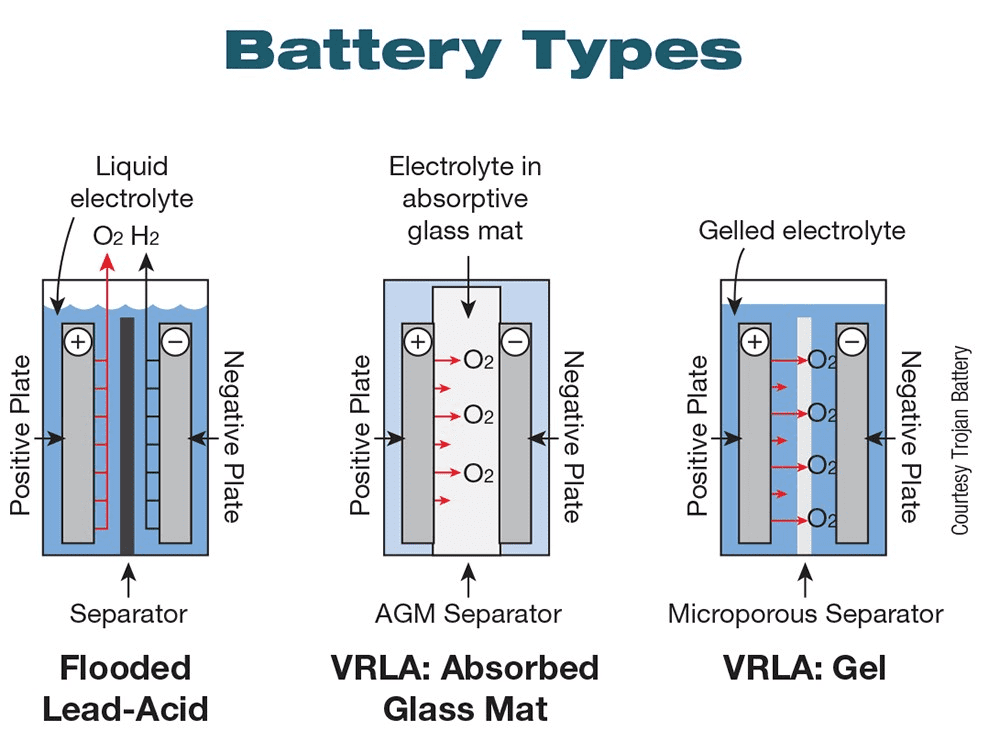
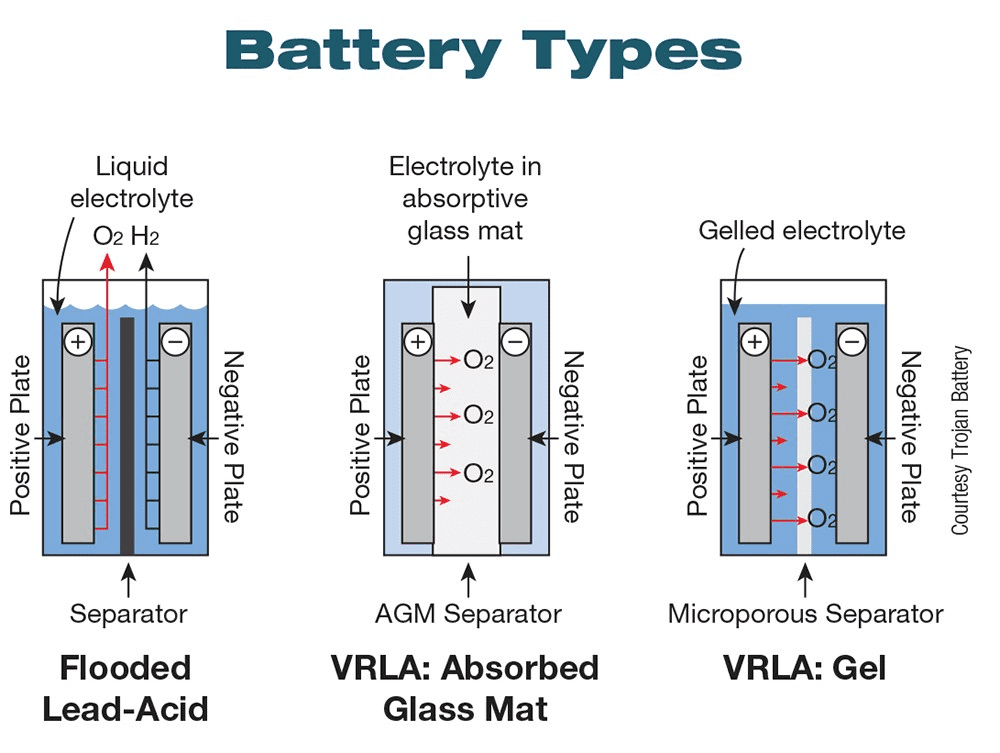
The central benefit of a gel lead acid battery is that it converts the traditional flooded lead acid format into a low-maintenance sealed design. In a flooded battery, the electrolyte is liquid and cells may require periodic water replacement depending on design and service conditions. In a gel VRLA battery, the acid is held in a silica-based gel. This reduces the movement of free electrolyte and supports operation without routine topping-up.
Because the electrolyte is immobilized, gel batteries can usually tolerate installation orientations that would be unsuitable for a flooded cell. They are often described as capable of sideways mounting, which can simplify mechanical packaging in UPS cabinets, mobility equipment, and backup power enclosures. This does not mean installation instructions can be ignored: terminals, venting path, mechanical restraint, and manufacturer orientation limits still matter. However, the gel format gives designers more flexibility than a conventional vented flooded battery.
Gel batteries also have low self-discharge relative to many practical standby requirements. This is important in emergency and reserve-power installations because the battery may spend most of its life on float charge, waiting for a power interruption. Low self-discharge helps preserve readiness during idle periods, provided the system maintains suitable float voltage and temperature conditions.
A major reason gel batteries remain relevant is their durability in deep-cycle and standby service. The gel structure can support long service life when the battery is charged correctly and operated within its current and temperature limits. Performance tends to remain useful for much of the battery’s life and then fall more rapidly near end of life, which is typical of many lead acid systems as active material degradation, grid corrosion, electrolyte changes, and internal resistance growth accumulate.
The sealed VRLA design also relies on internal gas recombination. During charging, oxygen generated at the positive plate can migrate and recombine at the negative plate. Hydrogen and oxygen recombination forms water internally, helping reduce water loss compared with flooded batteries. This recombination mechanism is a key part of why gel batteries can be marketed as maintenance-free: under correct charging conditions, the battery is not expected to need routine electrolyte service.
This water-recombination behavior is not unlimited. It depends on charging conditions staying within the battery’s intended voltage and temperature range. If charging is excessive, gas generation can exceed the recombination capability and pressure can rise. The valve-regulated design then vents gas to prevent unsafe pressure buildup. Once gas and water are lost, they generally cannot be replaced in a sealed gel battery. Correct charging is therefore not just an efficiency issue; it is central to service life.
Gel batteries are also valued for their thermal behavior. They are known for good performance at high ambient temperatures compared with some alternative lead acid configurations. The reference design advantage is not that heat is harmless, but that gel batteries can transfer heat to the outside and can tolerate warm operating environments comparatively well. Elevated temperature still accelerates aging in lead acid batteries, so thermal management, spacing, and avoidance of heat sources remain important engineering considerations.
Another useful characteristic is tolerance of moderate abuse. Gel batteries are generally considered forgiving compared with many battery chemistries because the lead acid system is mature, robust, and well understood. The immobilized electrolyte reduces spillage risk, and the sealed construction reduces routine maintenance errors. The gel design is also described as having less dry-out than AGM in some uses, because of its electrolyte-holding characteristics and recombination behavior.
Cycle performance is another area where gel batteries can be strong. Gel designs are often associated with higher cycle count than AGM designs in suitable applications, partly because the construction can hold more acid. This can make gel batteries attractive for deep-cycle equipment that draws moderate current repeatedly rather than demanding high cranking current. Examples include mobility devices, small electric utility equipment, emergency systems that cycle during outages, and some renewable or reserve-power uses where charge control is appropriate for gel chemistry.
Gel batteries may also be less prone to sulfation than some other lead acid systems. Sulfation occurs when lead sulfate crystals form and persist on the plates, reducing active material availability and increasing internal resistance. All lead acid batteries can suffer sulfation if left discharged or chronically undercharged, but the gel format has a reputation for comparatively good resistance under proper service conditions. This advantage should not be interpreted as permission to store the battery discharged; good charging practice is still required.
The product range is broad. Gel batteries are available in many sizes, from small sealed lead acid blocks used in compact standby equipment to larger VRLA batteries used in backup installations. This availability matters in engineering practice because replacement form factor, terminal style, enclosure space, weight, and charger compatibility often determine whether a battery type can be used without redesigning the system.
Common benefits can be summarized as follows:
| Characteristic | Practical significance |
|---|---|
| Immobilized gel electrolyte | Reduces free liquid movement and supports sealed construction |
| Maintenance-free VRLA format | No routine watering under correct operating conditions |
| Mounting flexibility | More installation options than flooded lead acid designs |
| Low self-discharge | Useful for standby and emergency backup service |
| Internal recombination | Converts oxygen and hydrogen back into water during normal charging conditions |
| Strong cycle and heat tolerance | Useful for moderate-current deep-cycle and warm-environment applications |
| Broad size availability | Simplifies replacement and system integration |
In practical selection, these advantages make gel batteries strongest where the load current is moderate, the charger can be correctly configured, and long unattended service is required. UPS systems, emergency backup, wheelchairs, mobility equipment, and other reserve or deep-cycle applications are typical examples. They are less compelling when the main requirement is maximum current delivery, rapid charge acceptance, or cold-start performance.
Drawbacks and Operating Limits
The same design features that make gel batteries useful also create operating limits. The most important limitation is sensitivity to charging conditions. A gel battery needs the correct charge voltage and float voltage for its design. If the voltage is too high, excessive gas generation can damage the battery, dry out the gel structure, or force the safety valve to release gas. If the voltage is too low, the battery may remain undercharged, encouraging sulfation and reducing available capacity.
This makes charger compatibility critical. A charger intended for flooded lead acid or for another VRLA profile is not automatically suitable for gel. Even within the lead acid family, charging voltages and compensation strategies vary by manufacturer, temperature, and intended service. In a standby installation, the float setting is especially important because the battery may remain connected continuously for years. In a cyclic installation, the absorption and termination behavior also matter because repeated overcharge or undercharge can shorten life.
Safety note: A gel battery is sealed, but it is not a gas-proof pressure vessel. Valve-regulated batteries can vent if internal pressure rises. Battery compartments should allow appropriate ventilation, and installations should avoid sparks, hot surfaces, and ignition sources near possible vent paths. This is especially important in enclosed cabinets, multi-battery strings, and locations with poor air exchange.
Manufacturing cost is another drawback. Gel batteries generally cost more to manufacture than AGM batteries. The gel electrolyte process and construction requirements add cost, and this often appears in purchase price. Where AGM can meet the electrical and environmental requirements, it may be selected because it provides similar sealed lead acid convenience at lower cost. Gel becomes easier to justify when its cycle behavior, heat tolerance, or standby characteristics provide a practical advantage.
Gel batteries also have moderate specific energy. This is a broader limitation of lead acid chemistry, not only the gel format. For a given stored energy, lead acid batteries are relatively heavy compared with many newer rechargeable systems. In stationary backup systems, weight may be acceptable. In portable or mobile equipment, weight and volume can be more restrictive. Engineers selecting gel batteries must therefore balance reliability, cost, recyclability, charger availability, and mechanical constraints against energy density.
Load-current capability is limited compared with AGM designs. Gel batteries tend to have higher internal resistance, which reduces their suitability for high-current applications. High internal resistance causes greater voltage sag under load and more internal heating at elevated discharge currents. This is why gel batteries are generally not used for engine starting or other applications that require very high short-duration current. AGM batteries typically perform better in those roles because their lower internal resistance supports higher current output.
The same comparison applies at low temperature. AGM batteries are usually superior in cold conditions because lower internal resistance helps preserve current delivery as temperature falls. Gel batteries can perform well in warm environments, but they are not usually the first choice where low-temperature cranking or high pulse power is the main design requirement. The choice is not simply “gel versus AGM”; it is a match between battery construction and duty cycle.
A practical comparison is:
| Requirement | Gel lead acid tendency | AGM tendency |
|---|---|---|
| High-current starting | Generally less suitable | Usually better suited |
| Low-temperature current delivery | More limited | Usually stronger |
| Warm ambient operation | Often performs well | Application-dependent |
| Deep-cycle moderate-current service | Often strong | Also used, but characteristics differ |
| Manufacturing cost | Generally higher | Generally lower than gel |
| Charge-voltage tolerance | Requires correct settings | Also requires correct settings, with different limits |
Ventilation requirements sometimes surprise users because gel batteries are often called sealed. In VRLA terminology, “sealed” means the battery is normally closed and does not require routine watering, not that gas release is impossible. If the battery is overcharged, overheated, internally damaged, or operated outside specification, the pressure-relief valve can open. Venting protects the case from excessive pressure, but it also represents loss of water and gases. Repeated venting is a sign of incorrect operation or battery distress.
Storage condition is another limit. Gel batteries should be stored charged. This is less critical than with flooded lead acid batteries, but it still matters. A discharged lead acid battery is vulnerable to sulfation, and self-discharge continues during storage. Long storage intervals should include a maintenance-charge plan appropriate for the battery model and ambient temperature. The higher the storage temperature, the more carefully state of charge should be managed.
Gel batteries also need protection from inappropriate equalization practices. Procedures used for flooded lead acid batteries to mix electrolyte or correct imbalance may not be suitable for sealed gel batteries. Because the electrolyte is immobilized and water cannot be replaced, aggressive overcharge can cause permanent damage. Multi-battery strings should be designed so that batteries are matched, connections are sound, and charging is evenly distributed. Poor interconnects or unequal thermal environments can push individual units outside their preferred operating range.
The moderate-current nature of gel batteries should influence system design. A load that appears acceptable by energy capacity may still be unsuitable if its peak current is high. For example, a battery sized only by ampere-hour rating may experience unacceptable voltage drop if the load demands large surge current. Engineers should check the manufacturer’s discharge curves, voltage limits, temperature range, and recharge recommendations rather than assuming that all sealed lead acid batteries of the same nominal voltage and capacity behave the same.
End-of-life behavior also needs attention. Gel batteries can maintain useful performance for a long period and then decline quickly. In standby applications, this makes periodic capacity testing or impedance monitoring valuable, especially where backup power is safety-critical. A battery can show normal float voltage while still having reduced reserve capacity. Replacement planning should consider service age, temperature exposure, discharge history, and test results rather than relying on voltage alone.
In short, gel lead acid batteries are not a universal upgrade over AGM or flooded lead acid designs. They are a specialized VRLA option with clear strengths in maintenance-free standby and moderate-current deep-cycle service, especially where mounting flexibility, low self-discharge, heat tolerance, and long service life are important. Their limitations are equally important: higher cost than AGM, strict charge-voltage requirements, possible gas release, moderate specific energy, and limited high-current capability. Used within those boundaries, gel batteries remain a practical and well-established energy-storage choice.
References
- Battery University | BU-201b: Gel Lead Acid Battery
- Battery University | BU-201b: Gel Lead Acid Battery
- Battery University | BU-214: Summary Table of Lead-based Batteries
- Battery University | BU-107: Comparison Table of Secondary Batteries
- Battery University | BU-216: Summary Table of Lithium-based Batteries
- Battery University | BU-201: How does the Lead Acid Battery Work?
- AGM Battery Overview: Insights & Benefits (BU-201a) - Studocu
- Gel Battery | Reliable Battery Options for Sale
- Lead-acid Battery VS. Gel Battery VS. AGM Battery
- How to Compare Battery Types