Temperature and operating pattern are two major influences on the service life of a starter battery. High under-hood temperatures accelerate aging, while start-stop vehicles subject the battery to many more partial discharge and recharge events than conventional vehicles. These effects can reduce usable capacity even when the battery still appears capable of delivering a strong engine-starting current.
The relationship is not identical for every battery or vehicle. Battery design, materials, climate, mounting location, charging control, and maintenance all affect the result. The figures below should therefore be treated as engineering guidance and study findings rather than a guaranteed life prediction for an individual battery.
How Heat and Start-Stop Loading Shorten Starter-Battery Life
As a rule of thumb, each 8°C (15°F) rise in temperature cuts the life of a sealed lead-acid battery roughly in half. This is not a universal law: actual aging depends on battery construction, state of charge, charging conditions, and how long the battery remains at the higher temperature. It is nevertheless a useful reminder that heat is often more damaging than cold over the long term.
For example, a valve-regulated lead-acid (VRLA) battery specified to last 10 years at 25°C (77°F) would, under the same continuous exposure assumption, last about 5 years at 33°C (92°F) and about 30 months at a constant 41°C (106°F). These are illustrative estimates based on the rule of thumb, not a warranty or a prediction for a vehicle battery that experiences changing temperatures.
Heat accelerates chemical and physical aging inside the battery. Once the battery has suffered heat damage, the lost capacity generally cannot be restored by charging or routine maintenance. A battery may continue to start an engine for some time after its capacity has begun to decline, but its reserve for repeated starts and accessory loads becomes smaller.
Starter-battery designs have also improved. A comparison of battery failure-mode studies reported that a temperature increase of about 7°C (12°F) affected life by roughly one year in the 2000 study, whereas the 2010 study indicated a wider heat-tolerance range of about 12°C (22°F). This suggests improved resistance to heat in newer designs and materials, while not eliminating the effect of elevated temperature.
Frequent discharge creates a second form of stress. A conventional starter battery may experience only a small number of engine starts each day, followed by enough driving for the charging system to restore the removed energy. A micro-hybrid or start-stop vehicle repeatedly shuts the internal-combustion engine off at stops and restarts it when traffic moves. This produces many shallow discharge and recharge events, often called micro-cycles.
A micro-hybrid application can impose approximately 2,000 micro-cycles per year. Data reported from vehicle manufacturers showed capacity falling to about 60% after two years in such use. The exact result depends on the vehicle and battery system, but the operating pattern demonstrates why a battery designed only for occasional engine starting may not provide adequate cycle life in a start-stop application.
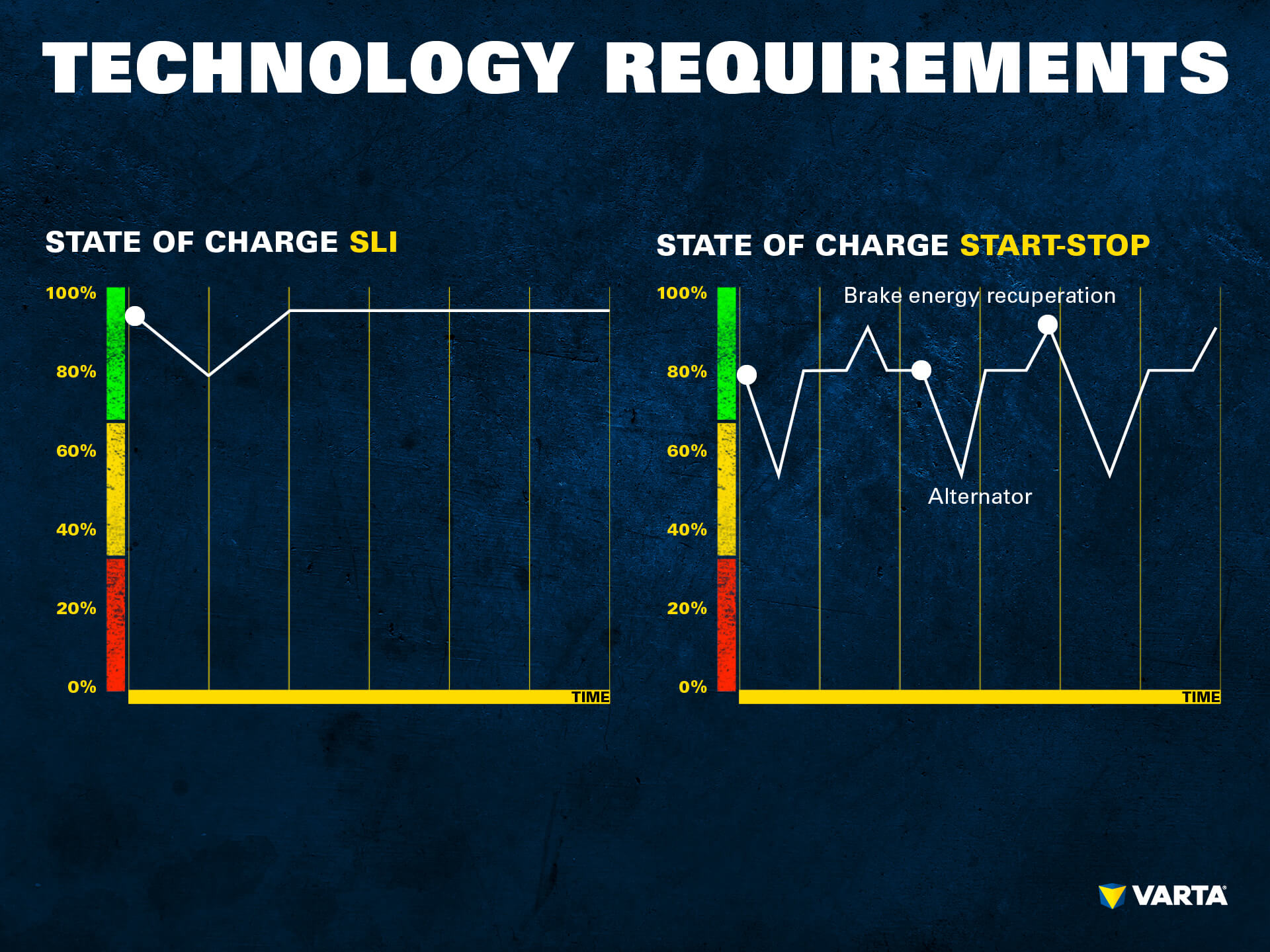
Source: Battery University

AGM batteries and other specialized systems are used in many start-stop vehicles because their construction is better suited to repeated partial cycling than a conventional starter-battery design. The choice of battery must match the vehicle’s charging system and control strategy; replacing an AGM battery with an unsuitable type can reduce durability and may interfere with the vehicle’s battery-management system.
North American Automotive Battery Failure Patterns
A 2005 failure-mode study conducted by Douglas, East Penn, Exide Technologies, and Johnson Controls examined 2,681 batteries tested between 2003 and 2004. The study reported that average battery life had increased over earlier historical values: approximately 34 months in 1962, 41 months in 2000, and 50 months in 2005. These dates describe the comparison data and study context; they should not be interpreted as a universal service-life schedule for all vehicles.
Improved materials were identified as one factor contributing to longer average service life. Battery construction, manufacturing quality, vehicle electrical loads, charging behavior, and climate also influence the result.
The study found a regional difference across North America. Batteries in warmer southern areas generally failed sooner than batteries in cooler northern areas, consistent with the accelerating effect of temperature on lead-acid aging. The comparison does not mean that cold climates are harmless: low temperatures reduce available cranking performance temporarily, while heat tends to accelerate permanent aging.
Shorted cells and grid failures were among the leading failure modes in the survey. A shorted cell reduces the battery’s effective voltage and available energy. Grid corrosion or structural failure can increase internal resistance, reduce the active plate area, and eventually prevent the battery from delivering adequate current. Temperature differences between regions can change the rate at which these failure mechanisms develop.
The reported average-life progression—from 34 months to 41 months and then 50 months—illustrates the benefit of improved battery materials over time. It does not remove the need to consider the battery’s actual environment. A battery mounted in a hot engine compartment may age faster than an otherwise similar battery operating at a lower temperature.
European AGM Starter-Battery Failure Patterns
Johnson Controls Power Solutions EMEA analyzed more than 800 AGM starter batteries at the end of their service life. The analysis summarized the distribution of reported failure modes and showed that AGM batteries can reach end of life through more than one mechanism. The study is useful because it examines batteries used in real automotive service rather than relying only on a laboratory aging model.
The JCI results were broadly similar to a study conducted by a German luxury-car manufacturer around 2007. That comparison involved approximately 175 starter batteries. In the German study, batteries that had failed from heat and exhibited high internal resistance were excluded before the capacity and cold-cranking results were compared. This qualification is important: removing heat-damaged batteries changes the population being analyzed and prevents that failure mechanism from being mixed with the remaining capacity-versus-CCA comparison.
The comparison showed that most of the aging batteries crossed a capacity limit before crossing a cold-cranking-ampere (CCA) limit. In other words, many batteries lost usable energy or reserve capacity while still appearing acceptable when judged only by their ability to deliver a short, high-current starting test. Relatively few batteries failed by falling through the CCA limit first.
Capacity and CCA describe different aspects of battery health. CCA indicates the ability to provide high current under a specified test condition, whereas capacity relates more closely to how much charge the battery can deliver over a longer discharge. A starter battery can retain sufficient short-duration cranking performance while having too little reserve to support repeated starts, vehicle electronics, or accessory loads.
This distinction is especially relevant in start-stop vehicles. Repeated engine restarts and partial cycling place greater importance on available capacity and cycle durability, not just a single strong crank. A battery that passes a CCA-oriented test may therefore still be approaching the end of its useful service life.
What Resistance-Based Battery Tests Can and Cannot Measure
Internal resistance is a useful diagnostic parameter, but it is not the same as battery capacity. Many electronic testers estimate battery condition by applying a signal or load and analyzing the resulting electrical response. The result can help identify a weak, damaged, or high-resistance battery, but resistance alone cannot directly reveal every aspect of the battery’s remaining energy storage.
CCA and capacity are related health indicators, but they do not necessarily decline at the same rate. The European and German study results show why this matters: most batteries crossed the capacity limit while relatively few crossed the CCA limit. A battery with apparently acceptable CCA can therefore have insufficient capacity for dependable service.
Some battery testers are advertised as measuring capacity when their principal measurement is internal resistance or an inference derived from resistance. Such a result should be treated as an estimate, not as equivalent to a controlled capacity test. Capacity is more complex to determine because it depends on discharge current, temperature, state of charge, rest period, battery history, and the test endpoint.
A practical battery assessment should consider several inputs:
- Visual and physical condition: Check for case damage, leakage, corrosion, loose connections, or signs of overheating.
- Charging and vehicle operation: Confirm that the charging system and battery-management controls are operating correctly.
- CCA or conductance result: Use the result to assess starting-current capability, while recognizing its limits.
- Capacity or reserve assessment: Where service decisions are important, use a test method capable of evaluating capacity rather than relying only on resistance.
- Operating history: Account for hot climates, short trips, frequent starts, start-stop operation, and prolonged low state of charge.
Resistance-based testing is therefore best used as one diagnostic input. It can identify trends and obvious weakness, but it should not be treated as definitive proof of remaining capacity. Conversely, a battery should not be condemned solely because an estimated value conflicts with its observed operating condition without checking state of charge, temperature, connections, and the test method.
For maintenance and replacement decisions, the most reliable interpretation combines the test result with the battery’s age, application, climate, and symptoms. This is particularly important where a battery still starts the engine normally but has lost the capacity and reserve needed for repeated start-stop service.
References
- Battery University | BU-806a: How Heat and Loading affect Battery Life. (n.d.). https://batteryuniversity.com/article/how-heat-and-harsh-loading-reduces-battery-life
- Battery University | BU-806a: How Heat and Loading affect Battery Life. (n.d.). https://www.batteryuniversity.com/article/bu-806a-how-heat-and-loading-affect-battery-life
- Battery University | BU-806a: How Heat and Loading affect Battery Life. (n.d.). http://www.batteryuniversity.com/article/bu-806a-how-heat-and-loading-affect-battery-life
- Mercedes Won’t Start in South Florida? No-Crank ... - Motronix. (n.d.). https://motronix.net/blog/mercedes-wont-start-no-crank-crank-no-start-south-florida
- Understanding The Heat And Load Effects On A Battery. (n.d.). https://blog.upsbatterycenter.com/understanding-heat-load-effects-battery
- How does the Lead Acid Battery Work? • Lead acid Automotive .... (n.d.). https://www.sunvoltbat.com/how-does-the-lead-acid-battery-work.html
- Extreme heat pushes every battery to its limit. (n.d.). https://www.facebook.com/SoliteBatteryME/posts/extreme-heat-pushes-every-battery-to-its-limit-and-most-fail-when-you-need-them-/1538818938249428
- Battery University | BU-905a: Testing Starter Batteries in Vehicles. (n.d.). http://www.batteryuniversity.com/article/bu-905a-testing-starter-batteries-in-vehicles
- Learn about the differences within the lead acid family and find .... (n.d.). https://www.academia.edu/35803185/Learn_about_the_differences_within_the_lead_acid_family_and_find_out_what_they_are
- HTTP Batteryuniversity | PDF | Energy Technology | Electricity. (n.d.). https://www.scribd.com/document/1003788197/http-batteryuniversity