Renewable energy is increasingly produced close to where it is used: on rooftops, in community microgrids, at telecom sites, on farms and at remote industrial loads. Solar panels, small wind systems and inverter-based power electronics have made local generation more practical, while batteries have made that generation more usable.
The central problem is timing. Solar modules can produce strongly at midday and nothing at night. Wind output can change quickly. Loads, meanwhile, follow human activity, weather and industrial schedules. Storage separates generation time from consumption time.
This matters especially in regions where the AC grid is weak, expensive or unavailable. In parts of Africa and other rural or islanded regions, battery-backed solar can provide lighting, refrigeration, communications and clinic power without waiting for a full transmission buildout. In mature grids, the same storage principle supports backup power, time-of-use shifting and grid services.
Why Renewable Energy Needs Storage
A renewable power system without storage must either use energy at the instant it is generated, export it to a larger grid or curtail it. Storage gives the system another option: save surplus energy and release it later.
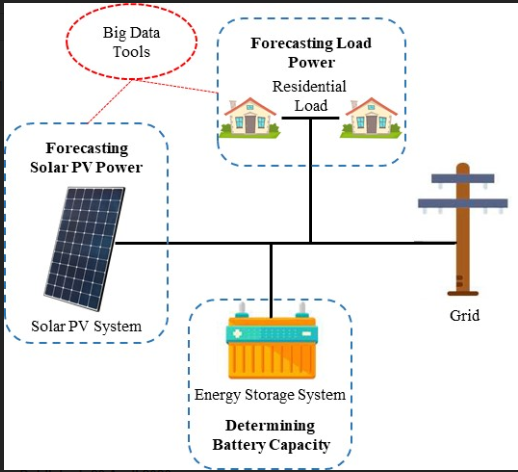
For solar photovoltaic systems, the mismatch is easy to see. PV output rises after sunrise, peaks near midday and declines toward evening. Many homes and small businesses, however, have important loads in the morning and evening. Batteries can absorb daytime surplus and discharge when solar output is low. In a weak-grid or off-grid installation, the same battery may also stabilize voltage and frequency through the inverter.
Wind power has a different profile but the same storage need. Wind generation can be strong at night or during weather events and low during calm periods. Storage reduces the operational stress created by rapid changes in output and gives microgrid controllers more time to dispatch generators, shed noncritical loads or adjust inverter setpoints.
Microgrids are a natural application for battery storage because they often have limited generation diversity and limited access to external balancing resources. A battery can provide:
- Short-term power smoothing for solar and wind fluctuations.
- Peak shaving when loads briefly exceed generator capacity.
- Backup energy during outages or cloudy periods.
- Black-start support for restarting an islanded electrical system.
- Reduced generator runtime in hybrid diesel-renewable systems.
The economics vary by region and tariff structure. Where utility electricity is cheap and reliable, a home battery may be justified mainly by backup value or time-of-use pricing. Where diesel fuel is expensive, grid service is unreliable or there is no grid connection, battery-backed renewable energy can be a practical electrification tool.
Storage is not limited to batteries. Pumped hydro, flywheels, compressed air, thermal storage, hydrogen and flow batteries all store energy in different forms. The right choice depends on power level, discharge duration, site constraints, response time, cycle life and cost.
Pumped Hydro and Large-Scale Gravity Storage
Pumped hydro storage is the largest and most mature form of grid-scale electrical energy storage. It stores energy by moving water from a lower reservoir to an upper reservoir when surplus electricity is available. When power is needed, the water flows back down through turbines and generates electricity.
The principle is simple gravity storage. The stored energy depends on the volume of water, the height difference between reservoirs and system losses. Modern pumped hydro plants commonly achieve round-trip efficiencies of about 70–85%, meaning 70–85% of the electrical energy used for pumping can be recovered as electrical output.
Pumped hydro is well suited to large, long-duration storage because reservoirs can hold very large amounts of energy. It can support daily cycling, reserve power and grid balancing over hours. Compared with electrochemical batteries, the storage medium is inexpensive and the plant lifetime can be many decades.
Its disadvantages are mostly site-related:
- It needs suitable elevation difference and water storage.
- Reservoir construction can affect land use, habitats and local communities.
- Permitting and civil construction can take many years.
- It is difficult to deploy in flat, urban or water-constrained regions.
- New projects require major capital investment and grid connection planning.
Gravity-storage concepts using solid weights instead of water apply the same basic idea: use surplus electricity to lift mass, then recover energy when the mass descends. These systems aim to reduce some reservoir-related constraints, but they are less established than pumped hydro.
The comparison with batteries is therefore not one of direct replacement. Pumped hydro is attractive for bulk, long-duration storage where geography permits. Batteries are attractive where storage must be modular, fast to install and placed close to loads or distribution feeders.
Flywheels for Short-Duration Grid Stabilization
Flywheels store energy as kinetic energy in a rotating mass. During charging, an electric machine accelerates the rotor. During discharge, the same machine acts as a generator and converts rotational energy back to electricity.
The energy stored in a flywheel depends on the rotor’s moment of inertia and the square of its rotational speed. Modern high-speed flywheels may use composite rotors, magnetic or low-friction bearings, vacuum enclosures and power electronics to reduce losses and control power flow.
Flywheels are most useful where high power is needed for a short time. Typical applications include:
- Frequency regulation.
- Voltage and power-quality support.
- Ride-through during brief grid disturbances.
- Regenerative braking recovery.
- Transient buffering for industrial loads.
- Hybrid systems that protect batteries from rapid cycling.
Reported flywheel round-trip efficiency spans a broad range, commonly about 70–95%, depending on bearing design, vacuum quality, motor-generator efficiency, standby losses and power electronics. Cycle life is a major advantage: flywheel systems can tolerate very high cycle counts, often far beyond conventional battery cycling. However, their energy capacity is usually limited to seconds-to-minutes service, with some systems capable of longer but still relatively short storage durations.
Compared with batteries, flywheels have high power capability and long cycling life but lower sustained energy capacity. A battery is usually better when a load must be supplied for one or more hours. A flywheel is often better when the task is to inject or absorb power quickly and repeatedly.
Flywheels also overlap with supercapacitors. Both technologies offer fast response, high power density and long cycle life. Both are useful for short-term stabilization rather than long-duration energy supply. Their limitations are also similar in practice: higher cost for stored energy, self-discharge or standby losses, and thermal-management requirements. Flywheels must also include containment for rotor safety and control systems for high-speed mechanical operation.
For renewable energy systems, flywheels are best viewed as power devices, not bulk energy reservoirs. They can improve power quality and reduce stress on batteries, but they normally do not replace the battery bank in a solar home system or the multi-hour battery in a microgrid.
Compressed-Air Energy Storage
Compressed-air energy storage, or CAES, stores energy by using surplus electricity to compress air. The compressed air is held in an underground cavern, reservoir or pressure vessel. When electricity is needed, the stored air is released through an expander or turbine to produce mechanical power and then electrical power.
CAES can be designed at large scale and can provide discharge durations measured in hours. It is therefore often discussed as a long-duration storage technology for renewable-heavy grids. Like pumped hydro, however, it depends strongly on site conditions and infrastructure.
The main engineering challenge is heat. Compressing air raises its temperature. If that heat is rejected to the environment, energy is lost. Later, when compressed air expands, it cools. Some CAES systems use fuel or stored heat to reheat the air before expansion, while advanced adiabatic concepts aim to capture compression heat and reuse it during discharge.
Round-trip efficiency depends heavily on system design. Practical CAES efficiency is often discussed in the range of roughly 40–70%, with improved concepts targeting the upper end by reducing thermal losses. This is generally lower than many lithium-ion battery systems and lower than pumped hydro in favorable installations.
Other constraints include:
- Suitable geology for underground storage, unless above-ground pressure vessels are used.
- Large compressors, turbines, heat exchangers and balance-of-plant equipment.
- Permitting and environmental review.
- Limited deployment history compared with pumped hydro and batteries.
- Complex operation when thermal storage or fuel-assisted expansion is included.
CAES remains important because it can theoretically store large amounts of energy for long durations without using electrochemical cells. But it is not a simple substitute for a battery. Batteries are modular and can be installed at homes, businesses and substations. CAES is an infrastructure project suited to specific sites and large-scale planning.
Battery Chemistries for Renewable Energy Storage
Batteries are favored in many renewable energy systems because they are modular. A designer can add storage in kilowatt-hour increments, install it close to the load and connect it through commercially available inverters. Batteries respond quickly, operate quietly and do not require mountains, reservoirs or underground caverns.
Source: Battery University
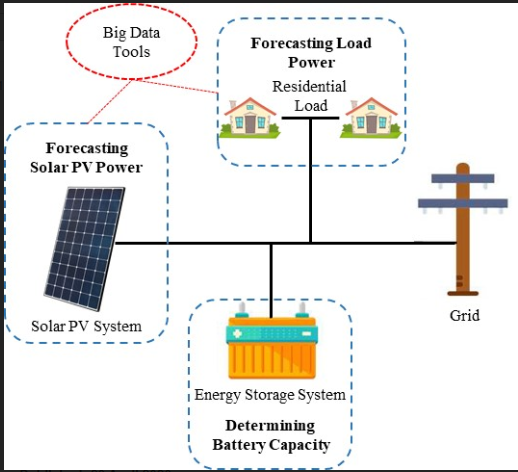
Battery systems can serve several renewable-energy functions at once:
- Store daytime solar generation for evening use.
- Provide outage backup.
- Reduce peak demand charges.
- Smooth renewable output.
- Support voltage and frequency in microgrids.
- Reduce diesel generator runtime in hybrid systems.
The main tradeoffs are cost, cycle life, usable depth of discharge, temperature sensitivity, maintenance, safety requirements and end-of-life management. Lead-acid and lithium-ion batteries have both been widely used, but they behave very differently under renewable-energy cycling.
Flow batteries also deserve mention for stationary storage. They store energy in liquid electrolytes held in external tanks. Increasing tank size can increase energy capacity without proportionally increasing cell-stack power. Flow batteries typically have lower energy density than lithium-ion systems, but their long cycle life and scalable energy capacity can be useful for multi-hour stationary applications.
Lead-Acid Batteries: Low Cost but Limited Cycling
Lead-acid batteries are familiar, widely available and comparatively inexpensive at the point of purchase. Flooded, AGM and gel variants have all been used in solar and backup systems. They remain practical where low upfront cost, simple charging equipment and established service knowledge are important.
Their weakness is cycling. A starting battery is not designed for repeated deep discharge. Deep-cycle lead-acid batteries perform better, but service life still depends strongly on depth of discharge, temperature, charge control and maintenance. Repeated deep discharge shortens life. Elevated temperature accelerates aging. In flooded cells, electrolyte level and equalization practices can matter.
Partial-state-of-charge operation is especially problematic. In many solar systems, a lead-acid bank may spend long periods only partly charged, particularly during cloudy weather or undersized charging. This encourages sulfation, where lead sulfate crystals become harder to reverse during normal charging. Sulfation reduces capacity, increases internal resistance and can make the battery appear to age prematurely.
Lead-acid batteries also provide less usable capacity than the nameplate rating suggests if long life is required. Designers often limit routine depth of discharge to preserve service life, which means a larger battery bank is needed for the same usable energy. Ventilation and acid-handling precautions may be required for flooded systems.
For standby backup with infrequent discharge, lead-acid can still be effective. For daily renewable cycling, the low purchase price can be offset by replacement frequency, lower usable depth of discharge and maintenance needs.
Lithium-Ion Batteries: Higher Efficiency and Longer Cycle Life
Lithium-ion batteries have become the dominant choice for many new stationary storage systems because they combine high energy density, high round-trip efficiency, good cycling capability and low routine maintenance. Lithium-ion battery systems commonly operate at round-trip efficiencies around 85–95%, depending on cell chemistry, inverter losses, temperature control and operating conditions.
A major advantage is usable depth of discharge. Lithium-ion systems can generally use a larger fraction of their rated capacity than lead-acid systems while maintaining useful cycle life, provided they are operated within manufacturer limits. This can reduce the amount of installed capacity needed for a given usable-energy target.
Lithium iron phosphate, or LFP, is especially common in stationary applications. It has lower cell voltage and generally lower energy density than some nickel-based lithium-ion chemistries, but it is valued for thermal stability, long cycle life and suitability for repeated cycling. These characteristics fit home storage, commercial storage and microgrid applications well.
Lithium-ion systems require electronic protection. A battery management system monitors cell voltage, temperature and current, balances cells where required, and disconnects the battery under unsafe or damaging conditions. Stationary lithium systems also require appropriate enclosure design, overcurrent protection, installation clearances and compliance with local electrical and fire codes.
Cost comparison should be made on lifetime delivered energy, not simply purchase price. A lead-acid bank may cost less initially, but a lithium-ion system may deliver more usable energy per cycle, last longer under daily cycling and need less maintenance. The better choice depends on the duty cycle, ambient temperature, service capability, replacement logistics and safety requirements.
Home Batteries and Microgrid Backup
A home solar battery stores PV energy that would otherwise be exported, curtailed or unused. In the evening, the inverter supplies household loads from the battery. During an outage, a properly configured system can isolate selected circuits and continue supplying power within the inverter and battery limits.
Commercial home batteries, including products such as Tesla Powerwall, are examples of integrated lithium-ion storage. They combine cells, battery management, enclosure, inverter interface and control software. Their functions typically include solar self-consumption, backup power and time-of-use shifting. The limitation is finite energy capacity: large loads such as electric heating, air conditioning, water heating or EV charging can drain a battery quickly unless the system is sized for those loads.
Microgrid batteries use the same principles at larger or more ruggedized scale. They may support remote communities, telecom towers, farms, island grids, mining sites, clinics and schools. In weak-grid regions, a battery can ride through outages, reduce voltage disturbances and allow solar generation to serve critical loads more consistently.
Sizing is an engineering exercise, not a guess. Important inputs include:
- Daily energy consumption.
- Critical-load power demand.
- Required autonomy in hours or days.
- Solar array size and seasonal production.
- Inverter continuous and surge rating.
- Battery usable depth of discharge.
- Ambient temperature and enclosure conditions.
- Generator or grid availability.
A battery does not create energy; it shifts energy in time. If the solar array is too small, the loads are too large or bad weather persists, the battery will eventually discharge. Good renewable-storage design therefore starts with load reduction, realistic autonomy targets and clear separation between critical and noncritical circuits.
For renewable energy, batteries are not the only storage technology, but they are often the most deployable. Pumped hydro provides bulk storage where geography allows. Flywheels stabilize power over seconds to minutes. Compressed air can address long-duration storage at suitable sites. Batteries fill the practical middle ground: modular storage for homes, businesses and microgrids where fast response, manageable installation and repeated cycling are required.
References
- Comparative Study on Hybrid Supercapacitors and Flywheel Storage. (n.d.). https://eureka.patsnap.com/report-comparative-study-on-hybrid-supercapacitors-and-flywheel-storage
- Advances in Battery Technologies for Next-Generation .... (n.d.). https://www.mdpi.com/2079-9292/15/3/690
- Basics of Energy Storage Technologies. (n.d.). https://link.springer.com/rwe/10.1007/978-3-030-87693-7_5-1
- A stochastic techno-economic comparison of generation-integrated long duration flywheel, lithium-ion battery, and lead-acid battery energy storage technologies for isolated microgrid applications. (n.d.). https://www.sciencedirect.com/science/article/abs/pii/S2352152X22006946
- Flywheel vs Battery Storage: A Cost-Benefit Breakdown. (n.d.). https://eureka.patsnap.com/article/flywheel-vs-battery-storage-a-cost-benefit-breakdown
- Energy Storage Technologies Overview and Comparison. (n.d.). https://quizlet.com/study-guides/energy-storage-technologies-overview-and-comparison-32c2b3f6-90a8-4ec6-9cc6-e820909862a5
- Journal of Energy and Power Technology | Battery-Less Off-Grid Renewable Microgrid: A Review of Storage Alternatives and PV-WT-CSP Integration with Green Hydrogen. (n.d.). https://www.lidsen.com/journals/jept/jept-08-03-015
- Critical Review of Flywheel Energy Storage System. (n.d.). https://www.mdpi.com/1996-1073/14/8/2159
- Clean energy storage technology in the making: An innovation systems perspective on flywheel energy storage. (n.d.). https://pmc.ncbi.nlm.nih.gov/articles/PMC5726083
- Energy Storage: Everything You Should Know - The Renewable Energy Institute. (n.d.). https://www.renewableinstitute.org/energy-storage-everything-you-should-know