A battery charger is not just an accessory that happens to refill a cell or battery pack. It is part of the battery system. The charger determines how current and voltage are applied, how full charge is detected, how heat and abnormal conditions are handled, and how much stress the battery experiences during repeated use.
Chargers are often undervalued because the battery receives most of the attention. In practice, the battery and charger belong together much like a horse and carriage: one cannot deliver reliable service without the other being suited to the task. A high-quality cell can be damaged or underused by the wrong charger, while a well-designed charger cannot safely overcome a battery that is aged, mismatched, or outside its operating limits.
This relationship is more complex than it first appears. Engineers who are comfortable with electronic loads, power supplies, and embedded systems can still underestimate battery power sources because electrochemical storage is not a fixed load. Battery voltage, internal resistance, temperature, state of charge, aging, and chemistry all change the charging response. Lithium-ion, lead-acid, nickel-cadmium, and nickel-metal hydride batteries do not accept charge in the same way, especially under adverse conditions such as high temperature, low temperature, imbalance, or elevated internal resistance.
At the most basic level, a charger supplies controlled DC current and voltage to reverse the discharge reactions of a rechargeable battery. Many chargers convert AC mains power to regulated DC output; others operate from DC sources such as vehicle power buses or solar systems. The important point is not only that energy flows into the battery, but that the charger applies the correct charging method for the chemistry and stops, reduces, or maintains charge at the correct time.
Types of Battery Chargers
Battery chargers can be grouped by charging speed, control method, and application. The familiar labels slow, rapid, fast, and ultra-fast describe approximate charge rates, but the label alone is not enough. A safe charger must also match the battery chemistry, nominal voltage, capacity, allowed charge current, temperature range, and termination requirements.
Charge rate is often expressed as C-rate. A 1C charge current is numerically equal to the battery capacity in ampere-hours delivered as amperes. For example, a 2 Ah cell charged at 1C would be charged at about 2 A, assuming the cell maker allows that rate. A 0.1C charger is much gentler and much slower. Real charge time is longer than a simple capacity divided by current calculation because charging efficiency, voltage limits, taper current, and termination rules matter.
The following table gives practical charger-rate context. These values are useful categories, not universal limits; the battery manufacturer’s data sheet always controls the allowed current, voltage, temperature, and termination method.
| Charger type | Typical charge-rate context | Approximate charging time | Typical sensing and termination approach | Main use and limitations |
|---|---|---|---|---|
| Slow charger | Around 0.1C | About 14 hours | Continuous low charge or fixed timer; may be subject to overcharge | Simple and low stress when correctly applied, but can be crude and should not be treated as universal |
| Rapid charger | Roughly 0.3C to 0.5C | About 3 to 6 hours | Monitors voltage, current, temperature, and usually includes a time-out | Better control than a simple slow charger; common where overnight charging is too slow |
| Fast charger | Around 1C | About 1 hour or more | Similar sensing to a rapid charger, with tighter control because current is higher | Reduces downtime but increases the need for correct chemistry matching and temperature control |
| Ultra-fast charger | Much higher rates, for suitable batteries only | About 10 to 60 minutes in supported cases | Applies very high current only under controlled conditions and normally reduces current after the early phase | Specialty use; requires a battery designed for it and a system able to manage heat, voltage lag, balance, and aging effects |
A slow charger is usually the simplest. It may provide a low fixed current and rely on a timer, user action, or the battery’s ability to tolerate a limited amount of continued charge. This can be acceptable in some low-rate nickel-cadmium or lead-acid applications, but it is not a guarantee of safety. Simple chargers can overcharge a battery if left connected too long, if the battery capacity is lower than expected, or if the charger is used with the wrong chemistry.
A rapid charger adds more control. It is intended to finish in a few hours rather than overnight, so it must know more about the battery while charging. Voltage, current, temperature, and elapsed time are commonly used to identify charge progress and detect abnormal behavior. This added sensing is important because heat generation and overcharge risk become more significant as current rises.
A fast charger increases current further, often around the 1C range when the battery supports it. Fast charging can be routine in power tools, portable equipment, industrial systems, and electric mobility applications, but it is not merely a larger power supply. Higher current magnifies the consequences of poor contact resistance, cell imbalance, inadequate thermal design, and incorrect voltage limits.
Ultra-fast charging is a special case. It is generally useful only during the first phase of charge, when the battery can accept high current without immediately reaching its voltage ceiling. After roughly 70 percent state of charge, the charge current is commonly reduced to limit stress and manage the difference between terminal voltage and true state of charge. At very high current, voltage can rise quickly even though the active materials inside the cell are not yet fully charged. The result is a voltage lag effect: the charger reaches the voltage limit early and must slow down for the saturation or finishing portion.
Chemistry is the main reason chargers are not interchangeable.
- Lead-acid batteries commonly use voltage-regulated charging with current limiting and, in standby service, float or maintenance charging. They can be damaged by excessive voltage or prolonged overcharge, which may cause heating, water loss, gassing, and reduced service life. A lead-acid maintenance charger should hold the battery at an appropriate float condition rather than continuously forcing a high charge current.
- Nickel-cadmium and nickel-metal hydride batteries are often charged by current-controlled methods with termination based on voltage behavior, temperature, and time. A simple low-rate charger may be tolerated in some cases, but rapid and fast chargers need reliable full-charge detection because overcharge becomes heat.
- Lithium-ion batteries require strict voltage control and chemistry-specific limits. They are commonly charged with a high-current early phase followed by a voltage-limited topping phase. They should not be charged by a charger intended for lead-acid or nickel batteries unless the charger is explicitly designed and configured for that lithium-ion pack and its battery management system.
Consumer chargers range from basic plug-in units for small cells to smart chargers that identify battery condition and display voltage, current, charge time, or fault status. Smart chargers may not make a weak battery new again, but they can reduce avoidable abuse by terminating charge, limiting current, or refusing unsafe conditions.
Industrial chargers have a different emphasis. Conventional chargers are used when equipment can be parked long enough for a full recharge. Opportunity chargers provide partial top-ups during breaks or idle periods. Fast chargers reduce downtime where utilization is more important than long rest periods. In forklift and similar traction applications, charger voltage must match the battery system, and the charger must be selected for the intended duty cycle rather than only for the nameplate voltage.
Trickle and maintenance chargers also deserve careful distinction. A maintenance charger is intended to keep a fully charged battery from self-discharging during storage or standby operation. A trickle charger that simply continues to apply current may be acceptable only when the battery chemistry and current level permit it. Leaving an unsuitable charger connected indefinitely can shorten battery life or create a safety hazard.
How to Choose the Right Battery Charger
Selecting a charger should start with the battery, not with the desired charge time. The essential inputs are chemistry, nominal voltage, capacity, maximum charge current, manufacturer-specified voltage limits, allowed temperature range, pack configuration, and whether the battery includes a battery management system. The intended use case then determines how much charging speed is actually needed.
A practical selection process is:
- Identify the battery chemistry. Lithium-ion, lead-acid, NiCd, and NiMH batteries need different charge profiles and termination methods.
- Match the voltage. A charger for a 12 V lead-acid battery is not automatically suitable for a 3-cell or 4-cell lithium-ion pack, even if the connector fits.
- Check capacity and allowed charge current. The charger current should be within the battery maker’s rating, not merely convenient for the user.
- Confirm termination behavior. The charger should stop, taper, float, or maintain according to the chemistry and application.
- Check temperature limits. Charging must occur within the manufacturer’s allowed temperature range; fast and ultra-fast charging should be restricted to moderate temperatures.
- Consider battery age and condition. A charger that is safe for a new, balanced pack may be too aggressive for an old pack with higher internal resistance or mismatched cells.
- Match the duty cycle. Overnight charging, shift work, standby service, field use, and high-utilization industrial service all justify different charger choices.
Charging effectiveness changes with state of charge. A battery can often accept higher current when it is partly discharged, especially during the early or bulk phase. Near the top of charge, the charger must reduce current, watch voltage more closely, or hold a regulated finishing condition. This is why the last portion of charge can take disproportionately longer than the first portion. A charger advertised as fast may restore a large fraction of capacity quickly but still need additional time to reach a true full charge.
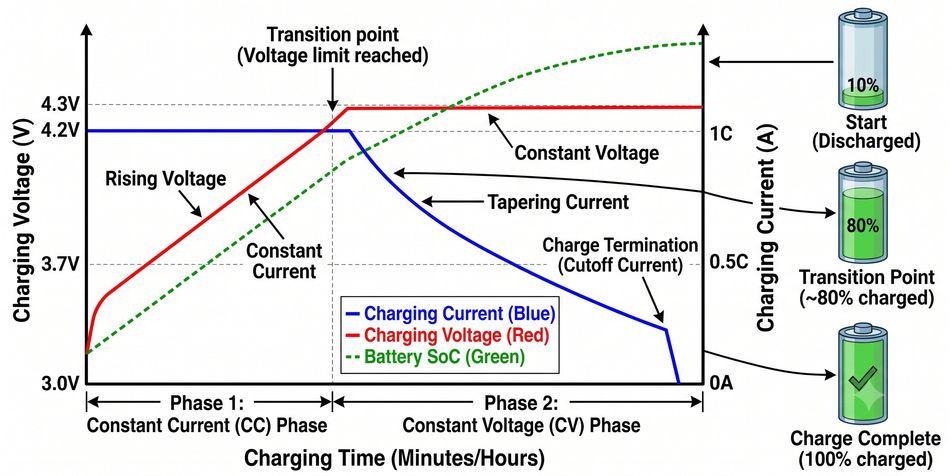
Source: Battery University
This behavior is especially important in lithium-ion charging. High-speed charging can push the terminal voltage to its upper limit before the cell is fully saturated. The charger then has to reduce current and allow the cell to finish more slowly. Charging only to 70 or 80 percent may be intentional in some systems because it reduces stress and avoids the slowest part of the charge cycle. It may also occur naturally when the charging rate is high and voltage reaches the ceiling early.
Overcharging is one of the main reasons to avoid poorly matched chargers. With a simple charger, full-charge detection may depend on a timer or on the user removing the battery. If the battery is smaller than expected, warmer than expected, already partly charged, or unable to accept charge normally, the same charger can apply energy after the useful charging process is complete. That excess energy appears as heat, gassing in some chemistries, accelerated aging, or a fault condition.
Automatic termination is therefore more than a convenience. A well-chosen charger should include suitable voltage regulation, current limiting, temperature sensing where appropriate, and a safety timer. These functions are especially important for rapid, fast, and ultra-fast chargers because high current leaves less margin for error. Temperature sensing should measure a meaningful battery or pack temperature, not only the temperature inside the charger housing.
Compatibility cannot be assumed from connector shape or nominal voltage alone. A lithium-ion charger, lead-acid charger, NiCd charger, and NiMH charger may all supply DC power, but they do not make the same decisions at the end of charge. A charger designed for one chemistry can undercharge another, fail to terminate correctly, exceed a cell-voltage limit, or maintain the battery in an unsuitable way. Multi-chemistry chargers are acceptable only when explicitly designed for the selected chemistry and configured correctly.
Temperature is another major selection factor. Charging should generally occur within the battery manufacturer’s specified range. As a broad practical category, common rapid, fast, and ultra-fast chargers are associated with moderate charging temperatures rather than hot or freezing conditions. Low temperature slows electrochemical reaction rates; energy that cannot be accepted cleanly may contribute to plating, gassing in relevant chemistries, or heat. High temperature increases aging and can reduce safety margin. If a system must charge outdoors, in a vehicle, or in an industrial bay, the charger and battery system need temperature-aware control.
Ultra-fast charging should be chosen only when the full system supports it. The battery must be designed for high charge acceptance, all cells in the pack should be well balanced, internal resistance must be low, and the pack must be in good condition. Aging cells often diverge in capacity and resistance, so a pack that once tolerated high current may later become stressed by the same charger. Cold packs, hot packs, unbalanced packs, or packs with elevated internal resistance are poor candidates for ultra-fast charging.
The application usually decides the best compromise:
- Slow charging is appropriate when low stress, simplicity, and overnight charging are acceptable.
- Rapid charging is useful when a few hours of downtime is available and the charger can monitor battery conditions.
- Fast charging fits applications where downtime matters, provided the battery and thermal design are specified for the current.
- Ultra-fast charging belongs in specialty systems where the cell design, BMS, interconnects, cooling, charger control, and manufacturer limits all support the method.
- Maintenance charging is best for standby or seasonal batteries, but only with a charger designed to maintain that chemistry safely.
For industrial equipment, the economic pressure to reduce downtime can make high-current chargers attractive. That does not remove the electrochemical limits of the battery. Conventional, opportunity, and fast charging strategies should be selected around the work schedule, ventilation and thermal environment, battery replacement cost, and the manufacturer’s charge profile. A charger that saves time in one duty cycle may shorten battery life in another.
For consumer devices and small rechargeable cells, the same engineering logic applies at smaller scale. Use the supplied charger or a replacement that explicitly supports the battery type and voltage. Avoid using a higher-current charger merely because it fits unless the device or pack controls the charging process and is rated for that input. If a battery becomes unusually hot, charges much faster or slower than expected, swells, vents, leaks, or repeatedly triggers charger faults, the problem should be treated as a battery or system fault rather than solved by trying a more powerful charger.
The right charger is therefore the one that meets the battery’s limits while serving the application’s downtime requirement. Faster charging is valuable when engineered into the cell, pack, BMS, and thermal design. When it is not, a slower and better-controlled charger is usually the more reliable choice.
References
- Battery University | BU-401a: Fast and Ultra-fast Chargers. (n.d.). http://www.batteryuniversity.com/article/bu-401a-fast-and-ultra-fast-chargers
- How Do Battery Chargers Work? | Redway Tech. (n.d.). https://www.redway-tech.com/how-do-battery-chargers-work
- What Are the Different Types of Forklift Battery Chargers?. (n.d.). https://www.lithium-battery-manufacturer.com/what-are-the-different-types-of-forklift-battery-chargers
- Different Types of Battery Chargers and Their Charging Methods. (n.d.). https://www.wiltronics.com.au/wiltronics-knowledge-base/types-of-battery-chargers
- Understanding the Difference Between Fast and Ultra-fast Chargers. (n.d.). https://www.large-battery.com/blog/difference-between-fast-and-ultra-fast-chargers-explained
- Fast Charging vs Slow Charging: Better for Battery Life?. (n.d.). https://www.large-battery.com/blog/fast-charging-vs-slow-charging-battery-longevity
- Fast Charging and Its Impact on Battery Health. (n.d.). https://www.scosche.com/blog/post/fast-charging-and-its-impact-on-battery-health
- How Do Industrial Battery Chargers Work?. (n.d.). https://studyelectrical.com/2024/05/industrial-battery-chargers-working.html
- INIU | Fast Charging Explained | High-Speed Charger Effects. (n.d.). https://iniushop.com/blogs/blog/what-is-fast-charging-and-do-high-speed-chargers-damage-battery
- Does Fast Charging Hurt Your EV Battery?. (n.d.). https://blinkcharging.com/blog/does-fast-charging-hurt-your-ev-battery-