A battery electrolyte is not just a passive filler between the plates. It is the ion-conducting medium that allows the electrochemical reactions at the electrodes to continue while the cell delivers or accepts current. The electrolyte must be compatible with the electrode materials, stable over the cell voltage range, and practical for the intended temperature, safety, cost, and service-life requirements.
Different battery families solve this problem in different ways. Lead-acid batteries use diluted sulfuric acid, nickel-cadmium and nickel-metal-hydride cells use alkaline potassium hydroxide, and most commercial lithium-ion cells use organic solvents containing dissolved lithium salts. Other systems may use gelled electrolytes, polymer electrolytes, solid ceramic conductors, or molten salts. Each choice affects conductivity, failure modes, maintenance, safety handling, and manufacturability.
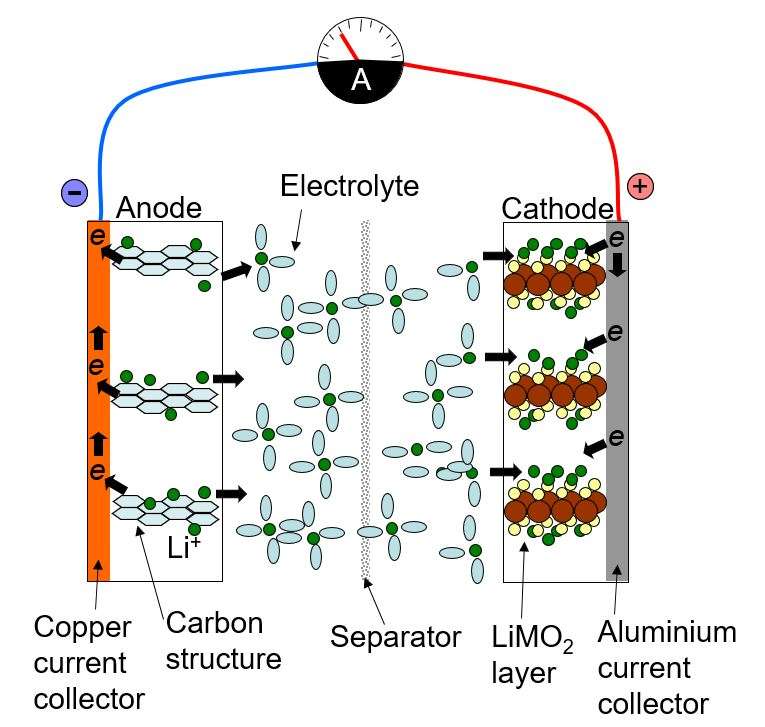
Source: Battery University

What an Electrolyte Does in a Battery
Inside a cell, the electrolyte provides a path for ions to move between the positive and negative electrodes. Electrons do not normally travel through the electrolyte in a healthy cell; they travel through the external circuit, where they can perform useful work. This separation of ionic conduction inside the cell and electronic conduction outside the cell is central to battery operation.
During discharge, chemical reactions at one electrode release electrons to the external circuit, while reactions at the other electrode consume electrons arriving from the load. To keep charge balanced, ions move through the electrolyte and separator. During charge, an external power source drives the reactions in the reverse direction.
Electrolytes can take several physical forms:
- Liquid electrolytes, such as sulfuric acid in flooded lead-acid cells or organic carbonate-based liquids in many lithium-ion cells.
- Immobilized liquids, including gelled lead-acid designs and absorbent glass mat, or AGM, lead-acid cells.
- Gel polymer electrolytes, where a polymer matrix holds liquid electrolyte and helps improve mechanical stability.
- Dry polymer electrolytes, which conduct ions through a polymer phase but often have lower conductivity at room temperature than liquid systems.
- Solid ceramic electrolytes, used in some solid-state battery concepts and specialty electrochemical systems because they can conduct ions without a flammable liquid solvent.
- Molten-salt electrolytes, used in high-temperature battery systems where salts become ionically conductive only when heated above their melting point.
The electrolyte is therefore selected as part of the complete cell design, not in isolation. A chemistry for engine starting, aircraft backup, consumer rechargeable cells, grid backup, or electric vehicles may require different tradeoffs in conductivity, low-temperature behavior, overcharge tolerance, spill resistance, corrosion control, and abuse response.
Lead-Acid Battery Electrolyte
Lead-acid batteries use diluted sulfuric acid as the electrolyte. The active materials are lead dioxide at the positive plate and spongy lead at the negative plate, with sulfuric acid and water supporting the reversible electrochemical reaction. Unlike some alkaline systems, the sulfuric acid concentration changes significantly with state of charge.
As a lead-acid battery discharges, sulfate ions participate in forming lead sulfate on both plates, and the electrolyte becomes more water-rich. The density of the electrolyte falls. During charging, the reaction is reversed: lead sulfate is converted back toward lead dioxide and spongy lead, sulfuric acid concentration increases, and the electrolyte density rises.
This density change is why specific gravity, often abbreviated SG, is useful in flooded lead-acid batteries. A hydrometer can measure electrolyte density and give a practical estimate of state of charge when the battery is at rest and accessible. This method applies to flooded batteries where liquid electrolyte can be sampled; it is not normally usable in sealed valve-regulated designs.
Typical sulfuric acid specific gravity is chosen for the service requirement:
| Lead-acid use case | Typical electrolyte SG tendency | Engineering reason |
|---|---|---|
| Some deep-cycle batteries | Up to about 1.330 | Higher acid density can support higher specific energy, but increases stress on materials |
| Many starter batteries | Around 1.265 | Balanced for high cranking power and conventional automotive service |
| Stationary batteries | Roughly 1.225 | Lower acid concentration helps moderate corrosion and supports longer standby life |
Higher acid concentration is not simply better. It can improve some performance characteristics, but it can also accelerate grid corrosion and water loss. Lower acid concentration can reduce corrosive stress, which is valuable in stationary batteries expected to remain in service for long periods.
Lead-acid batteries are built in both flooded and valve-regulated lead-acid formats. Flooded cells contain free liquid electrolyte and may require maintenance, ventilation, and periodic water replacement depending on design and service conditions. Valve-regulated lead-acid, or VRLA, batteries immobilize the electrolyte in one of two common ways:
- AGM batteries hold the electrolyte in absorbent glass-fiber mats between the plates.
- Gel batteries use a gelled sulfuric acid electrolyte, typically to reduce free liquid movement and improve spill resistance.
Immobilizing the electrolyte can reduce leakage risk, but it does not remove the chemical hazard. Sulfuric acid is highly corrosive. Skin contact can cause serious injury, and eye exposure can cause permanent damage. Flooded batteries also present spill hazards if cracked, tipped, or improperly serviced. Any work involving exposed electrolyte requires suitable eye protection, acid-resistant gloves, neutralization procedures, and ventilation appropriate to the installation.
Durability is also linked to electrolyte behavior. In flooded cells, acid stratification can occur because sulfuric acid is denser than water. If the electrolyte becomes more concentrated near the bottom of the cell, plate utilization and corrosion may become uneven. Charging practices that mix the electrolyte must be controlled because excessive gassing increases water loss and safety risk.
Nickel-Cadmium Battery Electrolyte
Nickel-cadmium batteries use an alkaline electrolyte, typically potassium hydroxide, rather than an acidic electrolyte. The positive electrode is nickel-based, and the negative electrode contains cadmium chemistry. The potassium hydroxide provides high ionic conductivity but is not consumed in the same concentration-changing way as sulfuric acid in a lead-acid cell.
This distinction matters in practical diagnostics. In a flooded lead-acid battery, electrolyte specific gravity is closely tied to state of charge because the acid concentration changes during normal operation. In a NiCd cell, the electrolyte mainly serves as an ion conductor, so density is not used in the same straightforward way to estimate state of charge.
Many sealed NiCd cells use cylindrical construction in which layers of positive and negative electrode material are wound into a jelly-roll and placed inside a metal can. This format is mechanically robust and suited to rechargeable cells that may experience frequent cycling. Flooded NiCd batteries also exist and have been used in demanding service, including aircraft batteries and UPS systems operating across hot and cold climates.
NiCd has historically been more expensive than lead-acid, but it can last longer in suitable service. Its strengths include tolerance of frequent cycling and operation over a broad temperature range. These characteristics explain why flooded industrial and aviation NiCd systems have remained relevant where reliability and environmental exposure are more important than lowest first cost.
The main limitation is not the potassium hydroxide electrolyte alone but the cadmium in the cell. Cadmium is toxic, and this has led to restrictions on many consumer applications in several markets. Collection, recycling, and controlled disposal are therefore important parts of responsible NiCd battery use. Cells should not be placed in general waste streams where regulated recycling routes are available.
Potassium hydroxide also requires careful handling. It is a strong alkaline material and can cause chemical burns. Leaked electrolyte from NiCd cells may not have the same visual cues or familiar odor associated with acid spills, but it is still hazardous to skin, eyes, and some materials. Maintenance procedures for flooded NiCd systems should treat alkaline electrolyte exposure as a serious chemical safety issue.
Nickel-Metal-Hydride Battery Electrolyte
Nickel-metal-hydride batteries also use an alkaline electrolyte, typically potassium hydroxide, similar to NiCd cells. The major difference is in the negative electrode. Instead of cadmium, NiMH cells use a hydrogen-absorbing metal alloy. The positive electrode remains nickel-based.
This substitution improves the environmental profile compared with NiCd because it removes cadmium from the cell chemistry. It does not make the electrolyte harmless. Potassium hydroxide remains strongly alkaline and should be treated with appropriate chemical safety precautions if a cell leaks or if industrial service exposes electrolyte.
In operation, the alkaline electrolyte supports ion transport between the electrodes while hydrogen is reversibly stored in the metal alloy at the negative electrode. As with NiCd, the electrolyte is not used as a direct state-of-charge indicator in the way sulfuric acid density is used in flooded lead-acid batteries.
Potassium hydroxide is also an important industrial chemical beyond batteries. Its battery use takes advantage of its alkaline conductivity and compatibility with nickel-based aqueous cell systems. However, industrial familiarity should not be confused with low hazard. Concentrated alkali can attack tissue and certain materials, and battery maintenance instructions should be chemistry-specific.
NiMH remains relevant even though lithium-ion dominates many high-energy portable and electric-vehicle applications. Common uses include:
- rechargeable AA and AAA consumer cells;
- hybrid vehicle battery packs in designs that prioritize long field experience and robust thermal behavior;
- equipment where simpler safety management, abuse tolerance, or compatibility with existing charging systems is preferred over maximum gravimetric energy density.
Compared with NiCd, NiMH avoids cadmium-related disposal concerns and generally offers better acceptance in consumer products. Compared with lithium-ion, it usually has lower energy density, but it can be attractive where ruggedness and mature aqueous-cell behavior are more important than achieving the lightest possible pack.
Lithium-Ion Electrolytes and the SEI Layer
Most commercial lithium-ion cells use organic liquid electrolytes containing dissolved lithium salts. A common salt is lithium hexafluorophosphate, LiPF6, dissolved in mixtures of carbonate solvents. The electrolyte must transport lithium ions between the positive and negative electrodes while remaining reasonably stable across a high cell voltage.
This is a difficult requirement. Water-based electrolytes cannot generally support the voltage range used by conventional lithium-ion cells, so organic solvents are used. These solvents provide useful electrochemical performance, but many are flammable. For this reason, lithium-ion safety depends not only on the electrolyte but also on separator behavior, electrode design, current interruption devices, cell venting, battery management systems, pack mechanical design, and thermal controls.
Lithium-ion electrolytes appear in several related forms:
- Liquid electrolyte is the mainstream format in many cylindrical, prismatic, and pouch cells.
- Gel polymer electrolyte uses a polymer host to immobilize or partially immobilize liquid electrolyte. This can support thin pouch-cell construction and reduce free-liquid movement.
- Dry polymer electrolyte conducts ions through a polymer material with little or no liquid solvent. These systems are technically important but have had more limited commercial use in mainstream cells because room-temperature ionic conductivity is often lower than in liquid electrolyte systems.
A central feature of lithium-ion electrolyte behavior is the solid electrolyte interphase, or SEI. The SEI is a passivation layer that forms mainly on the negative electrode during early cycling. It is produced when electrolyte components decompose at the anode surface. At first glance, decomposition sounds like a defect, but a stable SEI is essential. It allows lithium ions to pass while limiting continued electrolyte reduction.
The SEI also has a cost. Forming it consumes some cyclable lithium and electrolyte, which contributes to initial irreversible capacity loss. If the SEI is unstable, it can continue to grow, raising impedance, reducing capacity, and increasing gas generation. Mechanical cracking of the SEI during cycling can expose fresh electrode surface and trigger further side reactions.
Electrolyte additives are used to manage these interface reactions. Depending on the cell chemistry and voltage range, additives may be selected to:
- promote a more stable SEI during formation;
- extend cycle life by reducing continued electrolyte decomposition;
- reduce gas generation during storage or cycling;
- improve high-voltage stability at the positive electrode;
- improve low-temperature performance;
- suppress corrosion of current collectors or other cell components.
Additives are usually used in small concentrations, but their effect can be large because they react preferentially at electrode surfaces. The exact additive package is typically proprietary and optimized for the cell manufacturer’s electrode materials, formation process, operating voltage, and warranty target.
Safety research and commercialization efforts continue because conventional organic electrolytes are flammable. Several approaches are being developed or used selectively, including less-flammable solvent systems, flame-retardant additives, high-concentration or localized high-concentration electrolytes, ionic-liquid-containing electrolytes, ceramic solid electrolytes, and sulfide or oxide solid-state conductors.
These alternatives should be described carefully. Some are promising in laboratories or early commercial products, but not all are widely deployed in mainstream lithium-ion cells. Solid ceramic electrolytes can reduce reliance on flammable liquids, but they introduce other engineering challenges such as interfacial contact, manufacturability, pressure management, and fracture sensitivity. Ionic-liquid approaches can reduce volatility and flammability compared with conventional solvents, but cost, viscosity, conductivity, and compatibility must be solved for each cell design.
For practical battery selection, the electrolyte is therefore one part of a larger engineering compromise. Lead-acid electrolyte density is directly tied to state of charge and corrosion tradeoffs. Nickel-based alkaline cells rely on potassium hydroxide as a stable ion conductor while electrode chemistry determines many environmental concerns. Lithium-ion cells use more complex organic electrolyte systems where interface chemistry, especially the SEI, strongly influences capacity, aging, safety, and manufacturability.
References
- Battery University | BU-307: How does Electrolyte Work?. (n.d.). http://www.batteryuniversity.com/article/bu-307-how-does-electrolyte-work
- Battery Acid Composition & Safety Guide. (n.d.). https://suzukibattery.sg/blog/engineering/battery-acid-composition
- Lead-Acid and Nickel-Cadmium Battery Fundamentals for .... (n.d.). https://quizlet.com/study-guides/lead-acid-and-nickel-cadmium-battery-fundamentals-for-aviati-09b4e9c3-1f7a-40c6-9416-59daa828eb08
- A comprehensive review of past and present developments of Li-ion .... (n.d.). https://link.springer.com/article/10.1007/s43621-026-02920-8
- Lead Acid Batteries | PVEducation. (n.d.). https://www.pveducation.org/pvcdrom/batteries/lead-acid-batteries
- What electrolyte is used in lead-acid batteries?. (n.d.). https://www.facebook.com/groups/379514439836424/posts/1558401971947659
- Battery Acid: Powering Modern Energy Solutions. (n.d.). https://eureka.patsnap.com/blog/material-tech-resources/what-is-battery-acid
- What Are Lead-Acid Batteries? - Qurator. (n.d.). https://www.qurator.com/blog/what-are-lead-acid-batteries
- What Is a Lead Acid Battery?. (n.d.). https://www.rdbatteries.com/blog/post/what-is-a-lead-acid-battery.html
- What Is a Battery Electrolyte and How Does It Work? | Dragonfly Energy. (n.d.). https://dragonflyenergy.com/battery-electrolyte