Battery recycling is not one process. A lead-acid starter battery, a nickel-cadmium power-tool pack, an alkaline cell, and an electric-vehicle lithium-ion pack contain different active materials, electrolytes, casings, hazards, and economic value. Recycling plants sort batteries by chemistry, condition, and form factor before choosing mechanical, thermal, or chemical recovery steps.
The goal is to recover useful materials while preventing fires, toxic releases, and uncontrolled disposal. Some chemistries, especially lead-acid, have mature collection networks and strong commodity value. Others, especially small mixed consumer batteries, are harder to collect and sort economically. Lithium-ion batteries are the fastest-growing concern because cells in electronics, power tools, e-bikes, stationary systems, and electric vehicles are increasing quickly.
Why Battery Recycling Matters
The strongest environmental concerns historically came from lead- and cadmium-based batteries. Lead is toxic, persistent, and tightly regulated. Cadmium is also toxic and can accumulate in biological systems. If batteries containing these metals are landfilled, broken, burned, or processed in uncontrolled facilities, they can contaminate soil, water, and workplaces.
Regulation has reflected those hazards. In Europe, portable nickel-cadmium batteries have been heavily restricted for many years, with exemptions for emergency systems, alarms, medical equipment, and some industrial applications. The key point is not that every nickel-cadmium cell disappeared overnight, but that cadmium-containing portable batteries became unacceptable for most ordinary consumer uses. Lead-acid batteries remain widely used where their cost, high surge-current capability, recyclability, and established infrastructure are difficult to replace.
Lithium-ion batteries are different. They do not contain cadmium, and many modern lithium-ion chemistries contain no cobalt. Their waste problem is driven less by one universal toxic metal and more by volume, fire risk, electrolyte chemistry, critical-material demand, and embedded energy. A damaged lithium-ion cell can enter thermal runaway if mishandled. A mixed bin of loose cells can short-circuit. Large EV packs contain enough stored energy to require controlled handling even at end of life.
Lead-acid recycling shows what a mature circular system can look like. Automotive and industrial lead-acid batteries are heavy, standardized, valuable, and commonly returned through service shops, distributors, and scrap channels. Older recycling literature often cited U.S. lead-acid collection and recycling rates around 97%, and recent industry reporting typically describes lead-acid batteries as one of the most recycled consumer products. The economics are favorable because recovered lead can be refined and reused in new batteries, while polypropylene cases and neutralized electrolyte streams have established outlets.
That success is not automatically transferable to all battery types. A lithium-ion pouch cell from a phone, an NMC EV module, an LFP stationary pack, and a nickel-metal hydride hybrid-vehicle pack require different processing decisions. Recycling begins with knowing what the battery is.
Recycling Processes by Battery Chemistry
Battery recycling usually combines several unit operations:
- Collection and identification of the battery type.
- Sorting by chemistry, voltage, size, and damage condition.
- Electrical deactivation or discharge where required, especially for lithium-ion packs and modules.
- Mechanical preprocessing, such as crushing, shredding, screening, magnetic separation, density separation, or air classification.
- Thermal treatment, such as smelting or pyrolysis, where suitable.
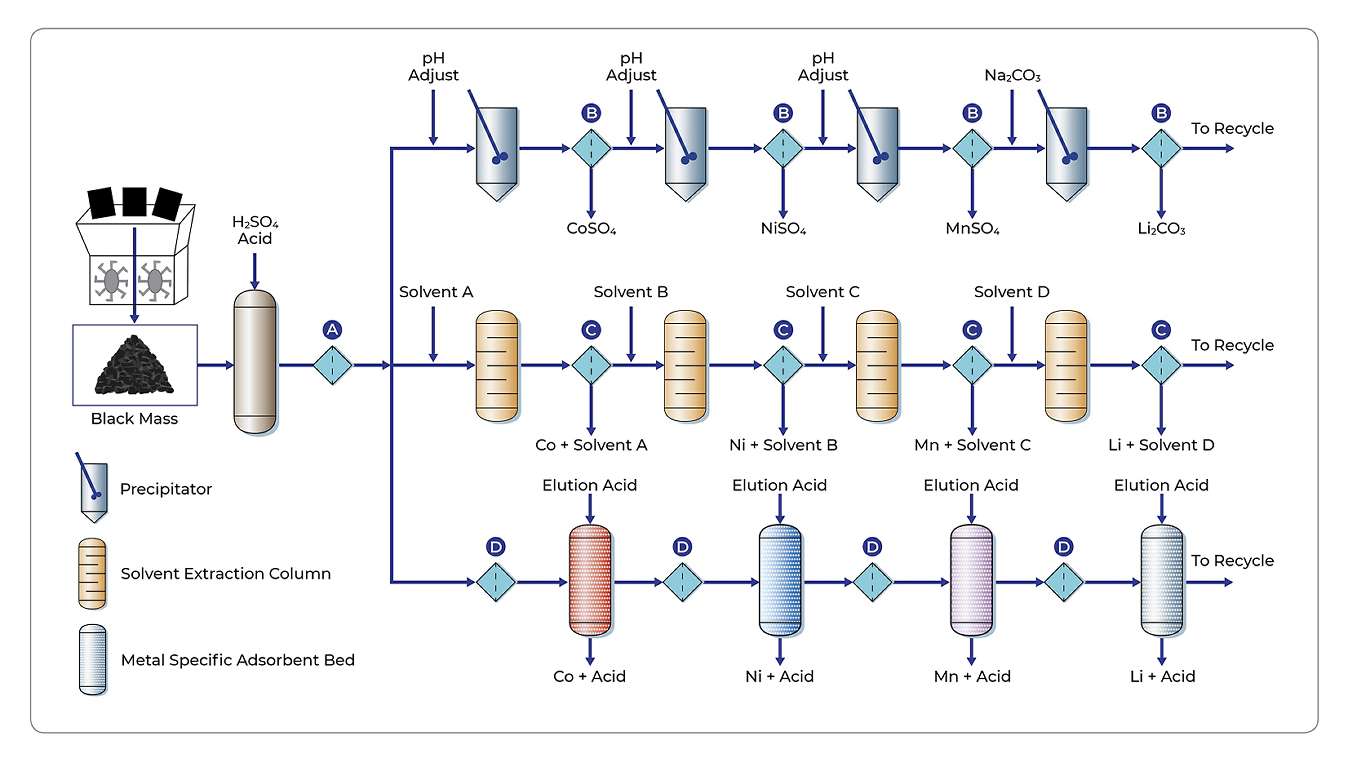
- Hydrometallurgical refining, using leaching, solvent extraction, precipitation, crystallization, or electrochemical recovery.
- Product preparation, such as refined lead, nickel alloy, cobalt/nickel/copper salts, lithium carbonate, steel scrap, plastics, or battery-grade precursor materials.
Chemistry sorting is essential because the same process does not work safely or economically for all batteries. A lead-acid battery in a lithium-ion shredder contaminates the output and introduces acid and lead. A charged lithium-ion cell in a general metal shredder can ignite. A nickel-cadmium cell in a mixed household stream creates cadmium-control requirements for the whole batch.
Source: Battery University
Modern lithium-ion recycling is often described using three broad technology families:
| Route | Typical role | Strengths | Limitations |
|---|---|---|---|
| Mechanical preprocessing | Opens cells and separates casings, foils, plastics, and black mass | Lower temperature; produces concentrated feed for refining | Requires fire control and good sorting |
| Pyrometallurgy | High-temperature smelting or thermal processing | Robust for mixed feeds; can recover nickel, cobalt, and copper into metal products | Lithium, aluminum, manganese, electrolyte, and graphite may need additional recovery routes or may be lost depending on process design |
| Hydrometallurgy | Leaching and chemical separation of black mass or alloy products | Can recover lithium, nickel, cobalt, manganese, and copper at high purity | Requires reagent management, wastewater control, and impurity control |
A fourth approach, direct recycling, attempts to preserve or restore cathode materials instead of breaking everything down into elemental or salt products. It can include cathode separation, relithiation, and regeneration. It is promising, but it depends strongly on feed consistency and is not yet the universal commercial route for mixed end-of-life batteries.
Lead-Acid Batteries
Lead-acid battery recycling is the most mature large-scale battery recycling system. The usual sequence is straightforward:
- Batteries are collected through automotive service shops, battery retailers, industrial users, and scrap channels.
- Whole batteries are crushed or broken in controlled equipment.
- Polypropylene case pieces are separated, washed, and recycled where market conditions allow.
- Lead grids, posts, paste, and other lead-bearing fractions are separated.
- Sulfuric acid electrolyte is neutralized or converted for controlled reuse, depending on facility design and local regulation.
- Lead-bearing material is smelted and refined into lead or lead alloys suitable for new batteries and other regulated applications.
The process is economically attractive because lead-acid batteries contain a high mass fraction of recoverable lead, and lead is the dominant material cost in many new lead-acid batteries. The format is standardized: a car battery is large, easy to identify, and normally returned when replaced.
The hazards are equally clear. Recycling must control lead dust, lead fumes, acidic electrolyte, contaminated wash water, and worker exposure. Modern plants use enclosed equipment, ventilation, filtration, wastewater treatment, and occupational monitoring. Informal or poorly controlled lead-acid recycling is dangerous precisely because the chemistry is recoverable but toxic.
Nickel-Cadmium and Nickel-Metal Hydride Batteries
Nickel-cadmium batteries require controlled recycling because cadmium is a toxic heavy metal. NiCd cells were once common in cordless tools, emergency lighting, portable electronics, and industrial systems. Because of cadmium risk, European rules restricted most portable NiCd battery uses while retaining exemptions for certain safety-critical and professional applications.
NiCd recycling commonly separates or recovers:
- cadmium,
- nickel,
- iron and steel casing material,
- electrode materials,
- plastics and other pack components.
Thermal processing can volatilize cadmium for controlled condensation and recovery, while nickel and iron remain in metal-bearing fractions. The exact route depends on plant design, cell type, and regulatory requirements. The essential requirement is containment: cadmium must not be dispersed into air, slag, dust, or mixed scrap streams.
Nickel-metal hydride batteries avoid cadmium but still contain recoverable nickel and, depending on design, rare-earth-bearing metal hydride alloys. NiMH packs were widely used in hybrid vehicles and rechargeable consumer batteries. Their recycling economics are usually less compelling than lead-acid because material value per kilogram and collection efficiency differ, but large traction packs are easier to identify and route than small loose cells.
NiMH recycling may use mechanical separation followed by pyrometallurgical or hydrometallurgical recovery. Nickel, iron, cobalt in some designs, and rare-earth elements may be recovered depending on the process. As with all battery chemistries, mixed feed reduces efficiency and increases refining complexity.
Lithium Primary and Lithium-Ion Batteries
Lithium primary batteries and lithium-ion batteries require special attention because they may contain stored energy and reactive materials. A primary lithium metal cell is not the same as a rechargeable lithium-ion cell: primary lithium cells contain metallic lithium, while lithium-ion cells shuttle lithium ions between host materials. Both can create fire and reactivity hazards if crushed, shorted, overheated, or mixed with incompatible waste.
For lithium-ion batteries, recycling often begins with safe receipt and assessment. Packs may be checked for voltage, physical damage, swelling, leakage, thermal history, and chemistry. Large packs may be dismantled into modules or cells before further processing. Many recycling flows include controlled discharge or other deactivation steps before shredding. Some plants shred under inert atmosphere, use submerged or wet processes, or apply low-temperature drying to reduce fire and electrolyte hazards.
The first major material product from many lithium-ion recycling plants is black mass. This dark powdery fraction contains active electrode materials, usually including graphite from the anode and metal oxides or phosphates from the cathode. Depending on chemistry, black mass may contain nickel, cobalt, manganese, lithium, iron, phosphate, aluminum, copper, carbon, binders, and electrolyte residues.
Downstream processing determines what is recovered:
- Smelting and pyrometallurgy commonly recover nickel, cobalt, and copper into alloy or metal-bearing products. Lithium recovery from smelting routes generally requires additional steps, because lithium may report to slag, dust, ash, or other residues depending on process design.
- Hydrometallurgy leaches black mass or intermediate products and separates metals into salts or other compounds. It can recover lithium along with nickel, cobalt, manganese, and copper when designed for those outputs.
- Mechanical-hydrometallurgical routes avoid some high-temperature steps and can produce black mass followed by chemical refining.
- Direct recycling aims to preserve cathode crystal structure or regenerate cathode materials through relithiation and repair, but it requires well-characterized feed and careful quality control.
Vendor claims should be read as process-specific, not as industry averages. Umicore describes a combined pyro-hydro battery recycling process that can recover more than 95% of cobalt, nickel, and copper, and the company has also reported high lithium recovery in newer process descriptions. C&EN has reported that Umicore’s process recovers more than 95% of nickel, copper, and cobalt from end-of-life batteries, with lithium captured through additional streams. Duesenfeld has promoted a lower-temperature process using vacuum drying and mechanical separation before hydrometallurgy; C&EN reported a company claim of 91% mass recovery. Redwood Materials describes a process combining mechanical shredding, chemical extraction, and purification, with company-reported recovery of more than 95% of critical elements including lithium, cobalt, nickel, and copper.
These examples show the industry’s direction: higher recovery, more lithium capture, less reliance on simple smelting, and output materials suitable for battery manufacturing. They do not mean every recycler achieves the same recovery rate for every chemistry and feed condition.
Alkaline and Other Common Household Batteries
Alkaline batteries are widely used in household devices and are technically recyclable, but local economics and collection programs vary. Modern alkaline cells generally contain steel casing material, zinc, manganese compounds, potassium hydroxide electrolyte, paper or polymer separators, and current collectors. Recycling can recover steel and zinc- or manganese-bearing fractions, but the value is modest compared with lead-acid or cobalt/nickel-rich lithium-ion batteries.
For that reason, disposal rules differ by region. Some jurisdictions allow ordinary alkaline batteries in household waste; others encourage or require collection through battery recycling programs. Rechargeable household batteries, button cells, lithium primary cells, and damaged lithium-ion cells should not be treated as equivalent to ordinary alkaline cells. Button cells may contain silver, zinc-air chemistry, lithium, or other materials, and older mercury-containing cells require controlled handling where encountered.
The practical rule is to follow local collection guidance and keep unlike batteries separated whenever possible. Even if an alkaline cell has low fire risk, a container of mixed loose batteries may include lithium-ion cells, lithium primary cells, nickel-cadmium cells, or damaged packs.
Collection, Sorting, and Safety Before Recycling
Battery recycling depends as much on collection discipline as on metallurgical technology. Batteries enter recycling streams through many channels:
- retail take-back boxes,
- e-waste collection sites,
- municipal hazardous-waste programs,
- automotive service centers,
- industrial battery suppliers,
- EV dealerships and repair shops,
- vehicle dismantlers,
- electronics refurbishers,
- specialized battery recyclers.
Each channel creates a different sorting problem. A pallet of returned lead-acid starter batteries is relatively uniform. A box of consumer batteries from a retail counter may include alkaline cells, lithium-ion pouch cells, cylindrical lithium-ion cells, lithium primary cells, NiMH cells, NiCd cells, button cells, and swollen device batteries.
Sorting by chemistry, form factor, and condition is critical for three reasons. First, it prevents hazardous reactions and fires. Second, it avoids contaminating recovered material streams. Third, it lets recyclers choose the process that recovers the most value with the least environmental burden.
Basic safe handling practices include:
- Tape exposed terminals on lithium-ion, lithium primary, NiCd, NiMH, and lead-acid batteries where short circuits are possible.
- Do not store loose mixed batteries in metal containers without insulation or separation.
- Isolate swollen, hot, leaking, crushed, or burned lithium-ion batteries and follow local damaged-battery instructions.
- Do not puncture pouch cells or dismantle packs unless trained and equipped.
- Keep lead-acid batteries upright where possible to reduce electrolyte leakage.
- Use approved packaging and transport procedures for large packs, damaged batteries, and commercial shipments.
Large lithium-ion packs may also be evaluated for repair, reuse, or second-life service before recycling. An EV pack that no longer meets vehicle power and range requirements may still have modules suitable for stationary energy storage, training systems, or controlled reuse. That assessment must include electrical testing, safety inspection, battery-management-system considerations, and traceability. Second life can delay recycling, but it does not eliminate eventual material recovery.
Regulations, Recovery Targets, and the Future of Battery Recycling
Battery recycling regulation is moving from simple disposal control toward material recovery and circular supply-chain requirements. The European Union’s Battery Regulation is one of the clearest examples. It sets recycling-efficiency and material-recovery targets that rise over time. For lithium-ion batteries, C&EN reports that 65% of the mass of end-of-life lithium-ion batteries must be recycled starting in 2026, increasing to 70% in 2031. The same reporting describes material recovery targets of 90% for cobalt, copper, and nickel and 50% for lithium by 2028, rising to 95% and 80%, respectively, in 2032.
Those targets matter because they influence process design. A process optimized only for cobalt and nickel is less attractive when lithium recovery becomes mandatory. A process that produces mixed low-grade residues is less useful than one that can return battery-grade salts, precursor materials, or directly reusable cathode material to the supply chain.
Electric-vehicle growth is also changing the economics. Early lithium-ion recycling was often built around consumer electronics and manufacturing scrap. Future flows will include larger volumes of EV modules and packs, but timing depends on vehicle life, warranty returns, accident damage, chemistry shifts, and second-life decisions. Recycling plants must handle a changing mixture that may include cobalt-rich NMC, lower-cobalt NMC, NCA, LFP, LMO blends, and future chemistries.
Several trends are likely to shape the industry:
- More front-end automation for pack discharge, dismantling, and identification.
- Better fire control in collection, storage, transport, and shredding.
- Higher lithium recovery, especially from LFP and low-cobalt chemistries where lithium may be a larger share of the recoverable value.
- Lower-emission process routes, including mechanical and hydrometallurgical systems that reduce unnecessary high-temperature treatment where feasible.
- Battery-grade recycled materials, not just generic metal products.
- Design for recycling, including clearer labeling, easier pack disassembly, fewer hazardous adhesives, and improved access to cell chemistry data.
Battery recycling will not remove the need for mining in a growing battery market, but it can reduce primary material demand, stabilize supply chains, and prevent hazardous waste. The best recycling system is chemistry-aware from the first collection bin to the final refining step: identify the battery, control the hazard, recover the highest-value materials, and return them to productive use wherever technically and economically possible.
References
- BU-705: How to Recycle Batteries. (n.d.). http://www.batteryuniversity.com/article/bu-705-how-to-recycle-batteries
- Lithium-ion battery recycling goes large. (n.d.). https://cen.acs.org/environment/recycling/Lithium-ion-battery-recycling-goes/101/i38
- Recycling & Refining. (n.d.). https://www.umicore.com/en/markets-products/metals/lithium/recycling-refining
- Step-by-Step Guide to the Li-Ion Battery Recycling Process - Green Li-ion. (n.d.). https://www.greenli-ion.com/post/step-by-step-guide-to-the-li-ion-battery-recycling-process
- How battery recycling works | Redwood Materials. (n.d.). https://www.redwoodmaterials.com/resources/how-battery-recycling-works
- How are Lithium-Ion Batteries Recycled? - AquaMetals. (n.d.). https://www.aquametals.com/recyclopedia/how-are-lithium-ion-batteries-recycled
- Lithium-Ion Battery Recycling. (n.d.). https://www.epa.gov/hw/lithium-ion-battery-recycling
- Recycling of Lithium-Ion Batteries – The LithoRec Project. (n.d.). https://ptacts.uspto.gov/ptacts/public-informations/petitions/1556107/download-documents?artifactId=2iY2py9a4UK8Cde063PRaVHZEdt13baqsyakTazMS39Lhm9teYLWpMI
- The Lithium-Ion Battery Recycling Process from a Circular Economy Perspective—A Review and Future Directions. (n.d.). https://www.mdpi.com/1996-1073/16/7/3228
- Comparison of different recycling processes of lithium-ion .... (n.d.). https://www.duesenfeld.com/comparison_recycling.html