A flow battery is a rechargeable electrochemical storage system that sits conceptually between a conventional battery and a fuel cell. Like a battery, it stores energy chemically and can be charged and discharged many times. Like a fuel cell, it circulates reactants through an electrochemical reactor, rather than storing all active material inside fixed solid electrodes.
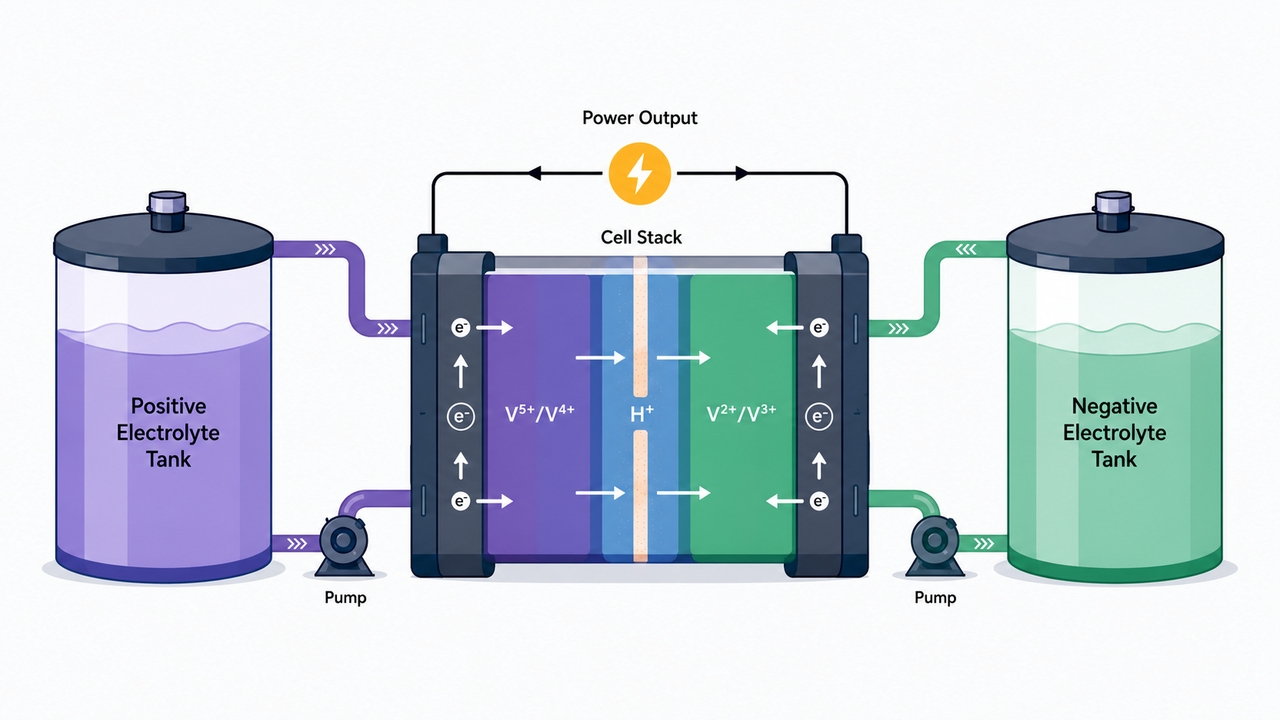
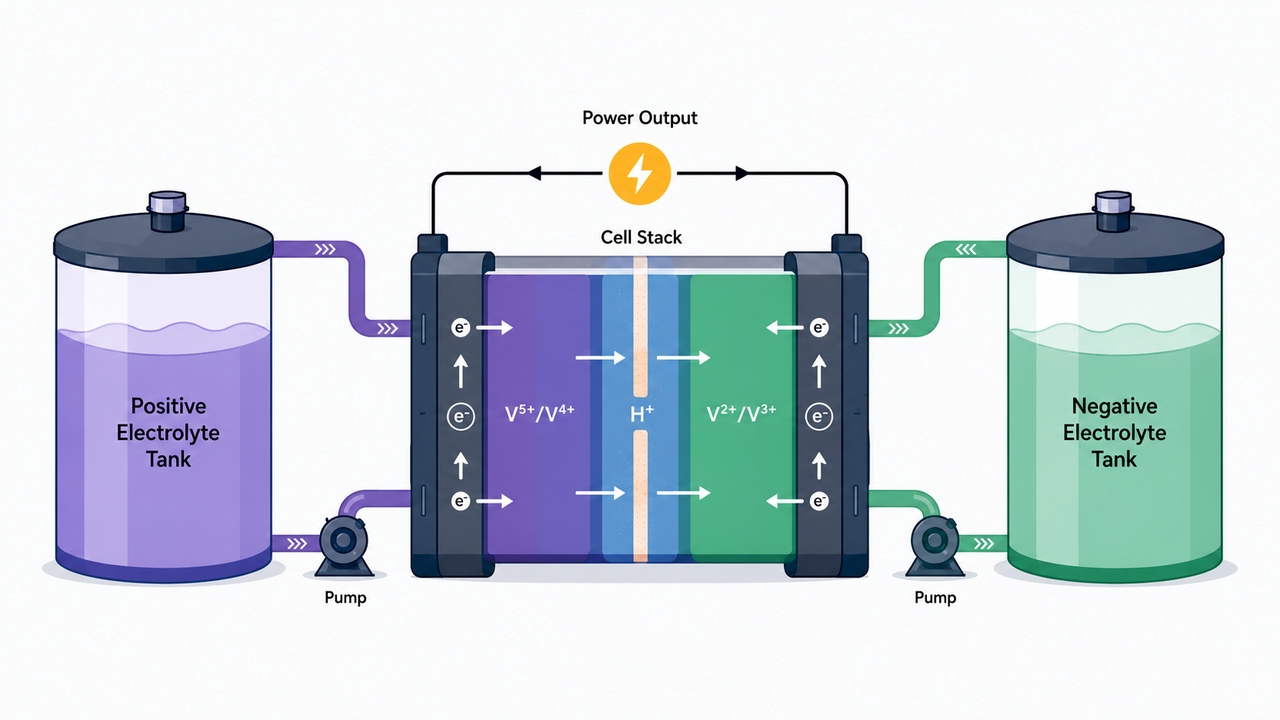
The defining feature is the use of liquid electrolytes. These electrolytes contain dissolved electroactive species, often metallic ions or salts, and are stored in external tanks. Pumps circulate the liquids through a cell stack where oxidation and reduction reactions exchange electrons through an external circuit and ions through a membrane.
Flow batteries are not usually chosen for phones, vehicles, or other weight-sensitive products. Their strength is stationary storage: applications where long service life, deep cycling, independent scaling of energy and power, and electrolyte reuse can matter more than compactness.
What a Flow Battery Is and How It Generates Electricity
A conventional lithium-ion or lead-acid battery stores active materials inside its electrodes. A flow battery separates much of the energy storage function from the electrochemical conversion hardware. The active chemicals are dissolved in liquid electrolytes held in tanks, while the electrochemical reactions occur in a stack of cells.
A typical redox flow battery contains:
- Two electrolyte tanks, usually one for the positive electrolyte and one for the negative electrolyte.
- Pumps and piping that circulate each electrolyte through the stack.
- Electrodes, often porous carbon-based structures that provide reaction surfaces.
- Bipolar plates or current collectors that conduct current and help distribute flow.
- An ion-exchange membrane or separator that limits direct mixing while allowing selected ions to pass.
- A cell stack, where multiple cells are connected electrically to obtain the required voltage and power.
During discharge, the negative-side active species is oxidized at the anode, releasing electrons. Those electrons travel through the external circuit and perform electrical work. At the positive electrode, the corresponding active species is reduced by accepting electrons. To maintain electrical neutrality, supporting ions migrate through the membrane or separator between the two sides.
During charging, an external power source drives the reactions in the reverse direction. The active species are returned to higher- and lower-energy oxidation states, storing electrical energy as chemical energy in the circulating electrolytes.
The terminology can be confusing because “anode” and “cathode” depend on whether the device is charging or discharging. In discharge, the anode is the oxidation electrode and the cathode is the reduction electrode. In practical system descriptions, manufacturers may instead refer to positive and negative electrolytes, positive and negative electrodes, or posolyte and negolyte to avoid ambiguity.
The basic architecture explains the main engineering tradeoff. A flow battery can hold more energy by using more electrolyte, but it still needs a sufficiently large stack, pumps, piping, and balance-of-plant hardware to convert that stored chemical energy at the desired power level.
Electrolytes, Electrodes, and Construction Materials
The best-known commercial flow-battery chemistry is the vanadium redox flow battery. In this design, vanadium ions in different oxidation states are dissolved in an acidic electrolyte, commonly sulfuric-acid-based. The use of the same element on both sides is important: if some vanadium crosses the membrane, it does not introduce a foreign metal contaminant in the same way that mixed-metal chemistries can.
Vanadium is not best understood as a corrosion-control additive. Its main role is as the electroactive species that stores and releases energy through reversible changes in oxidation state. Corrosion control, electrolyte stability, membrane life, and side reactions remain important design issues, but they are handled through material selection, electrolyte formulation, operating limits, and system management.
Electrodes in many flow batteries are carbon-based. Graphite bipolar plates, carbon felt, carbon paper, and other porous carbon materials are used because they can provide electrical conductivity, chemical resistance, and large reaction area. The porous electrode structure is especially important: the electrolyte must contact enough active surface area while pressure drop remains low enough for efficient pumping.
The membrane or separator is one of the most critical components. It should allow charge-balancing ions to pass while limiting crossover of active species. In practice, membranes add cost and can degrade through chemical exposure, mechanical stress, fouling, or long-term crossover effects. Membrane behavior affects efficiency, capacity retention, maintenance intervals, and electrolyte rebalancing requirements.
Research and development therefore focuses on several material directions:
- Lower-cost electrolytes, including iron, chromium, bromine, hydrogen, organic molecules, and other aqueous or non-aqueous systems.
- Improved membranes and separators with lower crossover, better chemical durability, and lower cost.
- Higher-performance carbon electrodes that improve reaction kinetics and mass transport.
- Stack designs that reduce pressure drop, leakage risk, shunt currents, and manufacturing cost.
- Electrolyte additives or formulation changes that improve stability or reduce degradation mechanisms.
Precious metals such as platinum are not central to mainstream vanadium redox flow battery construction in the way they are to some fuel-cell technologies. They may appear in research on selected electrochemical systems or catalyst studies, but a practical flow-battery discussion should not assume that platinum is a standard flow-battery electrode material. The mainstream engineering emphasis is usually on carbon materials, membranes, electrolyte chemistry, and stack manufacturability.
Performance, Cycle Life, and Best-Fit Applications
Flow batteries are generally most practical at stationary-storage scale. The reference benchmark that they perform best above roughly 20 kWh reflects the fact that tanks, pumps, controls, and stacks create a balance-of-plant overhead that is difficult to justify in very small systems. Modern commercial systems are often aimed at much larger commercial, industrial, microgrid, and grid-support installations.
A single flow-battery cell produces a relatively low voltage. For many aqueous flow chemistries, cited cell voltages are in the range of about 1.15 to 1.55 V per cell, depending on chemistry and operating condition. Cells are connected in series in stacks to reach useful DC bus voltages.
Cycle life is one of the main attractions. Flow batteries are commonly associated with very high cycling capability because the active material is stored in liquid form and the electrodes are not intended to undergo the same kind of repeated solid-state insertion and extraction that occurs in many conventional batteries. Reported targets and product claims often cite 10,000 or more full cycles and service lives on the order of 20 years, although actual life depends on chemistry, membrane durability, operating temperature, maintenance, electrolyte management, and system design.
Specific energy is modest. A rough system-level benchmark of about 40 Wh/kg is often cited, similar to lead-acid batteries rather than lithium-ion batteries. This low gravimetric energy density is a major reason flow batteries are poorly matched to electric vehicles, aircraft, portable electronics, and other applications where mass and volume dominate design.
The more relevant performance question is usually not “How light is it?” but “How many hours can it discharge at rated power, how many cycles can it perform, and how maintainable is the system?” Flow batteries are strong candidates for uses such as:
- renewable energy time shifting,
- solar-plus-storage and wind-plus-storage smoothing,
- microgrid energy storage,
- commercial and industrial load management,
- backup energy where long discharge duration is required,
- grid-scale long-duration energy storage.
Their response behavior is also more nuanced than the simple idea that pumps make them slow. Once the system is operating and electrolyte is present in the stack, electrochemical response can be fast enough for many stationary applications. However, pumps, controls, and the hydraulic system are still part of the dynamic design. For very high power density, very fast ramping, or compact mobile systems, other battery chemistries may be a better fit.
A practical comparison is shown below.
| Attribute | Flow battery tendency | Engineering implication |
|---|---|---|
| Specific energy | Low to moderate | Poor fit for weight-sensitive applications |
| Cycle life | High when well managed | Attractive for frequent deep cycling |
| Energy scaling | Mainly tank and electrolyte volume | Long durations are practical |
| Power scaling | Mainly stack size and design | Power can be designed separately from energy |
| Maintenance | More mechanical balance-of-plant | Pumps, sensors, seals, and electrolyte need attention |
| Best fit | Stationary storage | Grid, microgrid, commercial, and industrial use |
Scalability, Tanks, Costs, and Maintenance
The most distinctive system-level advantage of a flow battery is the partial independence of energy and power. In simplified terms, energy capacity is governed mainly by electrolyte volume and concentration, while power capability is governed mainly by cell-stack area, number of cells, electrode design, flow field, and allowable current density.
This is different from many packaged batteries, where adding energy usually means adding more complete cells, which also adds power capability whether or not the application needs it. In a flow battery, an engineer can design a system with a relatively large electrolyte inventory for long discharge duration and a stack sized for the required power.
For example, a four-hour and a ten-hour system might use similar stack concepts but different electrolyte tank volumes. The longer-duration system needs more stored active material, more tank volume, and associated piping and site space, but it does not necessarily require a proportional increase in stack power hardware.
Source: Original source
The reference source notes that increasing tank size can add capacity at a lower incremental cost than building a complete new system, citing an estimate that doubling tank size may add about 50 percent to system cost compared with a new system. That figure should be treated as a design-context estimate rather than a universal rule. Actual cost depends on tank material, electrolyte cost, civil works, safety containment, permitting, stack rating, pumps, thermal management, and project scale.
Flow-battery cost is commonly separated into two broad categories:
- Power-related cost: cell stacks, electrodes, membranes, current collectors, pumps, power electronics, controls, and enclosures.
- Energy-related cost: electrolyte, tanks, secondary containment, piping, and space required for larger volumes.
This split is useful for long-duration storage analysis. As discharge duration increases, the stack may remain similar while the tanks and electrolyte grow. If the electrolyte is expensive, the energy-related cost can dominate. If the membrane or stack is expensive, the power-related cost can dominate.
Maintenance is also different from sealed battery packs. A flow battery is an electrochemical system plus a fluid-handling system. Maintenance considerations include:
- pump operation and efficiency,
- seal and fitting integrity,
- electrolyte level and state-of-charge balance,
- membrane crossover and degradation,
- sensor calibration,
- filter or impurity control,
- secondary containment inspection,
- power-electronics and control-system health.
One important advantage is that electrolyte may be reusable when stacks are replaced or a system is refurbished. This can preserve a large portion of the stored chemical inventory, depending on chemistry, contamination, and electrolyte condition. For vanadium systems in particular, the electrolyte can represent a significant asset rather than a disposable consumable.
Membranes remain a major engineering concern. They can be costly, and their degradation can reduce efficiency or increase crossover. Additives, improved membranes, better operating windows, electrolyte rebalancing, and alternative separator concepts are all used or studied to mitigate these issues. The best approach depends strongly on chemistry; there is no single membrane solution that applies to every flow-battery design.
Vanadium Supply, Installations, and Market Direction
Vanadium is strategically important because vanadium redox flow batteries are among the most mature and commercially recognized flow-battery systems. Vanadium is also used in other industries, especially steelmaking, so battery demand competes with established material markets. For project developers, this creates both an opportunity and a supply-chain risk: the electrolyte may retain value, but its upfront cost and availability can affect project economics.
Because vanadium supply is tied to mining, co-product recovery, and industrial demand, current procurement decisions should rely on up-to-date mineral commodity data rather than fixed historical assumptions. Major producing regions and trade flows can change over time, and battery projects should verify the source, purity, pricing structure, and recyclability of electrolyte before final design.
Flow batteries also have a long technical history. The broad idea of storing electroactive liquids externally and circulating them through a reaction cell has been explored for decades through patents, laboratory systems, and demonstration projects. Vanadium redox systems became especially important because using one active element in multiple oxidation states reduces certain cross-contamination problems that affect mixed-chemistry systems.
Modern deployment is increasingly modular. A practical installation may use containerized stacks, pumps, controls, and power electronics, with external or integrated tanks sized for the required energy duration. Multiple modules can be combined to increase power, energy, or redundancy. This format suits commercial and grid installations because it simplifies transport, site layout, commissioning, and maintenance access.
Large flow-battery installations are generally discussed in the context of long-duration stationary storage rather than compact battery replacement. Typical project goals include storing renewable generation for later use, supporting microgrids, reducing curtailment, shifting energy across several hours, or providing resilience where frequent deep cycling would age some other battery types more quickly.
Europe, North America, and Asia all show interest in long-duration energy storage, including flow batteries, because grids with higher renewable penetration need storage technologies that can cycle frequently and discharge for many hours. Flow batteries are not the only option; lithium-ion systems, sodium-based batteries, thermal storage, compressed-air storage, pumped hydro, hydrogen systems, and other technologies also compete. The best technology depends on duration, duty cycle, site constraints, safety requirements, permitting, cost of capital, and market rules.
Current development trends include:
- reducing stack and membrane cost,
- increasing current density without excessive pumping losses,
- improving electrolyte stability and usable concentration,
- reducing system footprint,
- standardizing containerized modules,
- improving controls and state-of-charge measurement,
- developing non-vanadium chemistries with lower or more stable material costs.
The central engineering promise remains the same: a flow battery separates the storage tank from the power-conversion stack. That separation gives designers a useful tool for long-duration stationary storage, especially where cycle life, maintainability, and scalable energy capacity outweigh the need for high specific energy.
References
- Battery University | BU-210b: How does the Flow Battery Work?
- Flow Battery - an overview
- Flow battery - Wikipedia
- ELI5: How does a flow battery work? : r/explainlikeimfive
- How a Flow Battery Works - Redox Flow
- Flow batteries for grid-scale energy storage | MIT News | Massachusetts Institute of Technology
- About Flow Batteries | Battery Council International
- Flow Batteries - FSEC®
- Flow Battery Basics and Examples
- What you need to know about flow batteries - Flow Batteries Europe