Fuel cells convert chemical energy directly into electrical energy by electrochemical reaction. In the simplest hydrogen fuel cell, hydrogen and oxygen react to produce electricity, water, and heat. This makes the technology attractive where quiet operation, high conversion efficiency, and low point-of-use emissions matter.
A fuel cell is often compared with a battery, but the comparison is incomplete. A battery stores its reactants inside the cell and must be recharged or replaced when they are depleted. A fuel cell keeps operating as long as fuel and oxidant are supplied and the system remains within its limits. That distinction creates advantages, but also requires tanks, pumps, controls, thermal management, and fuel infrastructure.
Fuel Cell Basics: Turning Hydrogen and Oxygen into Electricity
A fuel cell is an electrochemical energy-conversion device. It does not burn fuel like an engine or furnace. Instead, it separates the fuel reaction into two half-reactions so that electrons are forced through an external circuit before completing the reaction.
In a typical hydrogen fuel cell:
- Hydrogen is supplied to the anode.
- Oxygen, usually from air, is supplied to the cathode.
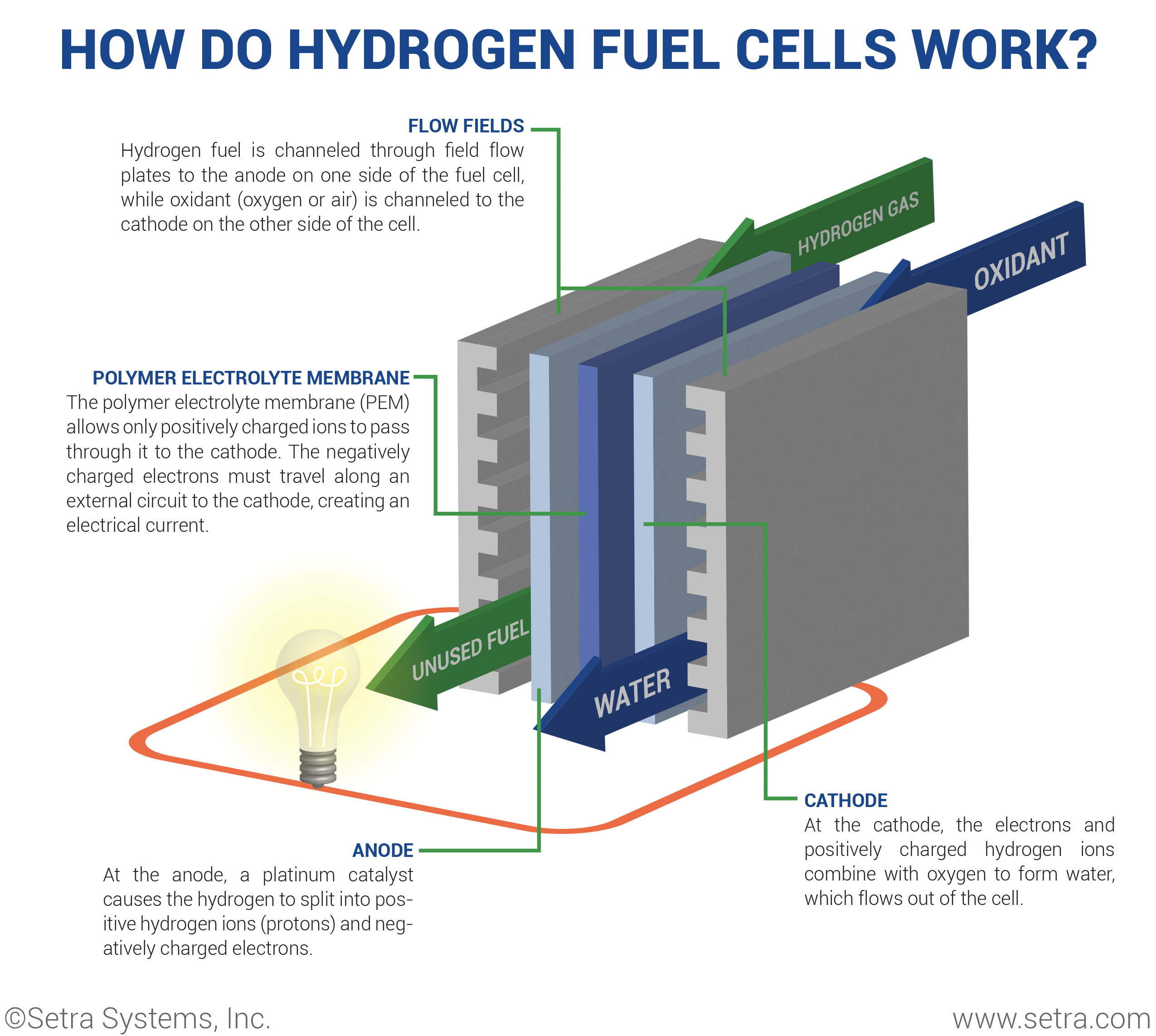
- A catalyst and electrolyte allow ions to move through the cell while electrons travel through an external circuit.
- The external electron flow provides usable DC electrical power.
- Hydrogen and oxygen ultimately combine to form water, with heat also produced.
Source: Original source
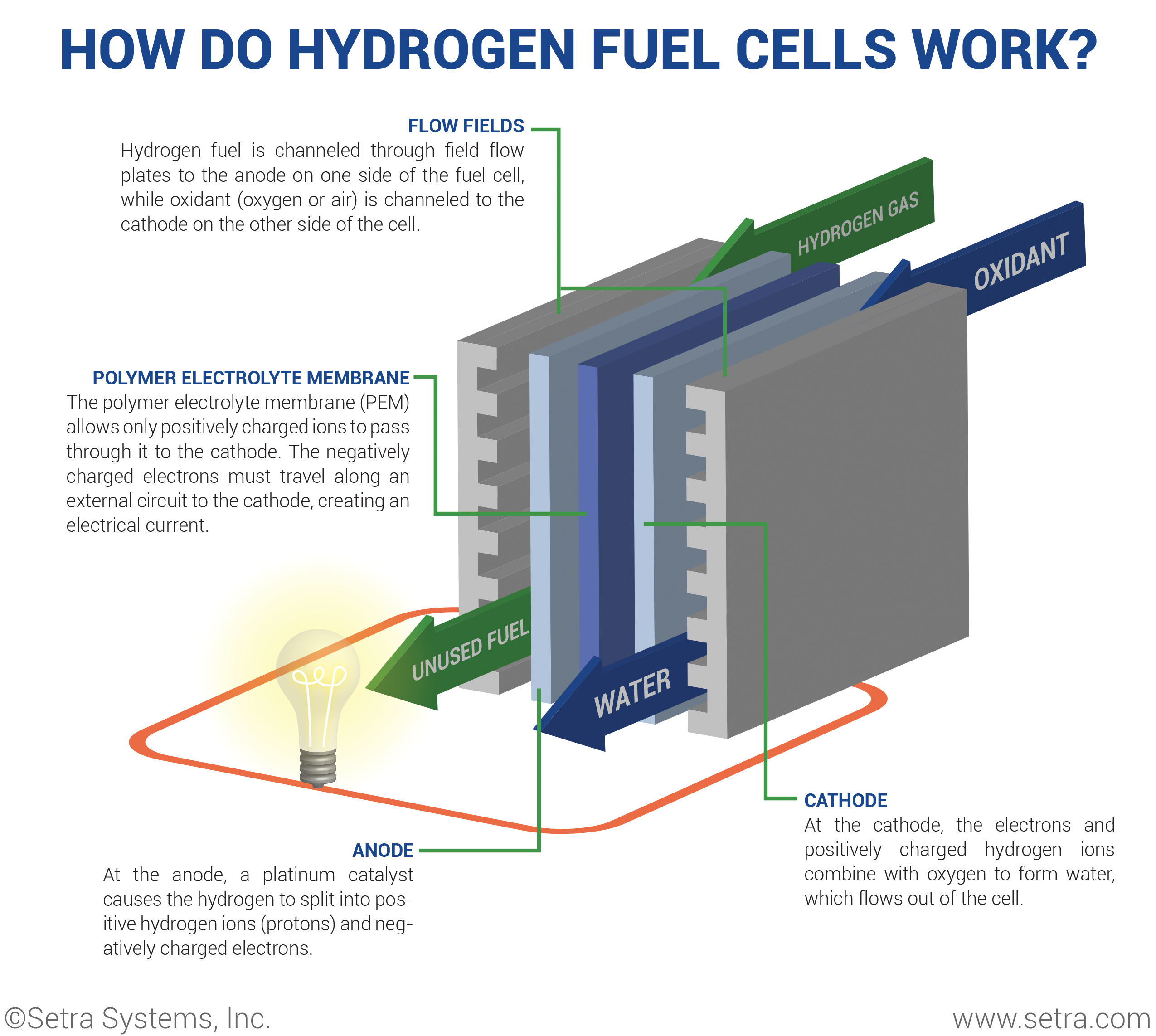
The exact ion transported through the electrolyte depends on the fuel-cell type. In a proton exchange membrane fuel cell, hydrogen is split into protons and electrons at the anode; protons cross the membrane and electrons travel through the load. At the cathode, oxygen, protons, and electrons combine to form water.
Fuel cells differ from batteries in several practical ways:
| Feature | Fuel cell | Battery |
|---|---|---|
| Energy source | External fuel and oxidant | Stored chemical reactants |
| Refueling/recharging | Refuel with hydrogen, methanol, or another fuel | Recharge electrically or replace |
| Runtime scaling | Mainly by fuel supply and system limits | Mainly by battery capacity |
| System needs | Stack plus fuel storage, controls, air handling, water and heat management | Cells/modules plus battery management and charging system |
Hydrogen fuel cells can have only water as the point-of-use exhaust when supplied with hydrogen and oxygen. However, that does not make all hydrogen energy carbon-free. Hydrogen is abundant in compounds, but free hydrogen is rarely available on Earth. Producing it, compressing or liquefying it, transporting it, and dispensing it require energy and equipment. Lifecycle emissions depend strongly on how the hydrogen is produced.
Efficiency also requires careful wording. Fuel cells can be more efficient than combustion engines in many operating conditions because electrochemical conversion is not limited in the same way as heat engines. But actual efficiency depends on fuel-cell chemistry, fuel, stack design, operating load, and whether useful heat is recovered. A stationary combined heat and power system may look very different from a vehicle fuel-cell stack operating over rapidly changing loads.
Alkaline Fuel Cells in Aerospace and Other Specialized Uses
Alkaline fuel cells (AFCs) are among the older and more developed fuel-cell technologies. They have been strongly associated with aerospace and space-mission use, where high-purity reactants can be supplied and where reliable electrical power and water production are valuable.
An AFC uses an alkaline electrolyte, historically potassium hydroxide in an aqueous system or, in newer variants, an alkaline polymer membrane. DOE comparison data lists AFCs as low-temperature fuel cells operating below 100°C, with electrical efficiency around 60% under the stated comparison basis. Their low operating temperature gives them fast response compared with high-temperature fuel cells and reduces some thermal stress issues.
AFC advantages include:
- Low operating temperature relative to ceramic fuel cells.
- Quick start and response, useful where load changes are expected.
- Potentially lower-cost materials, because alkaline chemistry can allow a wider range of stable catalysts and cell components.
- Simpler water management than some membrane systems in controlled applications.
The reference article emphasizes low stack cost relative to PEM systems, especially for separators. That general cost advantage remains useful, but exact historical separator prices should not be treated as current universal values. Present cost depends on design, production scale, catalyst selection, membrane or electrolyte format, and balance-of-plant requirements.
The major limitation of conventional AFCs is sensitivity to carbon dioxide. Carbon dioxide in air or fuel can react with the alkaline electrolyte, forming carbonates and reducing conductivity or blocking active sites. In practice, AFCs work best where hydrogen and oxygen are very pure, or where incoming air can be carefully cleaned. That is manageable in spacecraft and some controlled systems, but harder in polluted or uncontrolled ambient environments.
AFC systems can also be physically larger than PEM systems for comparable applications. PEM fuel cells generally offer high power density and compact packaging, which helps explain their strong position in vehicle applications. AFCs remain technically important, but sensitivity to CO2 and fuel/air impurities keeps them concentrated in specialized use cases rather than general urban power systems.
Solid Oxide Fuel Cells for Stationary and Utility Power
Solid oxide fuel cells (SOFCs) are high-temperature fuel cells intended mainly for stationary power, distributed generation, industrial energy systems, and utility-related applications. Instead of a liquid electrolyte or polymer membrane, an SOFC uses a solid ceramic electrolyte. Yttria-stabilized zirconia is a common example in conventional designs.
The reference article describes traditional SOFC operation at about 800–1,000°C and notes newer ceramic material developments that reduce core operating temperatures toward roughly 500–600°C. That lower-temperature direction can reduce material constraints and allow more conventional metallic auxiliary parts in some designs. Even so, SOFCs remain high-temperature systems compared with PEM, AFC, or DMFC technologies.
High temperature gives SOFCs several advantages:
- Fuel flexibility. SOFCs can use hydrogen and may also operate on reformed hydrocarbon fuels, depending on system design.
- Internal reforming potential. Heat inside the system can support conversion of fuel into hydrogen-rich gas.
- Combined heat and power suitability. Waste heat can be recovered for useful thermal loads.
- High electrical efficiency potential, especially in steady stationary operation.
DOE application comparisons identify SOFCs with electric utility and distributed-generation roles and note their high efficiency, fuel flexibility, and combined heat and power suitability. These strengths make SOFCs attractive where a system can run for long periods at stable output and where heat recovery has value.
The drawbacks are also tied to temperature. SOFCs generally have long startup times compared with low-temperature fuel cells. Thermal cycling can crack seals, stress ceramic components, and accelerate degradation. Load cycling is less favorable than steady operation, and the balance of plant must manage heat, fuel processing, sealing, insulation, and exhaust conditions.
For these reasons, SOFCs are not usually the first choice for passenger vehicles or small portable electronics. Their engineering fit is closer to stationary generation, industrial sites, buildings with steady power and heat demand, and grid-support systems where startup speed is less critical than efficiency and fuel flexibility.
Direct Methanol Fuel Cells for Portable Power
Direct methanol fuel cells (DMFCs) were developed as a fuel-cell option for portable and small electronic applications. Their central advantage is the fuel: methanol is a liquid at normal conditions, so it is easier to store and dispense than compressed hydrogen.
A DMFC uses methanol, usually mixed with water, fed directly to the anode. The fuel is electrochemically oxidized rather than first being converted in a separate reformer. This simplifies some parts of the system and allows compact refillable or cartridge-based energy supply concepts.
The appeal for portable power is clear:
- Liquid fuel can be packaged more easily than compressed hydrogen.
- Refueling can be faster than recharging a battery, at least in principle.
- Energy storage can be separated from the fuel-cell stack.
- Long runtime can be achieved by carrying more fuel rather than a larger battery.
Historically, DMFCs were compared favorably with older rechargeable battery chemistries such as nickel-cadmium for certain energy-per-mass or runtime scenarios. That comparison should be treated as historical context. Modern lithium-ion batteries have much higher performance than older NiCd packs and dominate portable electronics because they are efficient, compact, rechargeable, and supported by mature manufacturing.
DMFCs face several technical limitations. Methanol crossover through the membrane lowers efficiency and can reduce cathode performance. Power density is usually lower than PEM hydrogen fuel cells. Catalysts add cost, and the system still needs heat and water management. These constraints make DMFCs more suitable for low-power or long-runtime niches than for high-power propulsion.
Safety is also central. Methanol is toxic and flammable. A practical DMFC fuel system must control leakage, vapor release, cartridge integrity, user exposure, and refueling errors. Transport rules for methanol cartridges or fuel-cell systems should not be assumed from older references; they depend on current carrier, jurisdiction, and hazardous-material requirements. Methanol fuel packaging must be specifically certified for its intended transport and operating environment.
Technology Developments and Remaining Barriers
Fuel-cell technology has improved substantially, but many classic barriers remain: cost, durability, power density, fuel quality, stack life, and balance-of-plant complexity.
For PEM fuel cells, key development areas include lower precious-metal loading, better catalyst utilization, improved membrane durability, and more robust water management. PEM systems are attractive for vehicles because they operate at relatively low temperature, start quickly, and offer high power density. DOE material notes describe PEM fuel cells as typically operating below 120°C and as suitable for transportation, backup power, portable power, distributed generation, and specialty vehicles.
The same low-temperature characteristics create constraints. PEM cells typically require platinum or platinum-alloy catalysts, and the catalyst can be sensitive to impurities such as carbon monoxide. If hydrogen is produced from a hydrocarbon fuel, additional cleanup may be needed to protect the stack. Membrane degradation can occur under high stress, drying, flooding, freeze-thaw cycles, and chemical attack.
Fuel-cell efficiency and output vary with load. A fuel cell may achieve its best efficiency at partial load, while maximum power occurs at higher current density where voltage losses increase. Those losses include activation losses at the electrodes, ohmic losses through membranes and contacts, and mass-transport losses as reactants become harder to deliver to reaction sites. In a real system, compressors, pumps, humidifiers, cooling loops, and controls also consume power.
Development work has addressed many earlier shortcomings:
- improved membranes with better chemical and mechanical durability;
- catalysts that use precious metals more effectively;
- stack designs with improved gas distribution and sealing;
- better water and thermal management;
- lower-temperature SOFC materials;
- more integrated system controls and diagnostics.
Even when the stack improves, the surrounding system remains important. Hydrogen storage tanks, pressure regulation, air compressors, cooling hardware, safety sensors, humidification, and power electronics add cost and complexity. For transportation, limited hydrogen refueling availability remains one of the largest non-stack barriers. Fuel cells may be technically mature in selected niches, but broad adoption depends on the full fuel, service, and maintenance ecosystem.
Fuel Cell Longevity in Vehicles and Real-World Service
Fuel-cell longevity is not a single number. Stack life, system life, warranty life, and the economic replacement interval can differ. A stack may still function after measurable degradation, but the vehicle or power system may no longer meet rated output, efficiency, or operating-cost targets.
Vehicle fuel cells, especially PEM systems, face difficult operating profiles. They must start and stop frequently, follow rapid load changes, tolerate vibration, manage freezing conditions, reject heat, and operate with variable air quality. Buses and trucks may run long daily duty cycles, while passenger cars may see shorter trips and repeated cold starts.
Important degradation factors include:
- Start-stop cycling, which can accelerate catalyst and carbon-support degradation.
- Load cycling, which stresses electrodes and membranes.
- Freeze-thaw exposure, especially if water remains in the stack.
- Heat and humidity imbalance, including drying or flooding of membranes.
- Air contaminants, such as pollutants that affect catalysts or membranes.
- Fuel impurities, particularly in systems requiring high-purity hydrogen.
- Mechanical and chemical aging of seals, membranes, catalysts, and gas-diffusion layers.
Climate matters. Cold climates increase freeze-management demands and startup stress. Hot climates increase cooling loads and can accelerate material aging. Humid and dry environments create different water-management problems. A fuel-cell vehicle on a steady route with controlled maintenance may achieve different stack life than one exposed to irregular use, poor fuel quality, or harsh temperature swings.
Fuel-cell vehicles offer two practical advantages over battery-electric vehicles in some duty cycles: fast refueling and long range without carrying a very large battery. These advantages are most valuable for high-utilization fleets, heavy vehicles, buses, and applications where downtime is expensive. The counterweight is infrastructure. Hydrogen stations are costly, technically complex, and much less common than electrical charging points. They require compression, storage, dispensing, safety systems, and reliable fuel supply.
For fleet planning, longevity should be evaluated as a system question: stack durability, fuel cost, station access, maintenance capability, duty cycle, downtime tolerance, and replacement economics all interact.
The Fuel Cell Paradox: High Promise, Slow Adoption
Fuel cells have carried a long-standing promise: clean, efficient electrical power from abundant fuel, with water as the visible exhaust when hydrogen is used. That promise is real in a narrow electrochemical sense, but the broader energy system has proved much harder to change.
The contrast with the microprocessor revolution is useful but limited. Microprocessors scaled rapidly because manufacturing, materials, and infrastructure could improve in compact, high-volume supply chains. Fuel cells are different. They must handle reactive gases or liquid fuels, catalysts, membranes, seals, heat, water, pressure vessels, and safety systems. They also depend on external fuel production and distribution infrastructure. Progress is tied not only to stack performance but also to industrial gas supply, energy markets, public infrastructure, and regulation.
Current fuel-cell use reflects this reality. Fuel cells have found roles in space systems, forklifts and material-handling equipment, backup power, selected buses and trucks, demonstration passenger vehicles, buildings, industrial facilities, and stationary distributed generation. These are meaningful applications, but they are not the universal replacement for engines, batteries, or grid power that earlier expectations sometimes implied.
Hydrogen also plays more than one role. It can be a fuel for fuel cells, but it can also act as an energy carrier or storage medium for renewable electricity. Surplus renewable power can produce hydrogen, which can later be stored, transported, or converted back to electricity or industrial heat. The engineering question is whether the full pathway is efficient, low-carbon, and economical compared with alternatives such as direct electrification, batteries, thermal storage, or other fuels.
This is the fuel-cell paradox: a hydrogen fuel cell can provide very clean point-of-use power, yet the total system may be inefficient or carbon-intensive if the hydrogen is produced from fossil fuels without emissions control. Conversely, low-carbon hydrogen can improve the environmental case, but it requires production capacity, storage, transport, and dispensing infrastructure.
A balanced view is that fuel cells are neither failed technology nor universal solution. They are valuable where their strengths match the application: long runtime, fast refueling, quiet operation, high efficiency, clean point-of-use exhaust, or useful heat recovery. Wider adoption depends on continued cost reduction, longer stack durability, lower catalyst and material burden, reliable low-carbon hydrogen supply, and infrastructure dense enough to support real operation rather than isolated demonstrations.
References
- Battery University | BU-210: How does the Fuel Cell Work?
- PEM Fuel Cells 101: How They Work and Why They Matter - Plug Power
- Alkaline Fuel Cells vs PEM: Cost-Efficiency Evaluation
- KNOW EVERY THING ABOUT FUEL CELLS-(PEMFC, …
- PEM Fuel Cell Explained: How it works, Efficiency & Cost
- Comparison of Fuel Cell Technologies | Department of Energy
- A Proton Exchange Membrane & Solid Oxide Fuel Cell …
- PEM Fuel Cell System Selection Guide for Industrial and Commercial Applications
- Types of Fuel Cells | Department of Energy
- About Fuel Cells - Molinaroli College of Engineering and Computing | University of South Carolina