Lead acid is one of the oldest rechargeable battery systems still in regular industrial and automotive use. Invented by French physicist Gaston Planté in 1859, it became the first practical rechargeable battery chemistry and remains important because it can deliver high current at low upfront cost using a mature, serviceable technology base.
A lead acid battery is not light, compact, or especially tolerant of repeated deep discharge compared with many nickel- and lithium-based systems. Its strengths are different: dependable bulk power, high surge-current capability, simple voltage behavior, established charging equipment, and a highly developed recycling chain in many markets. These qualities explain why lead acid continues to appear in vehicles, UPS systems, emergency lighting, telecom backup, forklifts, golf cars, marine systems, mobility devices, and small standby-power installations.
Lead Acid Battery Fundamentals: Chemistry, Construction, and Operating Behavior
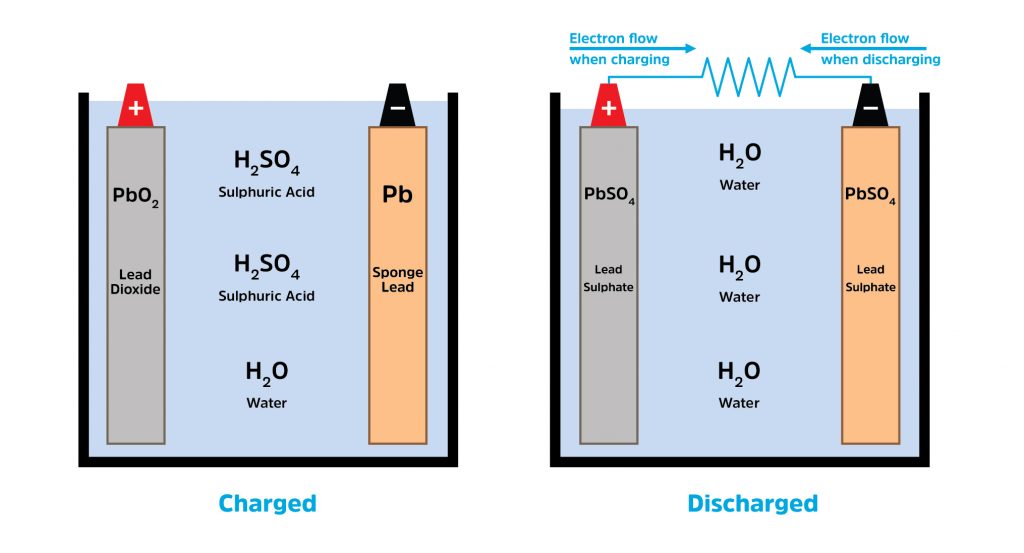
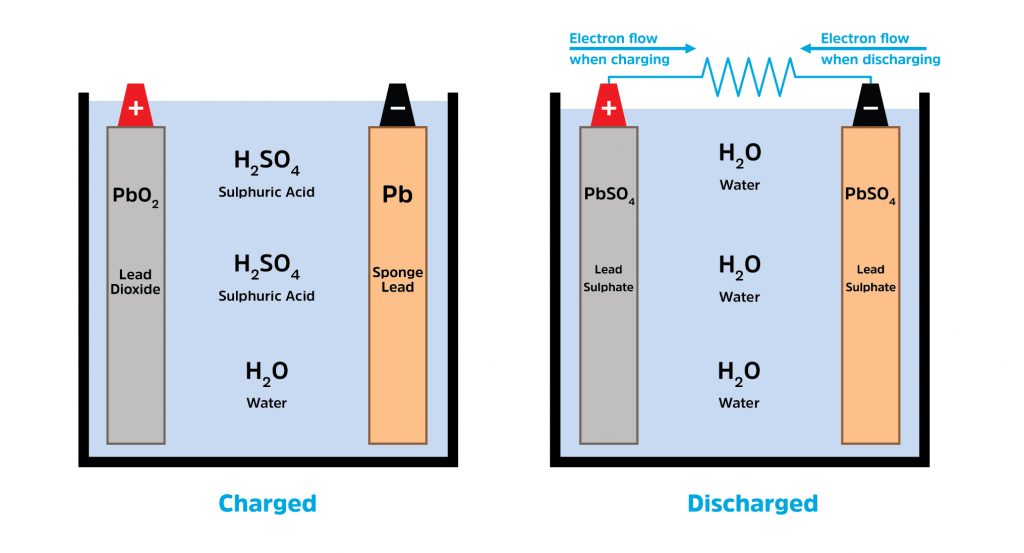
A lead acid cell uses lead dioxide as the positive active material, sponge lead as the negative active material, and sulfuric acid as the electrolyte. A separator keeps the positive and negative plates apart while allowing ionic conduction through the electrolyte. Cells are connected in series to form practical batteries; for example, six nominal 2 V cells are used in a typical 12 V lead acid battery.
During discharge, both plates are converted toward lead sulfate while sulfuric acid concentration decreases. During charging, the reaction is driven in the reverse direction, restoring lead dioxide at the positive plate, sponge lead at the negative plate, and increasing the acid concentration. This reversible chemistry is simple in principle, but real batteries are limited by plate structure, electrolyte distribution, corrosion, water loss, sulfation, temperature, and charge control.
Source: Original source
The physical construction is central to performance. A battery intended for engine starting uses many thin plates to maximize surface area and deliver high current for a short time. A deep-cycle battery uses plate structures better suited to repeated discharge, usually trading some peak current capability for durability. Separators, grid alloys, paste formulations, and additives are used to improve mechanical strength, charge acceptance, corrosion resistance, water consumption, and service life.
Lead acid remains widely used for several practical reasons:
- Low initial cost compared with many alternative rechargeable systems.
- Low cost per watt where high current or bulk standby capacity is more important than low weight.
- High surge-current capability, useful for starter motors and short-duration backup loads.
- Mature manufacturing and service infrastructure with familiar voltage ranges and charging equipment.
- Established recycling systems in many regions, especially for automotive batteries.
The limitations are equally important. Lead acid has low energy density and high mass compared with lithium-ion. It also has limited deep-cycle durability. A full discharge strains the plates, and every discharge-charge cycle removes a small amount of usable capacity. The decline is gradual when the battery is operated within its intended range, but deterioration accelerates when capacity has already fallen substantially.
Lead acid capacity is strongly affected by discharge rate. Manufacturers commonly rate batteries at slow discharge rates such as the 20-hour rate or 5-hour rate because usable capacity is higher when current is drawn slowly. At high discharge rates, internal losses and chemical transport limitations reduce the apparent capacity. Even so, lead acid can deliver very high pulse currents for a few seconds, which is exactly the requirement for engine cranking.
Cycle life depends heavily on operating conditions rather than chemistry alone. Important stress factors include:
- Depth of discharge: shallow cycling is much easier on the battery than repeated deep discharge.
- Sulfation: prolonged undercharge or storage in a discharged state encourages lead sulfate crystals that reduce active surface area.
- Temperature: heat accelerates aging and corrosion; cold reduces available power and charge acceptance.
- Charge control: incorrect voltage limits can cause chronic undercharge or damaging overcharge.
- Maintenance: flooded batteries may require electrolyte-level checks and proper water replacement where designed for service.
Charging should restore the battery fully without excessive gassing or water loss. Prolonged undercharge should be avoided because it promotes sulfation. Excessive overcharge should also be avoided, especially in sealed or valve-regulated designs, because gas generation and water loss may be irreversible. Flooded types can tolerate some controlled gassing, but they require ventilation and maintenance practices appropriate to the installation. As a general principle, lead acid batteries should be kept near their recommended operating temperature range and charged with equipment matched to the battery type.
Sealed Lead Acid and VRLA Batteries
“Sealed lead acid” is a common term, but it can be misleading. Most batteries described this way are more accurately called valve-regulated lead acid batteries, or VRLA batteries. They are not sealed in the sense of being able to contain unlimited gas pressure. They include pressure-relief valves that can vent gas if internal pressure rises beyond the design limit, such as during overcharge, fault conditions, or severe abuse.
The design goal of VRLA technology is reduced maintenance. Instead of a freely flooded electrolyte that requires periodic water addition, VRLA batteries use an immobilized or starved electrolyte system. Oxygen generated at the positive plate during charging can migrate to the negative plate and recombine, reducing water loss under proper operating conditions. The pressure-relief valve is a safety feature, not a normal operating vent.
The two major VRLA constructions are AGM and gel.
| VRLA type | Electrolyte method | Typical strengths | Main cautions | Common uses |
|---|---|---|---|---|
| AGM | Electrolyte absorbed in glass-mat separators | High power delivery, low internal resistance, good fit for UPS and automotive variants | Sensitive to overcharge and heat; drying can reduce life | UPS, security systems, telecom backup, start-stop vehicles, mobility equipment |
| Gel | Sulfuric acid immobilized with a silica gel | Good resistance to electrolyte movement, useful in some deep-cycle and standby applications | Often more sensitive to incorrect charge voltage; gas pockets can permanently reduce capacity | Wheelchairs, small renewable-energy systems, standby power, marine and mobility applications |
VRLA batteries are widely used where maintenance access is limited or where free liquid electrolyte is undesirable. Typical applications include uninterruptible power supplies, emergency lighting, telecom backup, medical equipment, security systems, mobility devices, and small standby-power systems. Their low upfront cost and familiar charging requirements make them attractive, but replacement intervals depend strongly on heat, float voltage accuracy, cycling frequency, installation design, and manufacturer quality.
Temperature is one of the most important practical variables. Battery University states that the optimum operating temperature for a VRLA battery is about 25°C, and that operation above this level sharply reduces life. The exact service life in a UPS cabinet, telecom enclosure, or mobility device therefore cannot be inferred from design life alone. A battery floated in a warm cabinet may require replacement much earlier than the same model operated in a cooler, well-regulated environment.
VRLA charging must be matched to the battery. AGM and gel cells may require different voltage limits, and gel cells in particular can be damaged by aggressive charging. Overcharge can drive gas generation faster than recombination can handle, causing venting and permanent water loss. Undercharge, on the other hand, encourages sulfation and capacity loss. Installations should also provide adequate ventilation because pressure-relief valves can release gas under abnormal or overcharge conditions.
Environmental handling remains important even when the battery is “maintenance-free.” VRLA batteries still contain lead and sulfuric acid. They should be treated as hazardous electrochemical devices and returned through approved recycling or take-back channels at end of life.
Starter Batteries and SLI Design
A starter battery, often called an SLI battery for starter-lighting-ignition, has a specific job: deliver a short, high-current burst to crank an internal-combustion engine. After the engine starts, the vehicle charging system quickly replaces the energy used for starting and supplies the vehicle’s electrical loads.
This duty cycle shapes the battery design. Starter batteries use many thin plates to create large surface area and low internal resistance. That construction supports high cranking current, but it is not optimized for repeated deep discharge. If a starter battery is repeatedly used like a deep-cycle battery—for example, to power accessories for long periods while the engine is off—its life can be shortened substantially.
Several ratings describe automotive starter batteries:
- Ampere-hours (Ah): an energy-capacity indication under specified discharge conditions. It is useful, but it does not fully describe starting performance.
- Cold cranking amps (CCA): a measure of the battery’s ability to deliver high current at low temperature. This is central to starting performance in cold climates.
- Reserve capacity: an indication of how long the battery can support a defined electrical load if the charging system is not operating.
These ratings serve different engineering purposes. A high Ah rating does not automatically mean excellent cold cranking performance, and a high CCA battery is not necessarily appropriate for deep cycling. Correct battery selection depends on vehicle requirements, climate, mounting constraints, charging-system behavior, and electrical accessory loads.
Modern vehicles have increased the demands on low-voltage batteries. Electronics, infotainment systems, security modules, electric pumps, heated accessories, and standby loads can all increase battery stress. Start-stop vehicles are especially demanding because the engine may restart many times during a drive cycle. This has led to broader use of AGM starter batteries and enhanced flooded batteries in vehicles that need better cycling tolerance and charge acceptance than conventional flooded starter batteries.
A starter battery’s service life depends on more than age. Hot climates accelerate grid corrosion and water loss. Cold climates reduce available cranking power. Vibration can damage plates and connections. Poor voltage regulation can undercharge or overcharge the battery. Parasitic loads can slowly discharge it while parked. Deep-discharge events are particularly harmful because the battery was not designed for that duty.
The distinction between starter and deep-cycle batteries should not be ignored. A starter battery is a high-power device for short pulses. A deep-cycle lead acid battery is designed to provide a lower current over a longer period and tolerate deeper discharge more often. Using either type outside its design purpose usually reduces reliability and life.
Lead Acid vs. Lithium-Ion in Cars
Lead acid has dominated automotive 12 V systems for decades because it fits the job well: low cost, high cranking current, rugged behavior, simple charging, broad service familiarity, and mature recycling infrastructure. For conventional internal-combustion vehicles, the energy required for one engine start is small, but the peak current demand is high. Lead acid is well suited to that profile.
Lithium-ion is favored where energy density, weight reduction, cycle life, and charging efficiency are more important. This is why lithium-ion dominates modern electric-vehicle traction packs. A traction battery must store large amounts of energy, operate over many cycles, and provide efficient propulsion power. Lead acid is too heavy and has insufficient energy density for most modern EV traction applications.
For low-voltage automotive batteries, the comparison is more nuanced.
| Criterion | Lead acid | Lithium-ion |
|---|---|---|
| Energy density | Low; heavy for stored energy | Higher; significant weight savings |
| High-current pulses | Very capable for short cranking bursts | Capable with proper cell design and electronics |
| Deep-cycle durability | Limited, especially for starter types | Generally better when properly managed |
| Charging system | Simple and widely supported | Requires compatible charging and battery management |
| Cold-weather behavior | Reduced power in cold, but familiar automotive design practice | Can be limited by low-temperature charging constraints depending on chemistry and system design |
| Safety concerns | Lead toxicity, sulfuric acid, gassing, high short-circuit current | Thermal runaway risk, electronics dependency, chemistry-specific hazards |
| Recycling maturity | Highly established in many markets | Improving, but less mature than lead acid in many applications |
| Upfront cost | Usually low | Usually higher |
A direct substitution is not always simple. A lithium replacement for a 12 V lead acid battery must be compatible with the vehicle’s charging voltage range, transient conditions, sleep current, safety diagnostics, temperature range, and failure-mode expectations. Lithium-ion batteries also require battery management systems to control cell voltage, temperature, current, and protection functions. Without this system-level compatibility, weight savings alone are not enough to justify replacement.
Some newer vehicles use lithium-based low-voltage batteries, particularly where weight reduction and electrical-system integration matter. However, lead acid remains common in 12 V auxiliary and starter applications because the installed base, charging infrastructure, cost structure, and recycling network are so well developed.
Environmental and safety comparisons require care. Lead acid contains toxic lead and corrosive sulfuric acid, but it benefits from one of the most established battery recycling streams. Lithium-ion avoids lead and can offer longer service life in many applications, but it introduces thermal-management and fire-risk considerations and requires different recycling processes. Neither chemistry is environmentally benign if poorly manufactured, abused, discarded improperly, or recycled under unsafe conditions.
Lead acid remains practical where low cost, high surge current, and predictable standby service are the priorities. Lithium-ion is favored where weight, usable energy, cycle life, fast charge capability, and high system efficiency justify the additional electronics and cost.
Safety, Recycling, and Responsible Handling
Lead acid batteries are common enough that their hazards are sometimes underestimated. They combine corrosive electrolyte, toxic heavy metal, high available fault current, heavy mass, and possible gas generation during charging.
Key hazards include:
- Sulfuric acid burns from electrolyte exposure.
- Lead exposure from damaged batteries, contaminated components, or improper recycling.
- Short-circuit current capable of heating tools, melting metal, or causing burns.
- Hydrogen gas generated during charging, especially with flooded batteries or overcharged VRLA batteries.
- Explosion risk if sparks or flames ignite accumulated gas.
- Lifting and handling injuries because many lead acid batteries are heavy.
Practical handling should be conservative. Wear eye protection and acid-resistant gloves when working around serviceable batteries. Keep sparks, flames, and smoking materials away from charging batteries. Ensure ventilation in charging areas. Do not place tools or conductive objects across terminals. Disconnect and connect cables in the correct order specified for the equipment. Use chargers with voltage and current settings appropriate for the battery type, and follow the manufacturer’s temperature and installation limits.
Damaged, leaking, swollen, overheated, or repeatedly vented batteries should not be treated as normal service items. They should be isolated from ignition sources, handled with suitable protective equipment, and processed according to local hazardous-waste or battery-return requirements.
Lead acid batteries should not be discarded in household trash. Their lead and acid contents can contaminate soil and water if dumped or broken open, and informal recycling can expose workers and communities to serious health hazards. End-of-life batteries should be returned through approved recycling channels, battery retailers, automotive service centers, industrial battery suppliers, or regulated take-back systems.
The mature recycling pathway is one of lead acid’s practical advantages, but that advantage only exists when batteries are collected and processed correctly. Low cost and recyclability do not remove the need for proper selection, charging, ventilation, transport, storage, and end-of-life handling. Used responsibly, lead acid remains a useful engineering solution for applications where its strengths match the duty cycle; used carelessly, it presents avoidable safety and environmental risks.
References
- Battery University | BU-201: How does the Lead Acid Battery Work?
- Advancements in Lead Acid
- Lead–acid battery - Wikipedia
- What is Valve Regulated Lead Acid Battery?-News
- Environmental Impact of Lead Acid Batteries: A Comparison
- C & D Technologies | Comparing Different Types of UPS Batteries
- What is a Lead-Acid Battery: Everything you need to know
- The Battery Basics: Understanding Lithium-Ion, Lead-Acid and More
- Lead Acid UPS Batteries: VRLA, VLA & Pure Lead Battery Backups | Mitsubishi Electric
- Valve Regulated Lead Acid Battery - an overview