Lithium batteries developed from a long search for lighter, higher-energy electrochemical storage. Early work is commonly traced to 1912, but practical products took much longer to mature. Non-rechargeable lithium-metal batteries became commercially available in the 1970s and took advantage of lithium’s very low atomic mass and high electrochemical potential.
Rechargeable lithium systems were more difficult. The most direct approach was to use metallic lithium as the negative electrode, but repeated charging could form needle-like lithium deposits called dendrites. By the mid-1980s, dendrite growth had become a major obstacle because it could pierce the separator, create an internal short circuit, and raise fire or explosion risk.
The commercial breakthrough was the lithium-ion cell. Instead of cycling metallic lithium, lithium-ion batteries store lithium ions inside host materials at both electrodes. This intercalation approach gives up some theoretical energy density compared with lithium metal, but it greatly improves reversibility and practical safety. Sony commercialized the first lithium-ion battery in 1991, marking the start of the modern rechargeable battery platform used in portable electronics, power tools, electric vehicles, and many energy-storage systems.
How Lithium-Ion Cells Work and the Materials They Use
A lithium-ion cell is built around controlled movement of lithium ions between two electrodes. The main internal parts are:
- Cathode: the positive electrode during discharge, usually a lithium-containing compound.
- Anode: the negative electrode during discharge, usually graphite or another carbon-based host material in conventional cells.
- Electrolyte: a non-aqueous ion-conducting medium that allows lithium ions to move between electrodes.
- Separator: a porous electrical insulator that keeps the electrodes from touching while allowing ion transport.
- Current collectors: thin conductive foils that carry electrons into and out of the electrode coatings; commercial cells commonly use aluminum on the cathode side and copper on the anode side.
During discharge, lithium ions move from the anode through the electrolyte and separator toward the cathode. Electrons cannot pass through the electrolyte, so they travel through the external circuit and power the load. During charge, an external charger drives the process in reverse: lithium ions leave the cathode and move back into the anode structure while electrons are supplied through the external circuit.
In a healthy conventional lithium-ion cell, this is not normally a process of metallic lithium plating and stripping. The intended mechanism is intercalation: lithium ions fit into sites within the crystal or disordered structure of the electrode materials. Metallic lithium deposition is generally an unwanted side reaction associated with conditions such as low-temperature charging, excessive charge rate, overcharge, or an anode that cannot accept lithium ions fast enough.
This distinction separates lithium-ion batteries from rechargeable lithium-metal batteries. A lithium-metal cell uses metallic lithium as an electrode and can offer high theoretical energy density, but dendrite control is a central challenge. A lithium-ion cell uses host materials that reversibly accept and release lithium ions, improving cycle life and manufacturability.
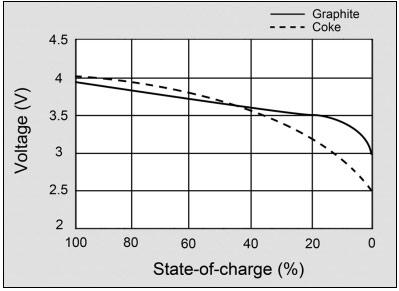
Sony’s original commercial lithium-ion battery used a coke or hard-carbon anode. This material could reversibly accept lithium ions and helped make the first commercial cell practical. Since the late 1990s, most manufacturers shifted toward graphite because it provides a flatter discharge voltage curve and good long-term cycling stability. Graphite remains the dominant commercial anode material in lithium-ion cells.
Source: Original source

The anode field continues to develop. Silicon can store much more lithium per unit mass than graphite, so silicon-enhanced anodes are widely studied and increasingly used in blended forms. However, silicon expands and contracts substantially during cycling, which creates mechanical and lifetime challenges. Graphene-related materials and other advanced carbon structures are also research and development topics. Nanotube carbons have been investigated, but they have not become common commercial lithium-ion anodes because processing behavior, entanglement, and practical performance have limited adoption.
Lithium-ion is not a single chemistry. It is a family of cell designs that share lithium-ion transport but use different electrode materials. Common cathode examples include:
| Cathode family | Common abbreviation | Typical reason for use |
|---|---|---|
| Lithium cobalt oxide | LCO | High energy density for portable electronics |
| Lithium manganese oxide | LMO | Power capability and thermal behavior in some applications |
| Lithium iron phosphate | LFP | Long cycle life and robust safety characteristics |
| Lithium nickel manganese cobalt oxide | NMC | Balanced energy, power, and lifetime for vehicles and equipment |
The exact voltage, energy density, cycle life, and safety behavior depend strongly on the cathode, anode, electrolyte, cell format, and battery management system. For this reason, statements about “lithium-ion batteries” are most accurate when the specific chemistry and operating conditions are known.
Advantages of Lithium-Ion Batteries
Lithium-ion batteries became dominant because they combine high energy storage with practical rechargeability. Compared with many older rechargeable systems such as lead-acid, nickel-cadmium, and traditional nickel-metal-hydride batteries, lithium-ion cells can provide high specific energy, useful power capability, and compact packaging.
The high cell voltage is one of the most important system-level advantages. Many lithium-ion cells have a nominal voltage of about 3.6 to 3.7 volts per cell, depending on chemistry and manufacturer convention. This is far higher than a single nickel-based cell, so fewer cells are needed to reach a useful pack voltage. In small electronics, one lithium-ion cell can directly support devices such as phones, tablets, cameras, and many portable instruments with relatively simple voltage conversion.
Lithium-ion cells also support strong load capability when designed for power delivery. A battery for a smartphone is optimized differently from a battery for a cordless drill or electric vehicle, but the chemistry family can be engineered for both energy-focused and power-focused use cases. This flexibility is one reason lithium-ion technology appears across consumer electronics, power tools, medical devices, electric bicycles, electric vehicles, and stationary energy-storage systems.
Another major advantage is low maintenance. Lithium-ion batteries do not require deliberate full-discharge cycling to prevent memory effect. Partial discharge and recharge are normal operating patterns. In fact, avoiding unnecessary deep discharges can be beneficial for service life in many applications.
Charge behavior is also convenient. When managed correctly, lithium-ion charging is relatively straightforward: the charger controls current and voltage according to the cell chemistry and pack design, and the battery management system supervises cell limits. Lithium-ion cells generally have good charge efficiency, especially compared with systems that require prolonged overcharge or equalization as part of normal maintenance.
Self-discharge is relatively low compared with traditional nickel-based rechargeable systems. This helps devices retain charge during storage and supports more accurate fuel-gauge behavior. The comparison should be made carefully, however: modern low-self-discharge nickel-metal-hydride cells have improved greatly, so lithium-ion’s advantage is not the same in every product category. Still, for many portable and high-energy applications, lithium-ion offers an attractive combination of energy retention and low maintenance.
Key practical advantages include:
- High specific energy: useful where weight and volume matter.
- High nominal cell voltage: fewer cells are needed for many electronics designs.
- Good cycle life: especially when temperature, voltage, and depth of discharge are well managed.
- No memory effect: no scheduled full-discharge exercising is required.
- Low maintenance: no electrolyte topping, equalizing charge, or routine conditioning in normal consumer use.
- Good efficiency: charge and discharge losses are relatively low when the system is properly designed.
These advantages explain why lithium-ion displaced many earlier rechargeable chemistries in laptops, phones, tablets, cameras, and cordless tools. They also explain its central role in electric vehicles, where energy density, cycle life, power capability, and pack-level monitoring can be engineered together.
Limitations, Safety Controls, and Shipping Constraints
Lithium-ion batteries are high-energy devices and must be operated within defined electrical and thermal limits. Their benefits depend on control. A bare cell can be damaged or made unsafe by overcharge, overdischarge, excessive current, external short circuit, physical damage, or exposure to unsuitable temperatures.
For this reason, lithium-ion packs normally require a protection circuit or a more capable battery management system. The required complexity depends on the application. A single-cell consumer pack may use a small protection board, while an electric-vehicle or stationary-storage pack requires extensive monitoring, balancing, contactors, current sensing, thermal sensing, and fault handling.
Protection functions commonly include:
- Overcharge protection to prevent cell voltage from rising beyond the safe upper limit.
- Overdischarge protection to prevent damaging low-voltage conditions.
- Overcurrent and short-circuit protection to limit heating and conductor stress.
- Temperature monitoring to block unsafe charge or discharge conditions.
- Cell balancing in multi-cell packs to reduce voltage spread between series-connected cells.
High temperature accelerates lithium-ion aging. Storage or operation at elevated temperature can increase side reactions inside the cell and reduce capacity over time. High state of charge also contributes to aging, especially when combined with heat. A battery stored fully charged in a hot environment will generally age faster than one stored cooler and at a moderate state of charge, assuming the manufacturer’s storage guidance allows it.
Cold charging is another important limitation. Rapid charging at or below freezing is restricted because low temperature slows lithium-ion diffusion into the anode. If the charging current is too high under these conditions, lithium ions may deposit as metallic lithium on the anode surface instead of intercalating into the host structure. This lithium plating can reduce capacity, increase internal resistance, and in severe cases contribute to dendrite growth and internal short-circuit risk.
Lithium-ion cells can also enter thermal runaway under abuse conditions. Thermal runaway is a self-heating failure process in which internal reactions generate heat faster than the cell can dissipate it. Possible initiating events include internal short circuits, severe overcharge, crushing or puncture, external heating, contamination, manufacturing defects, or failure of protection electronics. Pack design reduces risk through cell qualification, mechanical protection, electrical controls, thermal pathways, fusing, spacing, venting strategy, and conservative operating limits.
A practical safety view is therefore not that lithium-ion batteries are inherently unsafe, but that they require appropriate engineering controls. The same chemistry that provides high energy density also demands disciplined voltage, current, and temperature management.
Shipping adds another layer of constraints. Lithium batteries are regulated in transportation because damaged, defective, improperly packed, or incorrectly declared batteries can create fire hazards. Larger quantities and standalone cells or packs are subject to packaging, labeling, documentation, and state-of-charge requirements depending on transport mode and jurisdiction.
For air shipment, standalone lithium-ion cells and packs are commonly limited to a reduced state of charge; a widely used limit is 30% state of charge for cells and packs shipped by themselves under applicable air-transport rules. Batteries packed with equipment or contained in equipment may be treated differently. The details change with regulation, battery size, watt-hour rating, packaging configuration, and carrier requirements, so shippers should use current rules rather than relying on general technical articles.
In everyday use, most lithium-ion battery problems are avoided by following a few engineering and handling principles:
- Use chargers intended for the specific cell chemistry and pack configuration.
- Do not bypass the protection circuit or battery management system.
- Avoid charging below freezing unless the system is specifically designed to manage it.
- Keep batteries away from excessive heat and physical damage.
- Retire packs that are swollen, crushed, leaking, overheating, or behaving abnormally.
- Follow current transport rules when shipping cells, packs, or battery-powered equipment.
Lithium-ion technology succeeds because it balances energy density, cycle life, voltage, efficiency, and manufacturability better than many alternatives. Its limitations are real, but they are manageable when the cell chemistry, pack design, charger, thermal environment, and transportation requirements are treated as parts of one engineered system.
References
- Battery University | BU-204: How do Lithium Batteries Work?
- ALL TYPES OF LITHIUM-ION BATTERIES
- Battery University | BU-704a: Shipping Lithium-based Batteries by Air
- Lithium-ion battery - Wikipedia
- Lithium-Ion Battery - Clean Energy Institute
- Battery Safety | Division of Research Safety | Illinois
- How Lithium-Ion Batteries Generate Power & Store Energy
- Brief History of Early Lithium-Battery Development
- How do lithium-ion batteries actually work? | Canary Media
- Introduction to Lithium-Ion Battery Awareness Week