A battery is rarely empty at the moment a device shuts down. In most engineered products, shutdown occurs at a selected end-of-discharge voltage rather than at zero remaining chemical energy. That cutoff protects the cell, leaves a small operating reserve, and helps the product behave predictably across load, temperature, and battery age.
The correct lower limit depends strongly on chemistry and application. A mobile phone, a cordless drill, an electric vehicle, a backup lead-acid battery, and an alkaline flashlight cell all reach end of discharge in different ways. The voltage at cutoff is not just a fuel-gauge number; it is affected by current draw, internal resistance, temperature, cell construction, and the protection electronics around the battery.
Why Devices Shut Off Before the Battery Is Truly Empty
Many portable devices using conventional lithium-ion cells shut down at about 3.00 V per cell during discharge. At that point, the cell may still have roughly 5% capacity remaining, although the exact amount depends on cell design, discharge current, temperature, age, and how the device measures end of discharge.
This reserve is deliberate. Manufacturers do not normally want a product to run a lithium-ion cell to the lowest electrochemical limit during ordinary use. The remaining margin serves several practical purposes:
- It leaves energy for internal electronics, memory retention, control circuits, and orderly shutdown.
- It reduces stress compared with repeatedly running the cell to a deeper discharge point.
- It allows some time for self-discharge if the user does not recharge immediately.
- It helps avoid a condition where the protection circuit opens before a normal charger can recover the pack.
For many lithium-ion packs, a critical low-voltage region begins around 2.50 V per cell. Below this area, pack protection may disconnect the cell from the external terminals. Once that happens, many ordinary chargers will not start because they cannot detect a valid battery voltage or because the pack has entered a protected sleep state.
This is why a battery that was merely empty yesterday may become difficult or impossible to charge after sitting for months. Even when the device is off, lithium-ion cells have self-discharge, and the pack electronics can also consume a small current. If the voltage continues falling from the normal device cutoff toward the protection threshold, the pack can become unserviceable with a standard charger.
A low-voltage lithium-ion pack should not be forced back into service by improvising a power supply connection. Some specialized chargers include controlled recovery or boost functions for packs that are only slightly below their wake threshold, but the safe path depends on the cell design, protection circuit, and manufacturer limits. If a pack has been deeply discharged for an unknown time, replacement is often the safer engineering decision.
How Load, Temperature, and Internal Resistance Affect Cutoff
A device cutoff voltage is often treated as if it directly represents state of charge, but that is only partly true. The terminal voltage seen by the device is the cell voltage under actual operating conditions. When current rises, voltage drops across the internal resistance of the cell and pack wiring. This voltage sag can make the battery appear empty earlier than it would under a light load.
High-current devices such as power tools are a common example. A lithium-ion pack may reach the tool cutoff during a heavy load even though it still contains usable capacity. If the load is removed, the voltage may recover upward. The same pack could then run a lower-current device, or it might deliver more capacity if discharged at a gentler rate.
Cold temperature has a similar effect. At low temperature, electrochemical reaction rates slow and the apparent internal resistance rises. The voltage under load drops more sharply, so a product may shut down early even though the battery would deliver additional capacity after warming or under a lighter load.
Aged batteries are also more vulnerable to early cutoff. As cells age, internal resistance generally increases. The result is greater heat generation and larger voltage sag at the same current. The user may observe this as a device that still shows charge at rest but collapses quickly when the motor starts, the radio transmits, the screen brightens, or the processor draws peak current.
Primary cells can show the same behavior near end of life. In an alkaline cell, for example, rising internal resistance can cause a large voltage drop when the device demands current. The cell may still contain some chemical energy, but it can no longer maintain enough terminal voltage for the load.
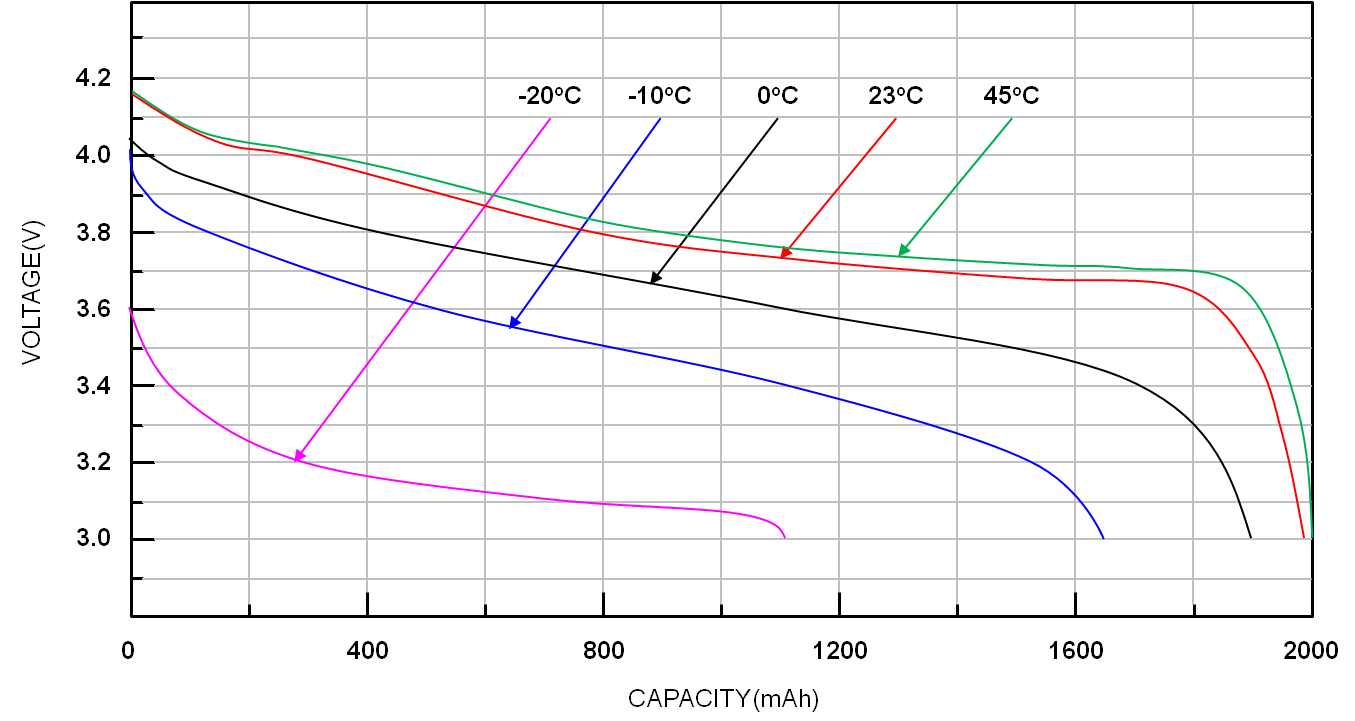
Source: Battery University
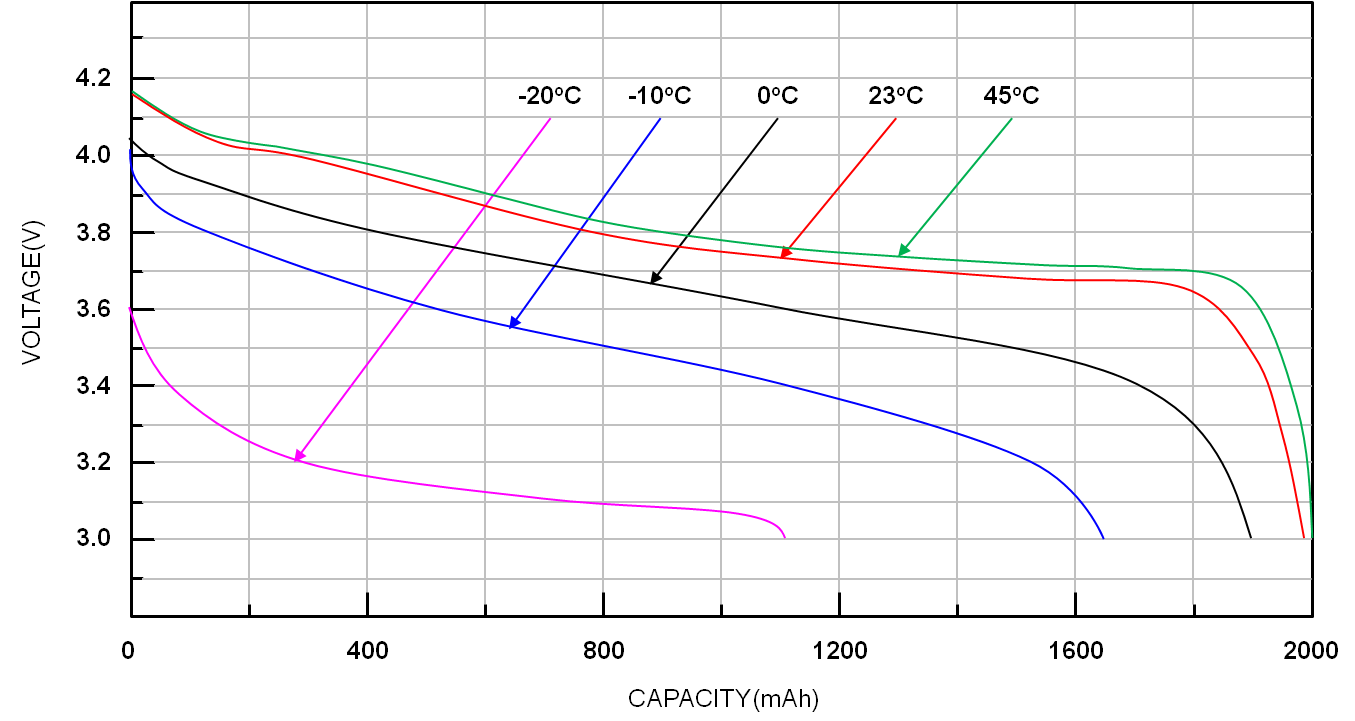
The important engineering point is that cutoff voltage is not a universal state-of-charge marker. It is a system limit selected for a chemistry, a load profile, a temperature range, a safety margin, and an expected battery condition. Two products using similar cells can legitimately use different cutoff settings if their loads and protection strategies differ.
Typical End-of-Discharge Limits by Battery Chemistry
General cutoff values are useful for orientation, but they should not override a cell datasheet, battery pack specification, charger manual, or battery management system setting. The safe lower limit is ultimately defined by the manufacturer and the system design.
| Battery chemistry or application | Typical end-of-discharge behavior | Practical caution |
|---|---|---|
| Conventional lithium-ion portable devices | Often about 3.00 V/cell | Leaves reserve capacity and reduces deep-discharge risk. |
| High-drain lithium-ion tools | May allow lower limits such as about 2.70 V/cell | Used to reduce premature cutoff under high load; not a universal safe value. |
| Lithium iron phosphate | Uses different nominal and cutoff voltages from cobalt- or manganese-based Li-ion cells; examples include lower limits around 2.45 V/cell in some high-load cases instead of about 2.70 V/cell | Must be managed with chemistry-specific BMS settings. |
| Lead-acid | Customary discharge cutoff may be around 1.75 V/cell, with lower limits such as 1.40 V/cell used in some high-load cases | Deep discharge accelerates damage, and the acceptable limit depends on battery type and application. |
| Nickel-cadmium and nickel-metal hydride | Commonly around 1.00 V/cell, with some high-load applications using about 0.90 V/cell | Avoid reversing weak cells in multi-cell packs during deep discharge. |
Lithium-ion cells used in phones and laptops are normally protected by device electronics and pack protection circuits. The user sees this as a clean shutdown before the cell reaches the most damaging low-voltage region. A power tool, however, may be designed around a higher current profile and may use a lower cutoff to prevent nuisance shutdown during short heavy loads.
Lithium iron phosphate needs separate treatment because it is not voltage-compatible with the common cobalt- or manganese-based lithium-ion assumptions. Its nominal voltage and end-of-discharge settings are different, and its relatively flat voltage profile can make state-of-charge estimation more dependent on coulomb counting and BMS logic. A charger or inverter setting intended for another lithium-ion chemistry should not be applied casually to LiFePO4.
Lead-acid batteries are especially sensitive to how long they remain discharged. A deep discharge can promote sulfation and shorten service life, even if the battery can be recharged afterward. The cutoff also depends on whether the battery is a starting battery, deep-cycle battery, standby battery, or traction battery. A short high-current event and a long low-current discharge do not impose the same conditions.
Nickel-based batteries tolerate discharge differently from lithium-ion, but multi-cell packs still need care. If a series string is discharged too far, the weakest cell can be driven into reversal while stronger cells continue pushing current through it. That condition can permanently damage the weak cell and degrade the pack.
The table values should therefore be treated as typical engineering reference points, not permission to drain every battery to those voltages. Cell construction, pack balancing, protection circuit behavior, warranty limits, and application safety requirements all matter.
Use Shallower Discharge for Longer Service Life
Consumer electronics often prioritize maximum runtime per charge. A phone, laptop, or camera that shuts off too early feels defective to the user, so manufacturers balance cell protection against the expectation of long single-cycle operation.
Industrial systems usually make a different tradeoff. In backup power, electric drive, telecommunications, robotics, energy storage, and aerospace applications, the target is often long service life, predictable reserve, and low failure risk rather than extracting every watt-hour on each cycle. In those systems, a shallower depth of discharge can be more valuable than maximum runtime.
Hybrid and electric vehicle battery packs illustrate the concept. Their battery management systems normally prevent the pack from using the full electrochemical capacity. Many such systems operate within a mid-range state-of-charge window, often described as roughly 30% to 80% when new, although the exact range varies by vehicle, battery chemistry, manufacturer strategy, age, and operating mode.
This middle operating band reduces stress. Repeatedly taking a lithium-ion cell from full charge to deep discharge and then back to full charge is harder on the cell than moderate cycling within a narrower window. The same principle appears in satellite and other high-reliability applications, where the battery may be operated in a mid-band or sweet zone to extend life.
The practical lesson is not that every battery must be kept between the same two percentages. Instead, the lesson is that depth of discharge is a design variable. If an application needs maximum runtime and the battery is easily replaced, deeper cycling may be acceptable. If the application needs long life, low maintenance, or high reliability, a conservative operating window is usually preferable.
For lithium-ion systems, this may mean avoiding routine operation to the lowest device cutoff when it is not necessary. For lead-acid systems, it often means avoiding deep discharge and recharging promptly after use. For nickel-based packs, it means preventing cell reversal and managing the pack as a series system rather than assuming every cell is identical.
A well-designed battery system defines more than one limit. It may include a normal user cutoff, a lower protective cutoff, a storage recommendation, a charger refusal threshold, and a service diagnostic threshold. Those layers are not redundant; they provide margins for real-world variation in load, temperature, aging, and user behavior.
Primary Batteries at Low Voltage
Primary batteries such as alkaline cells are not managed in the same way as rechargeable lithium-ion, lead-acid, or nickel-based packs. They are designed for one discharge cycle and are not intended for normal recharging. Therefore, the main question is not cycle life, but whether the cell can still maintain enough voltage under load to operate the device.
Alkaline cells can show a steep voltage decline near end of life. As discharge progresses, internal resistance rises. Under a light load, the terminal voltage may remain adequate for a long time; under a heavy load, the same cell may collapse below the device cutoff quickly. This is why an alkaline cell removed from a high-drain device may still run a clock, remote control, or other low-drain product.
Some chemical energy may remain after a high-drain device stops working, but it may not be usable at the required current. The limiting factor is no longer only stored energy; it is the ability of the cell to deliver that energy at sufficient voltage. This distinction explains many apparently inconsistent observations with primary cells.
Low-drain devices generally extract more apparent capacity from alkaline batteries because voltage sag is lower and the discharge can continue further before the device reaches its minimum operating voltage. High-drain devices reach that minimum voltage earlier because internal losses consume more of the available voltage margin.
Because primary batteries are not meant to be recharged, low-voltage guidance is different from rechargeable systems. The correct response to an exhausted alkaline or other primary cell is replacement and proper recycling or disposal according to local rules, not forced recharging. Attempting to recharge a primary cell can cause leakage, venting, or other failure modes.
Across all battery types, the safest answer to how low a battery can be discharged is application-specific. The usable lower limit is set by chemistry, current, temperature, cell age, protection electronics, and the consequence of failure. A device cutoff is therefore best understood as a controlled engineering boundary, not as proof that the battery has no energy left.
References
- Battery University | BU-802c: How Low can a Battery be Discharged?. (n.d.). http://www.batteryuniversity.com/article/bu-802c-how-low-can-a-battery-be-discharged
- BU-802b: What does Elevated Self-discharge Do?. (n.d.). http://www.batteryuniversity.com/article/bu-802b-what-does-elevated-self-discharge-do
- Battery University - WeCanFigureThisOut.org. (n.d.). https://wecanfigurethisout.org/ENERGY/Web_notes/Electrochemical/Batteries_and_Fuel_Cells_Supporting_Files/How%20do%20Lithium%20Batteries%20Work%20%E2%80%93%20Battery%20University.pdf
- Battery Discharger User’s Manual. (n.d.). https://www.piktronik.com/download/MAN/BT15/BT15-100_Manual_EN.pdf
- How critical is the 2.5V cut-off voltage for Li-Ion battery life? - Rechargeable Batteries - BudgetLightForum.com. (n.d.). https://budgetlightforum.com/t/how-critical-is-the-2-5v-cut-off-voltage-for-li-ion-battery-life/51929
- Battery Discharge Rate | Lithium Batteries Lithiumhub Ionic. (n.d.). https://lithiumhub.com/discharge-rate
- Is a Deep Discharge Really That Damaging? | Midtronics. (n.d.). https://www.midtronics.com/blog/is-deep-discharge-really-that-damaging
- Discharge and battery capacity - Rebelcell. (n.d.). https://www.rebel-cell.com/knowledge-base/battery-capacity
- how low can you drain a lifepo4 battery:A Practical Guide to Safe Discharge Limits - LeforESS. (n.d.). https://leforsolar.com/how-low-can-you-drain-a-lifepo4-battery%EF%BC%9Aa-practical-guide-to-safe-discharge-limits
- Why do most battery protection circuits have 2.5V discharge cap?. (n.d.). https://electronics.stackexchange.com/questions/338529/why-do-most-battery-protection-circuits-have-2-5v-discharge-cap