Supercapacitors occupy a useful middle ground in energy storage. They are not ordinary capacitors with slightly larger ratings, and they are not batteries with faster charging. Their value comes from a different storage mechanism: very rapid charge separation at electrode surfaces, usually with an electrolyte and porous electrodes that create an extremely large effective surface area.
In practical engineering, this makes supercapacitors attractive where power must be absorbed or delivered quickly: ride-through during short interruptions, regenerative braking pulses, actuator bursts, peak-load support, and battery buffering. Their weakness is equally important: they store much less total energy than most rechargeable batteries of comparable mass or volume. A good design therefore starts by asking whether the problem is mainly a power problem or an energy problem.
Source: Original source

What a Supercapacitor Is and How It Stores Energy
A supercapacitor, also called an ultracapacitor or electric double-layer capacitor in many contexts, is a capacitor designed for very high capacitance. Like any capacitor, it stores energy when a voltage difference separates positive and negative charge. Unlike a conventional electrostatic capacitor, it uses electrode and electrolyte structures that greatly increase the amount of charge that can be stored for a given terminal voltage.
The basic capacitor families are useful to distinguish:
| Capacitor type | Main construction idea | Typical role |
|---|---|---|
| Electrostatic capacitor | Conductive plates separated by a dry dielectric | RF tuning, filtering, timing, snubbing and general electronics |
| Electrolytic capacitor | Electrodes and electrolyte, often using a very thin oxide dielectric | Power-supply smoothing and bulk capacitance in electronics |
| Supercapacitor | Porous electrodes, electrolyte and ion-accessible surfaces; often double-layer storage | High-power, short-duration energy storage |
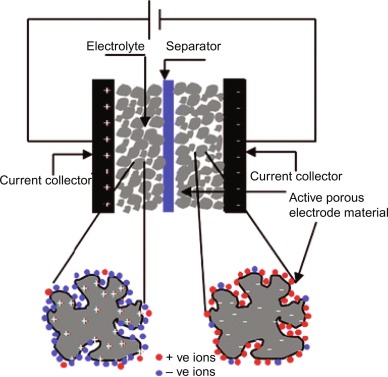
A conventional capacitor stores energy in an electric field across a dielectric. A supercapacitor stores most of its energy through electrostatic charge separation at the interface between electrode surfaces and ions in the electrolyte. In an electric double-layer capacitor, ions in the electrolyte move toward oppositely charged electrode surfaces and form very thin charge layers. Because the effective separation distance is extremely small and the porous electrode area is very large, capacitance can be far higher than in ordinary capacitors.
Some supercapacitors also include pseudocapacitance, where fast, surface-level electrochemical processes contribute additional charge storage. This does not make them operate like conventional rechargeable batteries, because the dominant design intent is still rapid, reversible charge storage rather than bulk chemical conversion throughout electrode material.
Historically, modern supercapacitor development is commonly traced to General Electric work in the late 1950s, including experiments reported around 1957, and later Standard Oil work in the 1960s, often associated with rediscovery and development around 1966. Since then, the technology has evolved from specialty backup components into high-power modules used in transportation, industrial equipment, grid support and electronics.
The most important framing is that supercapacitors bridge the gap between ordinary capacitors and batteries. They store much more energy than small film, ceramic or aluminum electrolytic capacitors, but much less energy than lithium-ion, lead-acid or other battery systems sized for long-duration output. Their engineering strength is fast power handling rather than long energy autonomy.
Supercapacitors Compared with Batteries
A battery and a supercapacitor may both connect to a DC bus and both store electrical energy, but their internal physics are different.
In a rechargeable battery, charge and discharge are governed by electrochemical reactions. Ions move through the electrolyte and participate in reactions or intercalation processes at the electrodes. The cell voltage is largely determined by the chemistry of the electrode pair and electrolyte. This chemistry gives batteries their high energy storage, but it also introduces limits related to reaction rate, heat generation, aging, and mechanical or chemical stress inside the electrodes.
A supercapacitor is predominantly electrostatic. Charging moves ions and electrons into separated regions; discharging lets that separated charge recombine through the external circuit. Because there is less reliance on slow bulk chemical transformation, a supercapacitor can usually accept and deliver current much faster than a battery of similar size.
Voltage behavior is also different. A battery tends to operate around a chemistry-defined voltage plateau over much of its discharge range. A capacitor follows the capacitor energy relationship:
E = 1/2 C V²
where energy rises with the square of voltage. As a supercapacitor discharges, its terminal voltage falls continuously. This is normal behavior, but it means many systems need DC-DC conversion or careful load design if they require a regulated output voltage.
The maximum voltage is also handled differently. In conventional capacitors, the allowable voltage is limited by dielectric breakdown. In supercapacitors, the electrolyte, separator, electrode system and cell construction impose a low maximum cell voltage, commonly in the low-single-digit volt range depending on chemistry and manufacturer rating. Exceeding the specified voltage is not a harmless overcharge condition. It can accelerate gas generation, heating, leakage-current rise, capacitance loss, and in severe cases dielectric or separator failure. Capacitor failures can become short circuits, so voltage margin and protection are important design requirements.
A practical comparison looks like this:
| Characteristic | Supercapacitor | Rechargeable battery |
|---|---|---|
| Dominant storage mechanism | Electrostatic double-layer storage, sometimes with pseudocapacitance | Electrochemical reactions or ion intercalation |
| Power delivery | Very high for short periods | Lower peak power for a given size, depending on chemistry and design |
| Energy storage | Low compared with batteries | High compared with capacitors |
| Charge time | Seconds to minutes in suitable systems | Minutes to hours for many applications |
| Voltage during discharge | Falls roughly linearly with state of charge | Often flatter over much of discharge |
| Aging mechanism | Often driven by voltage, temperature and electrolyte degradation | Driven by cycling, calendar aging, temperature, depth of discharge and chemistry |
This comparison does not make one device universally better. A supercapacitor can reduce stress on a battery by taking peak currents, absorbing regenerative pulses or providing ride-through while a battery or generator responds. In many modern systems, the best solution is a hybrid architecture: batteries provide energy capacity, while supercapacitors provide fast power.
Where Supercapacitors Are Used
Supercapacitors are best suited to loads that need high power for short durations. The useful time scale is often seconds to minutes, not hours. This makes them attractive in applications where conventional batteries would be oversized, overheated or prematurely aged by repeated pulse currents.
Common application areas include:
- Short power-gap bridging: maintaining control electronics, memory, communications or industrial controllers during brief interruptions.
- Peak power bursts: supplying high current for actuators, motors, solenoids, radio transmitters or engine-start support.
- Regenerative braking: absorbing short braking-energy pulses and returning them during acceleration.
- Grid and rail support: stabilizing voltage during rapid load changes or recovering braking energy in transit systems.
- Battery buffering: reducing battery peak current, which can improve usable life in pulse-heavy duty cycles.
- Backup power: providing seconds-to-minutes reserve where fast recharge and long cycle life matter more than stored energy.
Transportation is a natural fit because braking and acceleration are high-power transient events. In electric rail and transit systems, supercapacitors can capture energy that would otherwise be dissipated as heat and then release it during the next acceleration. Battery University cites the Long Island Rail Road trial in New York as an example of supercapacitors competing with flywheels for rail energy recovery and short-duration power support. Similar multi-megawatt installations have been discussed for rapid-response rail or power-quality support, including Japanese systems reported at the megawatt scale.
Supercapacitors and flywheels overlap in some applications. Both can accept and deliver high power quickly, both are suited to many shallow cycles, and both are more appropriate for short-duration support than for long energy storage. Flywheels store energy mechanically in a rotating mass; supercapacitors store it electrically. The choice depends on response time, maintenance strategy, installation environment, standby losses, safety case, and integration with the electrical system.
Hybrid battery-supercapacitor systems are often more practical than either technology alone. For example, a battery pack may be sized for average energy demand, while a supercapacitor bank handles acceleration peaks, inrush current or regenerative spikes. This can reduce battery heating and lower the severity of high-current cycling. The tradeoff is added controls, power electronics, packaging volume and cost.
Key Advantages of Supercapacitors
The main advantage of a supercapacitor is high specific power. It can move energy in and out very quickly because its storage process is largely surface-based and electrostatic. Where a battery may be limited by electrochemical reaction kinetics, ion diffusion through electrode material, or thermal constraints, a supercapacitor can often operate at very high charge and discharge rates if the rest of the system is designed for the current.
A second advantage is cycle life. Because supercapacitors do not rely primarily on repeated bulk chemical conversion of electrode materials, they usually tolerate far more charge-discharge cycles than rechargeable batteries. Educational and technical sources commonly describe useful life in the hundreds of thousands of cycles, and some devices or applications specify still higher cycle counts. Actual life depends strongly on voltage, temperature, ripple current, and end-of-life criteria such as capacitance loss or equivalent series resistance increase.
Fast charging is another major benefit. In suitable circuits, a discharged supercapacitor can recharge in seconds or minutes. This is valuable where energy appears briefly, such as braking recovery, or where downtime must be minimized, such as industrial shuttle vehicles, automated equipment or power backup modules that must be ready again quickly.
Supercapacitors can also offer useful safety and abuse-tolerance characteristics compared with some battery chemistries. They do not contain the same amount of stored chemical energy as a high-energy battery, and they are less prone to some battery-specific failure modes associated with overcharge reactions or electrode degradation. However, they are not risk-free. Large modules can deliver extremely high short-circuit currents, and overvoltage can cause heating, venting or failure. Safe design still requires fusing, isolation, discharge procedures and voltage control.
Operating-temperature capability is often broad. Many commercial supercapacitor families are specified for industrial ranges around -40°C to +70°C or +75°C, depending on cell chemistry and manufacturer limits. Performance still changes with temperature: low temperature can raise resistance and reduce available power, while high temperature accelerates aging. As with batteries, thermal design matters.
In summary, supercapacitors are strong where the engineering requirements are:
- very high pulse power,
- rapid recharge,
- frequent cycling,
- short-duration ride-through, and
- tolerance of many shallow charge-discharge events.
Limitations and Tradeoffs
The largest limitation is low specific energy. Contemporary comparison tables commonly place supercapacitors in the single-digit Wh/kg range, while lithium-ion batteries are often listed around 150–200 Wh/kg depending on chemistry and design. Exact values vary widely, but the order-of-magnitude difference is the key point: a supercapacitor module that can deliver a large burst of power usually cannot sustain that output for long.
This is why supercapacitors do not generally replace batteries in phones, laptops, electric vehicles or long-duration backup systems. They can assist those systems, but a battery remains the better choice when the load requires energy for tens of minutes, hours or days.
The discharge-voltage curve is another practical limitation. Since capacitor voltage falls as charge is removed, only part of the stored energy may be usable if the load requires a minimum voltage. For example, a motor drive or DC bus may need a converter to maintain a stable output as the capacitor bank voltage declines. That converter adds cost, losses, size and control complexity.
Series connection creates additional design requirements. Individual supercapacitor cells have relatively low voltage ratings, so higher-voltage systems require many cells in series. Because cell capacitance, leakage current and aging are not perfectly identical, voltage can divide unevenly across the stack. Designers therefore use passive balancing resistors or active balancing circuits to keep each cell within its rating. Without balancing, one cell may be overvolted even when the total stack voltage appears acceptable.
Self-discharge is also higher than many battery users expect. Supercapacitors can lose charge over days or weeks depending on cell type, voltage, temperature and leakage characteristics. This is usually acceptable for cycling applications where the device is frequently charged, but it is a drawback for long standby storage. A battery is generally better when stored energy must remain available for long periods with minimal recharge.
Cost and size are application-dependent tradeoffs. For a required amount of energy, supercapacitors are usually larger and more expensive than batteries. For a required amount of pulse power and cycle life, they may be competitive because the alternative battery would need to be oversized or replaced more often. The correct comparison is therefore not only component price per Wh, but system cost over duty cycle, lifetime, cooling, maintenance and reliability.
Important design constraints include:
- low cell voltage and the need for series balancing,
- high available fault current,
- continuous voltage decline during discharge,
- leakage current and self-discharge,
- temperature-dependent life,
- lower energy density than batteries, and
- packaging volume for useful energy capacity.
Supercapacitors are best understood as high-power, short-duration energy-storage devices. They are excellent at smoothing, buffering, recovering and delivering bursts of energy. They are poor substitutes for batteries when long runtime is the primary requirement. In well-designed systems, the most effective role is often complementary: the battery supplies energy, and the supercapacitor handles the fast electrical stress that batteries do not manage as efficiently.
References
- Battery University | BU-209: How does a Supercapacitor Work?
- BU-209: How does a Supercapacitor Work? - Battery University
- Supercapacitor - Wikipedia
- Supercapacitors vs. batteries
- Supercapacitor - Clean Energy Institute
- Supercapacitors – A Viable Alternative to Lithium-Ion Battery Technology?
- Comparative Analysis of Lithium-Ion Batteries and …
- Supercapacitors vs. Batteries: A Comparison in Energy Storage Solutions
- Supercapacitors vs. Batteries: Which Is Better for Peak Shaving?
- Supercapacitors explained - the future of energy storage?