Cold cranking amps (CCA) describe a battery’s ability to deliver the high current needed to crank an engine in cold conditions. The rating is especially relevant to starting batteries because low temperature reduces electrochemical reaction rates while increasing the effort required to turn a cold engine. A battery may still show a reasonable open-circuit voltage yet lack sufficient cranking capability.
A CCA value is not normally obtained by connecting a simple ammeter and observing the battery for a few seconds. The rating is established under controlled conditions, or estimated by instruments that model the relationship between electrical response and starting performance. The method used matters when interpreting the result.
What CCA Measures and Why It Matters
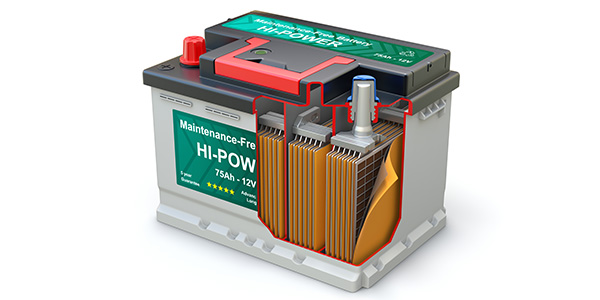
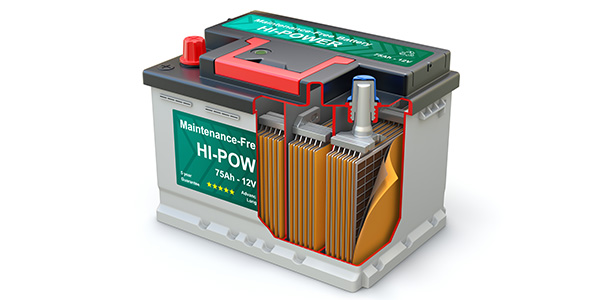
CCA is the current a battery can deliver during a defined cold-start test while maintaining at least the specified terminal voltage. Passenger-car batteries commonly have ratings in the several-hundred-amp range; the supplied reference gives approximately 350 to 600 A as a typical range for cars, with higher ratings used for trucks and other vehicles with larger engines or greater starting loads.
Under the commonly cited SAE definition, a 12-volt lead-acid starting battery is cooled to 0°F (-18°C). A battery rated at 500 CCA must be able to deliver 500 A for 30 seconds without its voltage falling below 7.2 V. The 7.2 V limit corresponds to 1.2 V per cell for a six-cell battery. This is a demanding, standardized test rather than a prediction that the battery will continuously provide that current during normal operation.
The required rating depends on the engine, starter motor, vehicle design, oil viscosity, climate, battery size, and the vehicle manufacturer’s specification. A larger CCA number is not automatically the correct replacement if the battery has unsuitable dimensions, terminal arrangements, chemistry, or charging requirements. The vehicle specification and the battery label should be checked together.
Source: Battery University
How Standardized Laboratory CCA Tests Work
A laboratory CCA evaluation controls the main variables that affect starting performance:
- The battery is fully charged according to the applicable procedure.
- It is conditioned at the specified low temperature, commonly -18°C for the SAE test.
- A defined discharge current is applied while the battery remains at that temperature.
- Terminal voltage is monitored for the specified test duration.
- The battery passes only if its voltage remains above the applicable cutoff.
For the SAE example, a 500-CCA battery is charged, cooled to -18°C, discharged at 500 A, and observed for 30 seconds. It must remain above 7.2 V. The test is intentionally severe: it evaluates high-current delivery at a temperature where both the battery’s electrochemical processes and the engine’s mechanical load are unfavorable.
SAE, IEC, and DIN procedures use the same general concept but are not interchangeable. They differ principally in conditioning details, discharge duration, and the minimum voltage used to determine whether the battery passes. Consequently, the numerical rating shown under one convention should not be compared casually with a rating obtained under another.
| Test procedure | Charging and conditioning | Applied current | Test duration | Voltage criterion |
|---|---|---|---|---|
| SAE cold-cranking test | Fully charge and cool to -18°C (0°F) | Rated CCA; 500 A for a 500-CCA example | 30 seconds | Above 7.2 V for a six-cell 12-V battery in the cited SAE example |
| IEC cold-start procedure | Fully charge and condition at the specified low temperature | Current and configuration specified by the applicable IEC procedure | Standard-specific | Standard-specific cutoff and battery configuration |
| DIN cold-start procedure | Fully charge and condition at the specified low temperature | Current and configuration specified by the applicable DIN procedure | Standard-specific | Standard-specific cutoff and battery configuration |
The IEC and DIN rows are deliberately expressed at the procedure level rather than assigned unverified numerical limits. Standards are revised and may define different battery configurations, preparation steps, and reporting conventions. A test report should identify the exact edition and procedure used before a result is compared with an SAE rating.
This is why a true certification-style CCA evaluation is not a quick workshop measurement. Charging, temperature conditioning, stabilization, instrumentation, and recovery can make the complete evaluation substantially longer than a field battery check—potentially several days or more when multiple batteries or repeated conditions are involved.
Carbon-Pile Load Testing for Cranking Performance
A carbon-pile tester provides a practical approximation of cranking behavior. It uses an adjustable resistive load to draw substantial current from the battery while the technician observes terminal voltage. Unlike a laboratory cold-cranking test, the battery is normally tested at workshop temperature, so the result is an indication of load performance rather than a direct SAE CCA certification.
The battery should be sufficiently charged before the test. A low state of charge can produce a poor voltage result even when the battery is otherwise healthy, while a recently charged battery can sometimes give an overly favorable impression. The tester’s instructions should define the acceptable state-of-charge range and the required battery temperature.
A common field approach is to apply a load related to the battery’s rated CCA—often approximately half the rated CCA for a short interval—and compare the voltage with the tester’s pass/fail limit. Other procedures apply the full rated CCA for 30 seconds, mirroring the basic structure of the SAE example. These are not automatically equivalent tests: the load, duration, temperature, and voltage limit must all be recorded.
As a practical safety rule, do not hold a high-current load longer than the tester or battery manufacturer permits. Stop the test if the battery case becomes excessively hot, the cables or connections overheat, or the battery shows signs of damage, leakage, swelling, or gas release. Ventilation and eye protection are appropriate for service work on flooded lead-acid batteries.
Cold temperature increases voltage drop because battery internal resistance rises and the electrochemical reaction becomes less effective. A battery that passes a warm carbon-pile test may therefore perform poorly during an actual cold start. The test also measures short-duration cranking performance, not energy storage. It does not determine ampere-hour capacity, reserve capacity, or how long the battery can operate a load after the engine is stopped.
Handheld Pulse and Resistance-Based CCA Testers
Handheld electronic testers are faster and less disruptive than a carbon-pile load bank. Depending on the instrument, the tester applies a brief electrical pulse or analyzes a small conductance or resistance-related response at the battery terminals. It observes the resulting voltage change and uses an internal model to produce a CCA-equivalent estimate.
The underlying relationship is based on the fact that a greater current-related voltage drop generally indicates higher effective internal resistance. In simplified form, the instrument evaluates the change in voltage associated with a known test stimulus and uses that response to estimate how the battery may perform under a much larger starting load.
These testers are useful because they are compact, quick, and convenient for screening batteries in vehicles or service bays. They usually place far less stress on the battery than a sustained load test. However, the displayed CCA value is an estimate, not direct certification under a cold-cranking standard. A short pulse at room temperature cannot reproduce every condition of a 30-second, -18°C discharge.
Readings can be influenced by state of charge, temperature, surface charge, terminal condition, cable resistance, battery construction, age, and the algorithm used by the tester. The correct battery type and rated CCA must be entered when the instrument requires those values. The result should be treated as one diagnostic input and, when necessary, confirmed with charging, visual inspection, load testing, or an approved laboratory method.
A pulse or resistance-based CCA estimate also does not directly measure ampere-hour capacity. A battery can have acceptable short-duration starting performance while having reduced capacity, and the reverse can also occur.
AC Conductance Testing and Its Limitations
AC conductance instruments inject a small alternating signal into the battery and measure the electrical response. The instrument uses that response, together with an internal model, to estimate battery condition and starting capability. Unlike a carbon-pile test, the method is non-invasive in the practical service sense: it applies a small signal, generates little heat, and can be implemented in compact handheld equipment.
The reference material identifies approximately 80–90 Hz as a commonly cited operating range for this class of method. That range should not be assumed to apply to every modern tester. Instruments may use different frequencies, signal-processing methods, battery models, or additional measurements. The manufacturer’s operating instructions define what the reported result means.
State of charge is important. The supplied reference recommends a state of charge of at least 70 percent for meaningful AC conductance readings. If the battery is discharged, charge it according to the manufacturer’s procedure and allow the required stabilization period before interpreting the result. Poor connections and surface contamination can also distort a low-level electrical measurement.
AC conductance primarily estimates starting performance or battery condition associated with starting performance. It should not automatically be interpreted as a direct measurement of capacity. Some modern instruments combine several measurements or models and may report additional condition indicators, but those outputs remain dependent on the instrument’s algorithms, battery chemistry, temperature, and test conditions.
Electrochemical Impedance Spectroscopy for Advanced Battery Diagnostics
Electrochemical impedance spectroscopy (EIS) takes the frequency-response concept further. Instead of relying on one brief pulse or a single alternating frequency, an EIS system measures how the battery responds across a range of frequencies. The resulting impedance spectrum contains information about ohmic resistance, charge-transfer behavior, diffusion effects, and other electrochemical processes.
Engineers can fit this response with an equivalent-circuit model. A Randles-type model, for example, may represent combinations of solution resistance, charge-transfer resistance, double-layer behavior, and diffusion-related impedance. More detailed models can incorporate temperature, state of charge, battery history, and other variables.
With suitable calibration and validation, EIS may help estimate starting capability and may provide information related to capacity or degradation. It is therefore potentially more comprehensive than a single-frequency conductance or short-pulse test. That does not make it automatically superior for every application. A model trained for one battery chemistry, design, temperature range, or state-of-charge window may produce unreliable results outside those conditions.
EIS-based CCA and capacity estimates require correlation against reference measurements. Battery age, temperature, charge history, electrode design, electrolyte condition, and operating history can all change the impedance spectrum. The technique also requires more capable instrumentation, data processing, and interpretation than a basic workshop tester.
EIS should therefore be viewed as an advanced diagnostic approach rather than a universal replacement for standardized testing. A laboratory cold-cranking test remains the appropriate reference when a formal rating must be established, while carbon-pile and electronic testers are useful for practical service decisions when their limitations are understood.
References
- Battery University | BU-902a: How to Measure CCA. (n.d.). http://www.batteryuniversity.com/article/bu-902a-how-to-measure-cca
- Battery 101: CCA Explained | R&J Batteries. (n.d.). https://www.rjbatt.com.au/news-and-advice/battery-101-cca-explained
- How to do CCA(Cold Cranking Amps) test of a battery? #CCA #battery. (n.d.). https://www.youtube.com/watch?v=9RWVkQi8c3g
- What Is the CCA on a Battery? How to Measure It and .... (n.d.). https://www.vdiagtool.com/blogs/what-is-the-cca-on-a-battery
- Cold Cranking Amps Explained. (n.d.). https://brsbattery.com/pages/cold-cranking-amps-explained
- What Does CCA Mean On a Battery? Cold Cranking Amps Explained. (n.d.). https://www.impactbattery.com/blog/post/what-does-cca-mean-on-a-battery
- Stupid Simple Guide to Car Battery CCA Meaning. (n.d.). https://www.marshallbatteries.com.au/resources/car-battery-cca-meaning
- CCA testing. (n.d.). https://www.youtube.com/watch?v=ZtPiZ7HF4Lg
- OPTI® CCA-TS2 Analyzer. (n.d.). https://www.optimedical.com/files/opti-cca-ts2-operators-manual-en.pdf
- Understanding CCA in Car Batteries | Interstate Batteries. (n.d.). https://www.interstatebatteries.com/blog/understanding-cca-in-car-batteries