Batteries are electrochemical systems, and their behavior is not always predictable from the nameplate rating alone. Like living organisms, they respond to treatment: charging method, discharge load, temperature, storage time, and operating duty all influence how much useful service they deliver.
This matters because batteries are embedded in daily life, from vehicles and power tools to backup systems, medical devices, portable electronics, and energy-storage equipment. A new battery may appear simple to install, but the best first-use practice depends strongly on chemistry. Some rechargeable batteries benefit from early controlled cycling, while others are supplied ready for service and should not be deliberately deep-cycled.
Battery life expectancy is also difficult to forecast at the time of manufacture. Some packs operate reliably for years; others fail early because of harsh loading, incorrect charging, elevated temperature, deep discharge, poor storage, or cell imbalance. Priming is only one part of battery care, but understanding it helps avoid both under-preparing batteries that need break-in and over-cycling batteries that do not.
Priming and Formatting a New Battery
Not all rechargeable batteries deliver full rated capacity immediately when new. In battery service language, formatting is the process by which a cell or battery reaches its intended operating condition through controlled charge and discharge exposure. Priming is the practical user-facing preparation step, often involving one or more controlled cycles before the battery is placed into demanding service.
The terms are sometimes used interchangeably, but they are not identical:
| Term | Practical meaning | Typical relevance |
|---|---|---|
| Formatting | Gradual electrochemical conditioning that may begin at the factory and continue in service | Lead-acid and nickel-based batteries |
| Priming | Intentional first-use preparation, often by charge/discharge cycling | Nickel-based batteries and some lead-acid applications |
| Normal commissioning | Installing, charging as instructed, and using without deliberate deep cycling | Most lithium-ion batteries |
A controlled cycle normally means charging with the correct charger, discharging under an appropriate load, and recharging before the battery is left idle. The goal is not to stress the battery. It is to bring the chemistry into a stable operating range and verify usable capacity.
The need for priming depends on chemistry:
- Nickel-cadmium and nickel-metal hydride batteries may leave the factory only partly formatted and can improve after several cycles.
- Lead-acid batteries undergo formatting at the factory and continue to develop through early field use, especially in deep-cycle service.
- Lithium-ion batteries are generally considered ready for use when supplied. Manufacturers typically state that deliberate priming cycles are unnecessary.
- Primary lithium batteries are non-rechargeable and must not be primed by cycling.
For first use, the safest practical approach is conservative:
- Read the battery or equipment manufacturer’s instructions.
- Use the correct charger and charge profile for the chemistry.
- Avoid high temperature during charging, storage, and use.
- Avoid abusive discharge loads, especially on a new lead-acid or nickel-based battery.
- Do not deep-discharge lithium-ion batteries in an attempt to “condition” them.
- Do not recharge non-rechargeable lithium cells.
Users have reported capacity gains when some lithium-ion batteries are cycled after long storage, but that observation should not be confused with a general requirement to prime every lithium-ion pack. In many cases, cycling after storage may simply help the device fuel gauge recalibrate or allow the protection and measurement electronics to re-establish a more accurate state-of-charge estimate.
How to Break In Lead-Acid Batteries
Lead-acid battery formatting begins during manufacture, but it can continue during early field use. The basic pattern is straightforward: apply a proper charge, discharge the battery in service, and recharge it fully. Repeating this pattern under moderate conditions helps the battery reach its practical operating potential.
A new lead-acid battery should not be treated as indestructible simply because it can deliver current immediately. When possible, avoid heavy deep discharges during the break-in period. Gradual, moderate cycling is preferable, much like easing mechanical equipment into service rather than applying maximum load from the first hour.
This advice is most relevant to deep-cycle lead-acid batteries, such as those used in motive power, renewable-energy storage, floor machines, marine house banks, and similar cyclic applications. Deep-cycle designs are expected to deliver repeated discharge and recharge events, so early formatting has more practical importance.
Starter batteries are different. A vehicle starting battery must supply cranking current from the beginning, and it is normally kept near full charge by the vehicle charging system. Starter batteries are therefore less dependent on priming. Their cranking performance may improve slightly as the battery formats in early use, but they are not normally broken in through deliberate deep cycling.
The expected number of cycles depends on battery design, manufacturing process, and duty profile. Deep-cycle lead-acid guidance commonly indicates that peak capacity may require roughly 20 to 50 full cycles. The reference material also states that lead-acid batteries typically reach full capacity potential after about 50 to 100 cycles. These numbers should be understood as approximate ranges, not universal guarantees.
A practical break-in procedure for a deep-cycle lead-acid battery is:
- Fully charge the battery using a charger intended for that battery type.
- Use moderate discharge loads during the first cycles when the application allows it.
- Recharge promptly after use rather than leaving the battery discharged.
- Avoid repeated deep discharges at the start of service.
- Maintain reasonable operating temperature.
- Follow the manufacturer’s charge-voltage and maintenance instructions, especially for flooded cells.
The main risk during early use is not that the battery will fail instantly under load, but that unnecessary strain can shorten long-term service life. Deep discharge, undercharge, and heat are especially damaging in lead-acid systems. A battery that is repeatedly left partly discharged can also become harder to recover because sulfation and related aging mechanisms progress during poor storage and charging conditions.
For applications that cannot avoid heavy duty immediately, such as vehicle starting, emergency equipment, or industrial service, the best available protection is correct charging and avoiding prolonged discharged storage. Break-in is useful, but it must not override the operational requirement of the equipment.
Priming Nickel-Based Batteries
Nickel-based rechargeable batteries, mainly nickel-cadmium and nickel-metal hydride, are the chemistries most commonly associated with priming. These cells are not always fully formatted when they leave the factory. Several charge/discharge cycles through normal use, or controlled cycling with a battery analyzer, can complete the formatting process.
A battery analyzer is useful when capacity must be verified before deployment. It can charge the pack, discharge it at a defined current, measure delivered capacity, and repeat the process as needed. This is especially valuable for mission-critical service where a battery cannot simply be assumed healthy because it is new.
New or long-stored nickel-based batteries may also benefit from an appropriate trickle charge, if the cell design and manufacturer instructions allow it. Trickle charging can help bring cells in a pack toward a more equal state of charge before cycling. However, trickle charging is not a universal instruction for every pack; sealed packs, smart chargers, temperature sensors, and manufacturer limits must be respected.
The number of cycles required varies widely:
- High-quality nickel-based cells may reach specification after about 5 to 7 cycles.
- Lower-cost cells may require many more cycles.
- The reference material notes that some lower-cost nickel-based cells may need 50 or more cycles to reach acceptable capacity.
This variation is one reason capacity testing matters in professional service. Two packs with the same label may not behave identically if they differ in cell quality, storage history, matching, or manufacturing control.
A practical nickel-based priming process is:
- Charge the battery with the correct charger.
- If recommended, apply a suitable top-off or trickle-charge period.
- Discharge under a controlled load that is appropriate for the cell rating.
- Recharge fully.
- Repeat for several cycles or until measured capacity stabilizes.
For everyday consumer use, normal charge and discharge may be enough. For medical, aviation, communications, industrial safety, or emergency-service applications, controlled conditioning and capacity confirmation are more appropriate.
Nickel-based batteries are more tolerant of full cycling than lithium-ion batteries, but they still should not be abused. Excessive heat, reversed cells in a multi-cell pack, over-discharge, incorrect chargers, and prolonged overcharge can all reduce service life or create safety risks.
Do Lithium-Ion Batteries Need Priming?
Lithium-ion batteries do not require the traditional priming cycles associated with nickel-based batteries. The common instruction to fully charge and fully discharge a new lithium-ion pack several times is largely a carryover from older rechargeable chemistries and is not a best-practice requirement for modern Li-ion cells.
Most lithium-ion batteries are supplied ready for use within the limits set by the equipment manufacturer. A first charge may be recommended before operation so the user starts with adequate runtime, but this is not the same as electrochemical priming. Deliberately deep-cycling a lithium-ion battery to “wake it up” is generally unnecessary and can add avoidable wear.
Some users report capacity gains after cycling lithium-ion batteries that have been stored for a long time. This can occur for several reasons, and the interpretation is not always simple. A few controlled cycles may help the device estimate capacity more accurately, may allow cell voltage behavior to settle after storage, or may reveal the true usable capacity under load. That does not mean a new lithium-ion battery benefits from routine forced full cycles.
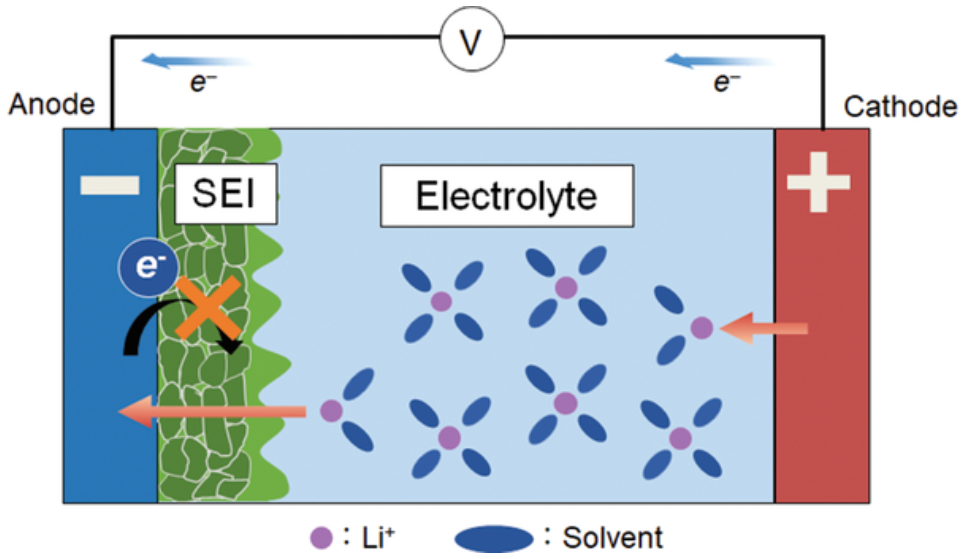
A key concept in lithium-ion behavior is the solid electrolyte interphase, usually called the SEI layer. The SEI forms mainly on the negative electrode during cell formation and early life. It is important because it allows lithium ions to pass while reducing further electrolyte decomposition. A stable SEI supports long-term cell function; an unstable or continuously growing SEI consumes active lithium and contributes to capacity loss.
Source: Battery University
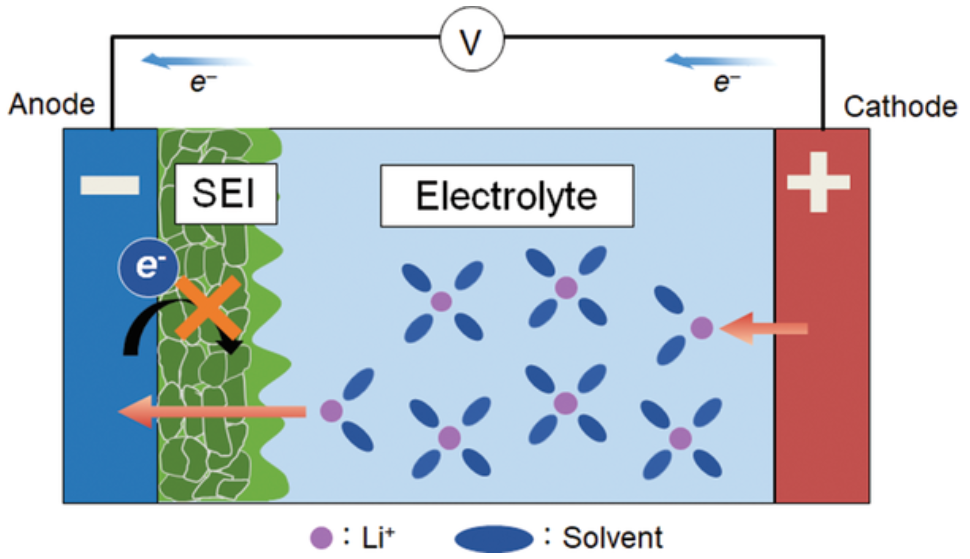
The reference discussion also describes passivation-layer effects in lithium-ion cells and notes that terminology and interpretation can vary among scientists and manufacturers. In practice, lithium-ion aging involves several interacting mechanisms, including SEI growth, electrolyte oxidation, loss of active lithium, impedance rise, and mechanical or structural changes in electrode materials. Which mechanism dominates depends on cell chemistry, voltage, temperature, charge rate, depth of discharge, and storage conditions.
Current best practice for lithium-ion first use is simple:
- Charge with the approved charger or equipment power system.
- Avoid unnecessary full discharge cycles.
- Avoid high temperature, especially when fully charged.
- Avoid storing the battery for long periods at very high state of charge.
- Do not bypass the battery management system.
- If a device fuel gauge is inaccurate, follow the device manufacturer’s calibration procedure rather than applying generic deep-cycle advice.
High voltage and elevated temperature are especially important stress factors. A lithium-ion battery kept hot and fully charged will generally age faster than one kept cooler and at a moderate state of charge. Similarly, repeated wide charge/discharge swings can create more aging stress than shallower operation, although the exact effect depends on cell design and operating conditions.
For users, the practical conclusion is that lithium-ion batteries should be commissioned gently, not conditioned aggressively. Use the battery normally, keep it within its specified temperature and voltage limits, and avoid the outdated practice of repeated full discharge as a first-use ritual.
Passivation in Non-Rechargeable Lithium Batteries
Primary lithium batteries are different from lithium-ion rechargeable batteries. They are designed for one discharge life and then replacement. They must not be recharged, and they are not primed by charge/discharge cycling.
Many primary lithium cells develop a passivation layer during storage. This layer forms on the lithium metal surface and helps reduce self-discharge and chemical degradation. That is one reason certain primary lithium chemistries can support long storage life when stored correctly.
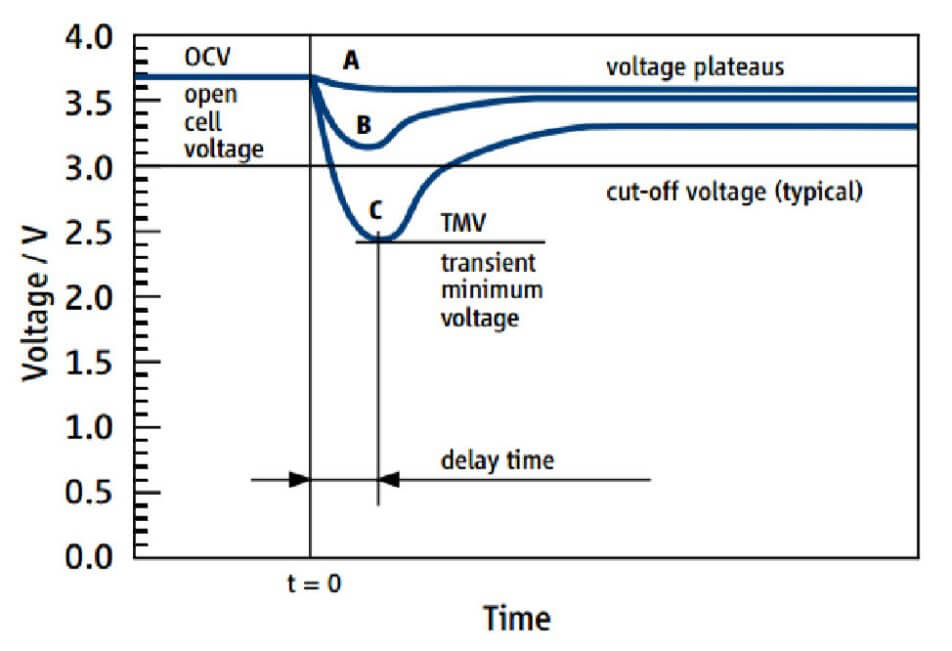
Passivation is useful, but it can also create a behavior known as voltage delay. When a passivated cell is first placed under load, the terminal voltage may temporarily sag before recovering as the passivation layer is reduced or disrupted by current flow. This process is often called depassivation.
Source: Battery University
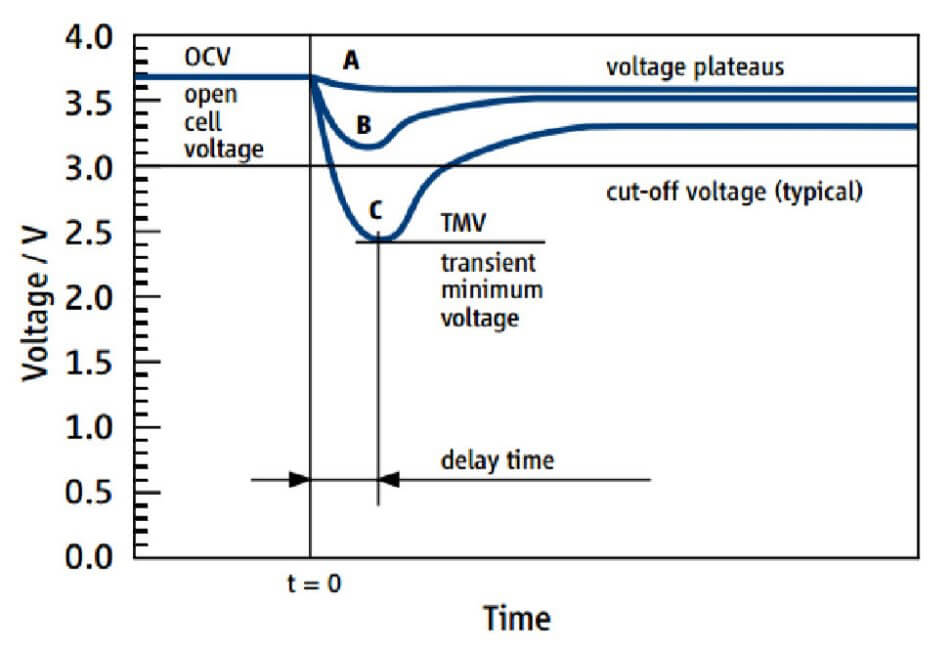
Voltage delay may be unimportant in a low-drain device, but it can matter in demanding or mission-critical applications. If equipment requires immediate high current after long storage, a heavily passivated cell may appear weak at the moment of activation even though it still has substantial capacity. This is why primary lithium batteries used in critical systems are often evaluated according to manufacturer-specific test and storage procedures.
Passivation behavior is influenced by several factors:
- Storage duration: longer storage can increase passivation effects.
- Temperature: storage and operating temperature influence chemical reaction rates and voltage response.
- Load profile: high initial loads can make voltage delay more visible.
- Cell chemistry and construction: different primary lithium systems behave differently.
- Previous discharge history: partial use and rest periods can alter voltage behavior.
Handling precautions are essential. Primary lithium cells contain high energy in a compact package and must be treated according to their datasheet and applicable safety instructions.
Practical precautions include:
- Do not recharge primary lithium cells.
- Do not short-circuit cells or carry loose cells where terminals can contact metal objects.
- Avoid heat, fire, crushing, puncture, or disassembly.
- Do not mix old and new cells, or cells of different types, unless the equipment manufacturer allows it.
- Store cells under the conditions recommended by the manufacturer.
- Follow local rules and manufacturer guidance for transport and disposal.
For critical equipment, passivation should be managed by specification, not guesswork. The correct procedure may include controlled load testing, defined pre-discharge, storage controls, or replacement intervals. Because primary lithium cells cannot be restored by recharging, any depassivation or readiness procedure must come from the cell or equipment manufacturer.
Priming, then, is not a universal battery ritual. It is chemistry-specific. Lead-acid and nickel-based batteries may benefit from controlled early cycling, lithium-ion batteries generally do not need it, and primary lithium batteries must never be recharged for conditioning. The best commissioning practice is to match the procedure to the battery chemistry, the application risk, and the manufacturer’s limits.
References
- Battery University | BU-701: How to Prime Batteries. (n.d.). http://www.batteryuniversity.com/article/bu-701-how-to-prime-batteries
- Battery University | BU-804: How to Prolong Lead-acid Batteries. (n.d.). http://www.batteryuniversity.com/article/bu-804-how-to-prolong-lead-acid-batteries
- How to Properly Prime New Batteries. (n.d.). https://www.large-battery.com/blog/how-to-prime-batteries-for-maximum-performance-and-life
- Why Lithium Ion Batteries Have Longer Cycle Life. (n.d.). https://www.sunvoltbat.com/why-lithium-ion-batteries-have-longer-cycle-life.html
- The Impact of Cycling on Lead-Acid Battery Performance. (n.d.). https://www.spaceflightpower.com/lead-acid-battery-performance-2
- Battery University | BU-808: How to Prolong Lithium-based Batteries. (n.d.). http://www.batteryuniversity.com/article/bu-808-how-to-prolong-lithium-based-batteries
- Lithium-Ion vs. Lead-Acid Battery Life: Which Lasts Longer?. (n.d.). https://www.fluxpower.com/blog/lithium-ion-vs.-lead-acid-battery-life
- How to Increase Lithium-Ion Battery Life to Improve Performance. (n.d.). https://www.altenergymag.com/article/2024/10/how-to-increase-lithium-ion-battery-life-to-improve-performance/43264
- Dynamic cycling enhances battery lifetime | Nature Energy. (n.d.). https://www.nature.com/articles/s41560-024-01675-8
- What Are Lithium Battery Cycle Counts and How to Extend Them? – Hulkman Direct. (n.d.). https://www.hulkman.com/blogs/mega-power-station/what-are-lithium-battery-cycle-counts