Transporting batteries is not just a packaging problem. A battery is an energy source, and under fault conditions it can deliver high current, release corrosive or flammable material, generate heat, or enter thermal runaway. The practical risk depends strongly on chemistry, state of charge, physical condition, packaging, and whether the battery is installed in equipment or shipped by itself.
Battery fires have also influenced transport regulation. Several serious aircraft cargo-fire accidents and unresolved crashes have been investigated with battery fires considered a likely or possible contributor, especially where large quantities of cells were being moved in the cargo system. Regulators have responded by tightening United Nations, aviation, and national dangerous-goods rules. The most visible changes affect lithium batteries: mandatory UN 38.3 testing, specific UN classifications, lithium battery marks and Class 9 labels where applicable, state-of-charge controls for standalone lithium-ion shipments by air, and cargo-aircraft-only restrictions for some standalone battery shipments.
This article summarizes the practical handling requirements by battery type. It is not a substitute for the current IATA Dangerous Goods Regulations, ICAO Technical Instructions, national transport rules, carrier tariffs, or a shipper’s dangerous-goods training, but it outlines the engineering reasons behind the rules and the precautions that apply in everyday transport.
Transporting Lead-Acid Batteries
Many lead-acid batteries are regulated because they combine two hazards: corrosive electrolyte and high short-circuit current. A fully charged automotive or stationary lead-acid battery can deliver very large fault current if a tool, strap buckle, or neighboring terminal bridges the posts. Wet batteries also contain sulfuric acid, so a cracked case, missing cap, or tipped package can create a corrosive spill.
Where the battery is a wet, spillable lead-acid type, it is commonly treated as a Class 8 corrosive dangerous good. The exact UN entry and shipping description must be selected from the current dangerous-goods list for the specific battery configuration. Transport rules distinguish between categories such as wet spillable batteries, non-spillable wet batteries, dry batteries, and batteries packed with or contained in equipment. Because those distinctions affect packaging, marking, documentation, and carrier acceptance, the classification step should not be guessed from appearance alone.
For ordinary handling, the important requirements are straightforward:
- Keep wet batteries upright unless the approved packaging and battery design permit another orientation.
- Protect terminals against short circuit using insulating caps, covers, tape, recessed packaging, or strong separation from conductive objects.
- Use packaging that can withstand normal transport vibration and impact without allowing the battery to shift.
- Prevent acid leakage from reaching the outside of the package.
- Keep batteries away from metal parts, loose tools, chains, and conductive straps.
- Mark and label regulated shipments as required by the applicable mode of transport.
Non-spillable lead-acid batteries are designed so that electrolyte will not freely leak under specified conditions. They may be subject to different exceptions or reduced requirements when they meet the applicable tests and are properly marked. However, non-spillable does not mean non-hazardous. A valve-regulated lead-acid battery can still short-circuit, overheat, vent gas, or be damaged by crushing.
Damaged lead-acid batteries require special care. A battery should be treated as damaged if the case is cracked, electrolyte may leak, caps are missing, terminals are loose, or the battery has been involved in a collision or severe mechanical abuse. Do not place damaged batteries in the same packaging as intact batteries unless the packaging system is designed and permitted for that condition. Use acid-resistant containment and absorbent or neutralizing material where appropriate. Sodium carbonate, often called soda ash, is commonly used in spill response to neutralize sulfuric acid, but neutralization should be performed only by personnel who understand the reaction, heat release, ventilation needs, and disposal rules.
A useful transport practice is to separate lead-acid batteries into three groups before loading: intact and secured, non-spillable and verified, and damaged or suspect. The third group should not be moved casually in a passenger compartment, open toolbox, or unlined vehicle trunk.
Transporting Nickel-Based Batteries
Nickel-cadmium and nickel-metal-hydride batteries generally face fewer transport restrictions than lithium batteries or spillable lead-acid batteries. They are still energy sources, and poor packaging can create heat, smoke, fire, or leakage. The transport focus is therefore less about thermal runaway regulation and more about preventing short circuits, accidental activation, and mechanical damage.
Small nickel-based cells are often treated as routine consumer batteries when packaged correctly, but large industrial nickel-cadmium batteries or battery assemblies may be subject to additional dangerous-goods requirements depending on construction, electrolyte, mass, and mode of transport. As with lead-acid batteries, classification should be checked against current rules when shipping commercial quantities or industrial packs.
For practical transport, apply these precautions:
- Insulate exposed terminals, especially on packs with blade contacts, snap contacts, ring terminals, or wire leads.
- Wrap loose cells or packs individually if they can touch each other.
- Do not carry loose batteries in a pocket with coins, keys, screws, or other conductive objects.
- Avoid storing small packs loose in a metal box unless each battery is individually protected.
- Prevent equipment from switching on during transport.
- Keep cells away from excessive heat and crushing forces.
Nickel-based rechargeable cells are often cylindrical and mechanically robust, but that can create a false sense of security. A metal-cased cell can still be shorted at the terminals, and a battery pack can contain internal wiring, protection devices, fuses, temperature sensors, and shrink wrap that are vulnerable to abrasion.
For service technicians, the highest-risk situations are usually informal transport: loose tool batteries in a truck drawer, unprotected packs in a parts bin, or used cells mixed with scrap metal. Treat any battery pack with exposed bus bars or damaged insulation as a potential short-circuit source. If a pack becomes hot during transport or storage, move it only if it is safe to do so, isolate it from combustible material, and follow the organization’s incident procedure.
Transporting Lithium-Based Batteries
Lithium-based batteries require the strictest transport controls because a fault can lead to intense heating, venting, fire, or propagation from one cell to another. Transport rules distinguish between rechargeable lithium-ion batteries and non-rechargeable lithium-metal batteries. Lithium-ion batteries are common in phones, laptops, power tools, e-bikes, medical equipment, and energy-storage modules. Lithium-metal batteries are primary cells used in some sensors, meters, memory backup devices, and consumer cell formats. Lithium-metal cells often face tighter limits because they contain metallic lithium and are not rechargeable.
Lithium batteries are regulated as dangerous goods. In regulated quantities they are generally handled under Class 9 miscellaneous dangerous goods requirements, with packaging, marks, labels, documentation, and training obligations. A central prerequisite is UN 38.3 testing under the UN Manual of Tests and Criteria. Cells and batteries must pass the applicable transport tests before they are offered for transport, unless a specific exception applies. These tests address transport stresses such as altitude simulation, thermal cycling, vibration, shock, external short circuit, impact or crush, overcharge, and forced discharge.
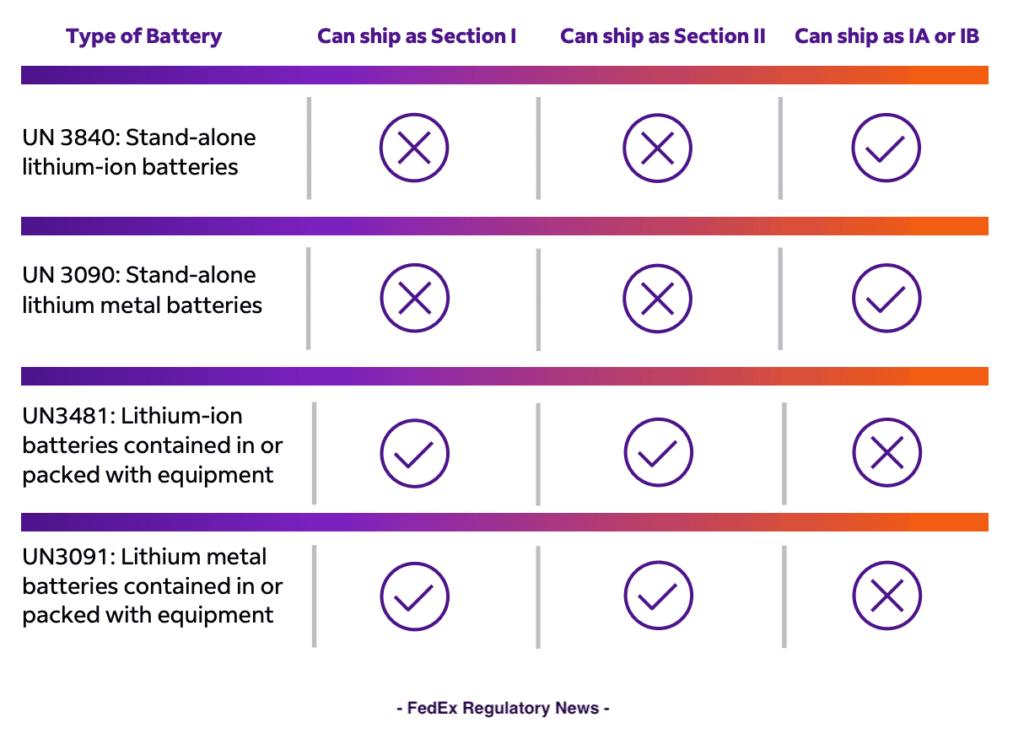
The current lithium transport framework uses different UN numbers depending on chemistry and whether the battery is shipped alone, packed with equipment, or contained in equipment:
| UN number | General description |
|---|---|
| UN 3480 | Lithium-ion batteries shipped by themselves |
| UN 3481 | Lithium-ion batteries packed with or contained in equipment |
| UN 3090 | Lithium-metal batteries shipped by themselves |
| UN 3091 | Lithium-metal batteries packed with or contained in equipment |
Source: Battery University
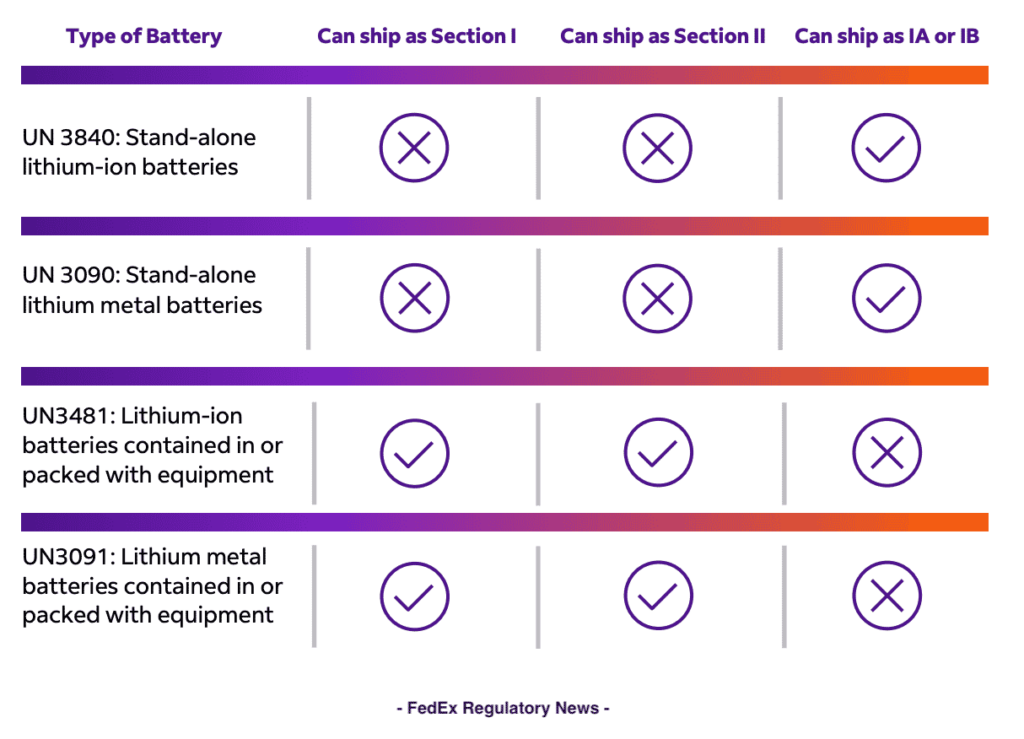
This distinction is operationally important. A lithium-ion battery installed inside a laptop is not prepared the same way as a box of spare lithium-ion packs. Equipment can provide mechanical protection and reduce loose-terminal contact, but equipment must also be switched off or protected against accidental activation unless the device is specifically allowed to remain active, such as low-risk monitoring equipment.
Air transport adds further controls. Current aviation concepts include passenger-aircraft restrictions for standalone lithium batteries and cargo-aircraft-only handling for many standalone shipments. Standalone lithium-ion batteries shipped by air are subject to state-of-charge limits; the supplied current guidance identifies a limit not exceeding 30% of rated capacity for lithium-ion batteries under UN 3480 unless approvals are obtained. The 30% rule does not apply in the same way to batteries packed with or contained in equipment under the cited guidance, but the shipment must still comply with the applicable packing instruction and carrier requirements.
Historical FAA data cited in the source material recorded 138 airport and air incidents between 1991 and 2016 involving lithium batteries, with smoke, heat, or fire related to devices such as e-cigarettes, laptops, and mobile phones. Some events occurred before departure, while others required intervention in flight. The operational lesson is clear: a lithium battery incident is easier to manage in the cabin, where crew can see and access it, than in an inaccessible cargo hold.
For shipping, damaged, defective, swollen, leaking, hot, or recalled lithium batteries should not be treated as ordinary cargo. They may require special packaging, special approvals, or may be forbidden by a carrier. A battery that has been crushed, submerged, overheated, or involved in a fire should be considered suspect even if it still shows voltage.
Battery Safety When Traveling by Air
Passenger air travel rules are not identical to cargo-shipping rules. A passenger carrying a camera battery, laptop, phone, or power bank is usually operating under passenger provisions, while a company shipping boxes of spare batteries is operating as a shipper of dangerous goods. The difference matters because cargo shipments require formal classification, packaging, labels, documentation, and trained personnel.
For passengers, the most important rule is that spare lithium batteries usually belong in carry-on baggage, not checked baggage. This includes loose camera batteries, power banks, spare laptop batteries, and external USB battery packs. Carry-on placement allows the crew to respond if a battery smokes, overheats, or ignites. Batteries installed in equipment may be permitted in checked or carry-on baggage depending on airline and regulatory limits, but equipment should be protected from accidental activation and physical damage.
Common passenger precautions include:
- Keep spare lithium batteries in original packaging when possible.
- If original packaging is unavailable, cover exposed terminals or place each battery in a separate plastic bag or protective case.
- Do not pack loose cells where they can contact coins, keys, jewelry, tools, or other batteries.
- Do not fly with a battery that is swollen, leaking, unusually hot, physically damaged, or subject to a safety recall unless the airline and authority specifically allow it under defined conditions.
- Do not charge a device that is overheating or visibly damaged during flight.
- Inform cabin crew immediately if a device smokes, smells, hisses, swells, or becomes too hot to touch.
Passenger limits for lithium batteries are commonly expressed in watt-hours for lithium-ion and grams of lithium content for lithium-metal. The supplied aviation guidance cites 100 Wh as a common boundary for many lithium-ion passenger batteries and 2 g lithium content per battery for lithium-metal batteries. Larger batteries, including some high-capacity packs used for professional equipment, mobility devices, or industrial tools, may require airline approval and may be quantity-limited or forbidden. Because airlines and jurisdictions can differ, check the airline’s current dangerous-goods page before travel.
Other dangerous goods may also be restricted or forbidden in baggage, including flammable liquids, certain compressed gases, corrosive chemicals, oxidizers, and some fuel-containing equipment. If an item can burn intensely, release pressure, leak corrosive fluid, or generate heat, do not assume it is allowed simply because it fits in luggage.
Undeclared dangerous goods can lead to confiscation, shipment refusal, travel disruption, carrier reporting, or enforcement action. Specific penalties vary by country and circumstance, so the safest approach is to declare uncertain items and ask the airline before arriving at the airport.
Common-Sense Battery Handling During Transport
Most battery transport incidents begin with simple failures: terminals left exposed, packs crushed under cargo, equipment switched on inside a bag, or damaged batteries moved as if they were new. Good handling practices reduce risk for every chemistry.
Use the following baseline precautions:
- Prevent short circuits. Cover terminals, separate batteries, and keep conductive objects away from cells and packs.
- Prevent mechanical damage. Do not crush, puncture, bend, or drop batteries. Use rigid packaging where loads may shift.
- Prevent accidental activation. Switch equipment off, use travel locks where available, and protect power buttons from pressure.
- Control heat exposure. Do not leave batteries on dashboards, near heaters, in direct sun, or against hot equipment.
- Separate damaged batteries. Do not mix leaking, swollen, hot, corroded, or suspect batteries with normal inventory.
The dominant hazard varies by chemistry. Lead-acid batteries add the risk of corrosive sulfuric acid leakage and heavy mass. Nickel-based batteries are often less restricted but can still heat dangerously if shorted. Lithium-based batteries combine high energy density with the possibility of thermal runaway, especially after abuse or internal failure.
For consumers transporting batteries in a vehicle, the best practice is simple: keep batteries in their retail packaging or in individual plastic cases, place them where they cannot roll or be crushed, and avoid leaving them in a hot vehicle. Tool batteries should not be thrown loose into a toolbox with drill bits and screws. Power banks should not be packed under heavy luggage where the switch can be pressed continuously. Coin cells and small cylindrical cells should not be carried loose in pockets.
For workshops and field service vehicles, create a dedicated battery container made of nonconductive or insulated compartments. Keep new, used, and damaged batteries separate. Label suspect batteries and move them to the correct recycling or hazardous-waste process rather than allowing them to accumulate in drawers.
If a battery is hot, swollen, hissing, leaking, smoking, or giving off an unusual odor, stop treating it as ordinary cargo. Isolate it from combustibles if this can be done safely, avoid breathing vapors, and follow emergency procedures. For lithium batteries, do not assume that cooling or extinguishing the visible flame has ended the hazard; cells can reignite or propagate after the first event.
Safe battery transport is ultimately a combination of correct classification and disciplined packaging. Regulations define the minimum legal framework, but everyday prevention depends on keeping energy sources insulated, immobilized, cool, undamaged, and separated from anything that can turn stored energy into an uncontrolled fault.
References
- Battery University | BU-704: How to Transport Batteries. (n.d.). http://www.batteryuniversity.com/article/bu-704-how-to-transport-batteries
- Battery University | BU-704: How to Transport Batteries. (n.d.). https://www.batteryuniversity.com/article/bu-704-how-to-transport-batteries
- BU-704: How to Transport Batteries - Battery University. (n.d.). https://batteryuniversity.com/article/bu-704-how-to-transport-batteries
- Battery University | BU-704a: Shipping Lithium-based Batteries by Air. (n.d.). http://www.batteryuniversity.com/article/bu-704a-shipping-lithium-based-batteries-by-air
- Battery University | BU-704a: Shipping Lithium-based Batteries by Air. (n.d.). https://batteryuniversity.com/article/bu-704a-shipping-lithium-based-batteries-by-air
- Lithium Battery Air Transport Compliance Guide. (n.d.). https://www.hazmatuniversity.com/news/lithium-battery-air-transport-2026-iata-and-icao-compliance-guide
- Battery University | Shipping Lithium-based Batteries by Air. (n.d.). https://batteryuniversity.com/article/shipping-lithium-based-batteries-by-air
- Battery University | Shipping Lithium-based Batteries by Air. (n.d.). http://www.batteryuniversity.com/article/shipping-lithium-based-batteries-by-air
- New Air Transport Regulations for Lithium and Sodium-ion Batteries (Effective January 2025) - MANLY. (n.d.). https://manlybattery.com/new-air-transport-regulations-for-lithium-and-sodium-ion-batteries
- Lithium Battery Resources | Federal Aviation Administration. (n.d.). https://www.faa.gov/hazmat/resources/lithium_batteries