Sulfation is the formation and hardening of lead sulfate on the plates of a lead-acid battery. Lead sulfate is a normal product of discharge and is normally converted back during proper recharging. The problem begins when the battery remains partially charged or discharged for too long: the deposits can become more difficult to reconvert and can reduce the battery’s usable performance.
This is a common concern in vehicles, standby equipment, marine systems, remote renewable-energy installations, and batteries that are used only occasionally. Longer charging times, reduced runtime, excess heat, and shortened service life are typical consequences. The most effective response is usually preventive: keep the battery charged according to its design, use the correct charging profile, and investigate battery condition before attempting a corrective treatment.
Practical Ways to Minimize and Manage Lead-Acid Battery Sulfation
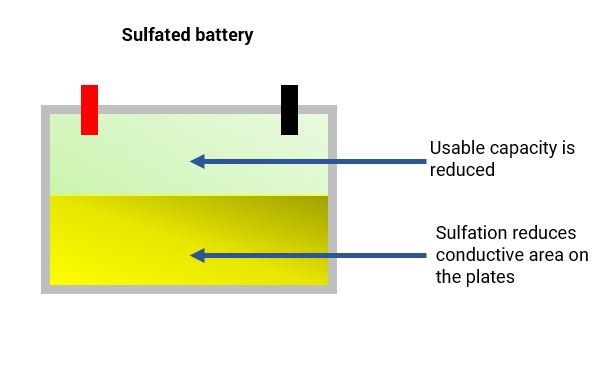
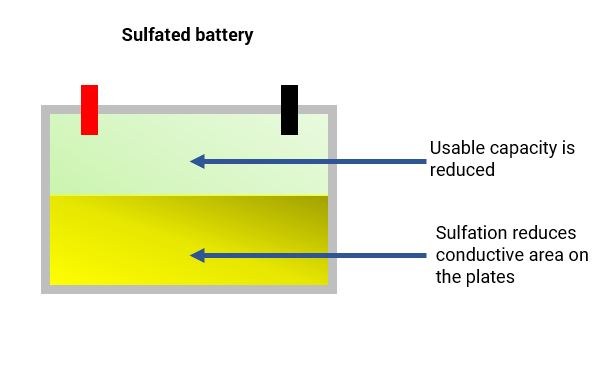
During discharge, sulfate from the sulfuric-acid electrolyte combines with lead on the negative and positive plates to form lead sulfate. A normal recharge reverses much of this reaction. If the battery is repeatedly undercharged, stored at a low state of charge, or never receives the charging time needed for full saturation, some sulfate can remain on the plates and gradually harden.
As deposits accumulate, they can obstruct the electrochemical reaction and increase the battery’s internal resistance. Possible symptoms include:
- longer charging times;
- shorter operating time between charges;
- reduced available capacity;
- increased heating during charging or discharging;
- a shorter service life; and
- eventual battery failure.
The first control is adequate charging. A lead-acid battery should not be left discharged for extended periods, and the charger should provide the voltage stages, current, absorption time, and float behavior specified by the battery manufacturer. Flooded, AGM, and gel batteries do not necessarily use the same settings. In particular, a charging profile suitable for a flooded battery can damage a valve-regulated or gel battery if it causes excessive voltage, gassing, or heat.
Solar and wind systems illustrate the problem clearly. Renewable generation may be insufficient to replace the energy used by a remote installation, especially during periods of low sunlight or wind. The battery can then operate for long periods in a partial state of charge. A periodic fully saturated charge may be needed to limit this condition, but it can be difficult where there is no dependable grid supply or backup generator.
Storage also requires planning. Before storage, charge the battery using the manufacturer’s procedure and check it periodically rather than assuming that a full charge will remain indefinitely. Self-discharge increases with temperature, so hot storage conditions can bring the battery to a damaging state of charge more quickly. A resting-voltage check can indicate that the battery needs attention, but a single voltage threshold is not appropriate for every battery model, temperature, or measurement condition. Use the manufacturer’s storage guidance and allow the battery to rest before interpreting an open-circuit voltage reading.
Source: Battery University
Sulfation is commonly described as either reversible, or soft, sulfation or permanent, or hard, sulfation. Soft sulfation is an early condition in which a controlled, manufacturer-approved charging procedure may restore some performance. Hard sulfation involves more stable deposits and may be accompanied by plate damage, corrosion, loss of active material, or other faults. In that condition, apparent voltage recovery does not prove that the original capacity has returned.
A corrective charge is not the same as ordinary charging. Some battery service procedures for early-stage sulfation use a regulated current of approximately 200 mA while allowing the terminal voltage to rise to about 2.50 to 2.66 V per cell. For a nominal 12 V monoblock, this corresponds to approximately 15 to 16 V. The cited procedure may run for about 24 hours, but these values are not universal instructions. They must be approved for the specific battery and applied with appropriate controls.
During any elevated-voltage service, monitor temperature, provide ventilation, and stop if the battery becomes excessively hot, swells, vents abnormally, or shows other signs of damage. The service must not be treated as a way to force a failed battery back into operation. Equalization, where permitted, is also battery-specific. It can be appropriate for some flooded batteries but may be unsuitable or damaging for AGM and gel batteries. Never substitute a generic equalization setting for the manufacturer’s instructions.
How Undercharging, Storage, and Temperature Accelerate Sulfation
Undercharging is especially common where the battery’s energy input does not match its load. Examples include:
- remote solar installations with insufficient panel capacity or prolonged cloudy weather;
- wind systems during periods of low wind;
- standby batteries that are not maintained by a suitable float charger;
- vehicles, boats, and marine equipment that remain unused for long periods; and
- backup batteries that supply intermittent loads but are not given enough time to complete charging.
In each case, the battery may appear to function while spending too much time partially charged. Repeated partial charging can allow soft sulfate deposits to remain on the plates and become harder to reconvert. The risk is not determined only by the number of charge cycles; the time spent at a low state of charge is also important.
For stored batteries, the practical routine is to charge before storage, keep the battery in a suitable environment, and check its condition at intervals recommended by the manufacturer. Periodic maintenance charging may be required. Temperature matters because higher temperatures increase self-discharge and can shorten overall battery life. Charger temperature compensation may also be necessary where the charging equipment and battery support it.
Do not use voltage alone to diagnose sulfation. Voltage can temporarily rise after charging because of surface charge, and a sulfated battery may reach a seemingly normal voltage while delivering little capacity. A meaningful assessment may require a controlled load or capacity test, inspection of electrolyte condition in serviceable flooded batteries, and review of charging current, time, and temperature. Sulfation itself is difficult to measure directly with a simple field instrument.
Recovery Methods, Anti-Sulfation Devices, and Safer Alternatives
Recovery should begin with diagnosis rather than a desulfation treatment. Confirm that the battery is the correct type, inspect it for physical damage or leakage, verify electrolyte level where applicable, and check whether the charger is operating correctly. A battery with low electrolyte, a cracked case, severe corrosion, a shorted cell, swelling, or evidence of freezing should not be subjected to an aggressive charging attempt.
For a battery that appears to have early, potentially reversible sulfation, a controlled corrective charge may be considered only when the manufacturer permits it. The procedure should use the specified current and voltage limits, include temperature monitoring, and stop at the prescribed time or if abnormal behavior occurs. Ventilation is important because flooded batteries can release hydrogen and oxygen during charging. Keep sparks, flames, and poorly protected electrical connections away from the battery, and use suitable eye and skin protection when working around electrolyte.
Commercial anti-sulfation devices commonly apply electrical pulses to the battery terminals. Their claims should be treated cautiously. The available evidence does not support viewing pulse devices as a universal repair method, and they generally cannot restore a battery with severely hardened sulfation or other permanent damage. They may help maintain some otherwise healthy batteries, but any benefit should be demonstrated through measured testing rather than inferred from a temporary voltage increase.
Uncontrolled pulses, blind overcharging, or excessive equalization can accelerate positive-grid corrosion, increase heat, damage separators, cause electrolyte loss, and create a gas or ignition hazard. A device that applies the same treatment to every battery cannot account for differences in capacity, construction, age, state of charge, temperature, or chemistry. Follow the battery and charger manufacturer’s instructions rather than relying on a generic desulfation claim.
Replacement is often the safer and more economical choice when testing shows permanent capacity loss. Recovery attempts are particularly difficult to justify when the battery has been deeply neglected, has a damaged plate structure, or cannot hold a stable charge. A battery that appears to recover its terminal voltage may still have inadequate runtime and may fail under load.
Lithium-ion batteries can be an alternative where frequent partial charging, high utilization, or unreliable renewable input makes lead-acid maintenance difficult. Lithium-ion systems generally tolerate partial-state-of-charge operation better and can offer higher usable capacity, improved efficiency, and a longer potential service life in suitable applications. Their purchase price is higher, however, and the total economic result depends on duty cycle, system design, operating conditions, and replacement requirements.
Lithium-ion is not a drop-in substitute for lead-acid charging. It requires a battery management system appropriate to the chemistry and pack design, with protection and monitoring for conditions such as overcharge, over-discharge, current, and temperature. Charging voltage limits, control logic, and protection behavior differ from lead-acid systems. A lead-acid charger or equalization routine must not be applied to a lithium-ion battery unless the complete system manufacturer explicitly specifies that configuration.
A practical decision path is therefore:
- Prevent sulfation with the correct charge profile, adequate absorption time, suitable float maintenance, and proper storage.
- Test the battery and charger before attempting recovery.
- Use corrective charging only as a controlled, manufacturer-approved service procedure.
- Monitor temperature, ventilation, electrolyte, and physical condition throughout charging.
- Replace the battery when testing indicates permanent damage or when charging presents an unsafe condition.
- Consider lithium-ion when the application routinely operates at partial charge and its higher initial cost and battery-management requirements are justified.
References
- Battery University | BU-804b: Sulfation and How to Prevent it. (n.d.). http://www.batteryuniversity.com/article/bu-804b-sulfation-and-how-to-prevent-it
- What Is a Sulfated Battery and How to Prevent It | Power Sonic. (n.d.). https://www.power-sonic.com/what-is-a-sulfated-battery-and-how-do-you-prevent-it
- What is a Sulfated Battery and How to Prevent It. (n.d.). https://www.crownbattery.com/news/sulfation-and-battery-maintenance
- What is Sulfation and How Does it Affect My Battery?. (n.d.). https://www.impactbattery.com/blog/post/what-is-sulfation-and-how-does-it-affect-my-battery
- How to Prevent Battery Sulfation: Definitive Guide (2026). (n.d.). https://www.batterytender.com/blogs/battery-tender-blog/how-to-prevent-battery-sulfation-definitive-guide-2026
- The Secret To Extending Battery Life & Preventing Sulfation -. (n.d.). https://www.bogartengineering.com/amp-hrs-based-charging-control.html
- What is Battery Sulfation: A Comprehensive Overview. (n.d.). https://blog.concentricusa.com/engineering-uptime/what-is-battery-sulfation-a-comprehensive-overview
- Li ion Battery vs Lead Acid Lifespan Safety and Cost Guide. (n.d.). https://www.kuruibms.com/blog/li-ion-battery-vs-lead-acid.html
- Reviving a Sulfated Battery: Recovery Methods. (n.d.). https://legacycarts.com/reviving-a-sulfated-battery
- Lead Acid Battery vs Lithium Ion Battery – A Comprehensive Guide - Deye ESS. (n.d.). https://deyeess.com/lead-acid-battery-vs-lithium-ion-battery