Lead-acid batteries are one of the oldest rechargeable battery systems still in large-scale use. Their continued relevance is not because they offer the highest energy density or the longest cycle life, but because they are rugged, familiar, relatively low-cost and well matched to many starting, standby and backup-power duties.
The lead-acid family is not a single design. A starter battery for an internal combustion engine, a flooded deep-cycle battery, an AGM battery for standby service, a gel cell and an advanced lead-carbon battery can all use lead-acid chemistry while behaving very differently in the field. Choosing correctly depends less on the nameplate voltage alone and more on the intended duty cycle, charging system, maintenance access and tolerance for weight.
Why Lead-Acid Batteries Still Matter
Lead-acid remains important because it solves several practical engineering problems at once. It can deliver high surge current, tolerate mechanically demanding environments, and operate with well-understood charging equipment. It is also supported by a mature supply chain, standardized package formats and established recycling infrastructure.
Compared with many newer rechargeable chemistries, lead-acid batteries are heavy for the amount of energy stored. This limits their appeal in electric vehicles, portable electronics and other systems where mass and volume dominate the design. Lithium-ion and related chemistries have gained share in those applications because they generally offer higher specific energy and better cycle performance when correctly managed.
Where lead-acid is still strong is in applications such as:
- engine starting and ignition support;
- uninterruptible power supplies and standby backup;
- telecom and emergency power systems;
- marine, powersports and recreational auxiliary loads;
- moderate-duty cycling where low upfront cost and service familiarity matter;
- renewable-energy buffering when the operating profile suits the selected lead-acid type.
A useful rule is that conventional lead-acid performs best when it is kept charged and is not repeatedly driven into deep discharge. Some lead-acid variants are built for cycling, but even those are strongly affected by depth of discharge, temperature and charge quality.
Main Lead-Acid Battery Types Compared
The main lead-acid categories differ in plate design, electrolyte management and charging tolerance. These differences determine whether a battery is better suited to high-current starting, standby float service, continuous moderate discharge or repeated cycling.
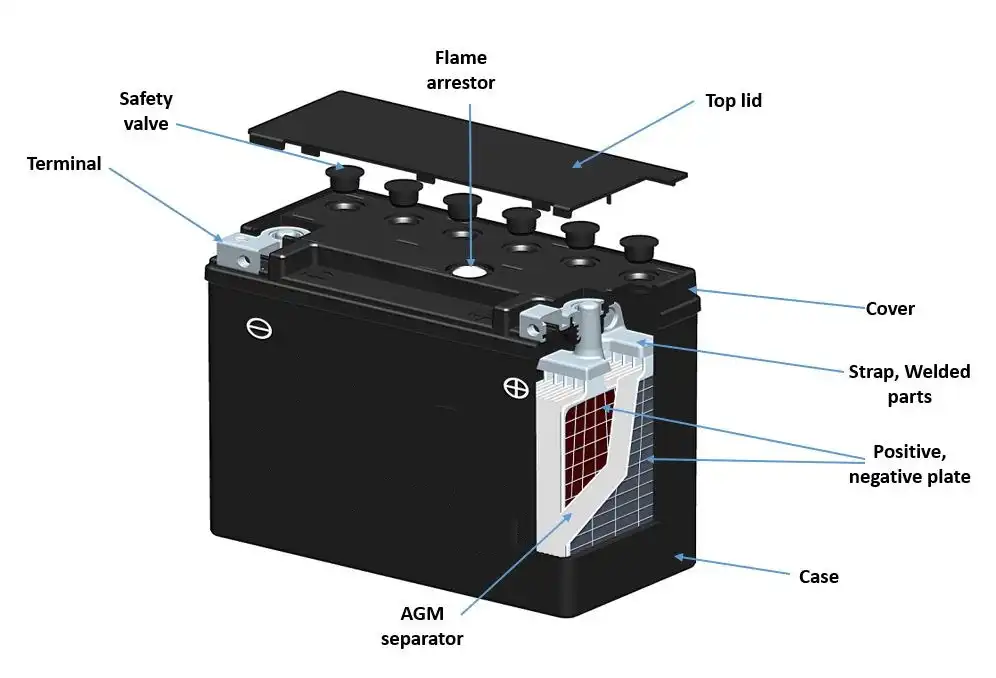
Source: Original source
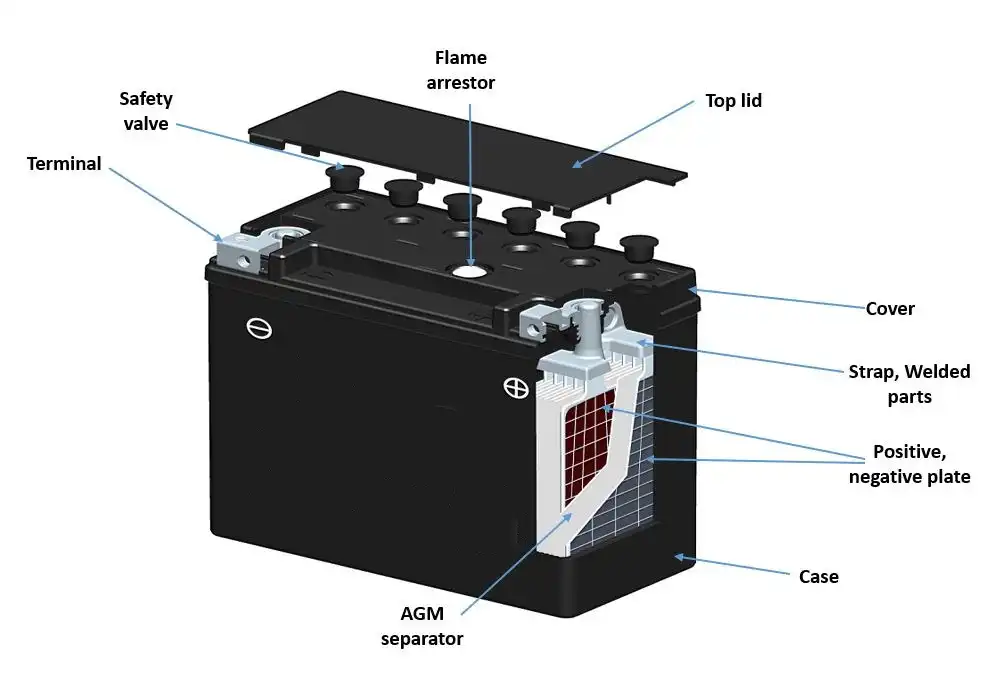
| Type | Basic construction | Best-fit duty | Main caution |
|---|---|---|---|
| Starter / SLI | Many thin plates to increase surface area | Short high-current bursts for starting, lighting and ignition | Poor tolerance of repeated deep discharge |
| Deep-cycle flooded or sealed | Fewer, thicker plates for capacity delivery and durability | Moderate continuous current and repeated cycling | Cycle life depends heavily on depth of discharge and charging practice |
| AGM VRLA | Electrolyte absorbed in fiberglass separator mat | Standby, UPS, marine, powersports, start-stop and high-current sealed applications | Sensitive to overcharge; needs compatible voltage regulation |
| Gel VRLA | Electrolyte immobilized in silica gel | Low-maintenance sealed service with controlled charging | High charging voltage can damage the gel structure or cause gas pockets |
| Advanced lead-carbon | Carbon added to the negative plate or electrode system | Partial-state-of-charge operation and more frequent cycling than conventional lead-acid | Improvement is duty-cycle-specific, not a universal lithium-ion substitute |
All of these batteries use lead-acid electrochemistry and have a nominal cell voltage of about 2.0 V per cell. A nominal 12 V lead-acid battery therefore contains six cells in series. Actual charge, float and cutoff voltages depend on battery design, temperature and manufacturer instructions.
The practical distinction is important: a battery built to deliver a few seconds of high cranking current is not automatically suitable for repeated deep cycling, even if its voltage and capacity rating look similar.
Starter or SLI Batteries
SLI means starting, lighting and ignition. These batteries are optimized for short, high-current events such as cranking an engine. To achieve high current delivery, starter batteries use many thin plates. The large plate surface area reduces internal resistance and helps deliver strong momentary current.
That same construction is a disadvantage in deep-cycle service. Thin plates have less mechanical and electrochemical reserve for repeated deep discharge. When an SLI battery is used to power loads for long periods and is then deeply discharged, active material can shed from the plates and capacity can decline rapidly.
Typical lead-acid voltage context is useful when evaluating SLI batteries:
- nominal cell voltage is about 2.00 V;
- full-charge voltage may be around the 2.4 V per cell range, depending on battery type, temperature and charger design;
- float voltage is commonly lower than full-charge voltage and must follow the manufacturer’s recommendation;
- a deeply discharged lead-acid cell is often treated around the 1.75 V per cell region, but allowing the battery to remain there is damaging.
The most important field rule is to avoid leaving an SLI battery discharged. Discharged storage accelerates sulfation, where lead sulfate becomes harder to reverse during charging. A starter battery that has been deeply discharged and then left standing may recover only partially, even if it later accepts charge.
Deep-Cycle Flooded and Sealed Batteries
Deep-cycle lead-acid batteries are designed for repeated capacity delivery rather than brief cranking pulses. They typically use fewer, thicker plates than starter batteries. Thicker plates improve durability during cycling and help the battery tolerate deeper discharges than an SLI battery.
Deep-cycle batteries are used where the load requires moderate current over a longer time. Examples include auxiliary marine loads, recreational vehicles, floor-cleaning machines, mobility equipment, off-grid systems and backup installations that cycle more than a simple standby battery.
Flooded deep-cycle batteries contain liquid electrolyte and may require routine service. Depending on the design and use, this can include:
- checking electrolyte level;
- adding distilled water when required;
- keeping terminals clean;
- applying an appropriate maintenance or equalization charge when specified;
- ensuring adequate ventilation during charging.
Sealed deep-cycle variants reduce routine maintenance because the user cannot add water. This is convenient, but it also means charging accuracy becomes more important. Water lost through excessive gassing cannot simply be replaced.
Cycle life is not a fixed property of the label “deep-cycle.” It depends strongly on depth of discharge, temperature, charge voltage, time spent discharged and whether the battery is fully recharged after use. The supplied comparison data indicates that deep-cycle lead-acid can achieve far more full-depth cycles than an SLI battery, and longer service is possible when discharge is limited rather than taken deeply every cycle. In practice, avoiding prolonged partial charge or discharged storage is as important as choosing the correct model.
AGM VRLA Batteries
AGM stands for absorbent glass mat. In an AGM battery, the sulfuric acid electrolyte is absorbed into a fine fiberglass separator mat between the plates. AGM is part of the VRLA family, meaning valve-regulated lead-acid. Under normal service conditions, the electrolyte is immobilized, making the battery spill-resistant or commonly described as spill-proof in normal orientation.
AGM batteries are popular because they combine sealed construction with good high-current capability. They are used in UPS systems, standby power, powersports, marine batteries, emergency equipment and automotive start-stop systems. Their relatively low maintenance requirements make them attractive where access is limited or where water checks are undesirable.
Important AGM advantages include:
- no routine watering;
- lower risk of acid spillage in normal use;
- good power delivery for moderate to high current loads;
- suitability for many standby and backup applications;
- reduced electrolyte stratification compared with flooded batteries.
The main caution is charging control. AGM batteries are sensitive to overcharge. A charger or regulator intended for a different lead-acid design may hold voltage too high or too long, causing gas generation, pressure venting and irreversible water loss. Because the battery is sealed, lost water cannot be replaced. For AGM installations, charger compatibility is not optional; it is part of the battery specification.
Gel VRLA Batteries
Gel lead-acid batteries are also VRLA batteries, but their electrolyte is immobilized in a silica-based gel rather than held in a fiberglass mat. This gelled electrolyte makes the battery spill-resistant in normal use and reduces routine maintenance.
Gel batteries can perform well in applications requiring sealed construction, low maintenance and controlled charge conditions. They are often chosen where vibration resistance, orientation flexibility and low electrolyte movement are useful. Like AGM, they do not require watering, and the user should not attempt to open or service the cells.
The key difference from AGM is charging sensitivity. Gel batteries usually require careful voltage limits. Excessive charging voltage can create gas pockets in the gel, reduce contact between electrolyte and plate material, and permanently reduce performance. A charger suitable for flooded or some AGM batteries may not be suitable for gel cells unless it has the correct gel profile.
At a high level, AGM is often favored where higher current capability and broad availability are priorities, while gel is favored where controlled charging and sealed low-maintenance operation fit the application. The two technologies should not be treated as interchangeable simply because both are VRLA designs.
Advanced Lead-Carbon Batteries
Advanced lead-carbon batteries modify conventional lead-acid behavior by adding carbon to the negative plate or electrode system. The purpose is to improve charge acceptance and cycling behavior, especially under conditions that are difficult for traditional lead-acid batteries.
One important use case is partial-state-of-charge operation. Conventional lead-acid batteries generally prefer to be fully recharged after discharge. If they spend long periods partially charged, sulfation and capacity loss can accelerate. Lead-carbon designs are intended to reduce some of these limitations and improve performance where the battery cycles more frequently or does not always return immediately to full charge.
Potential applications include renewable-energy buffering, micro-hybrid operation, some standby systems with frequent cycling, and industrial applications that need better charge acceptance than a standard flooded or VRLA battery can provide.
Lead-carbon should still be evaluated realistically. It is an improvement within the lead-acid family for specific duty cycles, not a universal replacement for lithium-ion. It remains a lead-based system with relatively low specific energy compared with many modern chemistries. Its value is strongest where existing lead-acid infrastructure, cost structure, safety practices and recyclability are important, but the duty cycle is harsher than ordinary standby service.
Key Specs to Check Before Choosing a Lead-Acid Battery
Selecting a lead-acid battery should start with the duty cycle, then move to electrical specifications. A battery that looks acceptable by voltage and amp-hour rating may fail early if the construction does not match the use.
Nominal voltage. A lead-acid cell is about 2.00 V nominal. Common battery blocks are built by connecting cells in series, such as six cells for a nominal 12 V battery. Nominal voltage is only a classification; it is not the correct charging voltage.
Full-charge and absorption voltage. Full-charge voltage depends on battery type, temperature and manufacturer limits. The supplied comparison data lists full-charge values in the approximate 2.40–2.45 V per cell range for several lead-acid types, with lower voltage required when hot and with some designs requiring tighter limits. This is why charger profiles must match the battery.
Float voltage. Float charging keeps a standby battery near full charge without intentionally cycling it. The supplied data lists float values around 2.25–2.30 V per cell for common lead-acid systems, but the correct value is design- and temperature-dependent. Too low a float voltage can allow gradual undercharge and sulfation; too high a float voltage can accelerate corrosion, gassing and water loss.
Discharge cutoff. Lead-acid batteries should not be left deeply discharged. The reference comparison identifies 1.75 V per cell as a full-discharge region for lead-acid, with the warning that the battery must be recharged to prevent sulfation. System designers should use the manufacturer’s cutoff recommendations rather than assuming one universal value.
Specific energy. Lead-acid specific energy is low compared with many modern chemistries. The supplied table gives values such as 30–50 Wh/kg for some lead-acid batteries and 20–30 Wh/kg for some deep-cycle designs, with some higher. This explains why lead-acid systems are heavy for the stored energy delivered. Weight is often acceptable in stationary backup systems, but it is a major disadvantage in portable and traction applications.
Charge rate. Lead-acid is not normally a fast-charge chemistry. The supplied summary lists charge rates around 0.1–0.05 C for some traditional lead-acid batteries and notes long charging time for full saturation. Some advanced designs can accept charge faster, but charge rate must be verified from the battery data sheet. Reaching a surface voltage quickly is not the same as fully restoring capacity.
Discharge rate. Starter batteries are designed for high momentary current. Deep-cycle batteries are designed for continuous moderate current. AGM batteries often handle moderate to high current well, while gel batteries require closer attention to manufacturer limits. Matching discharge profile to construction is essential.
Cycle life. Cycle life varies widely with depth of discharge, temperature and charging accuracy. The supplied comparison shows starter batteries having very poor full-depth cycling capability compared with deep-cycle designs. It also notes that deep-cycle life improves when the battery is not discharged as deeply. For engineering purposes, cycle life should always be read together with the specified depth of discharge.
Maintenance. Flooded batteries may require watering and inspection. Sealed AGM and gel batteries reduce routine maintenance but cannot be watered if abused by overcharge. Maintenance-free does not mean charging-condition-free.
Common failure modes. Lead-acid batteries fail through several mechanisms, including sulfation, grid corrosion, shedding of active material, electrolyte depletion, water loss, stratification and mechanical damage. Undercharge tends to promote sulfation. Overcharge promotes gassing, water loss and corrosion. In flooded cells, acid stratification can occur when electrolyte concentration becomes uneven, especially under poor charging or low mixing conditions.
A practical selection process is:
- Define whether the battery is for starting, standby float, occasional cycling, repeated deep cycling or partial-state-of-charge service.
- Select the construction type that matches that duty: SLI, flooded deep-cycle, AGM, gel or lead-carbon.
- Confirm the manufacturer’s charge voltage, float voltage, temperature compensation and discharge limits.
- Check whether maintenance access is available for flooded cells or whether sealed VRLA construction is required.
- Evaluate weight, expected cycle depth, operating temperature and replacement interval as part of total system cost.
Lead-acid batteries remain useful because they are practical, robust and well understood. Their limitations are equally well known: low specific energy, sensitivity to improper charging, damage from prolonged discharge and limited tolerance for deep cycling unless the battery is specifically built for it. The best results come from treating each lead-acid type as a distinct engineering component rather than as an interchangeable 12 V box.
References
- Battery University | BU-214: Summary Table of Lead-based Batteries
- Battery University | BU-214: Summary Table of Lead-based Batteries
- Learn About Batteries | Battery University
- Battery University | BU-107: Comparison Table of Secondary Batteries
- What are the physical differences between a lead-acid car battery and …
- 11.4.1.2: Lead-Acid Batteries - Engineering LibreTexts
- An Overview of Lead-Acid Batteries
- The Most Common Types of Lead-Acid Batteries Explained | Victron Energy
- [PDF] Technical Comparison of Lead-Acid and Lithium-ion Batteries
- Lead–acid battery - Wikipedia