Lithium batteries are regulated in transport because electrical energy, reactive materials, short-circuit risk, and thermal runaway hazards can create consequences beyond an ordinary parcel failure. Under dangerous-goods systems, many lithium-ion and lithium-metal shipments fall under Class 9, the miscellaneous hazardous-material class used for regulated materials that do not fit neatly into Classes 1 through 8 but still require hazard communication and controlled handling.
For lithium batteries, the Class 9 requirement is not just a label decision. A compliant shipment may also depend on the battery chemistry, whether the battery is shipped alone or with equipment, the package quantity, the transport mode, the packing instruction used, and whether the shipment is acceptable on passenger aircraft or only on cargo aircraft. The Class 9 lithium battery label is therefore one part of a larger classification, packaging, marking, documentation, and training system.
Class 9 Shipping Requirements for Lithium Batteries
A lithium battery package may require a Class 9 lithium battery hazard label when it is shipped as a regulated dangerous good. This label identifies the package as containing lithium batteries assigned to Class 9. It is commonly used together with other markings and documentation, not as a substitute for them.
In practice, the shipping requirement begins with classification. The shipper must determine the battery type and shipping configuration:
| Battery type and configuration | UN number | Typical proper shipping description |
|---|---|---|
| Lithium-ion batteries shipped by themselves | UN3480 | Lithium ion batteries |
| Lithium-ion batteries packed with equipment or contained in equipment | UN3481 | Lithium ion batteries packed with equipment / contained in equipment |
| Lithium-metal batteries shipped by themselves | UN3090 | Lithium metal batteries |
| Lithium-metal batteries packed with equipment or contained in equipment | UN3091 | Lithium metal batteries packed with equipment / contained in equipment |
These four UN numbers are central to lithium battery hazard communication. A package should not be marked with a generic battery description if the applicable UN number and proper shipping name are required. The distinction between “batteries,” “packed with equipment,” and “contained in equipment” matters because the allowed quantities, packaging provisions, documentation, and air-transport limits can differ.
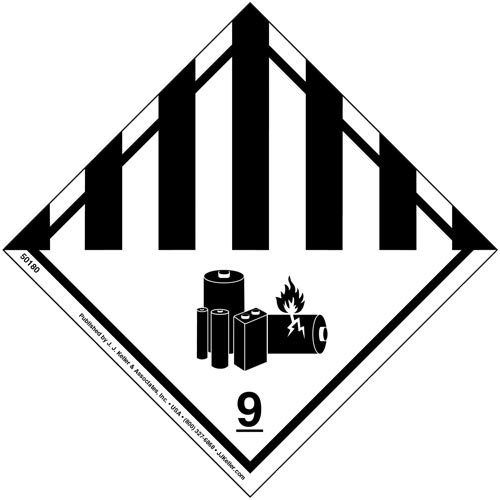
Source: Battery University
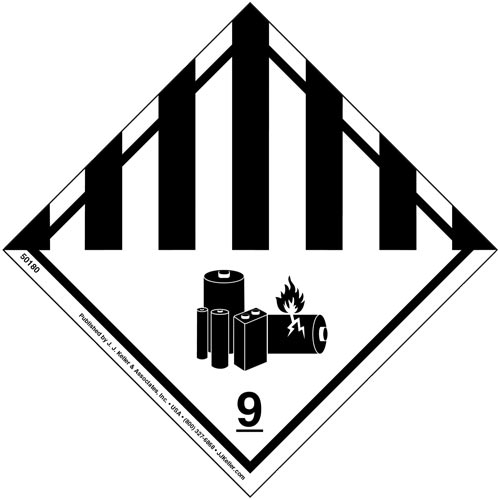
The Class 9 lithium battery label may appear alongside a lithium battery mark, a UN identification number, the proper shipping name, shipper and consignee information, and any transport-mode-specific labels. A small excepted package may have reduced marking requirements under some rules, while a fully regulated shipment may require the Class 9 label, lithium battery mark, shipper’s declaration for dangerous goods for air transport, and other hazard communication.
Training is part of compliance. Anyone who prepares, offers, accepts, or handles lithium-based batteries for transport should be trained for the applicable dangerous-goods function. The required content, documentation, and refresh cycle depend on the jurisdiction and mode of transport. Air shipments are typically governed through ICAO technical instructions and IATA Dangerous Goods Regulations in commercial practice. U.S. domestic ground and air shipments are regulated by DOT/PHMSA rules, and postal shipments have additional USPS restrictions. A person who only installs a printed label without understanding classification, packaging, and documentation can still create a noncompliant shipment.
UN 38.3 testing is a baseline requirement for transport. Lithium-ion and lithium-metal cells and batteries generally must meet the UN Manual of Tests and Criteria, Part III, subsection 38.3 before they are offered for transport. UN 38.3 is not a performance guarantee for every abuse condition, but it is the recognized transport test series used to demonstrate that a cell or battery design has passed required mechanical, electrical, altitude, thermal, vibration, shock, impact/crush, overcharge, and forced-discharge style evaluations as applicable to the test sequence. A shipper may need access to a UN 38.3 test summary or equivalent compliance documentation before accepting a battery for shipment.
Package markings commonly include several information layers. Depending on the shipment, regulations may require or call for:
- the Class 9 lithium battery label;
- the applicable UN number: UN3480, UN3481, UN3090, or UN3091;
- the proper shipping name or description;
- a lithium battery mark where applicable;
- packing instruction references, especially for air shipments using IATA packing instructions such as PI 965 through PI 970;
- shipper and consignee name and address;
- package count and gross weight where required;
- cargo-aircraft-only marking when the shipment is not permitted on passenger aircraft or exceeds passenger-aircraft limits;
- any required dangerous-goods documentation for the transport mode.
The exact combination depends on the regulation being used. For example, an air shipment of standalone lithium batteries is treated differently from batteries installed in a device, and a parcel shipment through a postal operator can have different acceptance limits from a commercial dangerous-goods carrier.
Packaging must control electrical and mechanical risk. The purpose of lithium battery packaging is to keep cells and batteries from short-circuiting, shifting, being crushed, or contacting conductive materials. Common requirements include:
- use of a strong or rigid outer package where required by the applicable packing instruction;
- terminal protection against short circuit;
- inner packaging or separation that prevents contact with metal or other conductive surfaces;
- cushioning or blocking to prevent movement inside the package;
- orientation and arrangement that reduce the chance of damage during normal transport;
- non-conductive cushioning or separation materials around cells and batteries.
The reference material specifically notes rigid outer packaging for packing instructions PI 968 to PI 970 and non-conductive cushioning around cells and battery packs. Current PHMSA-style guidance similarly emphasizes short-circuit protection, separation from conductive materials, and prevention of shifting that could damage the cells or batteries. For some fully regulated shipments, UN specification packaging or packaging meeting specified performance levels may be required. For large batteries with strong impact-resistant casings, special provisions can apply, but those should not be assumed without checking the current rule text and carrier acceptance policy.
A practical packaging review should answer four questions before a label is applied:
- Can any terminal or exposed conductor contact another conductive object? If yes, the battery is not adequately protected.
- Can the battery move inside the package during vibration or drops? If yes, blocking, cushioning, or inner packaging must be improved.
- Is the outer package suitable for the battery mass and transport mode? A lightweight retail carton may not be adequate for a regulated transport package.
- Does the package match the packing instruction used for classification and documentation? The label is not valid if the physical packaging does not meet the instruction.
Cargo Aircraft Only labeling is a separate decision. A Cargo Aircraft Only label may be required when lithium batteries are shipped by air in a way that is not allowed on passenger aircraft or does not meet passenger-aircraft quantity limits. The label tells carriers and handlers that the package must not be loaded on passenger aircraft. This is especially relevant for standalone lithium batteries and larger regulated shipments. The reference source notes that the Cargo Aircraft Only label applies only to some large shipments of lithium-metal batteries, while current dangerous-goods systems also contain cargo-aircraft-only provisions for certain lithium-ion and lithium-metal battery configurations. The safe approach is to classify the shipment under the current packing instruction and then determine whether passenger-aircraft transport is allowed.
Lithium-metal content limits require careful verification. The reference material states that lithium metal in equipment must not exceed 12 g per cell and 500 g per battery. Those values should be treated as rule-context-specific rather than universal limits. Current limits can vary by transport mode, packing instruction, whether the batteries are standalone, packed with equipment, or contained in equipment, and whether the shipment is moving by air, ground, vessel, or mail. Postal rules, for example, can impose much lower lithium-content limits for mailable lithium-metal cells and batteries. Air dangerous-goods rules also distinguish cells from batteries and may apply different thresholds to fully regulated and reduced-requirement shipments.
Lithium-ion shipments use watt-hour rating rather than lithium-metal content. The watt-hour value is generally determined from nominal voltage multiplied by rated ampere-hour capacity. If the watt-hour rating is absent or unclear, the battery cannot be casually assumed to fall below a reduced-requirement threshold; the rating must be determined and documented from reliable product data.
Button cells installed in equipment can be treated differently. The reference material notes that button cells installed in equipment and circuit boards do not add to the battery count. This is an important exception for electronics containing small memory-backup or real-time-clock cells. It does not mean that all button-cell shipments are unregulated. The exception depends on how the cells are installed, the chemistry, the transport rule being used, and whether the shipment otherwise meets the relevant conditions.
The following comparison shows how the main compliance elements fit together:
| Compliance element | Engineering purpose | Common mistake to avoid |
|---|---|---|
| UN number | Identifies chemistry and shipping configuration | Using UN3481 for standalone lithium-ion batteries or UN3480 for batteries installed in equipment |
| Class 9 label | Communicates regulated lithium battery hazard | Applying the label without meeting packaging and documentation rules |
| Lithium battery mark | Provides lithium battery handling information where required | Assuming the mark replaces the Class 9 label for fully regulated shipments |
| Packing instruction | Defines package type, limits, and conditions | Selecting a label before selecting the applicable instruction |
| Short-circuit protection | Prevents electrical fault heating and ignition risk | Leaving terminals exposed or allowing contact with metal objects |
| Cargo Aircraft Only label | Prevents loading on passenger aircraft when prohibited | Omitting it when air rules restrict the package to cargo aircraft |
Because lithium battery rules change over time, the final compliance check should be made against the current regulation and carrier requirements before shipment. Useful control documents include IATA Dangerous Goods Regulations for commercial air shipments, ICAO technical instructions, PHMSA/DOT hazardous-materials regulations for U.S. transport, USPS Publication 52 for postal shipments, and any local dangerous-goods rules that apply at origin, transit, or destination.
A technically sound Class 9 lithium battery shipment is therefore built in this order: identify the battery chemistry and configuration, confirm UN 38.3 eligibility, select the correct UN number and proper shipping name, apply the correct packing instruction, package the cells or batteries to prevent short circuit and damage, then apply the required marks, labels, and documentation. The Class 9 label is visible evidence of that process, but it is not the process itself.
References
- Battery University | BU-704c: Class 9 Label. (n.d.). https://www.batteryuniversity.com/article/bu-704c-class-9-label
- Battery University | BU-704c: Class 9 Label. (n.d.). http://www.batteryuniversity.com/article/bu-704c-class-9-label
- BU-704c: Class 9 Label – Battery University. (n.d.). https://batteryuniversity.com/index.php/learn/article/bu_704c_class_9_label
- Learn About Batteries | Battery University. (n.d.). https://batteryuniversity.com/index.php/learn/article/bu_704b_caution_overpack_labels
- LITHIUM BATTERY GUIDE FOR SHIPPERS. (n.d.). https://www.phmsa.dot.gov/sites/phmsa.dot.gov/files/2024-11/Lithium-Battery-Guide-2024.pdf
- 349 Class 9 Hazardous Materials | Postal Explorer. (n.d.). https://pe.usps.com/text/pub52/pub52c3_028.htm
- lithium-battery-guidance-document-2023. .... (n.d.). https://www.compliancetrainingonline.com/sites/cto/files/2026-01/lithium-battery-guidance-document-2023.pdf
- Lithium Battery Shipping Rules for Labs. (n.d.). https://casrai.org/guides/lithium-battery-shipping-regulations
- Your 2025 Guide to Lithium Battery Labels - Barcode Blog. (n.d.). https://www.smithcorona.com/blog/2023-guide-to-lithium-battery-labels
- eCFR :: 49 CFR 173.185 -- Lithium cells and batteries.. (n.d.). https://www.ecfr.gov/current/title-49/subtitle-B/chapter-I/subchapter-C/part-173/subpart-E/section-173.185