Energy storage has always carried risk. Steam boilers, pressurized fuel systems, gasoline tanks, and modern electrochemical batteries all concentrate usable energy into compact devices. The engineering problem is not to pretend that stored energy is harmless, but to understand the failure modes, reduce their probability, and limit consequences when failures occur.
Lithium-ion batteries deserve particular attention because they combine high energy density with flammable organic electrolyte and complex electronic charging requirements. In normal service they are safe enough to power phones, laptops, tools, medical equipment, aircraft systems, and electric vehicles. When a cell is abused, defective, overheated, shorted, or charged outside its safe window, however, it can enter a self-heating failure process that is difficult to stop.
Battery manufacturers, pack designers, equipment makers, and users share responsibility for safety. Manufacturers must control contamination, cell design, separators, quality systems, protection electronics, and compliance testing. Pack and product designers must consider thermal management, containment, charging limits, mechanical protection, and foreseeable misuse. Users and workplaces must inspect batteries, charge them correctly, and respond quickly to warning signs.
Why Lithium-Ion Batteries Fail
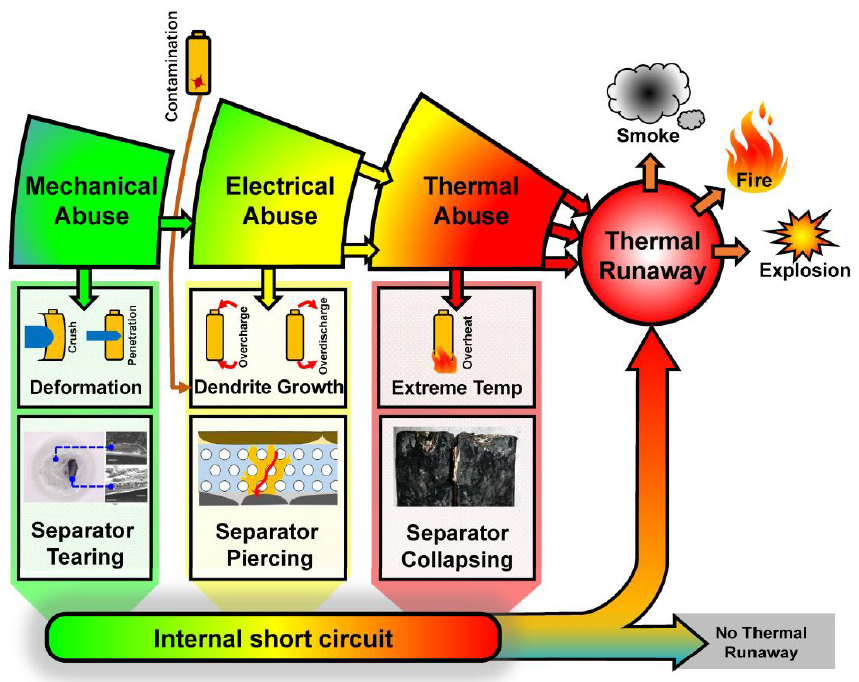
The central hazardous failure mechanism in a lithium-ion cell is thermal runaway. This is a self-accelerating overheating process in which internal reactions generate heat faster than the cell can dissipate it. As temperature rises, the separator may shrink or fail, electrolyte may vaporize, internal pressure may increase, and the cell may vent gas, smoke, flame, or flammable electrolyte. In a pack, one failing cell can heat neighboring cells and cause cell-to-cell propagation.
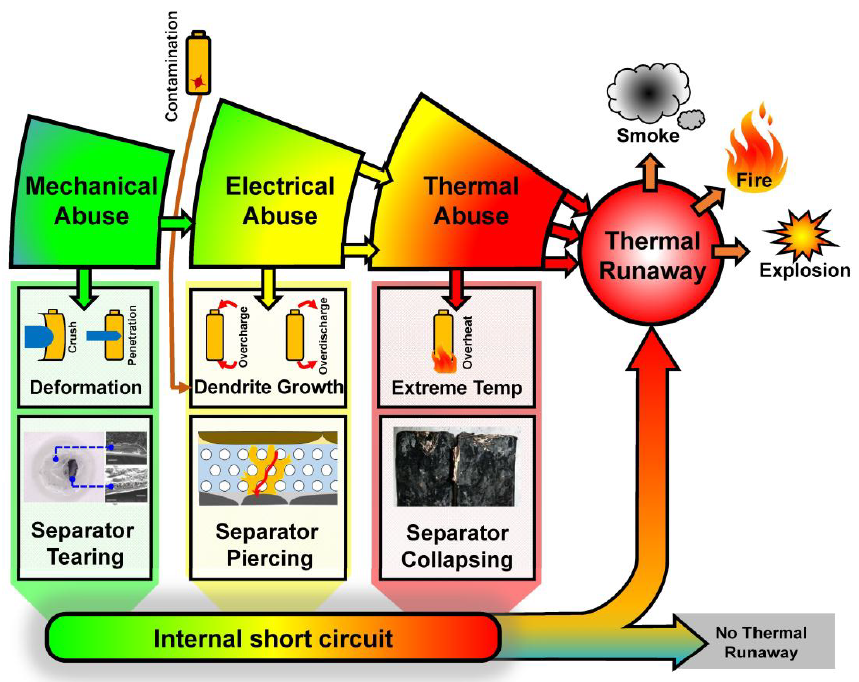
Source: Battery University
Lithium-ion failures usually begin with one or more initiating conditions:
- Manufacturing contamination or defects. Microscopic metal particles, burrs, misaligned electrodes, separator damage, poor welds, or process-control problems can create latent internal shorts.
- Internal short circuits. A conductive path between anode and cathode can bypass the normal load path and release heat inside the cell.
- External short circuits. Damaged wiring, crushed packs, conductive debris, or incorrect handling of loose cells can produce very high current.
- Overcharge. Charging above the allowed voltage can cause lithium plating, gas generation, heating, and cathode/electrolyte breakdown.
- Overdischarge. Severe discharge can damage internal structures and, if followed by recharge, may produce unsafe behavior.
- Mechanical damage. Crushing, puncture, bending, impact, or vibration can damage electrodes and separators.
- External heating. Fire exposure, hot equipment, direct sunlight in a vehicle, or inadequate cooling can push cells beyond their safe temperature range.
- Charging below freezing. Low-temperature charging can promote lithium plating, which increases the risk of internal shorting and capacity loss.
The per-cell probability of a serious lithium-ion incident is low in properly designed products, but the scale of use makes failures visible. Billions of cells are in service, and larger packs contain many cells connected electrically and thermally. A rare cell-level defect can therefore become a high-consequence pack event if the design lacks adequate monitoring, spacing, venting, isolation, or containment.
Two public examples illustrate different aspects of the problem. Samsung Galaxy Note 7 phones were recalled after battery overheating and fire incidents, showing how a consumer-product defect can become a global safety issue when production volume is high. Boeing 787 battery incidents showed the challenge in a certified, highly engineered system. Early in 787 service, two serious lithium-ion battery overheating events occurred, including the January 2013 Japan Airlines 787 auxiliary power unit battery fire at Boston Logan. The NTSB investigation described internal short circuiting, thermal runaway, smoke, fire, and flammable electrolyte release as key safety issues.
The 787 case is important because predicted failure rates proved too optimistic. The system had been assessed as highly unlikely to fail in that way, yet two serious incidents occurred within the aircraft type’s early operating hours. The lesson is not that lithium-ion batteries cannot be used in critical systems. It is that reliability estimates must account for root causes, manufacturing controls, installation design, abuse scenarios, thermal propagation, containment, and venting. A cell is not only an electrical component; it is also a chemical pressure vessel with failure products that must be managed.
What to Do if a Lithium-Ion Battery Overheats or Catches Fire
Early recognition is the safest intervention. A lithium-ion battery or device should be treated as suspect if it shows:
- unusual or rapidly increasing heat;
- swelling, bulging, or case deformation;
- hissing, popping, or venting sounds;
- chemical odor or visible vapor;
- smoke, sparks, flame, or leaking electrolyte;
- corrosion, melted plastic, or discoloration;
- sudden malfunction, repeated shutdowns, or abnormal charging behavior.
If any of these signs appear, stop using and charging the device if this can be done safely. Move people away from the battery, isolate the area, and avoid inhaling smoke or vapors. Do not hold an overheating device close to the face or body. If the battery is large, installed in equipment, spreading smoke, producing flame, or located indoors where evacuation is needed, call emergency services.
For a small consumer-device incident, a lithium-ion fire may be fought like other combustible fires only when it is safe to do so and an escape path remains available. Suitable agents can include foam, CO2, ABC dry chemical, powdered graphite, copper powder, sodium carbonate, or available water-based cooling methods. Water is often useful for lithium-ion battery fires because ordinary lithium-ion cells contain little metallic lithium, and cooling helps reduce propagation to adjacent cells.
This distinction matters: Class D extinguishers are generally for lithium-metal fires, not ordinary lithium-ion battery fires. Lithium-metal primary cells and lithium-ion rechargeable cells are different systems. Misidentifying the battery type can lead to poor emergency decisions, especially in laboratories, aviation, industrial storage, or mixed-battery waste areas.
Aircraft cabin procedures emphasize cooling. FAA-style guidance for portable electronic device battery events commonly uses water or nonalcoholic liquids after initial fire control because the heat source may remain inside the cell. Cooling the device and nearby cells helps prevent reignition and propagation. A fire extinguisher may knock down visible flames, but it may not stop the underlying thermal runaway.
After visible flames are out, continue to monitor the battery from a safe distance. Cells can vent sequentially, reignite, or heat neighboring cells later. If possible, move the device to a noncombustible, ventilated, isolated location using appropriate tools or protection. Do not place a damaged or hot pack in ordinary trash, a desk drawer, a vehicle cabin, or near combustibles.
Smoke from lithium-ion battery failures is a health hazard, especially in enclosed spaces. Emissions can include hydrogen fluoride, carbon monoxide, volatile organic compounds, dense smoke, ultrafine particles, and other decomposition products. Avoid inhalation, evacuate confined areas, and let trained responders handle significant incidents. Residue may be corrosive or toxic.
If a burning pack cannot be extinguished safely, the safest action may be to let it burn out under controlled conditions in an isolated location while emergency responders protect exposures. This is more realistic for large packs, damaged storage containers, or incidents where approaching the battery would create greater risk than controlled burnout.
Key Chemical Terms and Hazard Definitions
Lithium-ion safety discussions use chemical and cell-design terms that are easy to confuse. The following definitions focus on their relevance to failure and fire hazards.
| Term | Meaning in lithium-ion safety |
|---|---|
| Electrolyte | Ion-conducting liquid or gel inside the cell, commonly based on organic solvents and lithium salts. It is typically flammable and can decompose when heated. |
| Lithium hexafluorophosphate (LiPF6) | A common lithium salt used in many electrolytes. It supports ion transport but can decompose, especially with heat and moisture. |
| Hydrogen fluoride (HF) | A highly toxic and corrosive gas that can be generated during lithium-ion battery heating or fire. In contact with moisture it forms hydrofluoric acid. |
| Hydrofluoric acid | A water-containing form of HF. It is corrosive and toxic and requires specialized handling and medical awareness. |
| Phosphorus pentafluoride (PF5) | A reactive decomposition product associated with LiPF6 breakdown. It can react with water to produce phosphoryl fluoride and HF-related products. |
| Phosphoryl fluoride (POF3) | A reactive phosphorus oxyfluoride compound that may form during electrolyte decomposition. Toxicity data are more limited than for HF, and it can react further with moisture. |
| Separator | A thin porous polymer layer between anode and cathode. It allows ion flow but prevents direct electronic contact. Separator failure can cause internal shorting. |
| Anode | The negative electrode during discharge, usually graphite in many lithium-ion cells. Lithium plating at the anode is a safety concern under some charging conditions. |
| Cathode | The positive electrode during discharge. Cathode chemistry affects energy density, stability, gas generation, and thermal-runaway behavior. |
| Venting | Release of gas, vapor, electrolyte, smoke, or flame through a cell safety vent or ruptured enclosure as internal pressure rises. |
| Thermal runaway | A self-heating failure process in which internal reactions generate more heat, leading to further reactions, venting, fire, or propagation. |
Many lithium-ion electrolytes use fluorinated salts such as LiPF6 in organic carbonate solvents. When heated, burned, or exposed to moisture under abuse conditions, these materials can contribute to flammable and toxic emissions. Simplified reaction paths include LiPF6 decomposition to lithium fluoride and PF5, followed by moisture reactions that can form POF3 and HF. The exact chemistry depends on the cell materials and the event conditions.
HF deserves special attention because it is both toxic and corrosive. Exposure risk increases in enclosed or poorly ventilated spaces, during firefighting, and during post-incident cleanup. POF3 is less commonly discussed, partly because available toxicity data are more limited and measured emissions vary by test condition, but it is still relevant because it is reactive and can participate in moisture-driven chemistry that yields HF.
Toxic gas generation is not fixed for all lithium-ion batteries. It varies with cell chemistry, state of charge, cell format, pack design, ventilation, temperature, fire size, extinguishing method, and whether gases ignite immediately or accumulate. For that reason, precise gas quantities from one test should not be applied broadly to every product. The practical conclusion is simpler: treat lithium-ion smoke and residue as hazardous unless competent responders determine otherwise.
Simple Guidelines for Safer Lithium-Ion Battery Use
Lithium-ion safety depends on prevention more than firefighting. Most users will never experience a serious battery event, but disciplined charging, storage, inspection, transport, and disposal reduce the chance of abuse-related failures.
Use batteries, chargers, and power supplies from reputable sources. Manufacturer-approved chargers are important because lithium-ion charging requires controlled voltage, current, temperature monitoring, and termination behavior. Avoid counterfeit batteries, unknown replacement packs, damaged USB chargers, improvised adapters, and packs with missing protection electronics. In workplaces, battery purchasing should include traceability and compliance expectations rather than price alone.
Charge batteries on a stable, noncombustible or low-combustibility surface when practical, away from paper, bedding, solvents, packaging, and other fuels. Do not charge in exit paths. Avoid unattended charging in high-risk locations, especially for damaged equipment, e-bike packs, tool batteries, prototype packs, or cells recovered from unknown sources. Follow equipment instructions for charge rate and operating temperature.
Remove a battery from service if it shows any of the following:
- swelling or case bulging;
- excessive heat during charge or discharge;
- chemical odor, smoke, vapor, or leakage;
- corrosion at terminals or seams;
- physical damage, puncture, crushing, or deformation;
- abnormal self-discharge or unexpectedly short runtime;
- failure to charge normally;
- repeated device shutdowns, resets, or protection trips.
Temperature control is a major safety factor. Do not leave lithium-ion batteries in direct sunlight inside vehicles, near heaters, on hot machinery, or in locations where heat cannot escape. Avoid charging below freezing unless the product specifically allows it with proper temperature management. Cold charging can cause lithium plating; high-temperature storage accelerates aging and can weaken safety margins.
Do not deeply discharge lithium-ion cells and then store them for long periods. If a cell remains below about 2 V per cell for an extended time, copper can dissolve and later form internal conductive shunts. Recharging such a cell may produce elevated self-discharge, partial internal shorting, heating, or other abnormal behavior. Battery-management systems often prevent this, but neglected packs, unprotected cells, and stored equipment can still be vulnerable.
For long-term storage, follow the manufacturer’s instructions. In general, lithium-ion batteries are best stored with a partial charge, in a cool, dry location, protected from short circuits and physical damage. Loose cells should have insulated terminals and should not be stored in bulk where metal objects can bridge contacts. Packs should be separated from combustibles when practical, especially in commercial or repair environments.
Transport batteries with terminals protected and cases intact. Spare batteries should not be carried loose with keys, tools, coins, or conductive hardware. Air travel, shipping, and workplace transport may be subject to specific rules for lithium-ion batteries and damaged or recalled products. Follow airline, carrier, hazardous-material, and local regulatory requirements rather than assuming all batteries can be mailed or carried normally.
After an incident, do not return the battery to service. If it is safe to do so, isolate the pack outdoors or in a fire-resistant area and monitor it for delayed heating. Avoid touching residue without protection, and avoid breathing vapors from a damaged cell. Damaged, swollen, overheated, recalled, or fire-exposed batteries should go through approved recycling or hazardous-waste channels, not household trash. Local fire services, waste authorities, aviation guidance, and product-safety standards all treat lithium-ion batteries as engineered energy devices that require controlled handling when they fail.
References
- Battery University | BU-304a: Safety Concerns with Li-ion. (n.d.). http://www.batteryuniversity.com/article/bu-304a-safety-concerns-with-li-ion
- Lithium-Ion Aircraft Batteries as a Smoke/Fire Risk | SKYbrary Aviation Safety. (n.d.). https://skybrary.aero/articles/lithium-ion-aircraft-batteries-smokefire-risk
- Lessons Learned from the 787 Dreamliner Issue on Lithium-Ion Battery Reliability. (n.d.). https://www.mdpi.com/1996-1073/6/9/4682
- Assessing The Safety Of Lithium-Ion Batteries. (n.d.). https://cen.acs.org/articles/91/i6/Assessing-Safety-Lithium-Ion-Batteries.html
- Aviation Lithium Battery Fire Containment & Safety Solutions - LithiumSafe. (n.d.). https://www.lithiumsafe.com/lithium-battery-fires-in-aircraft
- Toxicology of the Lithium Ion Battery Fire. (n.d.). https://www.mass.gov/doc/toxicology-of-the-lithium-ion-battery-fire/download
- Auxiliary Power Unit Battery Fire Japan Airlines Boeing .... (n.d.). https://www.ntsb.gov/investigations/AccidentReports/Reports/AIR1401.pdf
- Toxic fluoride gas emissions from lithium-ion battery fires. (n.d.). https://pmc.ncbi.nlm.nih.gov/articles/PMC5577247
- Boeing’s Fix for the 787 Battery Problems is Ready – Cranky Flier. (n.d.). https://crankyflier.com/2013/03/19/boeings-fix-for-the-787-battery-problems-is-ready
- How to Reduce Explosion and Fire Risk of Lithium-Ion Batteries. (n.d.). https://www.azom.com/article.aspx?ArticleID=18632