Lithium-ion cells store substantial energy in a compact volume, which is why they dominate portable electronics, power tools, micromobility, electric vehicles, and many stationary storage systems. The same energy density also means that a lithium-ion battery must be controlled carefully. Unsafe voltage, current, temperature, mechanical damage, or internal defects can turn an electrical fault into heat generation, venting, fire, or thermal runaway.
Safety is therefore not a single component. A practical lithium-ion battery safety system combines cell-level safeguards, pack-level electronics, suitable chargers, mechanical protection, quality manufacturing, and correct user behavior. Small single-cell packs and large multi-cell battery systems use the same basic safety principles, but the consequences of failure become more severe as cell count and stored energy increase.
Source: Battery University

Pack-Level Safety Requirements and Application Scale
Rechargeable lithium-ion battery packs normally require electronic protection to keep cells inside their safe operating area. For portable sealed secondary lithium cells and batteries, IEC 62133-2 is the relevant IEC 62133 series standard for safety requirements. Compliance testing does not make a battery indestructible, but it establishes baseline expectations for construction, abuse tolerance, protection behavior, and safe operation under defined test conditions.
At the pack level, protection electronics are used to prevent the main electrical and thermal abuse conditions:
- Overcharge, where cell voltage rises above the allowed limit and accelerates heat generation, electrolyte breakdown, gas generation, or plating reactions.
- Over-discharge, where cell voltage falls too low and can damage electrodes or make later charging unsafe.
- Overcurrent and short circuit, where excessive current causes rapid heating of cells, interconnects, protection devices, or wiring.
- Excessive temperature, where charging or discharging continues while the cell is too hot or too cold for safe operation.
- Cell imbalance in series packs, where one cell reaches a dangerous limit before the total pack voltage appears abnormal.
These pack-level controls work alongside internal cell safeguards. Common internal safeguards include positive temperature coefficient devices, current interrupt devices, safety vents, and separators. Their exact design depends on the cell format and manufacturer, but their functions are broadly consistent.
A positive temperature coefficient device, often called a PTC, increases resistance as temperature rises. In cylindrical consumer cells, it can help limit current during an external short or overload. A current interrupt device, or CID, is designed to open the internal current path when internal pressure rises because of abnormal gas generation. A safety vent provides a controlled path for gas release if internal pressure becomes excessive. A separator is the porous insulating layer between the positive and negative electrodes; it allows ion flow through the electrolyte but prevents direct electronic contact between electrodes.
These protections are most effective when faults remain localized and energy is limited. In small consumer packs, such as a one-cell phone battery or a two-cell appliance pack, protection components can often isolate the fault before severe propagation occurs. In larger packs, the safety problem expands. More cells mean more possible fault points, more stored energy, more interconnects, greater difficulty maintaining uniform temperature, and a higher risk that heat from one failed cell will affect neighboring cells. Large battery systems therefore rely not only on cell protection but also on a battery management system, thermal design, fusing, contactors, enclosure design, spacing, monitoring, and system-level fault response.
The important engineering distinction is that cell-level devices are not a substitute for pack-level design. A small protected cell may tolerate a limited external fault, but a large multi-cell battery must be designed for fault detection, fault isolation, and fault containment.
External Protection Circuits and Series-Cell Monitoring
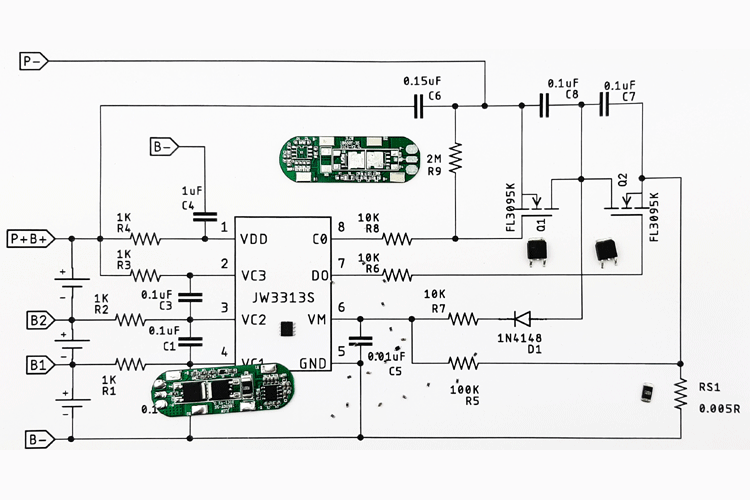
External protection circuits are the active electrical safety layer in most lithium-ion packs. Their job is to disconnect or limit charge and discharge paths when measurements move outside allowed conditions. In simple consumer packs, this function may be implemented with a dedicated protection IC, MOSFETs, a temperature sensor, and sometimes a fuse. In more complex packs, the same safety functions are handled by a battery management system with cell-voltage monitoring, current sensing, temperature sensing, balancing, data logging, and communication with the host device or charger.
Typical protection functions include:
- Charge overvoltage protection — stopping charge if any cell exceeds the permitted maximum voltage.
- Discharge undervoltage protection — disconnecting the load before a cell is driven too low.
- Overcurrent protection — opening the current path when load current exceeds a defined limit.
- Short-circuit protection — reacting quickly to very high fault current.
- Temperature protection — blocking charge or discharge when the pack is outside its allowed thermal range.
- Secondary cutoff — using a fuse or thermal device as a backup if electronic control fails.
The reference protection values commonly cited for lithium-ion packs are useful as general examples: an external circuit may prevent a cell from exceeding about 4.30 V during charge, and it may cut off discharge near about 2.20 V per cell to prevent excessive depletion. A fuse or thermal cutoff may also interrupt current if a cell surface or pack skin temperature approaches approximately 90°C. These values should not be treated as universal design limits. Actual thresholds depend on the cell chemistry, manufacturer specifications, pack design, certification requirements, and intended application.
Series-connected cells require special attention. A pack made from cells in series has a total voltage equal to the sum of the individual cell voltages. Measuring only the total voltage can hide a dangerous imbalance. For example, a nominal two-cell pack may appear to have an acceptable total voltage while one cell is too high and the other is too low. The total value looks normal, but one cell may already be outside its safe operating range.
For that reason, series lithium-ion packs need independent cell-voltage monitoring. The protection circuit or battery management system must know the voltage of each series cell or cell group. In many packs, it also performs balancing so that cells remain at similar states of charge over repeated cycles. Balancing is not only a performance feature; it helps prevent one cell from reaching an overcharge or over-discharge threshold before the rest of the string.
Off-the-shelf protection ICs make this practical for many consumer designs. Single-cell and multi-cell protection chips are widely used in small packs, and many include overvoltage, undervoltage, overcurrent, and short-circuit functions. However, such chips are not complete safety systems by themselves. They must be selected for the correct number of series cells, voltage range, current level, MOSFET arrangement, sensing accuracy, delay times, temperature inputs, and fault behavior. They also require correct printed circuit board layout and appropriate coordination with the charger and host device.
A protection IC can disconnect a pack under defined electrical conditions, but it cannot guarantee safe behavior under every manufacturing defect, crushed enclosure, counterfeit charger, water ingress, wiring error, or severe thermal event. Protection electronics reduce risk; they do not eliminate the need for sound pack engineering.
Failure Risks Protection Circuits May Not Fully Prevent
A lithium-ion protection circuit can respond to measurable external conditions, but it may not detect every internal cell fault before the fault becomes hazardous. Some failure mechanisms begin inside the cell, where voltage and current measurements may look normal until the defect has already produced localized heating.
Possible internal or abuse-related risks include:
- microscopic contamination introduced during manufacturing;
- latent electrode defects;
- separator damage;
- internal burrs or particles that create a weak point;
- damage from crushing, bending, puncture, or dropping;
- overheating from external sources;
- previous overcharge or over-discharge damage;
- water ingress or corrosion in a pack assembly.
Microscopic metallic contamination is a classic concern because a conductive particle can create a local internal short or grow into a defect over time. Quality manufacturing reduces this risk through clean production, process control, inspection, and testing, but a protection circuit outside the cell cannot physically remove an internal contaminant.
The separator is central to cell safety. It must keep the positive and negative electrodes apart while remaining porous enough for ion movement. If the separator shrinks, melts, tears, or is penetrated by a defect, the cell can develop an internal short. Separator technology continues to improve through designs such as reinforced separators and shutdown separators. A shutdown separator is intended to reduce ion transport when temperature rises, helping slow the reaction. Reinforcement can improve mechanical robustness. These features are useful, but they still have limits under severe abuse or high-energy internal faults.
Chargers introduce another important risk. A properly designed lithium-ion charger controls charge voltage and current according to the pack requirements. It should terminate or reduce charge as required and should coordinate with the battery pack protection system. A poorly designed or mismatched charger may depend too heavily on the battery’s protection circuit as the final charge termination device.
That is unsafe design practice because the protection circuit is primarily a safety backup, not the normal charge-control method. If a low-cost charger continues to apply current after the pack is full, and if the pack protection circuit fails, is bypassed, or is not compatible with the charger, overcharge can result. Overcharge is one of the most serious abuse conditions for lithium-ion cells because it can generate heat and gas inside the cell and may trigger venting or thermal runaway.
Mismatched chargers are also a concern. A charger intended for a different chemistry, different series-cell count, or different charge voltage can defeat the assumptions built into the pack design. Even when the connector fits, the voltage and charging profile may be wrong. The safest approach is simple: use the charger specified by the device or battery manufacturer, and use battery packs designed for the system.
This is especially important for replacement packs. A pack may fit mechanically but lack the required communication, temperature sensing, balancing, current rating, or protection thresholds. In energy storage and mobility systems, substituting packs or chargers without verifying compatibility can create a fault path that the original protection design did not cover.
Practical Safety Guidelines for Using Lithium-Ion Batteries
Safe use begins with avoiding conditions that damage cells or defeat protection systems. Lithium-ion batteries should not be short-circuited, overcharged, crushed, dropped, punctured, disassembled, exposed to excessive heat, or connected with reverse polarity. Packs should not be modified, soldered to casually, opened for reuse, or forced into devices they were not designed to power.
Do not use a lithium-ion pack if it is visibly damaged. Warning signs include a dented or cracked enclosure, swelling, leakage, corrosion, melted plastic, damaged wiring, loose terminals, or evidence that the pack has been punctured or crushed. A battery that has suffered mechanical abuse can contain internal damage even if it still appears to work.
Stop using a battery or charger immediately if any abnormal behavior appears during charge, discharge, or storage. Important warning signs include:
- unusual or increasing heat;
- swelling or deformation;
- chemical odor;
- hissing, popping, or venting sounds;
- leakage;
- smoke or vapor;
- repeated temperature rise during normal charging;
- charger cycling, restarting, or failing to terminate charge;
- sudden runtime loss after a damage event.
The Battery University guidance cited in the source material notes that regular temperature rise of more than about 10°C during normal charge is a reason to discontinue use of the battery and/or charger. In practice, any recurring abnormal heating pattern should be treated as a fault until the pack and charger are inspected or replaced.
Use only lithium-ion cells and packs with designated protection circuits. Bare cylindrical or pouch cells should not be used in equipment that expects a protected pack unless the system provides equivalent protection. Likewise, use approved chargers intended for the exact battery type, voltage, and device. Charging should take place on a nonflammable surface when practical, away from combustible materials, and where a fault can be noticed.
Fire response requires careful judgment. A significant lithium-ion battery fire, a fire involving a large pack, or a fire producing heavy smoke, jetting flames, repeated popping, or rapid spread should be treated as an emergency: evacuate the area, warn others, and call emergency services. Toxic and flammable gases may be released, and a pack can reignite after flames appear to be out.
For a small consumer device fire, if it is safe to act and an escape route remains available, standard extinguishers can be used to knock down flames. Current fire-service guidance commonly states that no special extinguishing agent is required for ordinary lithium-ion battery fires and that water and standard extinguishing agents can be effective. Water is particularly valuable because thermal runaway is fundamentally a heat and propagation problem; cooling the cells helps reduce the chance that adjacent cells will ignite.
The reference source lists foam, carbon dioxide, dry chemical agents, powdered graphite, copper powder, and sodium carbonate as possible extinguishing options. These agents can suppress flames or isolate burning material in some circumstances. However, they do not all provide the same cooling effect. Carbon dioxide and dry chemical extinguishers may knock down visible flames but may not cool the interior of a hot battery pack enough to prevent reignition. For larger packs, substantial and sustained cooling is often necessary, and professional responders may need large water flow, isolation, monitoring, and overhaul procedures.
It is also important to distinguish lithium-ion batteries from lithium-metal batteries. Class D extinguishing agents are generally associated with combustible metal fires, including lithium-metal fires. Ordinary rechargeable lithium-ion cells normally do not contain bulk metallic lithium in the same way, so Class D guidance should not be automatically applied to every lithium-ion incident. When the battery type is unknown or the fire is beyond an incipient stage, evacuation and professional response are the correct priorities.
After any lithium-ion fire or overheating event, do not assume the hazard is over when visible flames stop. A hot cell can reignite, and neighboring cells may enter thermal runaway later. If safe and appropriate, the affected device should be isolated away from combustibles and monitored. Damaged batteries should not be reused, recharged, shipped casually, or placed in ordinary trash. Follow local hazardous waste or battery recycling instructions, and treat the pack as damaged energy-storage equipment rather than normal electronic waste.
Lithium-ion battery safety is strongest when every layer works together: qualified cells, internal safeguards, correctly designed protection electronics, compatible chargers, mechanical protection, and conservative handling. No single device can make a damaged or misused battery completely safe, but layered controls greatly reduce the probability that a fault becomes a fire or injury event.
References
- Battery University | BU-304b: Making Lithium-ion Safe. (n.d.). https://www.batteryuniversity.com/article/bu-304b-making-lithium-ion-safe
- How to Extinguish a Lithium Battery Fire Safely and Effectively. (n.d.). https://www.large-battery.com/blog/extinguish-lithium-battery-fire-safely
- Lithium-Ion Battery Fire Suppression Recommendations. (n.d.). https://com.ohio.gov/divisions-and-programs/state-fire-marshal/fire-prevention/fire-department-guides/lithium-ion-battery-fire-suppression-recommendations
- Lithium-ion battery fire protection methods. (n.d.). https://www.facebook.com/groups/209829190372971/posts/1396291398393405
- Safety Update | Environmental Health & Safety. (n.d.). https://www.bu.edu/ehs/2024/04/24/19300
- New revolutionary method tested extinguishes lithium-Ion EV fires in ten minutes with minimal water use | CTIF - International Association of Fire Services for Safer Citizens through Skilled Firefighters. (n.d.). https://www.ctif.org/news/new-revolutionary-method-extinguishes-lithium-ion-ev-fires-ten-minutes-minimal-water
- How To Put Out A Lithium Ion Battery Fire | Fire Suppression. (n.d.). https://hct-world.com/how-to-put-out-a-lithium-ion-battery-fire
- A Review of Lithium-Ion Battery Fire Suppression. (n.d.). https://www.mdpi.com/1996-1073/13/19/5117
- Extinguishing Lithium Battery Fires with PFAS-Free Hydrogel. (n.d.). https://anogas.com/lithium-brand-blussen-veilig-en-effectief-omgaan-met-lithium-ion-accubranden
- Lithium-Ion Battery Fires: What Actually Works | Fire Suppression. (n.d.). https://firess.us/lithium-ion-battery-fires-what-works