Battery capacity does not remain constant throughout service. A battery that meets the equipment specification when new may deliver less usable energy after repeated cycling, extended storage, high temperature, heavy loads, or simple aging. If equipment is designed only around nominal new-battery capacity, this decline can create unexpected shutdowns or leave too little energy to complete a work period.
A practical response is to manage a reserve instead of waiting for a battery to fail in service. Minimum Operational Reserve Energy (MORE) is a reserve-management concept associated with Cadex battery supervision systems. It uses measured battery capacity and an application-defined threshold to indicate when a battery no longer has enough usable capacity for its intended duty. The central question is not merely whether a battery can be fully charged, but whether it can complete the required work while retaining an appropriate margin.
Using MORE to Set a Practical Battery Energy Reserve
MORE can be understood through the idea of Leftover Charge: the usable energy remaining at the end of a normal work period. For example, a supervisor may assess the worst-performing battery in a fleet after a typical shift and set a target that leaves approximately 10% to 20% of usable energy remaining. That range is described in the Cadex material as an operating example, not a universal requirement for every chemistry, load, climate, or safety-critical application.
The target should be selected from the actual duty cycle. Important inputs include:
- the energy consumed during a normal and worst-case work period;
- peak current and transient loads;
- battery chemistry and battery-management-system behavior;
- ambient and battery temperature;
- storage time and self-discharge;
- the consequences of an unexpected shutdown; and
- the time and resources needed to replace or recharge a battery.
A fuel-reserve analogy is useful. An aircraft does not plan to land with its tanks empty, and a work vehicle may retain fuel for diversions or delays. Leftover Charge serves a similar purpose: it is a managed reserve that protects the operation from normal variation and gradual capacity loss. Raising the target increases the margin but may retire batteries earlier or require more frequent charging. Lowering it may extract more service life, but leaves less protection against an unusually demanding shift or a battery whose displayed capacity is optimistic.
In a supervised system, the reserve target is represented by a threshold or target line. A battery remains acceptable while its measured full-charge capacity is above the selected boundary. As capacity fades toward that line, the battery approaches the end of its useful service for that application. The line is therefore an operational service boundary, not a guarantee of remaining runtime under every load or temperature condition.
An 80% setting illustrates the distinction. In a Cadex Universal Supervisor Charger example, the Target Selector can be set so that a battery passes when its measured Full Charge Capacity (FCC) meets the selected level. A battery with FCC below that threshold may be flagged for service or replacement. This does not mean that the battery will always provide exactly 80% of its original runtime, nor that 20% of energy is universally available as a safe reserve. Runtime depends on current, cutoff voltage, temperature, aging, and equipment behavior. The setting must be validated against the application’s actual end-of-shift performance.
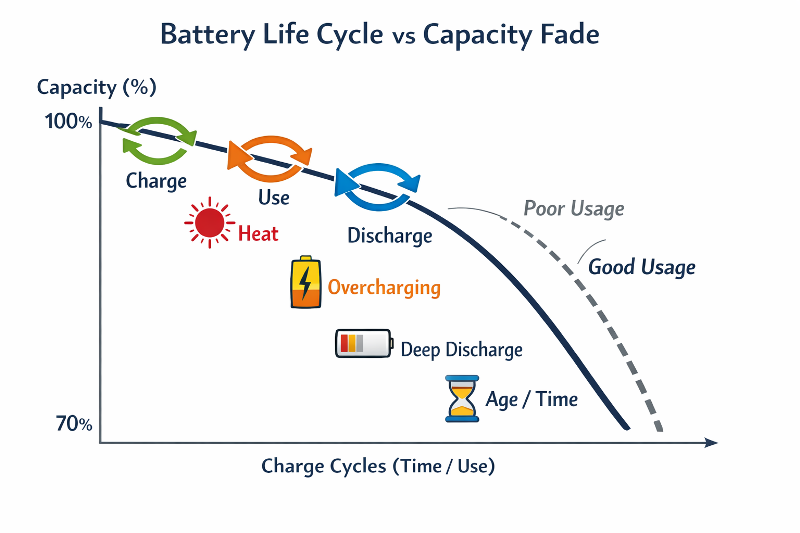
Source: Battery University
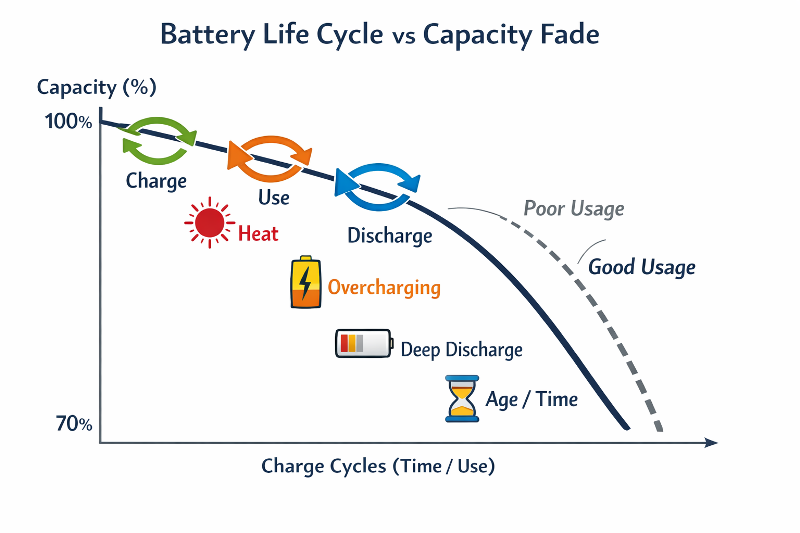
The term MORE should also be used carefully. It is not presented here as a universal battery standard or a chemistry-independent rating. It is a named reserve-management approach used in the referenced Cadex ecosystem. Other battery-management systems may implement similar threshold, state-of-health, or remaining-capacity functions using different terminology and measurement methods.
Standalone Battery Checks and Connected Supervision
A supervised charger can operate independently for routine battery handling. In the source example, a battery is inserted and the charger provides a simple service indication. A green state-of-health light indicates that the measured FCC meets the selected target. An amber indication calls for service, such as calibration, when the battery does not meet the target.
This type of indicator is useful because it converts a capacity measurement into an operational decision. It does not, however, eliminate the need for correct charging, inspection, and application-specific testing. Calibration may improve the accuracy of a smart battery’s reported capacity or reconcile its fuel-gauge estimate with an observed discharge. If the battery still fails to reach the required capacity after calibration, retirement may be appropriate, but a failed calibration should be confirmed with the manufacturer’s procedures and any required diagnostic and safety checks before disposal or replacement.
Connecting the charger to a computer expands the information available to a supervisor. Smart batteries can expose stored measurements such as reported capacity, charge state, cycle information, and other data fields. The supervisor can use a control interface or equivalent software to adjust the Leftover Charge target. Connected analytics may also relate battery longevity to usage patterns and environmental stress recorded over time.
Several terms must be kept separate:
- Full Charge Capacity (FCC): the capacity that the smart battery reports as available when fully charged, subject to the battery’s estimation accuracy and data quality.
- State of charge (SoC): the estimated energy remaining at a particular moment, usually expressed relative to the battery’s current usable capacity.
- State of health (SoH): a broader indication of condition or capacity relative to a reference, although its exact calculation varies by battery and system.
- MORE or the reserve target: the selected operational boundary used to decide whether the battery still provides sufficient capacity for the intended duty.
These values are related but interchangeable only with care. A battery can show high SoC immediately after charging while having reduced FCC. It can also report acceptable SoH for one application but fail to provide enough reserve for a more demanding application. Leftover Charge must therefore be evaluated against actual equipment performance rather than treated as a generic percentage that applies to every battery.
Vendor interfaces may present this information using visual dashboards. The Cadex examples include a Fishbowl view in which Leftover Charge, state of charge, capacity decline, and a target boundary are displayed together. A Status Dome can provide additional battery information, such as manufacturing data, ratings, readiness, or cell mismatch for supported smart batteries. These are vendor-specific interface concepts, not universal battery-data definitions.
Remaining Useful Life and Predictive Battery Risk Management
Remaining Useful Life (RUL) is the broader objective of battery risk management. It asks how long a battery is likely to remain suitable for a defined task, rather than simply asking whether it can accept a full charge today.
RUL assessment requires more than a single capacity reading. A useful evaluation may combine:
- measured usable energy and FCC;
- the rate and pattern of capacity decline;
- charge and discharge history;
- load profile and duty cycle;
- temperature exposure and storage conditions; and
- battery chemistry, age, and data quality.
MORE provides a practical control point by maintaining a minimum reserve and identifying batteries that approach the selected boundary. This can reduce dependence on manual inspection, especially where many batteries are rotated through chargers and equipment. It does not automatically constitute a fully validated predictive-maintenance model. A reserve threshold tells an organization that a battery has reached a defined operational limit; an RUL model must estimate future behavior and quantify uncertainty under changing conditions.
Cloud-based analytics can support that distinction by combining battery measurements with operational records. Trend data may show whether a battery is fading steadily, whether it experiences unusually high loads, or whether temperature and storage conditions are associated with faster decline. Such trends can improve replacement planning, but predictions remain dependent on representative data and a stable relationship between recorded conditions and future use.
Changing users, loads, temperatures, charging practices, and storage environments can reduce prediction accuracy. Smart-battery data may also be incomplete, stale, manufacturer-specific, or estimated rather than directly measured. Organizations should record the assumptions behind an RUL decision and use conservative limits where failure has serious consequences.
Connected supervision introduces additional operational issues. Battery telemetry may require reliable connectivity, access control, secure software updates, defined data-retention rules, and protection against unauthorized changes to reserve thresholds. Where cloud services are used, an organization should also consider privacy, cybersecurity, service continuity, and what happens if a network connection is unavailable. Local charging and safety functions should not be assumed to depend on continuous cloud access unless the system is explicitly designed that way.
Cloud Analytics for Battery-Fleet Visibility
A single charger can identify the condition of one battery at a time. A connected platform can provide visibility across a fleet. The Cadex examples describe cloud analytics that display values such as Leftover Charge, energy consumed, target capacity, capacity fade, and an estimated service-life outlook. The practical benefit is not the dashboard itself, but the ability to compare measured performance and identify which batteries require attention.
Supported equipment may include smart chargers, battery analyzers, rapid testers, and related service devices. When these devices upload records, a supervisor can review battery history instead of relying solely on labels, user reports, or the date of last replacement. Measured performance can then guide rotation, testing, maintenance, and retirement.
The source describes two broad deployment arrangements. A vertical system is a networked and expandable configuration with centralized oversight and independently programmable channels. The referenced example describes expansion to as many as 120 channels under a particular hardware and software configuration. That figure should not be treated as a general limit for all systems; actual capacity depends on the selected equipment, communications architecture, software, and installation.
A horizontal system is primarily operated locally. It may connect to cloud services when the appropriate communications hardware and service level are available. If communication uses USB, the number of connected units can be constrained by the ports and host arrangement. Local operation and cloud-connected operation should therefore be treated as different capabilities: a device may continue to charge or test locally even when fleet reporting is unavailable, subject to the manufacturer’s design.
Commercial service levels and product names can change, so vendor-specific labels such as Level 2 or Level 3 should not be assumed to have industry-wide meanings. The important engineering distinction is whether the system provides local supervision only, centralized network control, historical cloud records, or higher-level fleet analytics.
Fleet transparency is most useful when it leads to defined actions. A facility can set rules for confirming a low-capacity result, checking calibration, quarantining a suspect battery, assigning a replacement, and recording the retirement decision. This creates a traceable process instead of treating every low reading as either an immediate failure or an acceptable anomaly.
Reliability-Centered Maintenance, Safety, and Battery Retirement
A charger can be more than a passive power source. With suitable measurement and supervision, it can become part of a reliability-management process that checks battery condition, applies a reserve boundary, and supports replacement planning. This approach may be relevant wherever battery availability matters, including healthcare, defense, public safety, warehousing, transportation, mining, professional tools, robotics, drones, and rental equipment.
Automated reserve monitoring can reduce dependence on unexpected in-service failure and make replacement planning more predictable. It should not be described as a universal guarantee of reduced downtime or improved safety. Those outcomes depend on correct thresholds, representative measurements, disciplined workforce practices, suitable chargers, sound diagnostics, and timely action when a battery is flagged.
The approach fits within Reliability-Centered Maintenance (RCM), which treats maintenance as a way to preserve defined system functions and manage failure consequences. RCM was developed in aviation maintenance and was later applied more broadly in safety-critical and industrial environments. For batteries, the relevant question is not simply whether a component is old, but whether it can still perform its required function with an acceptable level of risk.
Battery retirement should therefore consider more than capacity. Physical damage, swelling, leakage, abnormal temperature, insulation problems, cell imbalance, unreliable telemetry, and charging faults may require immediate isolation regardless of the displayed FCC or SoH. Personnel should follow the battery, charger, equipment, and workplace safety procedures applicable to the installation. A capacity threshold is not a substitute for electrical, mechanical, thermal, or regulatory safety controls.
Standards and regulatory interest in usable energy and state-of-health information is increasing, but requirements vary by battery type, product category, jurisdiction, and application. Organizations should distinguish an established requirement from a vendor feature, an industry recommendation, or an emerging technical practice. Where batteries support critical operations, the reserve method should be documented, validated under representative conditions, periodically reviewed, and linked to a clear replacement and retirement process.
Reliable electrification requires lifecycle oversight. Deployment is only the beginning; workforce training, diagnostics, charging, data management, safe operation, replacement planning, and retirement all influence whether a battery system remains dependable. MORE and comparable reserve-monitoring methods provide one way to turn capacity fade into a managed service decision rather than an unexpected operational event.
References
- Battery University | BU-811: Assuring Minimum Operational Reserve…. (n.d.). https://www.batteryuniversity.com/article/bu-811-assuring-minimum-operational-reserve-energy-more
- Universal Supervisor Charger (USC) - Cadex Electronics. (n.d.). http://www.cadex.com/products/chargers/universal-supervisor-chargers
- Universal Supervisor Charger. (n.d.). https://www.master-instruments.com.au/files/battery_information/usc_flyer.pdf
- Battery University | BU-916: Deep Battery Diagnostics. (n.d.). http://www.batteryuniversity.com/article/bu-916-deep-battery-diagnostics
- Cadex. (n.d.). http://www.cadex.com
- Universal Supervisor Chargers from Cadex. (n.d.). https://tamuz-ele.com/universal-supervisor-chargers
- Universal Supervisor Chargers (USG) - Heynen. (n.d.). https://www.heynen.com/products/universal-supervisor-chargers-usg
- USC - Universal Supervisor Charger. (n.d.). https://www.youtube.com/watch?v=03ZaGdvTl3o
- Smart Battery Data Specification. (n.d.). https://sbs-forum.org/specs/sbdat110.pdf
- Smart Battery Market Companies, Size & Trends 2026-2035. (n.d.). https://www.precedenceresearch.com/smart-battery-market