Radio-control (RC) enthusiasts have long experimented with ways to obtain more power from small battery packs. One historical technique, usually called zapping, applies a very high-current pulse to an individual nickel-cadmium (NiCd) cell. The practice was reported to increase the cell’s loaded voltage and help it deliver more power in demanding applications.
Zapping is not a general battery-repair method, and it is not an approved service procedure for modern battery packs. The claimed benefits come mainly from hobbyist experience and older technical accounts. The high stored energy and uncontrolled current involved also make the process hazardous. Its reported effects, limitations, and lack of a well-established scientific explanation are therefore important parts of understanding the technique.
What NiCd Battery Zapping Is Supposed to Do
The application most often associated with zapping was model racing. A small electric race car could draw approximately 30 A from a 7.2 V battery for about four minutes. Using the basic power relationship (P = V \times I), that represents more than 200 W from a relatively small battery.
NiCd cells were commonly used in such applications because they could tolerate high-current discharge. RC users reported that applying a very short, high-current pulse to a NiCd cell could improve its performance under load. The intended effect was not necessarily a large change in the cell’s open-circuit voltage. Instead, the reported improvement appeared when the cell was delivering substantial current.
According to the historical account, a successfully treated cell could show a loaded-voltage increase of approximately 20 to 40 mV when delivering 30 A. This should be treated as a reported result, not as a universal or independently established performance value. Even a small voltage increase can raise power output in a high-current system, particularly when multiplied across several cells in a battery pack.
The proposed practical explanation is that the pulse may reduce the cell’s apparent internal resistance or improve its ability to sustain voltage during a heavy discharge. However, the voltage increase itself is the main reported observation. A higher loaded voltage does not automatically mean that the cell has gained capacity, longer cycle life, or improved safety.
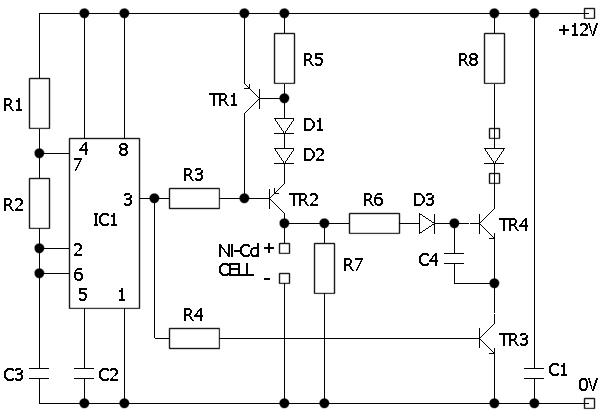
Source: Battery University
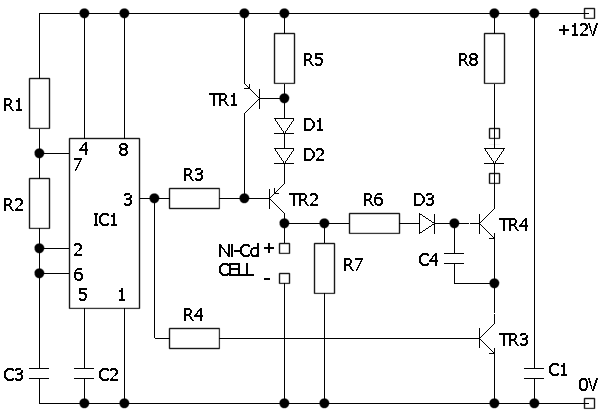
Which Cells May Respond and How the Treatment Is Described
Zapping is associated primarily with standard NiCd cells. The historical practice should not be transferred to nickel-metal hydride (NiMH) or lithium-ion cells. Those chemistries use different electrode materials, charging behavior, protection requirements, and failure mechanisms. A pulse treatment designed around a NiCd cell can be unsafe or destructive when applied to another chemistry.
The older procedure described a candidate cell as having an open-circuit voltage of approximately 1.11 to 1.12 V. A cell below about 1.06 V was considered unlikely to benefit. These thresholds belong to the reported hobbyist method and are not broadly validated acceptance criteria. Open-circuit voltage alone is also not a reliable diagnosis of a cell’s condition, capacity, internal resistance, or ability to deliver current.
The described process was as follows:
- Charge a 47,000 µF capacitor to approximately 90 V.
- Apply the stored energy directly across one nominal 1.2 V NiCd cell.
- Cycle the cell after the pulse treatment.
- If the historical procedure called for it, apply the treatment once more.
This is a high-energy electrical operation, not a routine battery-maintenance step. A charged capacitor can release a very large current in a short time, producing arcs, molten metal, burns, cell rupture, or fire. The cell itself can also heat rapidly or be damaged internally. Conductive tools, jewelry, wiring, and test equipment can create additional short-circuit hazards.
The procedure should therefore be understood as a description of historical practice rather than instructions for unsupervised experimentation. It is not a manufacturer-approved battery service method. Attempting it would require appropriate electrical engineering controls, current-rated equipment, enclosure and thermal safeguards, protective equipment, and qualified supervision. Lithium-ion cells and battery packs should not be subjected to this treatment.
Reported Benefits, Durability, and Limits of Zapping
The reported benefit of zapping is a higher cell voltage during high-current discharge. The historical account described this gain as approximately permanent, although a small portion of the improvement could diminish with use and time. The result was therefore not necessarily a permanent restoration of the cell’s original performance.
Further zapping was not reported to improve a cell that had already been treated and returned to service. The method was also not described as a way to regenerate a weak, damaged, or failed cell. If a cell has low capacity, high self-discharge, severe voltage depression, leakage, physical damage, or an internal defect, a high-current pulse should not be assumed to correct the underlying problem.
The historical report noted no apparent side effects from the treatment. That observation should be interpreted cautiously. The absence of an immediately visible side effect does not demonstrate that the treatment is harmless, nor does it establish a predictable service life. Battery manufacturers have generally not endorsed zapping as a standard maintenance or repair procedure, and reliable long-term data on treated cells are limited.
Several possible effects have been suggested, including a small increase in voltage and an apparent reduction in internal resistance. However, there is no convincing, broadly accepted scientific explanation in the supplied account for why the treatment would produce these effects. There is also little dependable information about how the treatment affects aging, cycle life, self-discharge, gas generation, or failure probability.
For these reasons, a measured voltage increase should not be treated as proof of any of the following:
- restored capacity;
- longer cycle life;
- improved reliability;
- recovery from internal damage;
- suitability for continued high-current operation; or
- safe use in a battery pack with mismatched cells.
A battery pack is only as strong as its weakest cell in many high-current applications. Treating one cell can also create differences in voltage behavior and internal resistance between cells. Those differences may affect pack balance and discharge performance, even if the treated cell appears better in an individual test.
Reconditioning and Battery-Chemistry Alternatives
Reconditioning is a different approach from zapping. It is intended to recover some usable capacity from NiCd cells and address what older battery literature described as early memory effects. The historical account associated reconditioning with an approximate 7 percent permanent capacity gain, but this figure should be treated as a reported claim rather than a guaranteed result.
The proposed mechanism involved crystalline formations within the cell. Repeated use under limited operating conditions was thought to promote crystal growth that could reduce the effective active area or cause the cell voltage to drop early during discharge. A controlled reconditioning cycle was described as potentially reversing some of this behavior and recovering part of the usable capacity.
Reconditioning does not make every weak NiCd cell serviceable. It cannot reliably correct an open circuit, a shorted separator, severe corrosion, electrolyte loss, physical damage, or a cell that has reached the end of its useful life. Capacity testing, self-discharge checks, and pack-level evaluation are more informative than voltage measurement alone when deciding whether a cell remains suitable for use.
NiCd cells historically had important advantages in rugged, high-current applications. They could tolerate demanding discharge conditions and were widely used in power tools, model vehicles, and other equipment. Those advantages do not mean that NiCd is the best choice for every present-day design. Modern battery systems are selected according to energy density, power capability, operating temperature, charging requirements, protection systems, cost, and environmental considerations.
Lithium-ion batteries became increasingly common in power tools and other portable equipment as manufacturers moved away from NiCd. The transition changed the design requirements. Lithium-ion cells generally require dedicated charging control, protection against overcharge and over-discharge, thermal monitoring, and suitable pack management. Their behavior under fast charging and high-current discharge is not interchangeable with that of NiCd cells.
Fast charging and high-current operation stress different chemistries in different ways. A charging method that was acceptable for one NiCd design cannot simply be applied to NiMH or lithium-ion cells. Cell temperature, charge termination, current limits, pack configuration, age, and protection electronics all influence safety and service life.
For an obsolete or degraded battery, the safer practical choice is often replacement with a correctly specified battery and charger rather than an unapproved high-energy treatment. The replacement should match the equipment’s voltage, chemistry, current requirements, connector arrangement, charging system, and protection provisions. Where a NiCd pack is still required, evaluation and service should follow the cell and pack manufacturer’s procedures rather than relying on anecdotal zapping results.
References
- Battery University | BU-807a: Effect of Zapping. (n.d.). http://www.batteryuniversity.com/article/bu-807a-effect-of-zapping
- Second blow to the head for effects of brain zapping. (n.d.). https://www.newscientist.com/article/2016196-second-blow-to-the-head-for-effects-of-brain-zapping
- Understanding Brain Zaps And Antidepressant Withdrawal. (n.d.). https://lonestarneurology.net/others/what-is-brain-zapping-neurological-insights-into-antidepressant-withdrawal
- Zap , Zapping Sound Effects. (n.d.). https://www.youtube.com/watch?v=ko43XDDUPCg
- Brain zap. (n.d.). https://www.wikidoc.org/index.php/Brain_zap
- Zap Sounds | Free Sound Effects. (n.d.). https://soundbible.com/tags-zap.html
- SPH BS 807 - Boston University Academics. (n.d.). https://www.bu.edu/academics/sph/courses/sph-bs-807
- Article ZAP inhibits double-stranded RNA virus infection by .... (n.d.). https://www.sciencedirect.com/science/article/pii/S2211124725015141
- Brain zap saps destructive urges - Stanford Medicine. (n.d.). https://med.stanford.edu/news/all-news/2017/12/brain-zap-saps-destructive-urges.html
- Free Electric Zap Effect Sound Effects Download. (n.d.). https://pixabay.com/sound-effects/search/electric%20zap%20effect